
Are You Leaving Social Security Benefits on the Table?
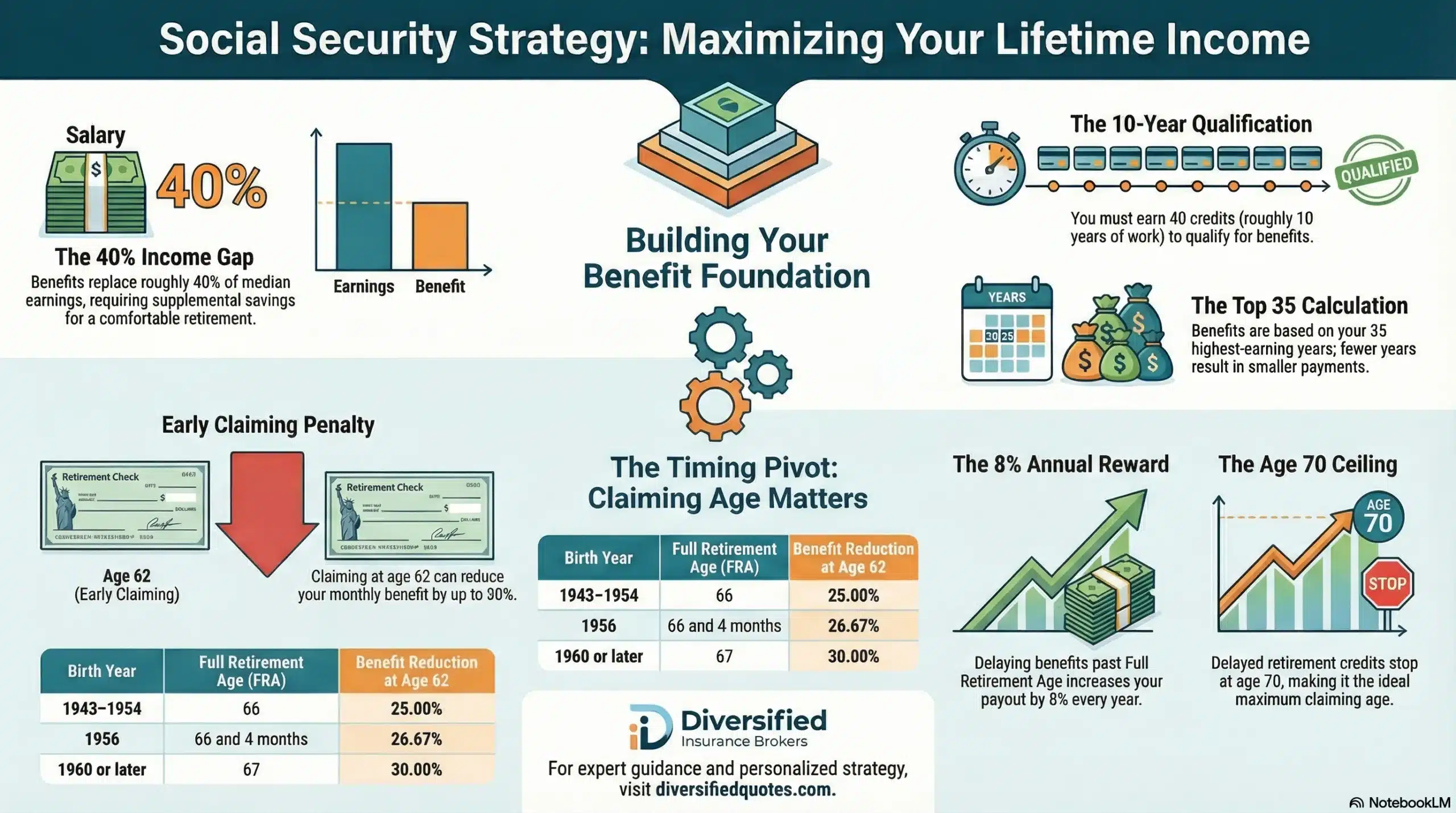
Social Security is one of the most important financial decisions you will ever make in retirement—yet it’s also one of the most misunderstood. For millions of Americans, including retirees, disabled individuals, surviving spouses, and widows of Social Security recipients, these benefits represent the foundation of lifetime income. What most people don’t realize is that the age you claim and the strategy you use can permanently affect how much you receive—for the rest of your life. Filing at 62 may feel like “getting your money sooner,” but it locks in a reduced benefit. Waiting until full retirement age eliminates early penalties. Delaying to age 70 can increase your monthly benefit dramatically through delayed retirement credits. The difference over a 20–30 year retirement can amount to hundreds of thousands of dollars in lifetime income. That’s not a minor adjustment—that’s a foundational retirement decision.

The challenge is that Social Security is not just about picking an age. Your earnings history, marital status, life expectancy assumptions, taxation of benefits, Medicare timing, work plans, pensions, and coordination with annuities or IRA withdrawals all matter. If you are still working, the earnings test may temporarily reduce benefits before full retirement age. If you are married, your spouse’s benefit and potential survivor income must be factored in. If you were divorced after a long-term marriage, you may have spousal eligibility. If you are self-employed, your benefit calculation may differ, which is why understanding Social Security benefits for self-employed individuals is critical. Even something as simple as continuing to work past traditional retirement age can change the equation, especially if you haven’t yet reached full retirement age—see how working past 65 affects Social Security benefits before making assumptions.
Many retirees assume the “best” strategy is to claim as early as possible. Others assume delaying is always superior. Neither rule is universally correct. The optimal decision depends on your income needs, risk tolerance, longevity expectations, tax bracket, and coordination with other guaranteed income sources. For example, if you have strong pension income or annuity income covering your essentials, delaying Social Security can create a larger inflation-adjusted benefit later in life. On the other hand, if you retire at 62 and need dependable income immediately, claiming earlier might reduce pressure on investment withdrawals. The key is integration—not isolation.
Taxes are another overlooked component. Up to 85% of Social Security benefits may be taxable depending on your provisional income. Coordinating withdrawals from traditional IRAs, Roth accounts, brokerage accounts, and annuities can significantly influence how much of your Social Security is exposed to taxation. In some cases, drawing down retirement accounts before claiming Social Security can lower long-term taxes and increase lifetime net income. In other cases, delaying withdrawals while benefits grow may be more effective. There is no shortcut calculation that replaces a personalized review.
Married couples have even more complexity—and more opportunity. The higher earner’s benefit often becomes the survivor benefit. That means delaying the higher earner’s claim can protect the spouse who is statistically likely to live longer. Failing to coordinate properly can leave a surviving spouse with substantially reduced income. If you are widowed, divorced, or caring for dependents, your claiming strategy may be entirely different from a single retiree with no spousal considerations. Survivor timing, restricted applications (when available), and coordination with other income streams all matter.
Medicare timing also intersects with Social Security. While you are not required to claim Social Security at 65, Medicare enrollment has strict timelines. Misaligning these decisions can result in unnecessary penalties or coverage gaps. Your retirement income timeline, health insurance coverage, and tax planning must be aligned—not treated as separate silos.
Beyond mechanics, there’s psychology. Many people claim early because they fear the system “running out of money.” Others claim because friends did. Some delay without considering cash flow strain. Emotional decisions can be costly. Social Security is one of the few income sources backed by the federal government and adjusted for inflation. Structuring it correctly creates stability in an otherwise uncertain retirement landscape.
At Diversified Insurance Brokers, we believe Social Security decisions should be made within a comprehensive retirement income framework. We evaluate your full financial picture—including pensions, IRAs, 401(k)s, annuities, tax exposure, longevity risk, and survivor needs—before recommending a filing strategy. Our personalized approach is designed to help you maximize lifetime value while protecting flexibility. Whether you are approaching 62, nearing full retirement age, planning to delay until 70, or already receiving benefits and questioning your decision, clarity is essential.
👉 Visit our Social Security page here
Even if you’ve already claimed benefits, it may not be too late to evaluate adjustments. Certain situations allow for strategy shifts, suspension, or coordination changes. For those who have not yet filed, modeling different claiming ages under various longevity and tax assumptions can provide a clear, data-driven comparison. The goal is not simply to “get more per month,” but to optimize lifetime income, reduce avoidable taxes, and strengthen survivor protection. When Social Security is integrated with annuity income strategies or structured retirement withdrawals, the combined effect can significantly increase retirement confidence.
Retirement planning is not about chasing returns—it’s about building predictable income you cannot outlive. Social Security is a central piece of that foundation. Getting the timing right can mean the difference between scraping by in later years and enjoying financial security well into your 80s and 90s. That’s why working with professionals who understand the program’s rules, nuances, and integration points is so important.
📞 Ready for clarity? Complete our secure form and schedule your personalized assessment today.
Request Your Social Security Review
Financial Protection Essentials
Explore annuity interest examples and retirement planning insights to understand how different investment sizes can affect income potential.
Talk With an Advisor Today
Choose how you’d like to connect—call or message us, then book a time that works for you.
Schedule here:
calendly.com/jason-dibcompanies/diversified-quotes
Licensed in all 50 states • Fiduciary, family-owned since 1980
FAQs: Leaving Social Security Benefits on the Table
What does it mean to leave Social Security benefits on the table?
It means claiming Social Security in a way that results in permanently lower lifetime benefits than you were eligible for, often due to timing mistakes, lack of coordination with a spouse, or misunderstanding benefit rules.
What is the most common mistake people make with Social Security?
Claiming benefits too early is the most common mistake. Taking benefits before full retirement age permanently reduces monthly payments and can significantly lower lifetime income, especially for those who live longer.
How does claiming age affect my total benefits?
Claiming before full retirement age reduces benefits, while delaying benefits past full retirement age increases them through delayed retirement credits. Waiting until age 70 can raise monthly benefits by up to 24–32% compared to claiming at full retirement age.
Can married couples lose benefits by claiming incorrectly?
Yes. Poor coordination between spouses—such as not considering spousal benefits, survivor benefits, or age differences—can result in tens or even hundreds of thousands of dollars in lost lifetime income.
How do survivor benefits factor into Social Security decisions?
When one spouse passes away, the surviving spouse generally receives the higher of the two benefits. Claiming strategies that maximize the higher earner’s benefit can significantly increase survivor income.
Does working while collecting Social Security affect benefits?
If you claim before full retirement age and continue working, your benefits may be temporarily reduced if you exceed annual earnings limits. While some benefits are credited back later, many people misunderstand how this works and claim too early.
Can taxes reduce the value of my Social Security benefits?
Yes. Depending on your income, up to 85% of Social Security benefits may be taxable. Poor tax planning can reduce net benefits and compound the impact of an early or inefficient claiming decision.
How can I avoid leaving Social Security benefits unclaimed?
Carefully evaluating claiming age, coordinating spousal strategies, factoring in longevity, and integrating Social Security with retirement income planning can help maximize lifetime benefits.
About the Author:
Jason Stolz, CLTC, CRPC and Chief Underwriter at Diversified Insurance Brokers (NPN 20471358), is a senior insurance and retirement professional with more than two decades of real-world experience helping individuals, families, and business owners protect their income, assets, and long-term financial stability. As a long-time partner of the nationally licensed independent agency Diversified Insurance Brokers, Jason provides trusted guidance across multiple specialties—including fixed and indexed annuities, long-term care planning, personal and business disability insurance, life insurance solutions, and short-term health coverage. Diversified Insurance Brokers maintains active contracts with over 100 highly rated insurance carriers, ensuring clients have access to a broad and competitive marketplace.
His practical, education-first approach has earned recognition in publications such as VoyageATL, highlighting his commitment to financial clarity and client-focused planning. Drawing on deep product knowledge and years of hands-on field experience, Jason helps clients evaluate carriers, compare strategies, and build retirement and protection plans that are both secure and cost-efficient. Visitors who want to explore current annuity rates and compare options across multiple insurers can also use this annuity quote and comparison tool.
