
Delaware Life Target Growth 10 Fixed Index Annuity – Principal Protection with Built-In Growth Guarantees
Market Growth with Downside Protection
At Diversified Insurance Brokers, we help clients make smarter annuity decisions that support long-term stability, predictable planning, and real retirement confidence. The Delaware Life Target Growth 10 Fixed Index Annuity, issued by Delaware Life Insurance Company, is built for people who want market-linked growth potential without putting their principal at the mercy of a down year. It blends index participation with a clear set of contract guarantees—most notably a 10-year framework that can be useful for accumulation, future income planning, and protecting a portion of retirement assets from volatility.

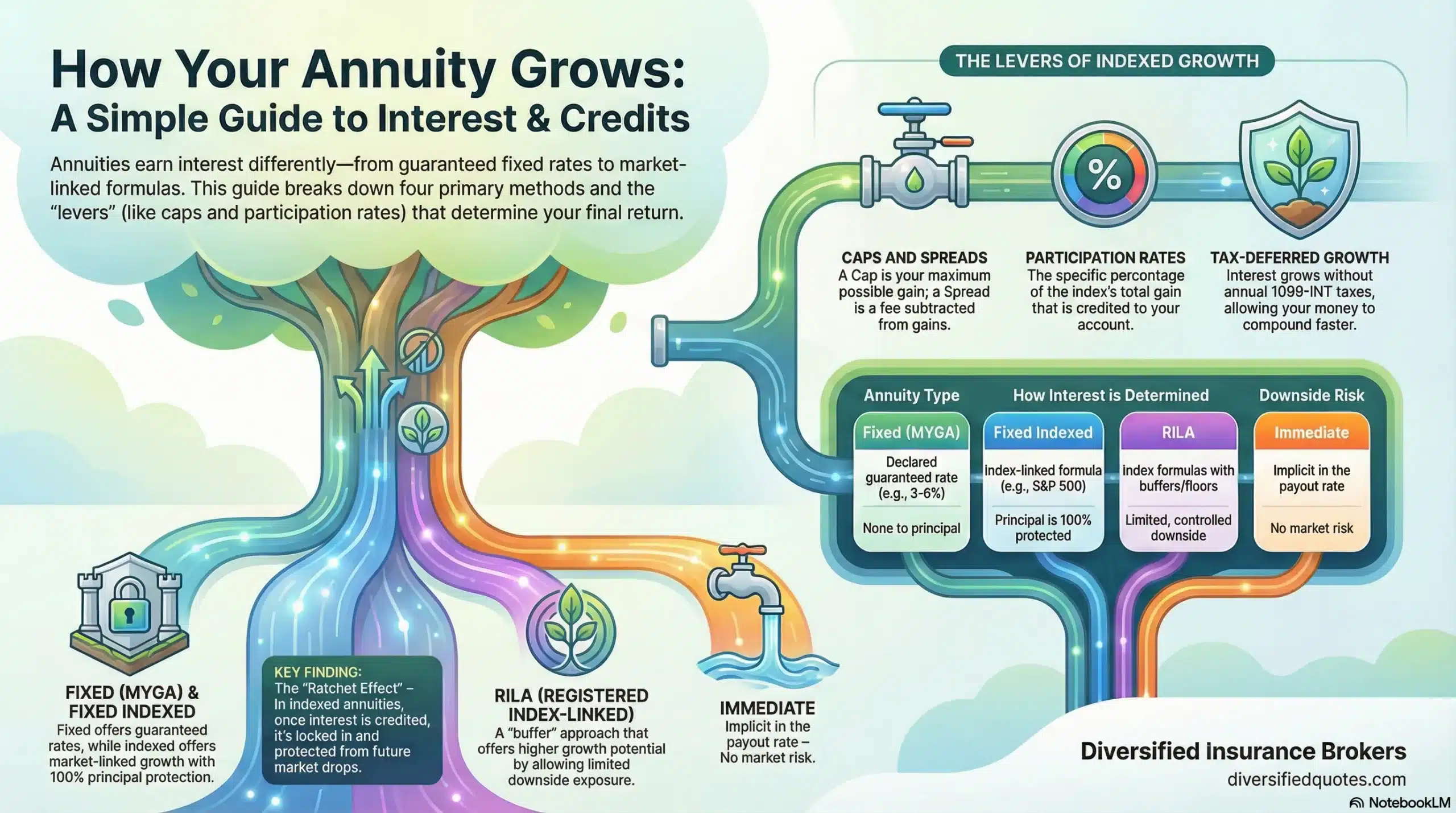
The appeal of a fixed indexed annuity (FIA) like Target Growth 10 is simple: you are not buying the stock market. Instead, you are buying a principal-protected insurance contract that credits interest based on an index formula. When the index performs well, your annuity may credit interest up to the cap or crediting limits. When the index performs poorly, your contract is designed to protect the accumulated value from direct market loss (subject to the contract terms). For many retirees and pre-retirees, that balance—upside potential with downside protection—can be the difference between staying invested in a plan and feeling forced to time the market.
Target Growth 10 also fits a common retirement planning need: “I want growth that I can live with.” People don’t always need the most aggressive strategy. They need a strategy that’s consistent with their risk tolerance, time horizon, and the role the annuity plays inside the bigger plan. For some households, a fixed indexed annuity is the middle ground between leaving everything exposed to market swings and locking everything into a simple fixed rate. If you’re weighing that decision, it’s worth reading our overview of how these contracts work: How Does a Fixed Indexed Annuity Work?.
This product typically includes a 10-year surrender schedule. That matters because it sets expectations. FIAs are designed for long-term planning, not short-term parking. If you think you’ll need to access the full premium quickly, you want to understand the surrender charge period, free-withdrawal provisions, and any special features like a bailout provision. On the other hand, if you’re allocating money you intend to keep positioned for a longer retirement window, a 10-year design can be appropriate—especially when the contract includes meaningful guarantees.
One of the smartest ways to approach any annuity is to start with the outcome you want. Are you focused on accumulation growth with protection? Are you trying to build future income? Do you need liquidity safeguards in case rates change? Are you repositioning an IRA rollover or a portion of a brokerage/CD ladder? The contract’s structure should match the goal. If you’re comparing options across the broader market, it also helps to know what fixed-rate annuities and bonus annuities are currently offering so you can compare tradeoffs apples-to-apples.
Ensure you are receiving the absolute top rates
Current Fixed Annuity Rates
Compare today’s best fixed annuity rates from top carriers.
Current Bonus Annuity Rates
See which annuities offer the highest upfront bonus today.
Request an Annuity Quote
Submit our annuity request form to get personalized rate options.
Lifetime Income Calculator
Use our calculator to see how much guaranteed income your annuity can provide.
Multiple Index Crediting Strategies
The Delaware Life Target Growth 10 is built around index crediting strategies that are designed to offer upside potential with protection against direct market loss (as defined in the contract). Instead of earning a variable return like a stock portfolio, your growth is based on a crediting method tied to an index. These choices matter because different indexes and strategies can behave differently across market conditions—especially when volatility is high or when rates shift.
Policyholders can typically choose from multiple index options, including well-known benchmarks and engineered indexes designed to manage volatility. Examples commonly include the S&P 500 Index and additional index choices such as the Goldman Sachs Canopy Index, the Franklin SG Select Index, and the First Trust Capital Strength Barclays 10% Index. The point isn’t that one index is always “best.” The point is that a well-designed FIA offers a menu of choices so you can align your approach to your goals—whether that’s smoothing volatility, seeking a certain type of return profile, or diversifying your crediting approaches inside one contract.
-
S&P 500® Index
-
Goldman Sachs Canopy Index
-
Franklin SG Select Index
-
First Trust Capital Strength Barclays 10% Index
These index options are generally designed to provide flexibility, but it’s still important to understand the mechanics that drive what gets credited to your annuity. Caps, participation rates, spreads, and declared rates can change over time (subject to the contract’s rules). That means your strategy selection should factor in how you plan to use the annuity. If you’re prioritizing predictable accumulation and long-term steadiness, you may prefer a strategy that historically behaves more consistently even if it’s less aggressive. If you’re planning for future lifetime income, you may focus on how the contract supports that objective and how the income features (if elected) work alongside the accumulation value.
All growth inside an annuity is generally tax-deferred, which means you’re not taxed each year on credited interest while the money stays in the contract. That tax deferral is one reason annuities can be attractive for retirement savers who have already maxed out other tax-advantaged accounts or who want to build another bucket of long-term money with a different risk profile. If you’re evaluating annuities inside an IRA rollover, you may also want to review: What Is an IRA Annuity?.
If you want help choosing the most appropriate crediting approach for your situation, a personalized illustration is the easiest way to compare how different strategies may look over time based on contract assumptions and your funding level. You can request that here: Request an Annuity Quote. We typically evaluate the crediting options in the context of your time horizon, liquidity needs, and what role the annuity is meant to play in your retirement plan.
Guaranteed Growth with GMAV
One of the standout features of the Target Growth 10 structure is the Guaranteed Minimum Account Value (GMAV). In plain English, GMAV is designed to provide a “floor” that helps protect your long-term outcome even if index returns underperform. With this feature, the contract generally targets that your account will be worth at least 120% of your initial premium at the end of the 10-year term (subject to contract provisions). That kind of guarantee can be meaningful for conservative investors who want upside potential but do not want to feel like their outcome is completely dependent on index performance.
It’s important to understand what GMAV is and what it is not. GMAV is not a promise of market-like returns every year. It’s a long-term safeguard designed to reinforce the purpose of the contract: principal protection with a defined guarantee at a set point in time. For some households, that guarantee acts like a planning anchor. It can help people commit to the time horizon needed for the annuity to do its job instead of reacting emotionally to short-term market headlines.
This is also where product comparison becomes especially valuable. A fixed annuity might offer a declared rate guarantee for a set term, while an FIA like Target Growth 10 can offer a different mix of upside potential and long-term guarantees. If your priority is simply a fixed declared rate, it can be useful to compare side-by-side with: Current Fixed Annuity Rates. If your priority is using an upfront credit to strengthen value from day one, review: Current Bonus Annuity Rates. Many clients make better decisions simply by seeing the tradeoffs clearly.
Liquidity and Protection Features
Liquidity is one of the first concerns people raise with a 10-year annuity—and it should be. The right annuity is one you can live with. Many long-term annuities are designed with a middle-ground approach: strong long-term benefits, plus controlled access so you’re not “locked up” if life happens. With Target Growth 10, a common feature is penalty-free withdrawals of up to 10% of the account value annually starting in year two (subject to contract rules). That feature can matter if you want access for planned expenses, unexpected needs, or simply peace of mind.
The contract may also include a bailout provision, which is designed to protect you if renewal terms (such as cap rates) fall below a stated threshold. Bailout provisions can be valuable because they acknowledge a real risk in annuity planning: terms can change. If a future renewal cap is materially less attractive, a bailout can give you an exit option without surrender charges. Not every annuity offers this kind of guardrail, and when it is included, the details are crucial. Threshold definitions, timing, and which strategies qualify can vary, so it’s worth reviewing the exact language in the policy illustration and contract.
Another common liquidity question is: “What if I need more than 10%?” That’s where planning matters. If you anticipate a large planned expense, it may be smarter to allocate only a portion of your assets to the annuity or to blend strategies (for example, combining different annuity terms or pairing an annuity with other liquid reserves). In certain situations, an annuity ladder may be worth exploring, where different terms mature in different years. If you’re building a structured approach, our main annuity hub can be a useful jumping-off point: Current Annuity Rates.
Estate Planning Benefits
Annuities can also play a straightforward role in estate planning. In the event of death, beneficiaries generally receive the full accumulation value (subject to contract provisions and any outstanding loans if applicable). This allows the annuity to serve as a wealth-transfer tool that can be simpler than many people expect. Beneficiary designations typically avoid probate in many cases, and the transfer process is often handled directly through the carrier.
That said, the tax treatment for beneficiaries depends on whether the annuity is qualified or non-qualified and on how the beneficiary elects to receive the funds. Because beneficiaries and payout elections can impact taxes, it helps to coordinate your annuity planning with your broader retirement and legacy plan. If you want a deeper explanation of how beneficiary payouts work for annuities, see: Annuity Beneficiary Death Benefits.
Who This Annuity May Be a Good Fit For
The Delaware Life Target Growth 10 Fixed Index Annuity may be a strong fit for individuals who are focused on protecting retirement assets while still pursuing reasonable growth potential. The most common fit is someone nearing or entering retirement who does not want to relive the emotional stress of market drawdowns, but still wants a strategy that can credit interest based on index performance rather than relying only on a fixed declared rate.
This contract can also appeal to savers who like the idea of a clear long-term guarantee. A GMAV that targets a minimum value after 10 years can be a compelling feature for people who want a “floor” that supports planning. It may also fit conservative investors who want to avoid direct market losses while staying positioned for upside potential. For IRA and rollover clients, it can serve as a long-term accumulation-focused solution when you’re not yet ready to turn on income but want to position assets with protection and structure.
It can also be a fit for people who value flexibility features like penalty-free withdrawals and bailout provisions, especially when they want safeguards against changing renewal terms. In retirement planning, flexibility is often as important as growth. The best plan is the plan you can stick with.
If you’re unsure whether Target Growth 10 is the right fit, the best next step is to compare it against other approaches—including fixed rate annuities and other FIAs with different crediting designs. Many clients are surprised by how much variation exists across carriers once you compare caps, spreads, liquidity provisions, and long-term guarantees. Use these resources to compare: Current Fixed Annuity Rates, Current Bonus Annuity Rates, and our main rate hub: Current Annuity Rates.
When you’re ready to see how this product looks for your age, state, premium level, and goals, request a personalized quote and illustration here: Quote Request Form. We’ll help you evaluate the annuity in plain language, including how the guarantees, liquidity, and crediting strategies line up with what you’re trying to accomplish.
Related Pages
Explore additional annuity education, rate comparisons, and retirement planning resources.
Talk to an Advisor or Request Your Annuity Quote
Ready to explore this annuity in more detail—or compare it with other carriers to see if even higher rates are available? With guaranteed income, principal protection, and long-term growth potential on the line, making the right choice is essential. The experienced advisors at Diversified Insurance Brokers will guide you through the options and design a strategy tailored to your retirement goals.
Schedule here:
calendly.com/jason-dibcompanies/diversified-quotes
Licensed in all 50 states • Fiduciary, family-owned since 1980
FAQs: Delaware Life Target Growth 10 Annuity
What is the Delaware Life Target Growth 10 Annuity?
The Target Growth 10 is a 10-year fixed or fixed-indexed annuity offered by Delaware Life. It helps savers accumulate funds with principal protection, while offering fixed-rate or index-linked interest crediting during the 10-year guarantee period.
How does interest or index crediting work?
You may choose a fixed-interest crediting option or one or more index-linked crediting strategies. If using an index-linked option, credited interest is calculated based on caps, participation rates, or spreads tied to a market index. Your money is not directly invested in the market — only credited based on index performance.
Is my principal protected from market downturns?
Yes. As a fixed or fixed-indexed annuity, Target Growth 10 protects your accumulation value (principal plus credited interest) from market losses. Even if the index performs poorly, your value is not reduced (assuming no withdrawals or contract penalties apply).
Can I access my funds before the end of the 10-year period?
Some contracts may allow a limited “free-withdrawal” each year after the first contract year — often a small percentage of the account value — without surrender charges. However, withdrawals beyond that allowance or full surrender during the 10-year period can trigger surrender charges or reduce credited interest or benefits.
What happens at the end of the 10-year guarantee period?
When the 10-year term ends, you generally have several options: withdraw the funds, renew or roll over into a new contract (at prevailing rates), or convert the value into payouts or income if the contract allows. Review the contract’s maturity-period options carefully.
Does Target Growth 10 offer payout or income options?
Depending on the version and any optional riders selected, you may have the option to convert accumulation value into structured withdrawals or lifetime income payments once the guarantee period ends. Evaluate payout terms and any associated fees before choosing this option.
How are withdrawals or income payments taxed?
Earnings grow tax-deferred while funds remain in the contract. Upon withdrawal or payout, the taxable portion is generally taxed as ordinary income. Early withdrawals (before age 59½) may also be subject to additional IRS penalties depending on your circumstances.
Who is Target Growth 10 a good fit for?
This annuity may suit individuals looking for a 10-year accumulation horizon, principal protection, and the possibility of index-linked or fixed growth without direct market risk. It can also appeal to those planning for mid-term goals or seeking a conservative component in a diversified retirement strategy. For more on how fixed and indexed annuities compare, check out our fixed indexed annuity primer.
What should I consider before purchasing?
Important factors to review: interest-crediting method, free-withdrawal allowance, surrender-charge schedule, liquidity needs, whether you can commit funds for the full 10 years, and any optional rider or payout fees. Ensure the contract’s structure aligns with your long-term goals and timing.
About the Author:
Jason Stolz, CLTC, CRPC and Chief Underwriter at Diversified Insurance Brokers, is a senior insurance and retirement professional with more than two decades of real-world experience helping individuals, families, and business owners protect their income, assets, and long-term financial stability. As a long-time partner of the nationally licensed independent agency Diversified Insurance Brokers, Jason provides trusted guidance across multiple specialties—including fixed and indexed annuities, long-term care planning, personal and business disability insurance, life insurance solutions, and short-term health coverage. Diversified Insurance Brokers maintains active contracts with over 100 highly rated insurance carriers, ensuring clients have access to a broad and competitive marketplace.
His practical, education-first approach has earned recognition in publications such as VoyageATL, highlighting his commitment to financial clarity and client-focused planning. Drawing on deep product knowledge and years of hands-on field experience, Jason helps clients evaluate carriers, compare strategies, and build retirement and protection plans that are both secure and cost-efficient.
