
Aspida Synergy Choice Max Fixed Index Annuity – Growth with Downside Protection and Flexibility
Aspida Synergy Choice Max Fixed Index Annuity – Growth with Downside Protection and Flexibility
At Diversified Insurance Brokers, we help clients find annuity solutions that align with their real retirement objectives — growth potential, principal protection, and flexibility. The Aspida Synergy Choice Max Fixed Index Annuity, issued by Aspida Life Insurance Company, is designed for retirees and pre-retirees who want market-linked upside potential with full principal protection and no exposure to direct market losses. Available in 5-year and 10-year surrender periods, Synergy Choice Max is an accumulation-focused product built around a diversified index menu, a structured liquidity framework, and a bailout provision that protects against unfavorable rate renewal environments. For investors who are comparing conservative retirement vehicles and want to understand how indexed strategies differ from declared-rate contracts, reviewing fixed annuities vs. fixed indexed annuities provides useful structural context before any side-by-side analysis.

Ensure you are receiving the absolute top rates
Current Fixed Annuity Rates
Compare today’s best fixed annuity rates from top carriers.
Current Bonus Annuity Rates
See which annuities offer the highest upfront bonus today.
Request an Annuity Quote
Submit our annuity request form to get personalized rate options.
Lifetime Income Calculator
Estimate how much guaranteed income your annuity could provide in retirement.
Aspida Synergy Choice Max: Key Product Features at a Glance
| Product Feature | Details |
|---|---|
| Issuing Carrier | Aspida Life Insurance Company. Administrative office: Durham, North Carolina. Founded 2020 (formerly Global Bankers Insurance Group, rebranded 2021). AM Best: A- (Excellent), 4th highest of 13, reaffirmed August 29, 2025. KBRA: A- (7th highest of 23, reaffirmed July 18, 2025). Backed by Ares Management Corporation (NYSE: ARES), a leading global alternative investment manager with approximately $644 billion in assets under management as of March 2026. Aspida total assets: $31 billion. Total GAAP equity: $2.4 billion. Total regulatory capital: $2.4 billion. Portfolio: 93% investment grade. Licensed in 49 states (excluding New York) and DC. Not FDIC insured. All guarantees backed by claims-paying ability of Aspida Life Insurance Company. |
| Product Type | Single-premium deferred fixed index annuity (FIA). Available in 5-year or 10-year surrender periods. Accumulation-only — no optional income riders on the Synergy Choice Max (the Synergy Choice Income is a separate product with a built-in GLWB). 20 crediting strategies. Zero floor — credited interest is never negative due to index performance. Tax-deferred growth. Not a direct market investment. Not FDIC insured. Not available in New York. |
| Premium | Minimum: $25,000. Maximum: $2,000,000. Amounts above $2,000,000 may be accepted with prior approval from Aspida Life. Single premium only — no subsequent premium payments accepted after issue. Eligible funding types include qualified and non-qualified funds; RMDs from tax-qualified IRAs are available after 30 days from contract issue. |
| Surrender Charge Period | 5-year or 10-year surrender period (selected at issue). Surrender charges decline over the period and reach zero at the end of the chosen term. Market Value Adjustment (MVA) applies on excess withdrawals above the free amount during the surrender period — the MVA may increase or decrease the amount received based on interest rate changes since contract issue. MVA does not affect annuitization or the Minimum Guaranteed Surrender Value. |
| Free Withdrawal Provision | Up to 10% of the contract value per year free of surrender charges, beginning after the first contract anniversary. RMDs from tax-qualified IRAs are available penalty-free after 30 days from contract issue, even if they exceed the standard 10% free withdrawal amount. At the end of the surrender charge term, up to 100% of the contract value may be withdrawn without charges. |
| Bailout Provision | Built-in at no additional charge. If the S&P 500 annual point-to-point cap renewal rate falls below the stated bailout cap rate established at contract issue, the contract owner may withdraw the full contract value without surrender charges. This provision protects against being permanently locked into materially reduced renewal cap rates for the remainder of the surrender period. |
| Health Event Waivers | Nursing home confinement waiver: if confined to a qualifying nursing home, up to 100% of the contract value may be withdrawn without surrender charges. Terminal illness waiver: if diagnosed with a qualifying terminal illness, up to 100% of the contract value may be withdrawn without surrender charges. Both waivers apply to the full contract value — not just the standard 10% free withdrawal amount. Subject to qualifying requirements and state availability. |
| Index Crediting Strategies | 20 crediting strategies available across multiple indices and crediting methods. Indices include: S&P 500; Nasdaq-100; Goldman Sachs Grand Prix Index (excess return basis, 0.50% per annum daily deduction applied — embedded in index level); Goldman Sachs Lexicon Long Short Index (AI/NLP-driven, 12.5% volatility control); Citi Aria Index (ESG-focused, 20% volatility target, notional costs deducted from index performance); BlackRock U.S. Equity Bitcoin Balanced Risk 10% Index (iShares S&P 500 ETF + iShares Bitcoin Trust ETF, 10% volatility target); Invesco QQQ Growth Index (multi-asset, 12.5% volatility target, truVol® methodology). Fixed interest account also available. Zero floor: if the chosen index declines during a crediting period, credited interest is 0% — principal does not decline due to market performance. |
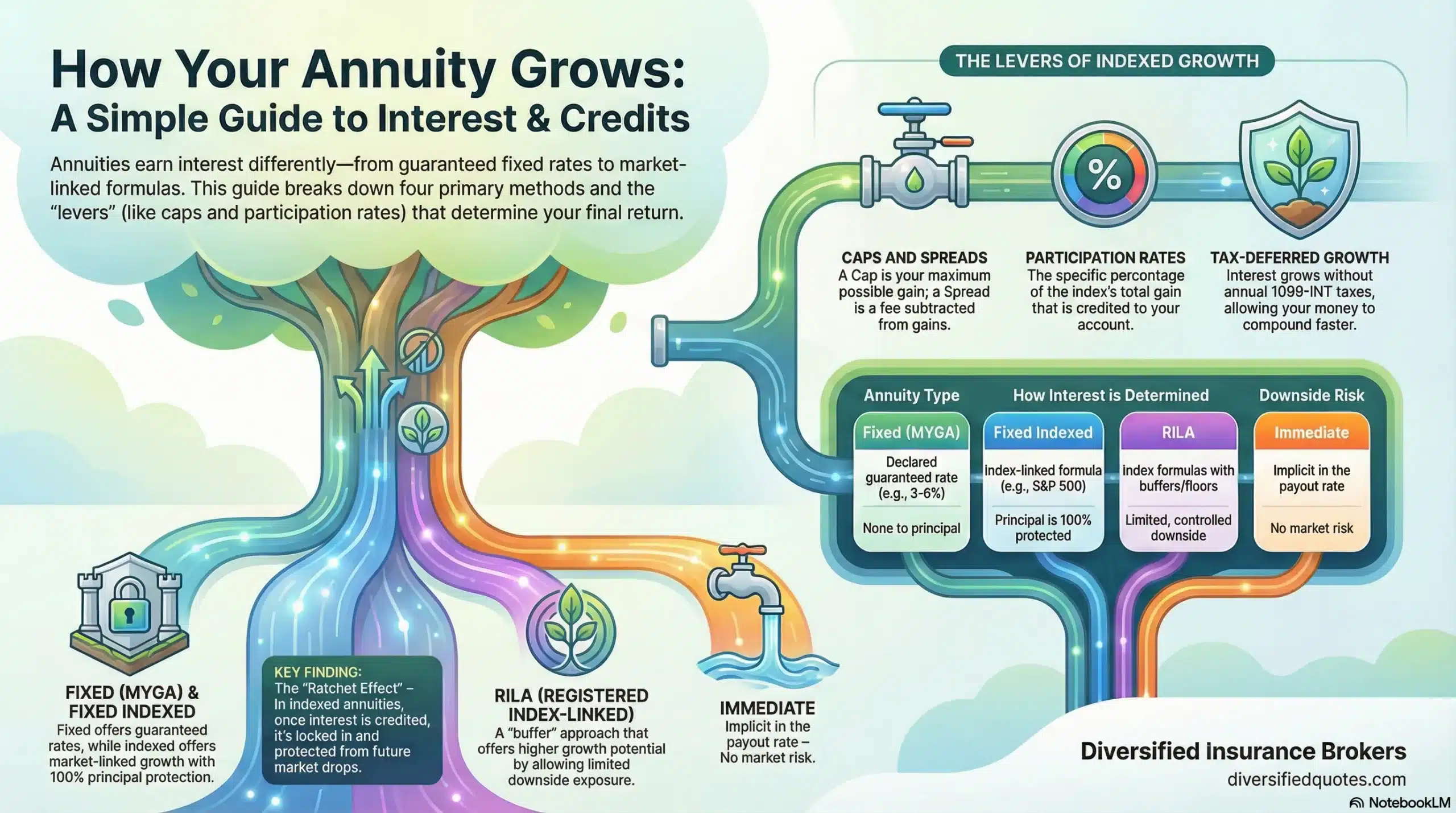
| Crediting Methods | Point-to-Point Cap Rate: 100% of index gain up to a declared cap. Point-to-Point Participation Rate: a stated percentage of the index gain, with no cap (e.g., 150% participation on a 12% index gain = 18% credit). Point-to-Point Performance Trigger Rate: a set trigger rate credited if the index return is flat or positive at the end of the term (e.g., 7% trigger on any positive index return). Crediting terms of 1-year or 2-year available. Rates declared at issue are guaranteed for the length of the crediting period; they may change at renewal. Gains credited at the end of each term are locked in and cannot be reduced by future negative index performance. |
| Optional Riders | None on Synergy Choice Max. This is an accumulation-only product. Aspida’s Synergy Choice Bonus offers a 10% premium bonus on the same base FIA structure. Aspida’s Synergy Choice Income includes a built-in Guaranteed Lifetime Withdrawal Benefit (GLWB) rider for buyers whose primary objective is guaranteed lifetime income. Buyers for whom income certainty is the primary goal should evaluate Synergy Choice Income rather than Synergy Choice Max. |
| Annuitization | After the first contract year, the accumulation value may be converted into a stream of regular income payments through annuitization. Multiple settlement options available including lifetime income options. Annuitization is irrevocable and exchanges the lump-sum contract value for a defined income stream — evaluate carefully before election. |
| Death Benefit | The death benefit pays the full account value plus a prorated portion of any index growth from the current crediting period directly to named beneficiaries — without the delays and costs associated with probate. No surrender charges apply at death. Beneficiary designations allow assets to pass efficiently outside of probate in most cases when properly structured. |
| Tax Treatment | Interest grows tax-deferred until withdrawal. Non-qualified: LIFO taxation (earnings distributed first, taxed as ordinary income). Qualified accounts: full distributions taxed as ordinary income. Withdrawals before age 59½ subject to 10% IRS early withdrawal penalty. Placing an annuity inside a qualified plan does not provide additional tax deferral — the value is the principal protection, indexed growth potential, and bailout provision. Not FDIC insured. |
About Aspida Life Insurance Company
Aspida Life Insurance Company was founded in 2020 by insurance industry veterans and operates with an administrative office in Durham, North Carolina. The company rebranded from Global Bankers Insurance Group in 2021, reflecting its growth trajectory and shift toward independent agent distribution. AM Best reaffirmed Aspida’s A- (Excellent) financial strength rating — the 4th highest of 13 rating categories — on August 29, 2025. KBRA also reaffirmed an A- rating in July 2025. The institutional backbone of Aspida is its relationship with Ares Management Corporation (NYSE: ARES), a leading global alternative investment manager with approximately $644 billion in assets under management as of March 2026. Ares Insurance Solutions (AIS) serves as Aspida’s dedicated in-house investment manager, providing investment management, capital solutions, and corporate development services with a focus on differentiated asset yield origination. Aspida’s investment portfolio is 93% investment grade. Total assets stand at $31 billion, with $2.4 billion in total GAAP equity and $2.4 billion in total regulatory capital as of March 2026. Aspida is licensed in 49 states (excluding New York) and the District of Columbia. For a full carrier evaluation, our resource on whether Aspida is a good company is already linked above — this is the first and only use of that URL on this page.
As a carrier founded in 2020, Aspida has a shorter institutional history than many competing annuity issuers. Buyers who place high weight on decades-long operating track records should weigh that context alongside the A- financial strength ratings and Ares institutional backing. The NAIC Complaint Index for Aspida has been consistently low — essentially at zero reported consumer complaints relative to its market share — which reflects well on the post-sale service experience. The Ares relationship underpins Aspida’s ability to offer competitive declared rates on MYGAs and competitive crediting structures on FIA products by accessing differentiated investment assets that smaller or more traditionally structured carriers may not access.
How the Synergy Choice Max Zero Floor Works and Why It Matters
The defining mechanical feature of any fixed indexed annuity — including Synergy Choice Max — is the zero floor guarantee. Your premium is not directly invested in equities or bonds. Instead, the insurance carrier uses a portion of your premium to purchase index options that provide participation in positive index performance, while the remainder is invested in the carrier’s general account. If the index you have chosen performs positively during a crediting period, the annuity credits interest based on the applicable crediting method — a cap rate, participation rate, or performance trigger — for that period. If the index declines during a crediting period, the credited interest for that period is zero — not negative. Your principal and all previously credited gains are protected from market loss.
This annual reset structure creates a compounding pattern that differs fundamentally from direct equity investment. In a direct equity portfolio, a 30% loss requires a 43% gain to recover the original value. In a zero-floor FIA, a negative index year produces no credited interest and no loss — the next crediting period begins from the same base. Over a 10-year period that includes multiple positive and negative market years, this stair-step accumulation — capturing positive periods, locking them in, and starting each new period from the same protected base — can produce a meaningfully different outcome than a portfolio that absorbs full market downturns. For conservative savers who are uncomfortable with equity volatility but still want growth potential beyond traditional fixed rates, this structure directly addresses the core tension between growth and protection. If you want a detailed explanation of how this crediting structure differs from the fixed declared-rate alternative, reviewing fixed annuities vs. fixed indexed annuities lays out that comparison in full.
The Index Menu: 20 Strategies Across Seven Index Providers
Synergy Choice Max offers 20 crediting strategies spanning seven index relationships. The breadth of this menu is one of the genuine structural differentiators of the product — most FIAs from carriers of comparable financial strength offer fewer index options and fewer crediting method variations. The index lineup spans established broad market benchmarks and institutional multi-asset strategies with integrated volatility controls. Understanding the index embedded fee structure on several strategies is important for evaluating real credited returns, not just nominal participation rates. For a full explanation of how caps, participation rates, spreads, and performance triggers interact with index performance to determine actual credited interest, reviewing index annuity crediting methods covers each design in full.
The S&P 500 is the broadest and most transparent index on the menu — 500 large-cap US equities covering approximately 80% of US equity market capitalization. It has decades of publicly available performance history, no embedded fee deductions, and is the benchmark index that triggers the bailout provision. The Nasdaq-100 covers the 100 largest non-financial domestic and international companies listed on the Nasdaq Stock Market and is particularly sensitive to technology sector performance — strong in technology bull cycles, more volatile in technology-specific downturns. The Goldman Sachs Grand Prix Index uses signals from market anomalies to dynamically rebalance between US technology equity futures and US Treasury futures, with the truVol® volatility control mechanism applied — but it operates on an excess return basis and has a 0.50% per annum daily deduction embedded in the index level before credited interest is calculated. Buyers evaluating the Grand Prix Index should understand that the participation rate or cap applies to an index return that has already been reduced by that daily fee. The Goldman Sachs Lexicon Long Short Index applies artificial intelligence natural language processing to score companies based on sentiment in earnings calls, building a long/short basket augmented by an enhanced gold component and a 10-year Treasury component with a 12.5% volatility control — one of the more complex and AI-dependent strategies available in the FIA market.
The Citi Aria Index is an ESG-focused strategy with a 20% volatility target, dynamically allocating monthly between US large-cap equities and US technology equities using ESG scores from an external data provider. Notional costs are deducted from index performance — meaning the credited participation applies to the fee-reduced index return, not the raw underlying equity return. The BlackRock U.S. Equity Bitcoin Balanced Risk 10% Index combines exposure to the iShares Core S&P 500 ETF and the iShares Bitcoin Trust ETF, managed to a 10% volatility target using a cash constituent as the balancing mechanism. This is the only strategy on the Synergy Choice Max menu with any cryptocurrency exposure — buyers who are not comfortable with Bitcoin exposure should avoid allocating to this strategy, as the iShares Bitcoin Trust ETF component means that Bitcoin price movements directly influence this index’s return calculation. The Invesco QQQ Growth Index is a multi-asset, target volatility strategy allocating to the Invesco QQQ ETF alongside two bond components and cash, targeting 12.5% volatility using the truVol® methodology. All seven of these index relationships are maintained with major institutional index providers — Goldman Sachs, Citi, BlackRock, Invesco, S&P Dow Jones, and Nasdaq — reflecting Aspida’s access to institutional-grade index partnerships despite its relatively short operating history.
The Three Crediting Methods: Cap, Participation Rate, and Performance Trigger
Synergy Choice Max offers three distinct crediting method designs, which interact with the index options to produce different risk-return profiles across the 20 available strategies. The point-to-point cap rate method credits 100% of the index gain up to a declared maximum — if the cap is 10% and the index gains 15%, the credited interest is capped at 10%. If the index gains 7%, the credited interest is 7%. The cap limits upside but provides full participation up to the cap in positive markets. The point-to-point participation rate method credits a stated percentage of the index gain with no cap — a 150% participation rate on a 12% index gain produces an 18% credit. This method does not limit upside through a cap but instead limits it through the participation percentage; in very strong markets, high participation rates can produce credited interest above what a cap-limited strategy would generate. The point-to-point performance trigger rate method credits a fixed stated rate if the index return is flat or positive at the end of the term — if the trigger rate is 7%, the buyer earns 7% whether the index gained 1% or 30%, as long as it was non-negative. The trigger method provides the most predictable outcome in flat or modestly positive markets but delivers less benefit in strongly positive markets.
Crediting terms of 1-year and 2-year are available on Synergy Choice Max. The term selection affects how often gains are locked in — a 1-year term locks in credits annually, while a 2-year term locks in credits every two years. The rates declared at issue are guaranteed for the full length of the chosen crediting period. At renewal, those rates may change — caps may be raised or lowered, participation rates may adjust — based on prevailing interest rates and the carrier’s option pricing. This renewal rate variability is the primary long-term risk in any FIA, and it is the reason the bailout provision matters: if renewal caps on the S&P 500 annual point-to-point strategy fall below the bailout cap rate set at contract issue, the buyer has a contractual exit option without surrender charges. Buyers who are investing over a 10-year period should evaluate not just the initial declared rates but also the contractual minimum guaranteed rates — the floor below which the carrier cannot renew any strategy — before committing to a long-term allocation.
The Bailout Provision: Protecting Against Rate Renewal Risk
Renewal rate risk — the possibility that declared cap rates or participation rates will be significantly lower at renewal than at issue — is a real planning consideration in the FIA market. Carriers have the right to declare new crediting rates at each renewal within contractual minimums, and in an environment where interest rates rise materially or where carrier investment returns compress, renewal rates can be lower than buyers anticipated at purchase. The Synergy Choice Max bailout provision directly addresses this risk. If the S&P 500 annual point-to-point cap rate at renewal falls below the bailout cap rate that was declared at contract issue, the contract owner may withdraw the full contract value without surrender charges or MVA. This is a binary trigger keyed to a single benchmark strategy, but it provides a clear, contractually defined exit pathway if the product’s core crediting benchmark becomes materially less competitive. The bailout provision does not require the buyer to be currently allocated to the S&P 500 strategy — it triggers based on the S&P 500 cap renewal rate regardless of current allocation. This means buyers who have diversified into the Goldman Sachs, Citi, BlackRock, or other index strategies still retain the bailout exit option based on the S&P 500 cap benchmark.
For investors evaluating a 10-year commitment, the combination of the bailout provision and the full free withdrawal at the end of the surrender term creates two defined liquidity checkpoints: the bailout exit (available if S&P 500 cap falls below threshold at any renewal) and the end-of-term full surrender (available with no charges at contract maturity). Between these checkpoints, the standard 10% annual free withdrawal and the nursing home and terminal illness waivers provide managed access. For buyers building a broader retirement income plan — including when and how to transition from accumulation to income — understanding how annuities compare to 401(k)s in retirement can provide useful strategic context for where an accumulation FIA like Synergy Choice Max fits within a larger retirement asset picture.
Tax Deferral, RMDs, and IRA Rollover Considerations
Interest credited within Synergy Choice Max compounds on a tax-deferred basis. Unlike taxable brokerage accounts where annual credited gains generate immediate tax liability, interest inside the annuity accumulates without annual taxation until distributions occur. For investors in higher marginal tax brackets, or for those seeking to build a retirement accumulation bucket that complements existing tax-advantaged accounts, this deferral efficiency can produce a meaningfully larger after-tax accumulated value over a 5- or 10-year period compared to a taxable alternative earning the same nominal rate. The benefit is most pronounced for non-qualified funds — already-taxed money placed into the annuity in a non-IRA account — where the annual tax drag on a comparable taxable investment would otherwise reduce compounding efficiency year over year.
For qualified funds — IRA rollovers, 401(k) transfers, and other pre-tax accounts — the annuity provides no additional tax deferral beyond what the qualified plan already provides, but it does provide the zero floor principal protection, the index-linked growth potential, and the bailout provision that a CD or money market account within an IRA would not. Buyers evaluating IRA rollover options who want to understand the full mechanics of how annuities interact with required minimum distributions, tax treatment, and rollover procedures should review how to transfer an IRA to an annuity before initiating a rollover. Aspida confirms that RMDs from tax-qualified IRAs are available after 30 days from contract issue — even if the RMD amount exceeds the standard 10% annual free withdrawal — which makes Synergy Choice Max accessible for qualified account holders who cannot defer RMDs without incurring penalty risk. For buyers who want to understand how annuities can extend the longevity of retirement assets through tax deferral and structured income — including the role of products like QLACs — our resource on what a QLAC is covers how deferred annuity structures can address longevity risk in qualified accounts.
Liquidity Framework, Death Benefit, and the Aspida Synergy Choice Product Family
Synergy Choice Max’s liquidity framework is built around four mechanisms: the 10% annual free withdrawal (from the second contract year), the RMD waiver for qualified accounts (from 30 days after issue), the health event waivers providing full contract value access upon nursing home confinement or terminal illness, and the bailout provision providing full surrender access if the S&P 500 cap renewal falls below the contractual bailout threshold. Together, these create a structured liquidity design where the most conservative buyers — those holding through the full surrender period without withdrawals or health events — face the most restrictive terms, while buyers who experience qualifying health events or rate renewal deterioration have access to the full contract value without penalty.
The death benefit on Synergy Choice Max is designed with a buyer-favorable feature not common in all FIA products: beneficiaries receive the full account value plus a prorated portion of any index growth from the current crediting period, not just the contract value at the most recent anniversary. In a strong index year where credits have not yet been locked in at the annual anniversary, this prorated current-period credit can produce a death benefit meaningfully higher than the most recently credited contract value. Proper beneficiary designation allows these funds to pass directly to named beneficiaries outside of probate in most cases, simplifying the asset transfer process. For a full explanation of how annuity death benefits work and how beneficiary designations interact with settlement options and tax treatment, our resource on annuity beneficiary death benefits covers the complete landscape.
Within the Aspida product family, Synergy Choice Max occupies the base accumulation-focused position. The Aspida Synergy Choice Bonus adds a 10% premium bonus on the same base FIA structure for buyers who want an immediate accumulation head start. The Aspida Synergy Choice Income offers the same index menu with a built-in GLWB rider for buyers whose primary objective is guaranteed lifetime income from the contract. And the Aspida Synergy Choice MYGA is a separate fixed declared-rate product for buyers who want no index exposure at all. The right product within the Aspida lineup depends on whether the buyer’s primary objective is accumulation (Max), accumulation with an upfront bonus (Bonus), or guaranteed lifetime income (Income). For buyers for whom income certainty is the first priority, the Synergy Choice Max’s accumulation-only design and annuitization pathway may be less efficient than the Income product’s built-in GLWB structure.
Related Pages
Explore additional annuity and retirement planning resources.
Financial Protection Essentials
Insurance planning resources covering retirement income planning, conservative annuity strategies, and financial protection fundamentals.
Talk to an Advisor or Request Your Annuity Quote
Ready to explore this annuity in more detail—or compare it with other carriers to see if even higher rates are available? With guaranteed income, principal protection, and long-term growth potential on the line, making the right choice is essential. The experienced advisors at Diversified Insurance Brokers will guide you through the options and design a strategy tailored to your retirement goals.
Schedule here:
calendly.com/jason-dibcompanies/diversified-quotes
Licensed in all 50 states • Fiduciary, family-owned since 1980
FAQs: Aspida Synergy Choice Max Fixed Index Annuity
What is the difference between Synergy Choice Max, Synergy Choice Bonus, and Synergy Choice Income?
All three are Aspida FIAs sharing the same base structure — single-premium deferred, 5- or 10-year surrender periods, the same index menu with 20 crediting strategies, the same zero floor, the same free withdrawal provision, and the same health event waivers. The differences are in what additional feature each product adds to the base. Synergy Choice Max is the base product with no bonus and no income rider — pure accumulation with the broadest index menu access and standard features. It is best suited for buyers whose primary goal is principal-protected indexed growth without paying for features they may not need. Synergy Choice Bonus adds a 10% premium bonus credited at issue on the same base structure — buyers get an immediate 10% accumulation head start. Premium bonuses typically come with trade-offs: the cap rates or participation rates on bonus products are often lower than on the non-bonus version, reflecting the economic cost of the bonus. The bonus is the right choice if the premium-amplified starting base produces a better net outcome over the chosen term than the higher crediting rates on the non-bonus Max version — this requires a side-by-side illustration to determine. Synergy Choice Income includes a built-in Guaranteed Lifetime Withdrawal Benefit rider that converts the accumulated value into guaranteed lifetime withdrawals that cannot be outlived. It is designed for buyers whose primary objective is guaranteed income certainty rather than maximum accumulation. The GLWB rider fee is deducted annually from the contract value, which reduces accumulation value compared to the Max, but guarantees income for life even if the contract value reaches zero through withdrawals. If guaranteed lifetime income is the primary goal, Synergy Choice Income is the appropriate product from this family. If accumulation is the goal, Max or Bonus is more appropriate — with the specific choice depending on whether the declared bonus produces better net outcomes than the higher crediting rates available on the non-bonus Max.
What should I understand about the Goldman Sachs Grand Prix Index’s embedded fee?
The Goldman Sachs Grand Prix Index on Synergy Choice Max is a volatility-controlled, multi-asset strategy that deploys signals from market anomalies to dynamically rebalance between US technology equity futures and US Treasury futures. It uses the truVol® volatility control mechanism developed by Salt Financial Indices LLC. The embedded fee structure requires specific attention: the index is calculated on an excess return basis, and a deduction rate of 0.50% per annum is applied to the index level on a daily basis. This means that the index return used to calculate your credited interest has already been reduced by 0.50% annually before the cap rate or participation rate is applied to it. In practical terms, if the raw strategy produces a 9% gross return in a year, the index-level deduction produces a net index return of approximately 8.5% before the crediting method is applied. If a 100% cap applies to that net return, your credited interest is 8.5%, not 9%. In a flat or modestly positive market, the 0.50% daily deduction can meaningfully reduce the effective credited interest compared to what a transparent headline participation rate would suggest. This is not unique to Aspida or to Goldman Sachs indexes — embedded fees in proprietary index strategies are standard across the FIA market — but buyers comparing the Grand Prix Index to the S&P 500 strategies should adjust their comparison for the embedded fee when evaluating expected net credits. The S&P 500 strategies on Synergy Choice Max do not have this type of embedded index-level fee deduction, making them simpler to evaluate on a gross credit basis. A personalized illustration from Diversified Insurance Brokers can show side-by-side projected credits across strategies at current declared rates, accounting for embedded fees, to help you evaluate which allocation makes sense for your specific objectives.
What should I know about the BlackRock U.S. Equity Bitcoin Balanced Risk 10% Index before allocating to it?
The BlackRock U.S. Equity Bitcoin Balanced Risk 10% Index is one of the more distinctive strategies on the Synergy Choice Max menu and warrants specific buyer attention before any allocation is made. The index combines exposure to the iShares Core S&P 500 ETF and the iShares Bitcoin Trust ETF, managed to a 10% Target Volatility using a cash constituent as the balancing mechanism. The inclusion of the iShares Bitcoin Trust ETF means that Bitcoin price movements directly influence this index’s return calculations. Bitcoin is among the most volatile assets in any market — historically exhibiting annualized volatility far exceeding the 10% target, which means the volatility control mechanism will frequently hold significant cash allocations to manage the combined portfolio to target volatility. In periods of high Bitcoin volatility, the index may be predominantly in cash and S&P 500, with minimal Bitcoin exposure. In periods of low Bitcoin volatility, the Bitcoin allocation may be higher. The zero floor guarantee still applies — even if the Bitcoin component creates negative index performance in a given crediting period, your credited interest is 0%, not negative. However, in a year where Bitcoin performs very poorly, the index may credit 0% even if the S&P 500 component performed well, because the Bitcoin component dragged the combined index into negative territory. This behavior is different from a pure S&P 500 strategy. Buyers who are comfortable with indirect cryptocurrency exposure and want the potential for above-S&P-500 credits in years where Bitcoin performs strongly may find this strategy interesting. Buyers who are not comfortable with any cryptocurrency exposure — even within a volatility-controlled, zero-floored FIA structure — should avoid allocating to this strategy and focus their allocations on the other available index options.
Should I choose a 5-year or 10-year surrender period on the Synergy Choice Max?
The choice between 5-year and 10-year surrender periods on Synergy Choice Max involves the standard FIA tradeoff between liquidity and crediting potential. A 10-year surrender period allows Aspida to invest premiums in longer-duration assets and purchase index options at better economics, which typically produces higher declared cap rates and participation rates than the 5-year version. A 5-year surrender period provides the same zero floor and index menu access but at lower declared crediting rates, in exchange for a shorter commitment. Neither choice is inherently correct — the right answer depends on the buyer’s planning horizon, liquidity requirements, and expected use of the product. Buyers who are five to seven years from a major retirement income transition — who plan to use the Synergy Choice Max to accumulate for five years and then reassess options — may find the 5-year term a better fit, even at lower crediting rates, because it avoids a 10-year commitment when the transition timeline is well defined. Buyers who have a 10-year accumulation horizon with stable liquidity provisions from other assets, who want to maximize indexed growth potential over a decade, and who are comfortable with a 10-year surrender structure, should evaluate whether the higher cap rates on the 10-year version produce a materially better projected accumulation outcome at the same age and premium. A side-by-side illustration from Diversified Insurance Brokers showing both options at current declared rates is the most reliable basis for this comparison — small differences in cap rates compound meaningfully over 5 versus 10 years, and the projected accumulation gap between the two options can be significant enough to justify or argue against the extended commitment.
How does Aspida as a newer carrier compare to longer-established FIA issuers?
Aspida was founded in 2020 — making it one of the newer entrants in the annuity market relative to carriers with 50, 80, or 100+ years of operating history. This is a legitimate buyer consideration for a product where the carrier’s claims-paying ability underpins guarantees extending 5 to 10 years and potentially income commitments beyond that. The institutional factors that partially offset the short operating history are the Ares Management Corporation backing ($644 billion AUM, a publicly traded NYSE-listed investment manager with a 1997 founding), the A- (Excellent) financial strength rating from AM Best (reaffirmed August 2025) and A- from KBRA (reaffirmed July 2025), the 93% investment-grade portfolio, $31 billion in total assets, and $2.4 billion in total regulatory capital. The NAIC Complaint Index for Aspida has been essentially at zero — reflecting minimal consumer complaints relative to market share, which is a positive service quality signal for a newer carrier establishing its policyholder service track record. Buyers who are specifically interested in comparing Aspida’s carrier profile against longer-established A-rated and A+-rated FIA issuers — Athene (A+ AM Best), Midland National (A+ AM Best), North American Company (A+ AM Best), Delaware Life (A- AM Best with Positive outlook), or F&G (A AM Best) — should request side-by-side carrier comparison information from Diversified Insurance Brokers. The key evaluation dimensions are: financial strength rating tier, institutional ownership quality, portfolio investment grade percentage, total regulatory capital, NAIC Complaint Index, and operating history. On most of these dimensions, Aspida is competitive with peers in its A- rating tier, with the institutional Ares backing providing a meaningful offset to the shorter operating history concern.
About the Author:
Jason Stolz, CLTC, CRPC, DIA, CAA and Chief Underwriter at Diversified Insurance Brokers (NPN 20471358), is a senior insurance and retirement professional with more than 25 years of real-world experience helping individuals, families, and business owners protect their income, assets, and long-term financial stability. As a long-time partner of the nationally licensed independent agency Diversified Insurance Brokers, Jason provides trusted guidance across multiple specialties—including fixed and indexed annuities, long-term care planning, personal and business disability insurance, life insurance solutions, Group Health, Travel Medical and Evacuation Insurance, and short-term health coverage. Diversified Insurance Brokers maintains active contracts with over 100 highly rated insurance carriers, ensuring clients have access to a broad and competitive marketplace.
His practical, education-first approach has earned recognition in publications such as VoyageATL, and contributions from his agency featured in Kiplinger and GoBankingRates— highlighting his commitment to financial clarity and client-focused planning. Drawing on deep product knowledge and years of hands-on field experience, Jason helps clients evaluate carriers, compare strategies, and build retirement and protection plans that are both secure and cost-efficient. Visitors who want to explore current annuity rates and compare options across multiple insurers can also use this annuity quote and comparison tool.
Explore More Annuity Options: Browse our complete guide to Best Fixed Indexed Annuity Products — covering individual fixed indexed annuity product reviews from top-rated carriers from 100+ carriers.
Last Reviewed: June 22, 2026 |
Reviewed by: Jason Stolz, CLTC, CRPC, DIA, CAA
Chief Underwriter, Diversified Insurance Brokers, Inc. | NPN: 20471358 | Diversified Insurance Brokers, Inc. — Licensed in all 50 states
Fact Checked by: Tonia Pettitt, CMIP©
Medicare Specialist, Diversified Insurance Brokers, Inc. | NPN: 14374308 | Diversified Insurance Brokers, Inc. — Licensed in all 50 states
Did you find this content helpful? Leave us a Google review — it helps others find trustworthy guidance too.
Editorial Standards: Diversified Insurance Brokers maintains rigorous editorial standards to ensure accuracy, clarity, and independence in all content. Learn more about our editorial standards and commitment to transparency.
