
Do You Lose your Principal in an Indexed Annuity

Jason Stolz CLTC, CRPC
Do you lose your principal in an indexed annuity? In most cases, no—indexed annuities are built specifically to protect your principal from market losses when the contract is used as intended. That’s the defining design feature. You are not buying a mutual fund or an ETF. You’re buying an insurance contract that uses an external market index only as a reference point to calculate potential interest credits. When the market declines, the typical indexed annuity outcome is straightforward: you earn zero percent for that crediting period rather than posting a negative return. Prior credited interest generally stays locked in, and your contract value does not drop because the index dropped.
That principal protection is not an accident and it’s not marketing fluff. Indexed annuities exist because retirement math changes as you approach the distribution years. A 30-year-old can recover from a market drawdown by continuing to contribute. A 60-year-old who is about to retire—or a 70-year-old who is already withdrawing—can’t rely on the same recovery timeline. Indexed annuities were created to help solve that problem by removing market-loss risk from the portion of money allocated to that contract while still offering a contractual way to earn interest tied to index movement.
At the same time, “principal protection” is often misunderstood. People hear “you can’t lose money” and assume there is no downside at all. The truth is more precise: indexed annuities are generally designed to prevent loss due to market declines in the index crediting strategy. But principal can still be reduced by non-market factors—withdrawals above free-withdrawal limits, surrender charges during the surrender period, rider fees, or taxes depending on how and when funds are withdrawn. Understanding where protection is strong (market loss) and where it has boundaries (contract usage) is what helps you use these products correctly.
This page is a deep, practical explanation of how principal protection works in indexed annuities, when it’s most valuable, and the main situations where the contract value can be reduced even though the market is down. The goal is clarity. If you understand the mechanics, you can decide whether principal protection is worth the tradeoffs for your retirement strategy.
See Which Indexed Annuities Protect Principal Most Effectively
Compare protection floors, crediting options, rider choices, and surrender schedules side-by-side.
What “Principal Protection” Really Means in an Indexed Annuity
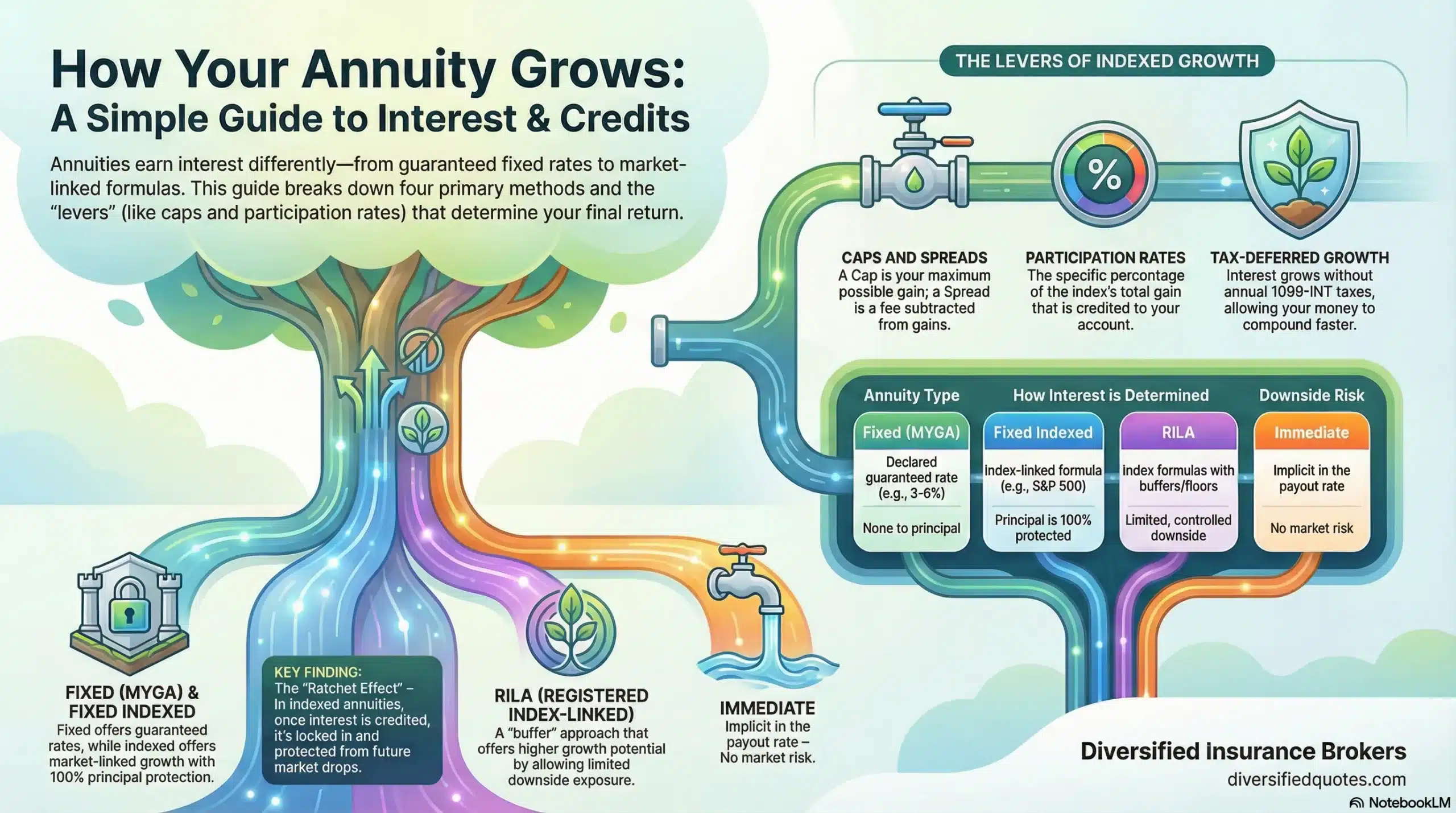
In an indexed annuity, principal protection typically refers to the way interest is credited when the index used for a strategy goes down. Most contracts are built with a floor—often described as a “0% floor”—that prevents negative index performance from producing a negative credit. So if the index is down over the measuring period, the credited rate for that strategy is usually zero percent (not negative). This creates a “stair-step” pattern: the account value can go up when interest is credited, and it stays level when the index is negative, rather than dropping with the market.
That stair-step behavior is one of the key reasons indexed annuities are discussed in retirement planning. Losses late in the accumulation phase can be hard to recover from quickly, and losses early in retirement can be devastating if you are drawing income at the same time (the classic sequence-of-returns problem). Principal protection doesn’t guarantee that you’ll earn a certain return each year, but it generally removes the need to “dig out of a hole” after a market crash for the funds allocated to the annuity.
If you want to understand how different indexed annuity structures handle the protection-versus-crediting tradeoff, it helps to look at designs that emphasize guaranteed elements and clearly defined mechanics. A good overview point is fixed indexed annuity designs that incorporate guaranteed components. Even if you don’t choose that exact structure, seeing how guarantees are built into the contract makes it easier to understand why and how principal protection is possible.
Why Indexed Annuities Don’t “Lose Money” When the Market Falls
The simplest explanation is that you are not directly invested in the market. The indexed annuity uses the index as a benchmark for calculating interest credits, not as an investment you own. If the index is down, the insurer does not pass the decline through to you. Instead, it credits no interest for that period. Your prior gains generally remain locked in. Your principal is not reduced by the index moving lower because the contract is not structured to transmit negative index returns to your account value.
From a planning perspective, this matters because of recovery math. If an investment drops 30%, it must then gain about 42.86% just to break even. That recovery requirement can force retirees into tough choices: reduce spending, increase portfolio risk to chase returns, delay retirement, or draw down principal faster than planned. Indexed annuities are often used to remove that recovery burden for a portion of retirement assets, allowing the rest of the portfolio to pursue growth without needing to carry the entire income plan during downturns.
Another reason principal protection feels so valuable to many retirees is psychological. Many people say they can tolerate volatility—until they experience a real bear market with real dollars at stake. When markets fall sharply, investors often change behavior: they sell at the wrong time, stop contributing, or stay in cash too long. A protected annuity position can help reduce the odds of that behavior derailment because the annuity is not reporting negative performance due to index losses in the first place.
The Core Mechanism: Floors, Resets, and Locking in Gains
Indexed annuity strategies typically operate on defined measuring periods. The contract sets the rules for how index movement is observed and how interest is credited. Common approaches include annual point-to-point designs (where the index value is measured on day one and day 365, for example) and other methods that translate index performance into a credited interest rate. The strategy’s “floor” prevents a negative credited rate, and the contract’s crediting rules determine what happens in positive years.
When a positive credit is applied, many contracts treat that credited interest as locked in. In practice, that means if you earned 6% last year and the index is down this year, you generally keep the 6% that was already credited, and you simply earn 0% for the down year. Over time, that creates the characteristic stair-step growth pattern that so many people associate with “principal protection.”
It’s important to keep expectations realistic. A floor can stop losses, but it doesn’t guarantee strong gains. The tradeoff for removing market downside is that the upside is usually managed through caps, participation rates, or spreads. In a strong bull market, the annuity likely credits less than a direct market investment. The purpose is not maximum growth; it’s stable, contract-based accumulation without market drawdowns for the portion of money inside the annuity.
So Is Principal Guaranteed? The Difference Between “Market Loss” and “Contract Risk”
Here’s where clarity matters: principal protection is strongest against market loss, but that doesn’t mean the account value can never be reduced. If you take withdrawals beyond what the contract allows without penalty, the contract value can decrease. If you surrender the contract early during the surrender-charge period, the surrender charge can reduce the proceeds you receive. If you add riders with fees, those fees can reduce accumulation. None of those reductions are driven by market losses, but they still can reduce the contract value.
That’s why the best way to think about indexed annuity principal protection is: “The market won’t take it from me, but I can still reduce it through my own actions or contract terms.” When people are disappointed, it’s often because they assumed principal protection was an absolute statement about every possible scenario. In reality, it’s a statement about the index crediting function, not a promise that withdrawals or surrender charges don’t exist.
When Could Your Principal Be Reduced in an Indexed Annuity?
There are a handful of common scenarios where a contract value can be reduced even though the market is down. If you understand these, you can avoid most surprises.
1) Withdrawals above the free withdrawal amount
Most indexed annuities allow a limited amount of penalty-free withdrawals each year—often expressed as a percentage. That free withdrawal feature is designed to provide some liquidity without undermining the insurer’s long-term pricing. If you withdraw above that amount during the surrender period, surrender charges may apply. Those charges can reduce what you receive, even if the market is down and the annuity itself is posting a 0% credit for that period.
This is not a “loss due to market.” It’s a cost for breaking the long-term commitment early. The practical lesson is simple: the money you place in an indexed annuity should be money you can commit for the surrender timeframe, with adequate cash reserves elsewhere for emergencies and short-term spending needs.
2) Surrendering the contract during the surrender-charge period
If you fully surrender (cash out) the annuity during the surrender period, you may pay a charge that reduces the amount you receive. Surrender schedules exist because the insurer is investing and hedging with a long-term plan in mind. If you leave early, you may pay the cost of that disruption. This is also why fit matters so much: a perfectly good product can feel “bad” if someone buys it with short-term money.
3) Rider fees that reduce the account value
Many indexed annuities offer optional benefits such as lifetime income riders. Those riders can be valuable, but they typically come with an annual cost. Depending on the contract, the fee might be deducted from the account value or in other ways that still reduce net accumulation. If the index is down and you’re credited 0%, the rider fee may still be charged, which can cause a slight decline in the account value even in a “down market” period.
This is not a failure of principal protection; it’s the natural tradeoff of buying additional contractual guarantees. If the goal of the rider is lifetime income, it may still be worth it. But you should understand that principal protection against market losses does not necessarily mean “no account value changes” if rider costs are present.
4) Taxes and penalties (depending on age and account type)
If an indexed annuity is held in a non-qualified account (not inside an IRA or 401(k) rollover), earnings are typically tax-deferred and taxed as ordinary income when withdrawn. If you withdraw gains, taxes can reduce what you net. If you are under certain ages, additional penalties can apply depending on your situation. In other words, “principal protection” is not the same thing as “tax protection.”
For a clear explanation of how taxation and basis work inside annuities—and why it matters when you withdraw—see what is an annuity cost basis. Even if your primary focus is principal protection, understanding cost basis helps prevent after-tax surprises.
Why Principal Protection Becomes More Valuable Near Retirement
Principal protection is often most valuable when your timeline shifts from “grow it” to “use it.” In the accumulation years, market volatility is often tolerable because time is on your side. In the distribution years, volatility becomes more dangerous because the portfolio may be funding spending. When you withdraw during a down market, you permanently remove shares from the portfolio at depressed prices, which can reduce long-term recovery potential.
That’s why many retirement plans use “bucket” strategies or layered approaches: a protected bucket that can support spending needs during market volatility, a growth bucket that can pursue longer-term appreciation, and a liquidity bucket for short-term cash flow. An indexed annuity can play the role of the protected bucket for many households, especially when the goal is to reduce sequence-of-returns risk.
It’s also why discussions about principal protection often overlap with discussions about income certainty. Some retirees want a protected accumulation contract; others want a contract that can support predictable lifetime income. These objectives can overlap, but they are not identical. If your goal is to maximize guaranteed lifetime income, you may evaluate different tools and accept different tradeoffs than someone who primarily wants principal protection during accumulation.
The “0% Floor” Is Powerful, But It’s Not the Only Protection Feature That Matters
A 0% floor is the headline feature, but there are additional contract features that can influence how “protected” the experience feels in real life. These features differ by product, and they’re often where the most meaningful comparisons happen.
Crediting term length and reset timing
Crediting occurs over terms. If you are in a one-year strategy, you reset annually. If you are in longer terms, the crediting and reset may behave differently. Shorter terms can feel more responsive. Longer terms may provide different cap or participation structures. The point is not that one is always better; it’s that the timing affects how quickly your contract can reflect positive index movement after a down period.
How interest is applied to contract value
When interest is credited, does it apply to the account value in a way that becomes part of the base for future credits? Most contracts do, but the details can vary. Over multi-year periods, compounding mechanics can materially affect outcomes. Protection and crediting are linked: you want strong protection, but you also want a crediting approach that doesn’t create unnecessarily low accumulation outcomes.
Liquidity features and free-withdrawal provisions
Protection is not just about market risk. It’s also about “life risk.” If the contract has a reasonable free withdrawal amount, and you maintain adequate liquidity outside the annuity, the plan tends to hold up better when life changes occur. If the contract is too restrictive for your real cash flow needs, the surrender schedule can become the hidden “risk” even though market risk is minimal.
The Role of Insurance Company Strength (and Why It Matters for “Protection”)
Indexed annuities are backed by the claims-paying ability of the issuing insurer. That is a different risk profile than FDIC-insured bank deposits. Insurers are regulated, and state protections exist, but the foundation remains the insurer’s financial strength. For most consumers, this is not a practical problem day-to-day, but it is part of responsible due diligence—especially for a long-term contract meant to support retirement.
If you want a plain-English guide to one of the most commonly referenced rating measures used to evaluate insurers, see what does an insurance company’s AM Best rating mean. Understanding ratings helps you evaluate the “contract backing” component of principal protection: you’re not only protecting against markets; you’re also choosing the institution standing behind the guarantees.
This is also where diversification can matter. Some households prefer to diversify across insurers when allocations are large, especially when contracts are meant to be held long-term. The right approach depends on the household’s objectives, total assets, and how the annuity fits into the broader plan.
Common Misconceptions That Create Confusion About Principal Protection
Most confusion around principal protection comes from mixing up how an indexed annuity is structured with how market investments behave. Below are the most common misunderstandings that cause people to ask, “Wait, can I lose principal?” after they already bought a contract.
Misconception: “If the index is down, my account must go down too”
With market investments, that is true. With indexed annuities, it’s typically not. A down index period usually results in a 0% credit, not a loss. That’s the core design.
Misconception: “Market-linked means I’m invested in the market”
Market-linked in this context means “interest credits reference index movement.” It does not mean ownership of the index. This is why dividend treatment differs and why credited interest is controlled by contract levers like caps and participation rates.
Misconception: “If I see a bonus or income roll-up, I can take that as cash”
Some contracts illustrate bonuses or roll-ups tied to income features. Those values may be used to calculate future income, not to represent a cash value you can withdraw. This misunderstanding isn’t directly about principal protection, but it’s a common reason people feel surprised by what they can actually access in cash.
Misconception: “Principal protection means there’s no downside”
Principal protection reduces one major risk—market loss—but introduces other tradeoffs: limited upside, surrender schedules, rider fees, and taxation rules. A good decision is one where the tradeoffs match the job you want the annuity to do.
Model Retirement Income With Principal Protection
See how protected accumulation and income options can stabilize a retirement plan during downturns.
How Principal Protection Interacts With Retirement Withdrawals
One of the most important practical questions is not just “Can the market reduce my contract value?” but “How does this behave when I start taking income?” In many retirement plans, the indexed annuity is used in one of two ways. First, it can serve as a protected accumulation contract that you tap later, often after other assets have done their job. Second, it can be structured with income features so the annuity becomes part of the retirement paycheck strategy.
When you withdraw, you are reducing account value—just like you would when withdrawing from any account. The difference is that the account value isn’t being reduced by market loss while you withdraw. That can help the plan avoid the compounding damage of “losses plus withdrawals” that can shorten portfolio life.
That said, withdrawals still need to be coordinated thoughtfully. If a contract has surrender charges and you withdraw more than allowed, you may pay surrender costs. If you withdraw gains, taxes may apply. If you added riders, rider fees may continue. The best planning outcome happens when the annuity is matched to a timeline and withdrawal strategy that avoids unnecessary penalties and uses the contract’s strengths for what they are.
Lifetime Income Calculator
💡 Note: The calculator accepts premiums up to $2,000,000. If you’re investing more, results increase in direct proportion — for example, doubling your premium roughly doubles the guaranteed income at the same age and options.
Does Principal Protection Also Mean You’re Protected From Inflation?
No—this is one of the most important clarifications for people evaluating principal-protected strategies. Protecting principal from market loss does not automatically protect purchasing power. If inflation runs high, a conservative strategy that earns modest credited interest may still lose ground in “real dollars” over time. That doesn’t mean the strategy is bad. It means you should evaluate it for the correct role: stability, predictability, and loss avoidance, not necessarily maximum long-term real return.
For many households, the solution is diversification of roles: protect a portion of the plan with principal-protected tools, keep another portion in growth assets, and keep liquidity appropriate for spending needs. Principal protection becomes a planning anchor, not the entire plan.
How Indexed Annuities Fit Inside a Diversified Retirement Plan
Indexed annuities are rarely an all-or-nothing move for households that are thinking clearly. Most often, they are a “slice” used to stabilize an income plan. That slice can help cover essential expenses, support later-life income needs, or create a protected pool of money that reduces pressure on risk assets during down markets.
When these products work well, it’s because the allocation size matches the job. If the annuity is too large relative to liquidity needs, the surrender schedule becomes the real risk. If the annuity is too small, it may not materially improve income stability. A good plan is one where every account has a role—and principal-protected tools are used where they solve a specific problem.
Many households also prefer to compare multiple contract designs, not just accept a single carrier illustration. Even though indexed annuities share core mechanics, differences in crediting options, surrender schedules, and rider structures can materially change the fit. That’s why many buyers choose to work through a comparison process rather than focusing on one product in isolation.
Get a Clear Answer on Principal Protection for Your Situation
We’ll confirm how protection works, what could reduce value, and which designs match your timeline.
A Practical “Yes/No” Checklist: Will I Lose Principal in an Indexed Annuity?
If you want a quick way to sanity-check principal protection, use this simple checklist. If the index is down, will the contract credit a negative number? In most indexed annuities, no—down periods credit 0% for that term. Could your value go down because you took withdrawals above what the contract allows without penalty? Yes. Could your value go down because you surrendered early during the surrender period? Yes. Could your value go down due to rider fees if you chose paid riders? Yes. Could your value go down because the market went down? In most standard indexed annuity designs, no—that is the risk the contract is designed to remove.
Once you understand the difference between market risk and contract-usage risk, you can evaluate the product realistically. And when expectations are realistic, indexed annuities tend to do exactly what they’re supposed to do: provide a stable, protected base that helps your retirement plan survive rough markets without forcing emotionally-driven decisions.
Related Principal-Protection Resources
Explore additional guides on rates, comparisons, and protection-focused planning tools.
Financial Protection Essentials
Chronic condition underwriting, burial insurance solutions, legal funding guidance, and specialized life insurance structures.
Talk With an Advisor Today
Choose how you’d like to connect—call or message us, then book a time that works for you.
Schedule here:
calendly.com/jason-dibcompanies/diversified-quotes
Licensed in all 50 states • Fiduciary, family-owned since 1980
Indexed Annuity Principal Protection FAQs
Can you lose money in an indexed annuity?
Indexed annuities are designed to protect principal from market losses. However, surrender charges or excess withdrawals could reduce value.
Is indexed annuity principal guaranteed?
Principal protection is typically contractually guaranteed when held according to contract terms and backed by the financial strength of the issuing insurer.
Do indexed annuities ever post negative returns?
Most indexed annuities credit zero instead of negative interest when the index declines.
Can you lose gains already credited?
No. Once interest is credited to the contract, it is typically locked in and cannot be lost due to future market performance.
Are indexed annuities safer than market investments?
They are designed differently. Indexed annuities remove direct market loss exposure but may limit upside compared to direct market investing.
About the Author:
Jason Stolz, CLTC, CRPC and Chief Underwriter at Diversified Insurance Brokers (NPN 20471358), is a senior insurance and retirement professional with more than two decades of real-world experience helping individuals, families, and business owners protect their income, assets, and long-term financial stability. As a long-time partner of the nationally licensed independent agency Diversified Insurance Brokers, Jason provides trusted guidance across multiple specialties—including fixed and indexed annuities, long-term care planning, personal and business disability insurance, life insurance solutions, Group Health, and short-term health coverage. Diversified Insurance Brokers maintains active contracts with over 100 highly rated insurance carriers, ensuring clients have access to a broad and competitive marketplace.
His practical, education-first approach has earned recognition in publications such as VoyageATL, highlighting his commitment to financial clarity and client-focused planning. Drawing on deep product knowledge and years of hands-on field experience, Jason helps clients evaluate carriers, compare strategies, and build retirement and protection plans that are both secure and cost-efficient. Visitors who want to explore current annuity rates and compare options across multiple insurers can also use this annuity quote and comparison tool.
