
Emergency Medical Evacuation Insurance

Jason Stolz CLTC, CRPC
Emergency medical evacuation insurance helps protect you from one of the most expensive and stressful travel emergencies: needing to be transported to appropriate medical care when local facilities cannot treat your condition. Whether you are traveling internationally, living abroad, or heading to a remote destination, a serious illness or injury can quickly become a six-figure logistical problem when air ambulance coordination, medical escort services, or cross-border transfers are required on short notice.
At Diversified Insurance Brokers, we help travelers, expats, mission teams, contractors, and families compare evacuation-focused options so the plan you choose matches the way you travel—where you go, how long you will be away, and how much coordination support you want when the unexpected happens. The goal is not to buy the “cheapest” evacuation benefit. The goal is to have a workable response plan when timing, access, and medical decision-making matter.
If you are also comparing general travel medical protection, it can help to review travel medical insurance so you understand how treatment benefits and evacuation benefits fit together. For travelers headed to remote areas or destinations with elevated operational risk, the framework in high risk travel insurance is also useful, because high-risk travel often changes evacuation expectations and coordination needs.
Compare Emergency Medical Evacuation Plans
Shop evacuation-focused coverage options and apply online in minutes.
What Is Emergency Medical Evacuation Insurance?
Emergency medical evacuation insurance is coverage designed to coordinate and pay for medically necessary transport when you cannot receive appropriate care where you are. “Evacuation” can mean a ground transfer from a rural clinic to a regional hospital, an air transfer to a facility with higher-level capabilities, or a cross-border move to a neighboring country when the local healthcare system cannot provide the level of treatment required. In some plan designs, evacuation and repatriation are separate benefits, which is why the definitions in the policy are just as important as the dollar limit.
The most valuable component is often not the aircraft itself. It is the 24/7 assistance and coordination that manages medical decision-making, facility acceptance, documentation, and logistics when time matters. In real emergencies, the problem is rarely “just pay a bill.” It is a coordination problem involving physicians, receiving hospitals, safe transport arrangements, and rapid decisions while you or your family is under stress.
Want Us to Verify Evacuation Fit for Your Trip?
Share destination(s), trip length, and who is traveling, and we’ll point you to evacuation structures that avoid common coordination gaps.
Why This Coverage Matters
Many people assume they can “figure it out” if something happens. In reality, serious travel emergencies involve multiple moving parts that can stall care: language barriers, local documentation requirements, physician-to-physician coordination, medical clearance for transport, airline or aircraft restrictions, and the need for a receiving facility willing to accept the patient. Even if you are near a hospital, the nearest facility capable of treating major trauma, stroke, complex infection, or surgical complications may be hours away—or located in another country.
Evacuation insurance helps prevent these moments from turning into a financial crisis and a logistical nightmare for family members. It also reduces the chance that a traveler stays in an inadequate facility longer than necessary because no one knows how to coordinate the next step. When your priority is continuity of care, “Who is coordinating the transfer?” can be more important than “What is the deductible?”
What Emergency Medical Evacuation Insurance Typically Covers
Coverage varies by plan, but evacuation-focused policies commonly include medically necessary transport to the nearest appropriate facility that can provide required treatment. The “nearest appropriate facility” definition matters because it determines where the plan can send you and how medical necessity is evaluated. Some plans also include medical repatriation benefits, which may allow return to your home country when medically appropriate and coordinated through the assistance team.
Many plans include or allow services such as medical escort support when commercial travel is safe but monitoring is required, as well as coordination for air ambulance transport when a specialized aircraft is medically necessary. Depending on the plan, there may also be benefits that support dependent children, a traveling companion, or logistical help for returning travelers to their point of origin after stabilization.
Because the contract language determines how a real evacuation is handled, we recommend reviewing benefit limits, definitions, and authorization requirements before you buy. A plan can show a high dollar limit but still create practical problems if approvals or definitions are narrow.
Medical Evacuation vs. Travel Medical Insurance
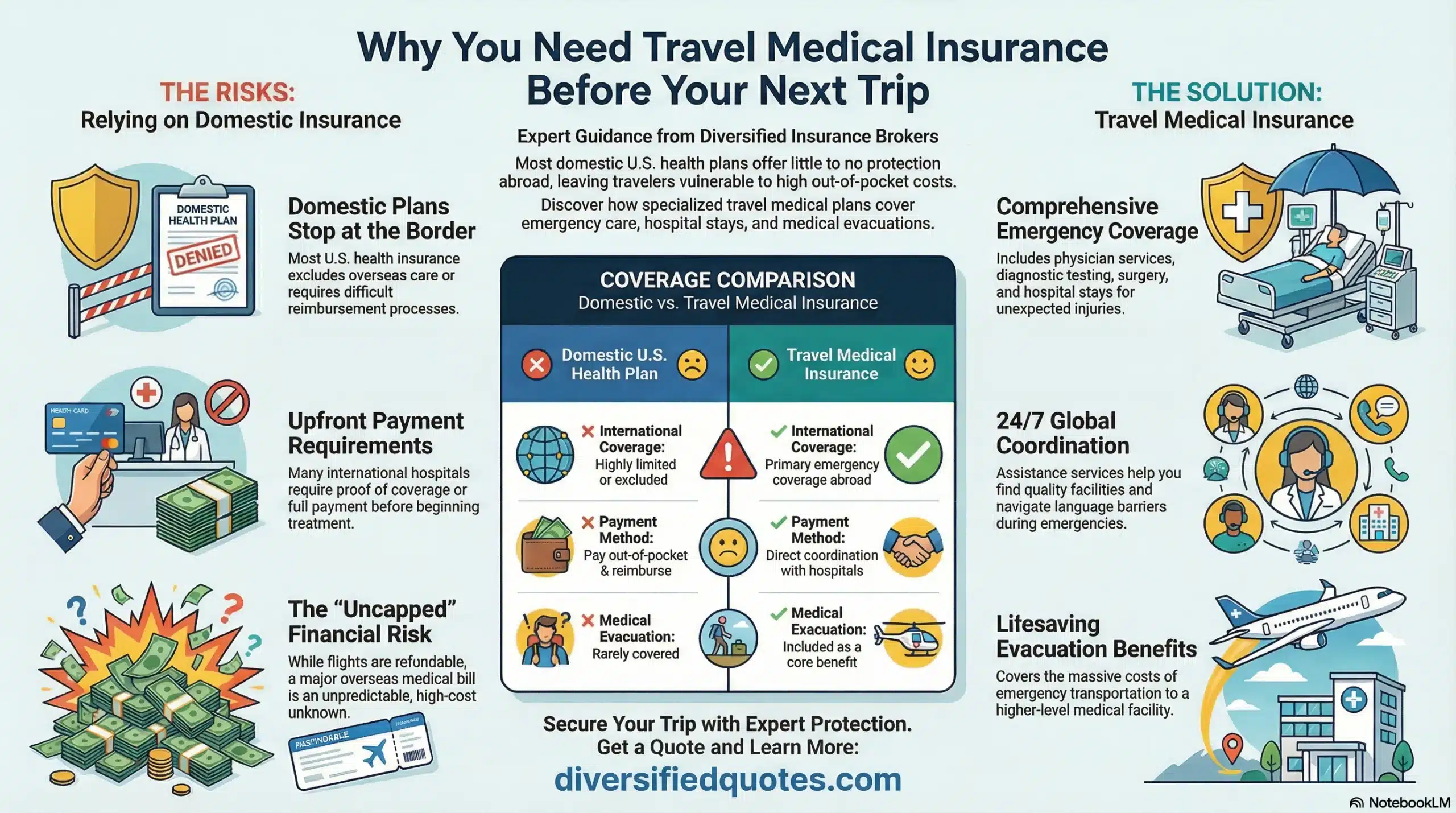
Travel medical insurance is primarily designed to help pay for treatment costs—doctor visits, hospital stays, tests, and prescriptions—during a trip. Evacuation insurance is designed to address the transport-and-coordination problem when appropriate care is not available locally. Many travel medical plans include evacuation as a built-in benefit, but travelers headed to remote regions, higher-risk destinations, or multi-country itineraries sometimes prefer a plan that prioritizes evacuation limits and coordination strength.
If you are building a travel protection strategy, it helps to think in layers. The first layer is treatment coverage. The second layer is evacuation coordination. Depending on where you are going and what you are doing, the evacuation layer can be the most critical part of the plan because it determines whether you can access the level of care your condition requires.
Need Help Choosing an Evacuation Limit?
We’ll recommend a sensible range based on remoteness, infrastructure, and how complex a transfer could be from your itinerary.
When Evacuation Insurance Is Especially Important
Emergency medical evacuation coverage becomes especially valuable when your travel increases the likelihood that appropriate care will not be available in the immediate area. This is common when traveling outside major cities, visiting islands or rural regions, or going to countries where advanced specialty care is limited to a few facilities. It is also common for mission trips, humanitarian deployments, contractor assignments, and itineraries where transportation and infrastructure are unpredictable.
Frequent travelers and long-term stays can increase exposure simply because you are abroad longer. If you are living internationally or traveling for months at a time, you may also want to compare evacuation-focused options alongside broader medical structures like international health coverage. If you are exploring those longer-term structures, review international health insurance to understand how ongoing care differs from emergency-only travel medical design.
For certain travelers, a combined strategy is appropriate: travel medical coverage for treatment costs plus a strong evacuation structure for coordination and transport. The best approach depends on destination, duration, and the type of work or activities planned.
How Claims and Evacuation Requests Work
Evacuation benefits usually require coordination through the insurer’s assistance provider. In a serious situation, you or a companion contacts the 24/7 assistance number, and the team coordinates next steps. They typically confirm medical necessity, identify appropriate facilities, coordinate physician communication, and arrange transportation when required. This process is designed to keep medical decisions coordinated, reduce delays, and ensure coverage rules are followed.
One of the most common mistakes is arranging transport independently without contacting the assistance team first. Many policies require pre-authorization unless it is impossible due to the emergency. This is why it is important to keep assistance contact information accessible, saved in your phone, and shared with traveling companions or group leaders.
If you are leading a group trip, it is wise to build a simple procedure: who calls first, where the policy numbers are stored, and how the group communicates in a medical emergency. The policy is only as useful as your ability to activate it under stress.
Key Features to Compare Before You Buy
Not all evacuation plans are structured the same, even when they look similar on a brochure. The most important decision points are usually the evacuation benefit limit, the definition of “nearest appropriate facility,” and the repatriation rules that determine whether return to your home country is included or restricted. Authorization rules are also critical. You want a plan where it is clear how approval works, who makes the medical decision, and how the assistance team coordinates with treating physicians.
Companion benefits and dependent support can matter for families and mission teams. If a parent traveling with children is hospitalized or evacuated, benefits that help coordinate child return travel or companion arrangements can reduce chaos. These benefits vary widely by plan, so it is worth confirming details when you are planning family travel or group trips.
If you are traveling to higher-risk destinations or remote regions, it can also help to review the broader framework in travel and medical insurance for high risk travel so you understand why certain evacuation definitions and coordination structures matter more when infrastructure is limited.
Why Work With Diversified Insurance Brokers?
Emergency medical evacuation insurance is one of those products where small wording differences can create big outcomes. Our advisors help you compare plan structures, understand what “evacuation” really means in the contract, and choose coverage that aligns with your destination, risk profile, and time away. We focus on clarity so you know how to activate coverage, what triggers evacuation, and what the plan is designed to do when local care is not sufficient.
Whether you are traveling for business, leisure, ministry, study abroad, or long-term international living, we help you get covered before you go so you are not trying to solve a six-figure logistics problem during a crisis.
Get Emergency Evacuation Coverage Before You Travel
Compare plans, review limits, and apply online in minutes.
Traveling with a Group or to a Remote Area?
We can confirm evacuation rules, coordination requirements, and what “nearest appropriate facility” typically means for your itinerary.
Related Travel Medical Pages
Use these pages to compare emergency medical coverage structures that often pair with evacuation benefits.
Related High-Risk and Specialty Travel Guides
Explore higher-risk travel planning guidance where evacuation coordination is often the most critical benefit.
Talk With an Advisor Today
Choose how you’d like to connect—call or message us, then book a time that works for you.
Schedule here:
calendly.com/jason-dibcompanies/diversified-quotes
Licensed in all 50 states • Fiduciary, family-owned since 1980
Emergency Medical Evacuation Insurance FAQs
What is emergency medical evacuation insurance?
It provides coverage and coordination for medically necessary transportation to an appropriate medical facility when adequate care is not available locally.
Is medical evacuation included in travel insurance?
Some travel medical plans include evacuation benefits, but limits and definitions vary widely. Remote travel often requires higher evacuation limits.
Does evacuation insurance cover air ambulances?
Many plans cover air ambulance services when medically necessary and arranged through the insurer’s assistance provider, subject to policy limits.
Do I need pre-authorization for evacuation?
Usually yes. Most policies require contacting the 24/7 assistance team unless circumstances make it impossible during a true emergency.
Will the plan return me to my home country?
Some plans include medical repatriation when appropriate, while others only transport you to the nearest suitable facility.
What does “nearest appropriate facility” mean?
It refers to the closest hospital or center capable of providing the medically necessary treatment for your condition.
Can evacuation coverage help my family if I’m hospitalized?
Certain plans include benefits for companion travel, return of minor children, or family assistance. Coverage varies by policy.
How much does emergency evacuation insurance cost?
Costs depend on age, destination, trip length, evacuation limits, and whether the benefit is bundled with travel medical coverage.
Are pre-existing conditions covered?
Coverage varies. Some plans exclude pre-existing conditions or only cover acute onset situations. Review policy terms carefully.
What should I do first in an emergency abroad?
Seek immediate local care, then contact the insurer’s 24/7 assistance provider as soon as possible to coordinate next steps.
About the Author:
Jason Stolz, CLTC, CRPC and Chief Underwriter at Diversified Insurance Brokers (NPN 20471358), is a senior insurance and retirement professional with more than two decades of real-world experience helping individuals, families, and business owners protect their income, assets, and long-term financial stability. As a long-time partner of the nationally licensed independent agency Diversified Insurance Brokers, Jason provides trusted guidance across multiple specialties—including fixed and indexed annuities, long-term care planning, personal and business disability insurance, life insurance solutions, Group Health, and short-term health coverage. Diversified Insurance Brokers maintains active contracts with over 100 highly rated insurance carriers, ensuring clients have access to a broad and competitive marketplace.
His practical, education-first approach has earned recognition in publications such as VoyageATL, highlighting his commitment to financial clarity and client-focused planning. Drawing on deep product knowledge and years of hands-on field experience, Jason helps clients evaluate carriers, compare strategies, and build retirement and protection plans that are both secure and cost-efficient. Visitors who want to explore current annuity rates and compare options across multiple insurers can also use this annuity quote and comparison tool.
