
Emergency Travel Health Insurance

Jason Stolz CLTC, CRPC
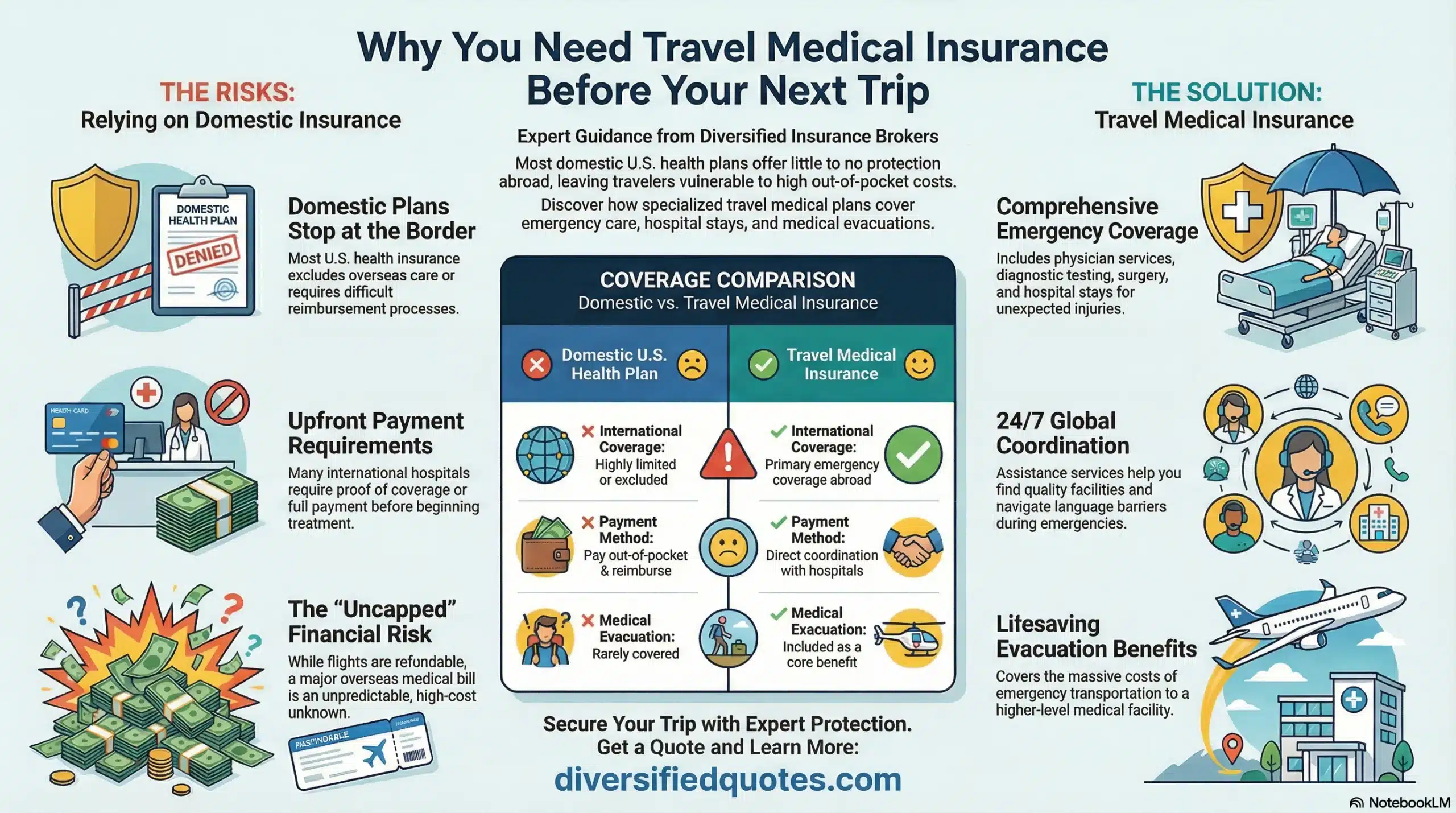
At Diversified Insurance Brokers, we help U.S. travelers secure emergency travel health insurance that protects you beyond your domestic health plan once you leave the United States. Even short international trips can expose you to costly medical bills, limited provider access, and serious logistical complications if you need care in an unfamiliar system. A purpose-built emergency travel medical policy is designed for urgent treatment abroad, emergency medical evacuation coordination, and repatriation benefits that many domestic plans do not include.
For many travelers, the biggest risk is not a routine doctor visit. It is a situation that escalates quickly—an injury that needs imaging, a hospitalization after an infection, a medical complication that requires specialist care, or a scenario where the nearest appropriate facility is not in the city (or country) where you are located. That is why travel medical coverage should be treated as part of your trip planning, not an optional add-on you decide on at the last minute.
If you want a broader framework of plan structures and how travel medical works across destinations, start with our overview on international travel health coverage. If your itinerary involves remote locations, unstable infrastructure, or activity profiles that increase medical and evacuation exposure, it can also help to review high risk travel insurance so you understand what typically changes in plan wording and benefit structure when risk is elevated.
Get Emergency Travel Health Coverage
Fast, secure online quote and enrollment for U.S. travelers heading abroad.
What Emergency Travel Health Insurance Typically Covers
Emergency travel health insurance is designed to help you manage the medical and logistical realities of an unexpected illness or injury overseas. Instead of relying on domestic coverage that may reimburse poorly (or not at all), travel medical coverage provides a benefit structure and an assistance framework built for international emergencies. For travelers, that often matters as much as the benefit maximum itself, because the assistance team can guide next steps and coordinate transfers when local care is not sufficient.
Typical benefits include emergency physician services, urgent care, emergency room evaluation, hospital stays, outpatient diagnostics when medically necessary, and prescription medications related to a covered condition. Many plans also include medically necessary evacuation and repatriation benefits, but those benefits come with important coordination rules that travelers should understand before departure. If you want a deeper explanation of how evacuation is triggered and why approval/coordination matters, start with our guide to Emergency Medical Evacuation Insurance.
Some plans include limited trip interruption or return-home benefits tied to a covered medical event. Those can be helpful for getting home early when it is medically appropriate, but the primary value for most U.S. citizens traveling abroad is medical care, evacuation structure, and the assistance team that helps coordinate decisions under pressure.
Want Us to Confirm the Plan Fits Your Trip?
Send your travel dates, destinations, ages, and activity profile and we’ll point you to a plan structure that avoids common gaps.
Who This Coverage Is Best For
Emergency travel health insurance is a strong fit for U.S. citizens traveling abroad for leisure, business, study abroad programs, visiting family, mission trips, cruises, or itineraries that include remote or higher-risk regions. It is also a smart fit for travelers whose domestic plans have limited overseas benefits, high out-of-network exposure, no evacuation coverage, or reimbursement rules that make overseas care difficult to manage.
Frequent travelers often prefer a structure that aligns with how they travel. Some trips are one-off vacations where a single-trip policy is enough, while other travelers take repeated international trips and want a multi-trip annual option. The right structure depends on how often you travel, where you go, and whether your travel style includes activities or environments that increase medical and evacuation exposure.
If you are planning travel that is inherently higher-risk due to destination, infrastructure, or activity profile, reviewing travel and medical insurance for high risk travel can help you understand why certain policies respond well in real emergencies and why others fail due to exclusions, low limits, or narrow evacuation wording.
Plan Design Basics
Emergency travel medical plans are built for short-term protection and typically apply only while you are outside the United States. Coverage is usually tied to a defined policy period, and it ends when that period ends or when you return to the U.S., depending on plan rules. The main decisions that shape how a policy performs are the medical maximum, deductible, coinsurance structure, and the coverage window that must match your travel dates.
Medical maximums should reflect the medical cost environment and the logistical realities of your itinerary. Deductibles and coinsurance are the levers that balance premium and out-of-pocket exposure. A higher deductible can lower premium, but you want to be realistic about what you could pay if you need urgent care or an emergency evaluation. Coinsurance matters because some plans do not pay 100% after deductible, and your share can increase quickly if a hospitalization occurs.
Destination scope also matters. Many plans are worldwide, but exclusions may apply to certain sanctioned regions. If your travel is “off the typical tourist path,” you will want to verify that the plan fits both the destination and the activities you plan to do. If you are trying to keep premium manageable, it can help to understand what “budget” travel insurance often trades away. Our cheap travel insurance guide helps you identify tradeoffs that can create dangerous gaps for medical and evacuation scenarios.
Not Sure What Limits to Choose?
Tell us where you’re going and how long you’ll be abroad, and we’ll recommend a sensible coverage range.
Common Questions Travelers Ask Before They Buy
Pre-existing conditions are one of the most important details to confirm. Some travel medical policies exclude them entirely, while others may offer limited protection, “acute onset” coverage under specific rules, or time-sensitive options that depend on eligibility and purchase timing. The exact definitions matter, so it is important to review how the plan defines a pre-existing condition and what the look-back and stability rules are.
Adventure activities can also change coverage. Certain hazardous sports and remote activities may be excluded or require an optional rider. If your itinerary includes mountaineering, diving, backcountry skiing, remote trekking, or any activity that is more than basic tourism, it is important to verify how the policy defines eligible activities.
Direct billing availability varies by country and facility. Some locations support direct billing arrangements, while others require you to pay and submit claims for reimbursement. Evacuation rules are also often misunderstood. Evacuation is typically only for medically necessary transfers and usually requires carrier approval and coordination through the assistance provider. If you want a deeper explanation, review emergency medical evacuation insurance so you understand the “medically necessary” standard and coordination requirement before you travel.
How Diversified Insurance Brokers Helps
As an independent brokerage, Diversified Insurance Brokers compares travel health options for U.S. citizens to align benefits, exclusions, and pricing with your itinerary. We help you select appropriate limits for higher-risk or higher-cost destinations, confirm the assistance services that matter in a true emergency, and reduce the chance of unpleasant surprises at claim time—so you can travel with confidence.
If you are a foreign national traveling to the United States, you will want a plan designed for that direction of travel. Be sure to review emergency travel health insurance for foreign nationals so the policy structure matches the needs of visitors to the U.S.
What You’ll Need to Get Started
To enroll efficiently, you will typically want traveler details (names, dates of birth, and U.S. residence), your trip dates and destination countries (including cruise segments), and a rough activity plan so exclusions or riders can be verified. If you are unsure about medical maximum and deductible choices, that is normal. Many travelers start with a reasonable coverage range and then adjust deductible and coinsurance based on budget and comfort level.
Tip: Purchase coverage before you depart the U.S., keep your policy ID card and assistance phone numbers with your passport, and contact the assistance team as soon as possible if a medical event occurs abroad so they can coordinate care and confirm next steps.
Ready to enroll?
Traveling for a Program, Mission, or Group Trip?
We can confirm evacuation rules, activity coverage, and documentation so your group is aligned on dates and benefits.
Related Travel Medical Pages
Explore travel medical resources that help you choose the right emergency structure for overseas trips.
Related Evacuation and Special Travel Guides
Use these guides to understand evacuation coordination, higher-risk travel structure, and visitor-to-U.S. coverage.
Talk With an Advisor Today
Choose how you’d like to connect—call or message us, then book a time that works for you.
Schedule here:
calendly.com/jason-dibcompanies/diversified-quotes
Licensed in all 50 states • Fiduciary, family-owned since 1980
FAQs: Emergency Travel Health Insurance
What is emergency travel health insurance?
It’s short-term medical coverage for travelers that helps pay for unexpected illnesses or injuries while you’re outside your home country, including ER visits, hospital stays, and urgent care.
How is it different from trip insurance?
Trip insurance focuses on non-medical benefits like trip cancellation, delay, and lost baggage. Emergency travel health insurance focuses on medical treatment and evacuation while abroad. Many travelers carry both.
Does it cover pre-existing conditions?
Some plans exclude them; others offer limited coverage or time-sensitive waivers. If you have a condition, ask about stability requirements, look-back periods, and waiver options before purchase.
Are COVID-19 illnesses covered?
Many plans treat COVID-19 like other covered illnesses subject to policy terms. Always verify country entry rules and any plan-specific limitations.
What about medical evacuation and repatriation?
Many plans include emergency medical evacuation and repatriation of remains. Review coverage triggers, maximums, and whether companion benefits or return transportation are included.
Will the plan satisfy visa or entry requirements?
Some destinations require proof of medical coverage. Choose a plan with limits, territory, and documentation that match your itinerary’s requirements.
How long can I be covered?
Policies are commonly available from a few days to a year, with options to extend. Coverage typically runs from your departure date through your return date.
Are adventure sports covered?
Standard plans may exclude higher-risk activities. Some carriers offer optional riders for activities like skiing, scuba, trekking, or organized athletics—review the activity list before purchase.
How do deductibles and networks work abroad?
You choose a deductible at purchase. Some plans have international provider networks while others reimburse out-of-network care. Keep itemized receipts and medical documentation.
When should I buy?
Buy before departure. If you need time-sensitive benefits, purchase within the plan’s required window after initial trip payment.
How do claims work?
For non-emergencies, contact the assistance line first. For emergencies, seek care immediately and notify the insurer as soon as practical. Submit itemized bills, medical notes, and proof of travel.
Can U.S. residents get coverage for domestic trips?
Emergency travel health plans are designed for travel outside your home country. For domestic trips, rely on your primary health plan and consider other travel protection options.
About the Author:
Jason Stolz, CLTC, CRPC and Chief Underwriter at Diversified Insurance Brokers (NPN 20471358), is a senior insurance and retirement professional with more than two decades of real-world experience helping individuals, families, and business owners protect their income, assets, and long-term financial stability. As a long-time partner of the nationally licensed independent agency Diversified Insurance Brokers, Jason provides trusted guidance across multiple specialties—including fixed and indexed annuities, long-term care planning, personal and business disability insurance, life insurance solutions, Group Health, and short-term health coverage. Diversified Insurance Brokers maintains active contracts with over 100 highly rated insurance carriers, ensuring clients have access to a broad and competitive marketplace.
His practical, education-first approach has earned recognition in publications such as VoyageATL, highlighting his commitment to financial clarity and client-focused planning. Drawing on deep product knowledge and years of hands-on field experience, Jason helps clients evaluate carriers, compare strategies, and build retirement and protection plans that are both secure and cost-efficient. Visitors who want to explore current annuity rates and compare options across multiple insurers can also use this annuity quote and comparison tool.
