
Group Health Insurance for Law Firms

Jason Stolz CLTC, CRPC
Group Health Insurance for Law Firms
Compare fully insured, level-funded, and self-funded options built for partners, associates, and support staff—without benefit disruption.
Group health insurance for law firms requires a different approach than coverage designed for traditional small businesses. Legal practices often have highly compensated partners, diverse employee demographics, predictable work schedules, and a strong need for benefit stability. When your team is your product, a health plan that renews cleanly and remains competitive is not a “nice-to-have”—it’s part of your retention strategy and your operating model.
Whether you operate a boutique practice, a multi-partner firm, or a growing regional operation, selecting the right structure—fully insured, level-funded, or self-funded—can significantly affect both annual premiums and long-term sustainability. Many firms begin by reviewing the fundamentals of group medical insurance, then refine the decision by focusing on partner eligibility, contribution strategy, and renewal behavior.
At Diversified Insurance Brokers, we help law firms compare plan structures side-by-side so decisions are practical, not theoretical. The goal is a plan your attorneys will actually use, a cost profile leadership can budget for, and a renewal process that stops being a yearly fire drill.
Why Law Firms Need a Specialized Group Health Strategy
Law firms have benefit dynamics that are different from many other small-to-mid-size employers. First, compensation is often uneven across the firm, which can change how employees perceive out-of-pocket costs and contribution levels. Second, many practices employ multiple classes of workers—partners, associates, paralegals, and administrative staff—each with different expectations and financial constraints. Third, even when the firm is stable overall, hiring tends to happen in bursts, and benefits must support recruiting without forcing constant plan redesign.
One-size-fits-all plans are frequently inefficient for legal practices because they are built for an “average” workforce. Law firms are rarely average. They often have older partner groups, high earners, and professionals who value stability and strong provider access. If the plan is too restrictive, it creates dissatisfaction. If the plan is overly rich without a cost strategy, it becomes a budgeting problem at renewal.
Many legal practices also outgrow fully insured plans quickly as premiums rise without clear explanations, especially if the carrier is pricing conservatively to protect against perceived risk. This is why firms increasingly explore alternatives such as self-funded group health insurance or level-funded structures that can improve transparency and control.
The point is not to chase complexity. The point is to match plan structure to the firm’s reality so the plan renews with stability and stays competitive without turning into a financial surprise.
What Actually Drives Cost in Law Firm Plans
Most law firm leaders assume the biggest driver of health plan cost is “the carrier raising rates.” In reality, the carrier’s rate decision is usually a downstream result of a few predictable cost drivers. Understanding these drivers helps you design the plan with intention and explains why some plans renew cleanly while others spike unexpectedly.
One driver is utilization. Legal professionals often work long hours. Preventive care gets delayed. That can push employees toward more expensive care later, including urgent care or ER visits that could have been avoided with earlier treatment. A plan that supports accessible primary care and telehealth can improve the employee experience while reducing waste.
Another driver is pharmacy spend. Specialty medications can create disproportionate cost pressure even in relatively small groups. A firm can feel “stable” but still see renewal increases if just a few high-cost prescriptions hit the plan. This is one reason transparency matters—so leadership can understand trends early rather than learning about them at renewal.
Network leakage is another common problem. If attorneys and staff cannot access in-network providers where they live or where the firm operates, out-of-network claims increase quickly. That creates cost volatility and employee dissatisfaction at the same time. For multi-office firms, network fit is often more important than the carrier brand name.
Finally, contribution strategy influences participation. If employee costs rise too quickly, participation can drop and underwriting can become less favorable. A strong plan strategy balances plan richness with a contribution structure that keeps enrollment stable.
Plan Types: Fully Insured vs Level-Funded vs Self-Funded
Law firms typically choose between three funding structures. Fully insured plans prioritize simplicity. Level-funded plans balance predictability and efficiency. Self-funded plans offer the most control and transparency but require stronger governance. The right structure is the one that matches your firm’s stage, cash-flow tolerance, and desire for plan control.
Many firms begin with a fully insured plan and later move to level-funded once they want better renewal stability and the potential to benefit from favorable claims experience. Larger or more mature firms may consider self-funding when they want deeper customization and better long-term cost management.
If you want a baseline overview of how employer plans are structured, our group health insurance resource is a helpful starting point because it frames how funding, eligibility, and renewals tend to behave across different employer sizes.
Fully Insured Plans for Law Firms
Fully insured health plans remain a common starting point for smaller law firms or newly established practices. These plans offer fixed monthly premiums for the plan year and straightforward administration. For leadership teams that want to avoid complexity, fully insured coverage can be a practical choice—especially when the firm is small and the priority is simply getting a plan implemented correctly.
The tradeoff is that fully insured plans provide limited transparency into claims drivers and fewer levers to influence renewal outcomes. Renewals may be influenced by the firm’s experience, but pricing also includes carrier margins, risk buffers, and broader market assumptions. This can make renewals feel unpredictable even in years when leadership believes claims were “normal.”
Fully insured plans can still make sense when administrative capacity is limited, when participation rules are strict, or when the firm is in a fast growth phase and wants the simplest structure while headcount stabilizes. The key is to avoid complacency. A fully insured plan should still be reviewed with intent so it doesn’t drift into an expensive structure year after year.
For firms that remain fully insured long term, stability often comes from selecting a network employees can use and applying modest plan adjustments over time instead of making disruptive changes at every renewal.
Level-Funded Health Plans for Law Firms
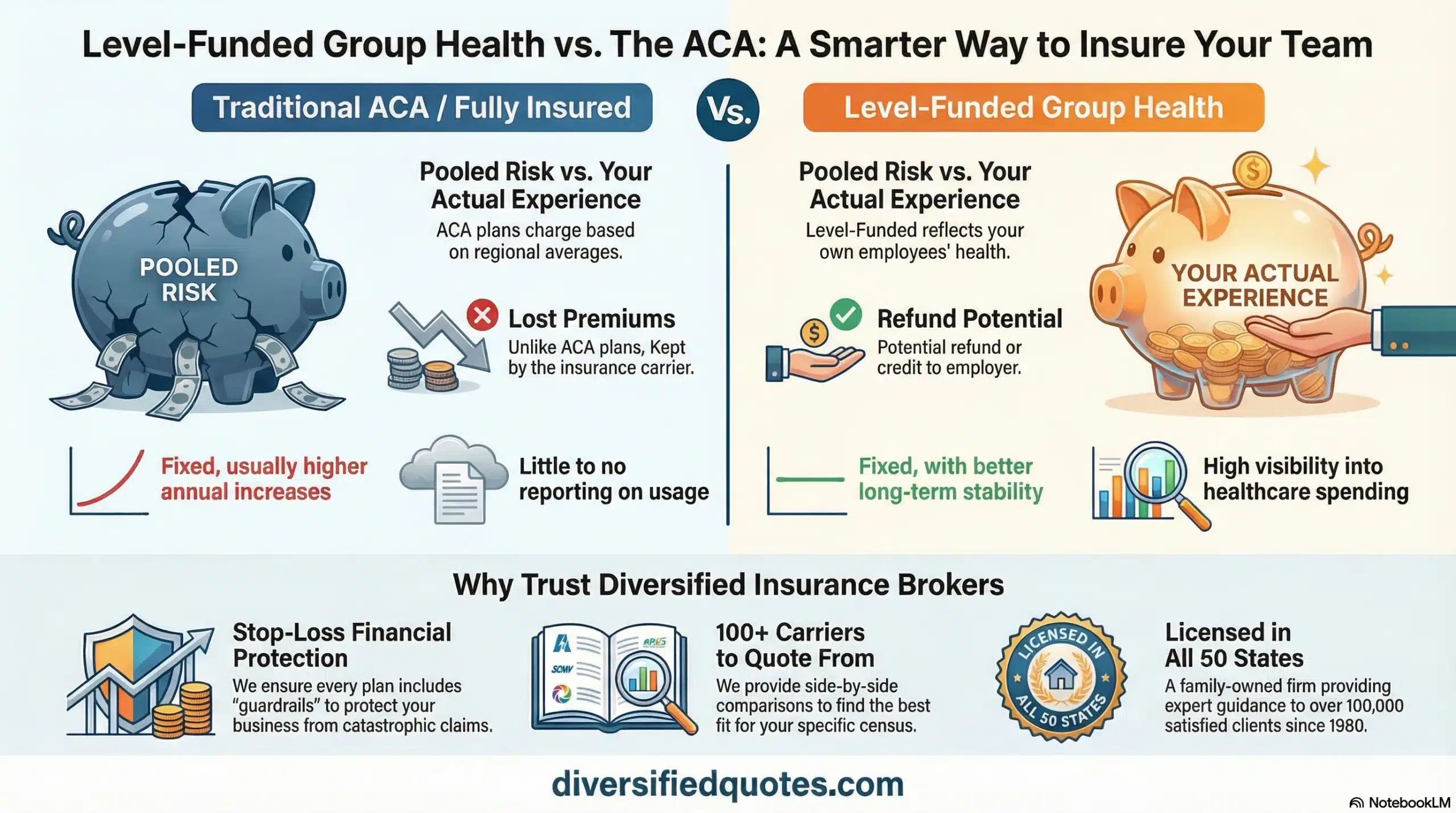
Level-funded plans often represent an ideal middle ground for law firms. These plans combine predictable monthly payments with many of the financial advantages of self-funding, typically supported by stop-loss protection. From a budgeting standpoint, level-funded can feel similar to fully insured coverage, but the plan mechanics often align costs more closely with the firm’s own experience.
Professional service firms often perform well under level-funded structures because their workforce demographics can be stable and because leadership typically values predictability. A key advantage is that level-funded designs can create a pathway to savings in favorable years. When claims run better than expected, unused claim dollars may be returned or credited depending on plan terms.
Another advantage is improved visibility. Level-funded reporting can help leadership understand trends earlier, which supports better plan decisions. Instead of reacting at renewal, the firm can identify what is driving spend and consider targeted adjustments.
Many law firms evaluate level-funded plans when they are tired of double-digit renewals and want more control without jumping straight into full self-funding. If you want to go deeper into the mechanics and guardrails, start with what self-funded group health insurance is and then compare the tradeoffs in plain language using pros and cons of self-funded group health.
Self-Funded Health Plans for Larger Law Firms
Larger law firms and multi-office practices often benefit most from self-funded health plans. With self-funding, the firm assumes direct responsibility for claims while purchasing stop-loss insurance to limit exposure to high-cost cases. This structure can provide the greatest level of cost control and the highest level of transparency when paired with strong reporting and a disciplined renewal process.
Self-funded plans are particularly effective for firms with strong cash flow, predictable staffing, and a long-term approach to benefits planning. The firm gains meaningful insight into claim categories, pharmacy trends, and network utilization. That insight can be used to make proactive plan adjustments that improve renewal stability over time.
However, self-funding is not a “set it and forget it” arrangement. To work well, it needs governance: a clear renewal calendar, vendor oversight, and an intentional contribution strategy that keeps participation strong. When governance is strong, self-funding often becomes a system that the firm can manage rather than a cost that the firm must accept.
Many firms move toward self-funding after gaining comfort with level-funded structures, especially once they want deeper customization and better long-term control of medical spending.
Covering Partners, Associates, and Staff
One of the most important considerations for law firms is how partners are classified under the health plan. Ownership structure—LLC, partnership, or professional corporation—can affect eligibility and contribution strategy. Proper plan design ensures compliance while preserving flexibility for partner compensation planning.
Associates, paralegals, and administrative staff often have different coverage needs and different sensitivity to out-of-pocket costs. This is where multiple plan options or tiered strategies can be valuable. A two-plan approach can keep benefits competitive without forcing the firm to fund the richest plan design for every employee.
For example, a firm can offer a “value” plan and a buy-up plan. Employees who prefer lower payroll deductions can select the value plan, while employees who prefer lower out-of-pocket costs can select the buy-up option. When designed correctly, this approach reduces cost pressure while giving the team choice, which supports retention.
Classing and contribution strategies must be simple enough to administer and clear enough to explain. Law firms benefit from benefits clarity. Confusion creates dissatisfaction, and dissatisfaction can lead to turnover—especially when employees can easily compare offers across firms.
Networks, Multi-Office Footprints, and Access to Care
Network strength is often the most important day-to-day driver of employee satisfaction. Attorneys and staff want predictable provider access. A plan that looks cheaper on paper can become expensive if it pushes employees out of network or makes it difficult to access care conveniently.
If your firm has multiple offices, remote staff, or employees living across state lines, network fit becomes a strategic decision. The goal is not necessarily to choose the broadest network available at any cost. The goal is to choose a network that employees can realistically use, because that reduces out-of-network utilization and helps claims behave more predictably over time.
Network decisions also affect recruiting. Candidates often ask about provider access and plan flexibility early in the hiring process. A stable, usable network supports a smoother recruiting experience and reduces the “benefits friction” that can derail offers.
Many firms also find that benefits education improves outcomes. Explaining urgent care vs ER usage, telehealth access, and prescription basics reduces avoidable waste. That helps both employees and the firm’s renewal experience.
Employer Contributions and Classing Strategies
Contribution strategy is one of the biggest drivers of long-term plan sustainability. If contributions are too low, participation can drop and carrier options can narrow. If contributions are too high, payroll becomes inflexible and renewals get harder to absorb. The most effective contribution strategy is one the firm can repeat every year without creating disruption.
Many law firms contribute strongly toward employee-only coverage and then structure dependent contributions differently. This protects recruiting value for employees while giving families flexibility. For firms with partner classes, the best approach is often to design contributions that are compliant, repeatable, and easy to administer rather than overly customized to individual preferences.
Another best practice is aligning contribution strategy with plan option design. If your value plan is meant to drive participation, contributions should support that goal. If your buy-up plan is meant to provide optional richness, contributions can be structured so employees who want richer coverage can elect it without forcing the employer to fund it universally.
Clear contribution communication is critical. When employees understand what the firm pays and what employees pay, benefits feel more valuable and participation is usually stronger.
Renewal Strategy and Long-Term Cost Control
Annual renewals are a critical opportunity for law firms to reassess plan performance. Reviewing plan utilization, contribution strategy, and market pricing each year helps prevent unnecessary premium escalation. Firms that wait until the last minute often make reactive decisions that create disruption without delivering true stability.
A stable renewal strategy typically includes three elements. First, establish a repeatable renewal calendar that starts early enough to gather good information. Second, benchmark alternatives so you can compare your current structure to realistic options. Third, make modest, intentional adjustments rather than major swings.
Firms that fail to benchmark alternatives often overpay for coverage because they assume the renewal is the only path forward. Proactive comparison—especially between insured, level-funded, and self-funded structures—helps leadership choose a path that is sustainable rather than simply tolerable.
Reviewing the broader landscape of group medical insurance options helps ensure the plan evolves alongside the firm. The goal is a plan that stays competitive for recruiting, renews with predictability, and supports long-term stability.
Implementation Checklist for Law Firms
A smooth rollout doesn’t require a large HR department, but it does require a repeatable process. Law firms tend to do best when the plan is implemented with clear eligibility rules, simple communications, and a clean enrollment timeline.
Start by confirming eligibility definitions and waiting periods. Then finalize plan options and contributions. Next, build employee-facing materials that explain the options in plain language: payroll deductions, deductibles, copays, networks, and how to choose. Finally, run enrollment with a clear timeline and a single point of contact so employees can get answers quickly.
After enrollment, a short “first 90 days” check prevents administrative friction. Confirm ID cards, verify payroll deductions match elections, and address any network issues early. Those small steps protect employee confidence in the benefit and reduce the likelihood of complaints that pull leadership into avoidable administrative work.
Implementation success looks like this: employees understand the plan, payroll is accurate, and leadership is not surprised at renewal because the plan was structured with stability in mind.
Design the Right Health Plan for Your Law Firm
We help law firms compare carriers, funding models, and contribution strategies—clearly and objectively.
Related Pages
Explore more group health resources for professional service firms and plan-structure comparisons.
Financial Protection Essentials
Carrier reviews, retirement income planning tools, and specialized coverage resources for individuals and businesses.
Talk With an Advisor Today
Choose how you’d like to connect—call or message us, then book a time that works for you.
Schedule here:
calendly.com/jason-dibcompanies/diversified-quotes
Licensed in all 50 states • Fiduciary, family-owned since 1980
FAQs: Group Health Insurance for Law Firms
Can a small law firm with just a few employees get group health insurance?
Yes. Many carriers offer group plans for small law firms, and in some cases a firm can qualify with only a handful of eligible employees depending on your state’s participation and employer-contribution rules.
What’s the difference between fully insured, level-funded, and self-funded plans?
Fully insured plans have fixed premiums set by the carrier. Level-funded plans blend predictable monthly costs with claims-based performance potential. Self-funded plans have the employer pay claims directly while using stop-loss coverage to cap risk.
Are level-funded plans a good fit for law firms?
Often, yes. Law firms frequently have stable employee populations and predictable benefit usage, which can make level-funded plans a strong option for cost control while keeping monthly budgeting consistent.
Can partners be covered under the firm’s group health plan?
Usually, yes, but eligibility can depend on your firm’s ownership structure and how partners are classified for benefits purposes. The plan can typically be designed to include partners while remaining compliant with carrier rules.
Do self-funded plans mean the firm is “on the hook” for unlimited claims?
No. Properly structured self-funded plans use stop-loss insurance to limit exposure. The goal is to keep risk controlled while gaining better transparency and potential long-term savings.
How can a law firm control renewals and reduce premium increases?
Renewal control typically comes from comparing multiple carriers, reviewing claims and utilization trends, adjusting plan design (deductibles, copays, networks), and evaluating alternatives like level-funded or self-funded structures.
Can a firm offer more than one health plan option to employees?
Yes. Many law firms offer multiple plan options (for example, a richer PPO-style option and a lower-cost alternative) to balance recruiting needs, employee choice, and overall cost management.
What information is needed to quote group health insurance for a law firm?
Most quotes require a basic census (ages, ZIP codes, dependent info), the firm’s contribution approach, and current plan details if you already have coverage. Some funding models may also request claims summaries.
How long does it take to set up a new group plan?
Timelines vary, but many law firms can implement a new plan in a few weeks once the census is complete and the plan selection is finalized. More complex funding models may take longer due to underwriting and onboarding steps.
Can a law firm switch plans outside of the typical renewal date?
Sometimes. Certain changes require specific enrollment windows, but there are situations where mid-year changes may be possible depending on carrier rules and qualifying circumstances.
About the Author:
Jason Stolz, CLTC, CRPC and Chief Underwriter at Diversified Insurance Brokers (NPN 20471358), is a senior insurance and retirement professional with more than two decades of real-world experience helping individuals, families, and business owners protect their income, assets, and long-term financial stability. As a long-time partner of the nationally licensed independent agency Diversified Insurance Brokers, Jason provides trusted guidance across multiple specialties—including fixed and indexed annuities, long-term care planning, personal and business disability insurance, life insurance solutions, Group Health, and short-term health coverage. Diversified Insurance Brokers maintains active contracts with over 100 highly rated insurance carriers, ensuring clients have access to a broad and competitive marketplace.
His practical, education-first approach has earned recognition in publications such as VoyageATL, highlighting his commitment to financial clarity and client-focused planning. Drawing on deep product knowledge and years of hands-on field experience, Jason helps clients evaluate carriers, compare strategies, and build retirement and protection plans that are both secure and cost-efficient. Visitors who want to explore current annuity rates and compare options across multiple insurers can also use this annuity quote and comparison tool.
