
High Risk Disability Insurance: Coverage Options for Those with Medical Challenges
High Risk Disability Insurance exists for professionals, skilled workers, business owners, and high-income earners who have been told—directly or indirectly—that their medical history, occupation, or lifestyle makes income protection difficult to obtain. Many individuals assume disability insurance requires perfect health and a low-risk desk job. That assumption prevents thousands of people from even applying. In reality, disability coverage is often more critical for individuals with elevated risk factors, and specialized carriers are built specifically to insure these situations.

If you work in construction, aviation, offshore energy, trucking, emergency services, or another physically demanding field, your risk exposure is measurable—but that does not mean you are uninsurable. Just as coverage is available for individuals in high-risk occupations, disability insurance can be structured to reflect your real-world duties rather than automatically decline you. The difference is strategy and carrier alignment.
Every year, applicants are declined not because they are uninsurable, but because their application was submitted to the wrong company. One carrier may decline a history of controlled diabetes or a prior cardiac event, while another may treat the same case as routine with adjusted pricing. We see the same pattern in life underwriting—particularly with applicants navigating life insurance with diabetes or those correcting prior mistakes outlined in common life insurance buying errors. Disability underwriting works the same way: success depends on precise carrier matching.
High risk disability insurance is designed for applicants who fall outside traditional underwriting guidelines. This includes individuals managing chronic conditions such as diabetes, hypertension, heart disease, autoimmune disorders, arthritis, or cancer history. It includes professionals with treated depression or anxiety. It also applies to physically intensive trades, commercial pilots, firefighters, law enforcement officers, offshore workers, and individuals with occupational hazard exposure. Even recreational activities like scuba diving or motorcycle riding can influence underwriting—but influence does not equal denial.
Underwriting for higher-risk disability applicants is individualized. Insurers evaluate how stable a condition is, how consistent treatment has been, and whether complications exist. They analyze occupational duties line-by-line, distinguishing between supervisory and hands-on responsibilities. Financial documentation is reviewed to justify monthly benefit levels. Based on this holistic profile, carriers may offer modified benefits, apply premium ratings, add condition-specific exclusions, or shorten benefit periods. These adjustments allow meaningful income protection when traditional policies might not be available.
Your income is the engine behind every financial strategy—mortgage payments, payroll, tuition, debt servicing, retirement savings, and long-term wealth building. Without income protection, even temporary disability can disrupt broader planning efforts such as retirement income strategies or permanent coverage planning like converting term to permanent life insurance. Disability insurance preserves your ability to continue contributing to these plans, even during periods of medical interruption.
For families integrating protection planning with estate goals, disability coverage supports broader strategies discussed in modern estate planning with life insurance. If income stops, funding for trusts, legacy objectives, or long-term asset growth may stall. High risk disability insurance ensures that illness or injury does not derail long-range planning.
Request a Confidential Disability Risk Review
We evaluate your medical, occupational, and financial profile and align you with carriers that specialize in higher-risk approvals.
Start Your Confidential ReviewMany applicants who have previously been declined assume the decision is permanent. In reality, underwriting philosophies vary widely between carriers. What one company declines, another may approve with structured modifications. This is particularly true when job duties are clearly documented and medical stability is demonstrated. Strategic positioning dramatically improves approval odds.
Business owners and key professionals often underestimate how closely disability insurance connects to overall financial architecture. Income disruption can affect retirement planning, debt servicing, and even strategies involving long-term vehicles like fixed annuities or comparisons of current annuity rates that rely on ongoing contributions. Without income stability, these strategies lose momentum.
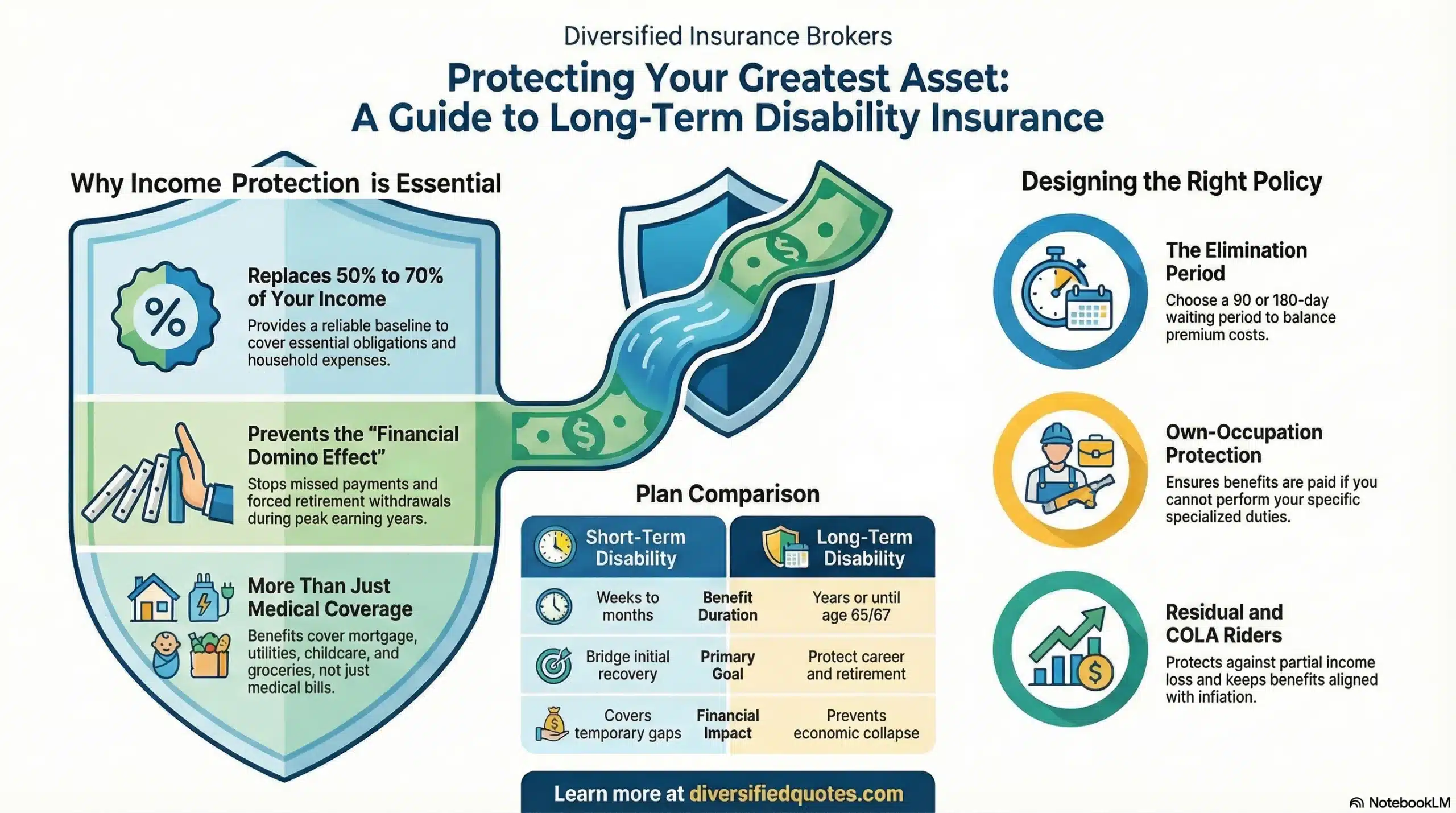
High risk disability coverage can include modified but meaningful monthly benefits, graded structures that improve over time, and riders that allow future increases as income rises. In some cases, exclusions may be reconsidered after claim-free periods or documented health improvements. The key is working with a brokerage that understands underwriting nuance rather than relying on a single carrier.
If you are comparing personal protection options alongside employer-sponsored benefits, it is equally important to understand structural differences—similar to evaluating group vs individual life insurance. Employer disability coverage is often limited, taxable, or non-portable. Individual policies offer stronger contractual definitions and portability, especially critical for higher-risk professionals whose employment circumstances may change.
High risk disability insurance is not about forcing coverage where it does not belong. It is about accurately assessing risk and aligning it with carriers equipped to manage it. With proper documentation, transparent medical disclosure, and precise occupational classification, many applicants discover coverage is far more attainable than they expected.
Start Your Disability Insurance Quote
Coverage may be achievable—even if you’ve been declined before.
Begin Your Quote RequestA diagnosis, occupation, or past underwriting outcome does not define your insurability. High risk disability insurance exists precisely because real life does not fit neatly inside rigid underwriting boxes. With strategic carrier matching, detailed financial documentation, and experienced positioning, meaningful income protection is often available—even in complex cases.
Related High-Risk & Protection Planning Guides
Talk With an Advisor Today
Choose how you’d like to connect—call or message us, then book a time that works for you.
Schedule here:
calendly.com/jason-dibcompanies/diversified-quotes
Licensed in all 50 states • Fiduciary, family-owned since 1980
FAQs: High Risk Disability Insurance
What makes an occupation “high risk” for disability insurance?
High-risk occupations face elevated chances of injury, physical strain, or hazardous work environments. This includes first responders, construction trades, and certain transportation roles. These factors increase the likelihood of claims and influence underwriting.
Can people in high-risk jobs still get disability insurance?
Yes. Many insurers offer specialized policies tailored to hazardous occupations. Coverage may differ in price, benefit periods, or exclusions, but most applicants can secure meaningful protection.
Will my occupation affect the premium?
Yes. Jobs with higher risk classifications generally pay higher premiums. Carriers analyze duties, equipment used, and exposure to physical danger when determining pricing.
Are certain injuries excluded for high-risk workers?
Depending on your role, an insurer may apply occupation-specific exclusions, such as back injuries or aviation-related risks. Reviewing limitations carefully is essential before accepting coverage.
Can high-risk workers still qualify for own-occupation coverage?
Some carriers offer own-occupation definitions for select high-risk roles, but availability varies. Specialized markets may provide modified versions based on your duties and income level.
Is a medical exam required?
Most high-risk applicants undergo full underwriting, including medical history, build, and lifestyle review. Some simplified-issue options exist, but benefits are often more limited.
Do first responders get access to specialized plans?
Yes. Many insurers have dedicated programs for police, firefighters, and EMTs. You can review examples such as disability coverage for firefighters to see how benefits differ.
Will hazardous hobbies affect my disability coverage?
Yes. Activities like racing, scuba diving, or mountaineering may result in exclusions or adjusted premiums, even if your occupation is the primary risk factor.
How long are benefit periods for high-risk disability policies?
Benefit periods typically range from two years to age 65. Some high-risk occupations may have shorter maximums depending on underwriting guidelines.
Who is high-risk disability insurance best suited for?
This coverage is ideal for individuals whose income would be hard to replace due to physically demanding or dangerous work—such as law enforcement, construction, or technical rescue roles. Many find it comparable to the considerations outlined in disability insurance for law enforcement professionals.
About the Author:
Jason Stolz, CLTC, CRPC and Chief Underwriter at Diversified Insurance Brokers, is a senior insurance and retirement professional with more than two decades of real-world experience helping individuals, families, and business owners protect their income, assets, and long-term financial stability. As a long-time partner of the nationally licensed independent agency Diversified Insurance Brokers, Jason provides trusted guidance across multiple specialties—including fixed and indexed annuities, long-term care planning, personal and business disability insurance, life insurance solutions, and short-term health coverage. Diversified Insurance Brokers maintains active contracts with over 100 highly rated insurance carriers, ensuring clients have access to a broad and competitive marketplace.
His practical, education-first approach has earned recognition in publications such as VoyageATL, highlighting his commitment to financial clarity and client-focused planning. Drawing on deep product knowledge and years of hands-on field experience, Jason helps clients evaluate carriers, compare strategies, and build retirement and protection plans that are both secure and cost-efficient.
