
How Much Disability Insurance Do I Need

Jason Stolz CLTC, CRPC
How much disability insurance do I need? If you rely on your income to run your household, keep your financial plan on track, and protect the lifestyle you’ve built, this is one of the most practical questions you can ask. Disability insurance is often best understood as income insurance—its purpose is to replace a portion of your earnings if an illness or injury prevents you from working, reduces your capacity, or causes a meaningful income loss for an extended period of time.
Most people underestimate how quickly an income interruption becomes a long-term financial problem. A short disruption can create missed payments, debt accumulation, and stress. A longer disruption can force unwanted decisions—selling investments at the wrong time, draining retirement accounts, abandoning business plans, or returning to work earlier than your health realistically supports. When you size disability coverage correctly, you’re not trying to “profit” from a claim. You’re trying to preserve stability so your family can keep living, saving, and planning—even while you recover.
For many working adults, the risk of being unable to work for months or years is far more likely than an early death during peak earning years. That’s why disability coverage is often viewed as a foundational protection tool. If your income suddenly stopped for six months, two years, or longer, your savings would have to carry the entire load unless you had a solid disability insurance strategy in place.
High earners, business owners, and key professionals often need more sophisticated disability planning because the “distance” between their actual lifestyle and the benefit cap on typical coverage is large. If you want to see how deeply a disability can affect income, retirement momentum, and long-term lifestyle decisions, review the executive-focused discussion at disability insurance for executives. The concepts are relevant even if you don’t consider yourself an “executive”—anyone with performance-based income, high fixed expenses, or a specialized career can face the same exposure.
Estimate the Right Disability Benefit for Your Situation
Share your income, existing coverage, and priorities. We’ll help you identify the benefit target that actually protects your lifestyle.
What Disability Insurance Actually Protects
Disability insurance protects your ability to fund your life. That sounds obvious, but it’s easy to miss what’s really at stake until you map your income to your monthly obligations. Your paycheck does more than pay bills. It maintains housing stability, funds healthcare, supports family responsibilities, powers retirement savings, and creates options. When income stops, your options shrink fast.
Most people start with a simple question: “Can I pay my bills if I’m disabled?” That’s a good starting point, but it’s not the full picture. A more useful question is: “If my income drops for 12–24 months (or longer), what financial decisions would I be forced to make that permanently change my future?” That’s where disability coverage becomes the difference between a hard season and a long-term setback.
Instead of thinking in a generic list, think in categories. Housing is usually the largest fixed cost (mortgage, rent, property taxes, insurance, utilities). Healthcare costs often rise during a disability (premiums, deductibles, medications, therapy). Debt obligations don’t pause just because your income does (student loans, auto loans, revolving balances, business obligations). And then there’s the “invisible damage” category: missed retirement contributions, paused investing, and the loss of compounding that never comes back.
When you ask, “How much disability insurance do I need?” you’re really asking: “How much of this structure do I need to keep intact if I can’t work the way I work today?”
Start With the Two Numbers That Matter Most
Most people get stuck because they try to calculate an exact benefit amount first. A better approach is to establish two numbers and then build from there:
Number 1: Your minimum required monthly lifestyle cost. This is the “keep the house running” number. It covers housing, utilities, food, insurance, transportation, basic family obligations, and minimum debt payments. If you’re disabled, this is the threshold you need to avoid immediate crisis.
Number 2: Your desired stability number. This is the “keep our plan intact” number. It includes the minimum required costs, plus the items that prevent long-term damage—maintaining savings habits, preserving certain retirement contributions, covering healthcare surprises, and reducing the likelihood you’ll have to liquidate long-term investments under pressure.
If you’re not sure which number to use, many households choose a disability target that keeps them close to their current monthly spending level, then adjust based on existing coverage and what the market will reasonably allow. The ideal target is usually not “the maximum you can buy.” It’s “the amount that keeps you stable without overpaying for benefits you won’t realistically need.”
How Much Disability Insurance Do I Need as a Percentage of Income?
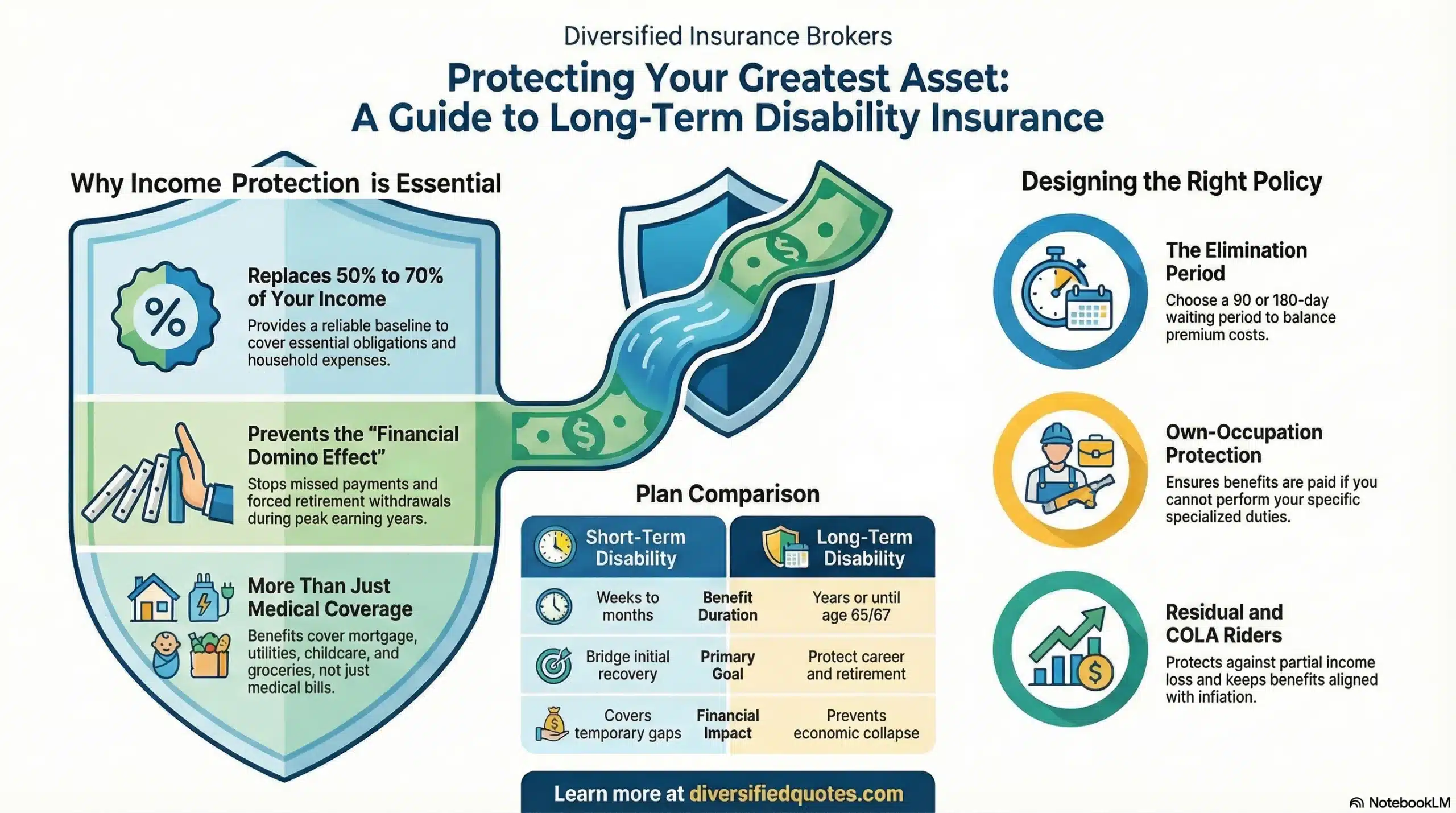
Most individual disability insurance policies are designed to replace a portion of your income—often around half to roughly two-thirds of earnings—because disability insurance is built to maintain stability without removing the financial incentive to return to work when you are able. But percentage-based thinking can be misleading unless you translate it into your actual after-tax lifestyle.
Here’s why: two people earning the same salary can have completely different “need” profiles based on taxes, debt, savings habits, and household structure. A professional earning $200,000 with a large mortgage, childcare, and aggressive retirement contributions may need a higher “stability number” than someone earning $200,000 with no debt, a paid-off home, and a spouse with strong income. Percentage is a useful starting point, but it’s not the finish line.
Also, disability benefits are often structured so that when you pay premiums personally (with after-tax dollars), benefits are generally received tax-free. That means a lower benefit amount can sometimes preserve a surprisingly similar spendable lifestyle compared to your gross income. The right way to evaluate “percentage” is to convert it to spendable cash flow and compare it to your two baseline numbers: minimum required and desired stability.
If you want a simple framework without overcomplicating the math, use this three-step approach:
Step 1: Identify your monthly spending reality. Look at what actually leaves your account each month. That number often matters more than your salary because it reflects your real lifestyle cost.
Step 2: Identify what would truly change during a disability. Some costs might decrease (commuting, business travel, professional dues). Others might increase (medical costs, home support, therapy, medications). Most people assume expenses go down; many discover they don’t.
Step 3: Choose the lifestyle outcome you want. Some people want “survival coverage.” Others want “stability coverage.” The right answer depends on your assets, risk tolerance, household structure, and the role your income plays in long-term plans.
Why “Partial Disability” Often Determines the Right Benefit Amount
Most people picture disability as an all-or-nothing event: either you can work or you can’t. In reality, many claims are capacity claims. You may work fewer hours. You may be able to do some duties but not others. You may return but at reduced production, reduced travel, or reduced stamina. That often results in a meaningful income loss even when you’re technically still employed or still “working.”
This matters because your benefit amount isn’t only about total disability. It’s also about whether your policy design will actually protect you in the more common scenario: partial income loss. Professionals in production-driven careers—sales, consulting, law, medicine, executive leadership—are especially exposed to this. If reduced capacity means reduced bonuses, reduced billable hours, or reduced performance-based compensation, the “right amount” of coverage is the amount that closes the gap between your reduced earnings and your stability number.
That’s why benefit design and rider selection matter alongside the monthly benefit. A smaller monthly benefit paired with strong residual/partial disability provisions can sometimes protect you better than a larger benefit with weak partial disability language. When you size coverage, you’re sizing the benefit and the scenario under which it pays.
How Much Disability Insurance Do I Need if I’m a Professional?
Licensed and highly trained professionals often need a benefit target that protects more than “a paycheck.” Your income is often tied to a narrow set of duties—clinical work, surgical procedures, trial work, complex analysis, executive leadership, or specialized production. If a condition prevents you from performing your core duties, even if you can still “work,” your income can change dramatically.
Healthcare is a clear example. If you work in medicine, your ability to practice can be affected by physical limitations, fine motor impairment, or even cognitive stamina issues. If you want profession-specific context, review disability income insurance for doctors and physicians and disability income insurance for nurses. Even small limitations can create big income changes, which means your “needed” benefit is often higher than someone in a role with more flexible duties.
Attorneys often experience the same issue from a different angle. Billable hours, trial readiness, concentration, and stress tolerance can determine earning ability. A partial limitation can reduce output for months, and those months can alter client retention and partnership tracks. If that resonates, see disability income insurance for attorneys for how disability definitions and partial disability provisions become critical in practice.
In all of these cases, you’re usually not asking whether you need disability insurance. You’re asking how much and what type will preserve your specialized earning power if your capacity changes. That’s exactly what proper benefit sizing is meant to solve.
Short-Term vs Long-Term: How the Time Horizon Changes the Answer
When people ask how much coverage they need, they’re usually thinking about a short recovery window—surgery, a severe illness, a serious injury. But the financial damage often comes from the long-duration event: a chronic condition, a complication, a multi-year recovery, or a permanent impairment that changes career trajectory. A well-sized disability strategy should be built around the scenario that creates the most permanent financial consequences.
Short-term disability is designed to cover shorter disruptions and typically has shorter benefit periods. Long-term disability is designed to protect against extended or permanent loss of income and often includes benefit durations that align with career timelines and retirement planning. If your plan is “I can handle 30–90 days with savings,” that can be true—and still not solve the risk of a multi-year disruption.
For many households, the “right amount” of disability insurance is not determined by whether you can survive a short gap. It’s determined by whether you can survive the long gap without destroying the plan you’ve built. That’s why benefit period selection matters just as much as the monthly benefit itself.
Design Choices That Change How Much Disability Insurance You Need
Two people can buy the same monthly benefit and end up with completely different real-world protection. Why? Because disability insurance is contract-driven. Definitions and design features determine whether benefits pay in the scenarios that actually occur. When you size coverage, you should size it in context of these design choices.
1) Own-Occupation vs Any-Occupation
If you have specialized work, the definition of disability can determine whether your “coverage” is real or mostly theoretical. Own-occupation style definitions are designed to pay if you cannot perform the material and substantial duties of your own occupation, even if you can work in another role. That can matter for professionals who can technically work, but not at the same income level or not in the same specialized role that created their earning power.
If you want a deep breakdown of why this matters in plain language, review own-occupation disability insurance. In practical terms, the stronger the own-occupation language, the more confident you can be that your benefit amount will actually protect your lifestyle if your specialized duties are impacted.
2) Elimination Period (Waiting Period)
The elimination period is how long you must be disabled before benefits begin—often 60, 90, 120, or 180 days. This decision changes your “need” because it determines how much cash you must self-fund before the policy becomes your paycheck. A longer elimination period can reduce premium cost, but it increases the importance of emergency reserves, short-term benefits, or household flexibility.
When you decide how much disability insurance you need, you should also decide how long you can cover your stability number without the policy. If you can realistically self-fund for 90–180 days, you may be able to structure the policy to focus on the long-duration risk (the risk that causes permanent financial change). If you cannot self-fund, a shorter elimination period can be more appropriate—even if it costs more.
3) Benefit Period
The benefit period is the maximum length of time benefits can be paid while you remain disabled. Some policies are designed for shorter periods (two years, five years, ten years). Others are designed to align with planned retirement ages. Benefit period selection changes how much you need because it changes the scenario you’re protecting. Short benefit periods can be helpful as a bridge. Longer benefit periods protect against career-altering events.
If you’re in your prime earning years, the risk is not a short interruption. It’s a long interruption that permanently changes your income path. That’s why many people prioritize a meaningful benefit period and then right-size the monthly benefit to fit budget and underwriting realities.
4) Residual / Partial Disability Protection
Partial disability is often where real-world protection is won or lost. If you can work in a limited capacity but experience a measurable income loss due to illness or injury, residual benefits can provide a proportional benefit. This is a major factor in the “how much do I need” question because a benefit that only pays for total disability may not protect the more common “reduced output” scenario.
For many professionals, the most financially relevant claim is not “I can’t work at all.” It’s “I can work, but I can’t produce at my prior level for a long time.” If your policy design supports that scenario, you may not need to buy the maximum monthly benefit to stay stable. If your design does not support that scenario, even a large benefit may not solve your real risk.
How Much Disability Insurance Do I Need if I Already Have Group Coverage?
Employer-provided long-term disability coverage is common, but it often does not protect high earners as well as they expect. Group plans may replace a percentage of income, but they often cap the maximum monthly benefit. They may also exclude bonuses, commissions, or other variable compensation. Some group plans have definitions that are less favorable than strong individual policies, and benefits can be taxable if the employer pays premiums.
To decide how much additional coverage you need, don’t start with the “percentage” listed in the benefits booklet. Start with the net cash flow you’d actually receive during a claim and compare it to your two baseline numbers: minimum required and desired stability. If group coverage covers the minimum required number but not the stability number, individual coverage can be structured as the gap filler. If group coverage doesn’t even cover the minimum required number after taxes and caps, individual coverage becomes more urgent.
Also, review how long group benefits can last and how the plan defines disability after a certain period (some plans shift to a stricter definition). These details determine whether group coverage is a helpful foundation or a plan that creates false confidence.
How Much Disability Insurance Do I Need if My Income Is Variable?
Many people with the greatest need for disability insurance are the ones whose income is hardest to insure: commission earners, business owners, partners, and professionals whose income changes year to year. Variable income can be protected, but the way it’s documented matters. Carriers often look at multi-year averages, tax returns, and income stability trends to determine insurable benefit limits.
This means your “need” might be higher than what’s immediately insurable, especially if you’ve had a recent income increase. In those cases, the strategy is often to secure the maximum available now with policy provisions that allow growth later, then review and increase coverage as income documentation supports it.
If your income is tied to long-term wealth-building strategy—investing, tax planning, and disciplined saving—disability becomes more than a paycheck problem. It becomes a compounding problem. That’s why some people also evaluate broader wealth-behavior concepts like how the wealthy stay wealthy as part of framing the goal: protect the income engine so the long-term plan doesn’t collapse under stress.
How Much Disability Insurance Do I Need as My Income Grows?
If you expect your income to rise through promotions, business growth, partnership tracks, or expanding production, you should assume your disability need will rise too. Many people buy a policy once and never revisit it, even though their income doubles over time. That creates a growing protection gap—your lifestyle expands, your obligations increase, your retirement contributions rise, but your disability benefit stays fixed.
The best way to prevent this is to build a plan that can evolve. Some policies include options that allow benefit increases as income rises (subject to program rules). In other cases, you may add coverage layers over time. The correct strategy depends on your age, health, income stability, and underwriting approach.
If you’re integrating disability protection with a broader tax strategy and long-term compounding goals, it can also help to understand how long-term tax strategy impacts wealth over decades—see how tax deferral creates generational compounding. The connection is simple: disability risk can interrupt the very contributions that make compounding work. Benefit sizing is partially about ensuring you can keep the long-term strategy intact.
Practical Case Examples: What “The Right Amount” Looks Like
Example 1: Mid-career professional with rising income. A 38-year-old professional earns a strong salary with bonuses and contributes aggressively to retirement accounts. Their minimum required monthly number is manageable, but their stability number includes continued retirement contributions and avoiding liquidation of investments. The “right amount” of disability coverage is not just enough to pay the mortgage—it’s enough to keep them from pausing the plan for multiple years. In this scenario, benefit sizing tends to favor strong residual benefits and a benefit period aligned with career timeline.
Example 2: High fixed-cost household. A household with a large mortgage, childcare, and high monthly commitments may need a higher stability number because they have less room to “cut expenses” without major life disruption. For this profile, the right amount is often the amount that prevents forced decisions—selling a home, pulling kids out of school, or draining savings quickly—during a 12–24 month disruption.
Example 3: Near-retirement professional. A 58-year-old professional still earning strong income may not need a benefit period to age 67 if the main goal is protecting the transition into retirement and preventing early withdrawals. In this case, “the right amount” is often a bridge benefit that preserves timing and prevents damaging portfolio decisions. The target is still based on the stability number, but the time horizon is different.
These examples show why benefit sizing is personal. The best answer is the one that protects the decisions you care about most: keeping housing stable, preserving retirement momentum, protecting family obligations, and avoiding forced liquidation of long-term investments.
Putting It All Together: A Clean Framework
Here is a practical way to turn “How much disability insurance do I need?” into an actionable decision:
1) Establish your minimum required number and your desired stability number. The first protects survival. The second protects the plan.
2) Identify what coverage you already have. Group LTD, union coverage, employer benefits, or existing individual coverage. Translate it into net, spendable income during a claim.
3) Decide the gap you need to fill. If your goal is to preserve the plan, size the gap to your stability number, not your minimum required number.
4) Choose the design that matches your real claim scenario. Own-occupation language for specialized work, residual/partial benefits for capacity claims, and a waiting period you can realistically self-fund.
5) Plan for growth and review periodically. As income rises, revisit coverage so the gap doesn’t quietly widen over time.
The goal is simple: if you can’t work, your family can stay stable, keep your long-term plan intact, and avoid the cascade of forced financial decisions that can permanently change your future.
Find Out What Benefit Level Actually Protects Your Lifestyle
We’ll help you compare your real monthly need against what your current coverage would actually pay—then identify the gap.
Financial Protection Essentials
Accident coverage, retirement timing strategy, legal funding education, and advanced life insurance planning resources.
Talk With an Advisor Today
Choose how you’d like to connect—call or message us, then book a time that works for you.
Schedule here:
calendly.com/jason-dibcompanies/diversified-quotes
Licensed in all 50 states • Fiduciary, family-owned since 1980
FAQs: How Much Disability Insurance Do I Need?
Is there a standard amount of disability insurance everyone should have?
No. The right amount of disability insurance depends on your income, monthly expenses, existing coverage, and how much of your lifestyle you want to protect if you cannot work.
How much of my income should disability insurance replace?
Many people aim to replace enough income to cover essential expenses and maintain a reasonable standard of living. The exact percentage varies, but the goal is to avoid draining savings or selling long-term investments.
Do I still need disability insurance if I have coverage through work?
Often yes. Employer coverage may be limited by benefit caps, taxable benefits, or weaker policy definitions. A private policy can help you reach a total benefit level that more accurately reflects your income and needs.
How does my occupation affect how much disability insurance I need?
Specialized or higher-risk occupations often justify stronger coverage and better policy definitions, especially if your income depends on specific skills or credentials that could be lost due to an injury or illness.
What is the difference between short-term and long-term disability insurance?
Short-term disability insurance covers shorter interruptions in income, while long-term disability insurance is designed for extended or permanent disabilities that can last years or even to retirement age.
How do elimination periods affect how much disability insurance I need?
A longer elimination period lowers premiums but requires more savings to cover expenses before benefits begin. Your emergency fund and risk tolerance will influence which waiting period makes sense.
How often should I review my disability insurance amount?
You should review your disability coverage whenever your income, debts, or lifestyle change significantly, and periodically as you move closer to retirement.
Can I increase my disability insurance later as my income grows?
Many policies allow increases in coverage over time, often with additional underwriting or specific riders. It is important to ask about future increase options when you first set up your policy.
About the Author:
Jason Stolz, CLTC, CRPC and Chief Underwriter at Diversified Insurance Brokers (NPN 20471358), is a senior insurance and retirement professional with more than two decades of real-world experience helping individuals, families, and business owners protect their income, assets, and long-term financial stability. As a long-time partner of the nationally licensed independent agency Diversified Insurance Brokers, Jason provides trusted guidance across multiple specialties—including fixed and indexed annuities, long-term care planning, personal and business disability insurance, life insurance solutions, Group Health, and short-term health coverage. Diversified Insurance Brokers maintains active contracts with over 100 highly rated insurance carriers, ensuring clients have access to a broad and competitive marketplace.
His practical, education-first approach has earned recognition in publications such as VoyageATL, highlighting his commitment to financial clarity and client-focused planning. Drawing on deep product knowledge and years of hands-on field experience, Jason helps clients evaluate carriers, compare strategies, and build retirement and protection plans that are both secure and cost-efficient. Visitors who want to explore current annuity rates and compare options across multiple insurers can also use this annuity quote and comparison tool.
