
Hybrid Life Insurance with Long Term Care Benefits

Jason Stolz CLTC, CRPC
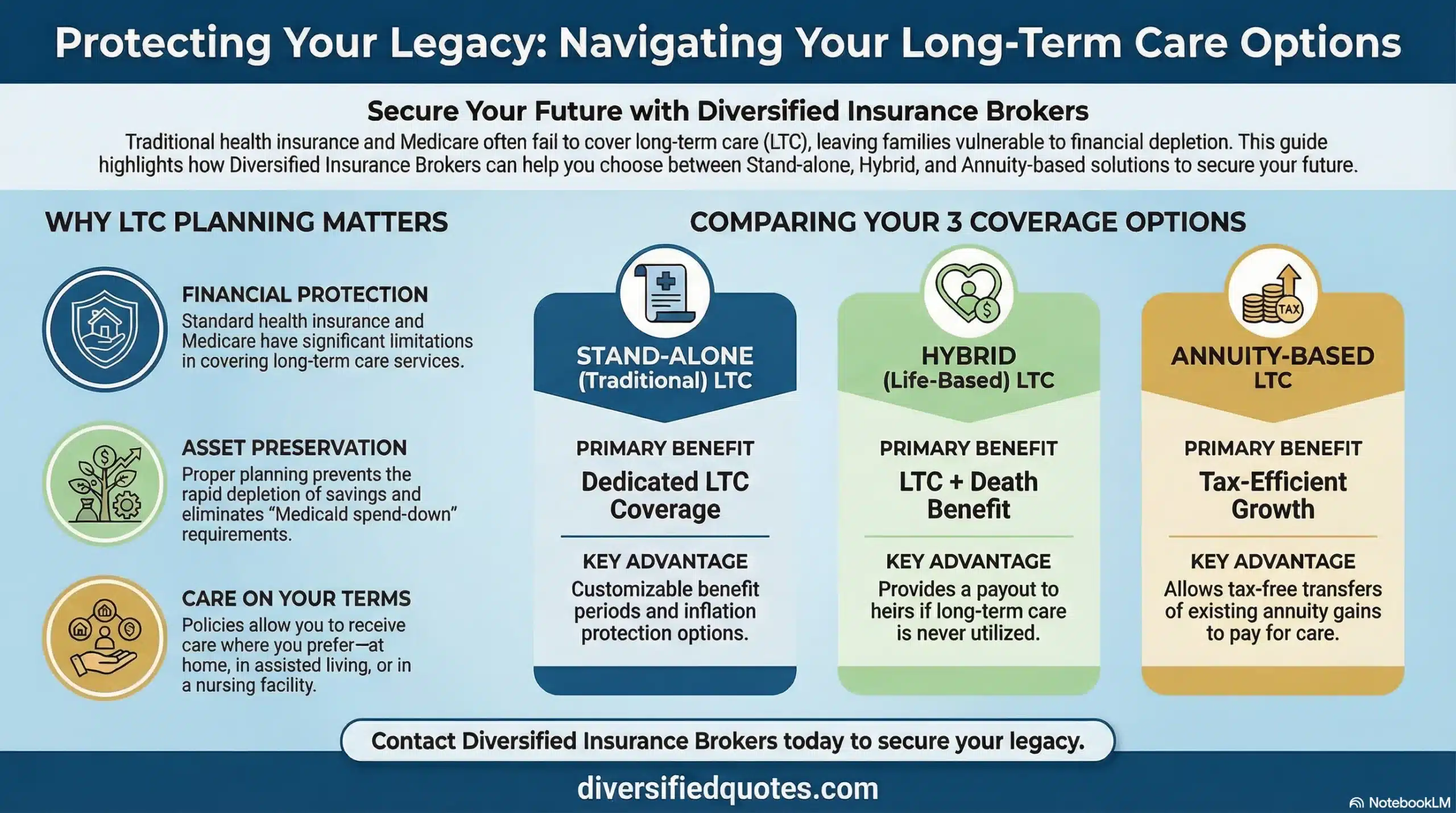
A hybrid life insurance and long term care (LTC) policy (often called a linked-benefit policy) is designed for one core goal: create a plan where your money does something useful no matter what happens. If you need long-term care later in life, the policy can provide benefits to help pay for care. If you never need care, your beneficiaries receive a life insurance death benefit. Many designs also include surrender value and optional return-of-premium flexibility, which can make hybrid long-term care planning feel less like a “cost” and more like an asset-based strategy.
Families usually explore hybrid life + LTC coverage when they want long-term care protection but do not like the idea of paying premiums for decades and potentially never using the coverage. Others are drawn to hybrid policies because many designs offer premium guarantees and limited-pay funding options. Instead of committing to lifetime premiums, some people prefer a single premium or a 5-pay/10-pay approach that funds the plan on a predictable timeline. When the funding is complete, the benefits remain in place and the long-term care protection is still there if it is ever needed.
At Diversified Insurance Brokers, we help clients compare hybrid life + LTC policy designs side-by-side with other long-term care strategies. The most important part is not the product label. The most important part is how the plan behaves in real life: what triggers benefits, how much the policy can pay each month, how long benefits can last, what care settings are included, and what happens to the life insurance death benefit if you use the long-term care portion.
Get a Hybrid Life + LTC Quote
Compare linked-benefit designs, benefit pools, elimination periods, and inflation options based on your age and health.
What a Hybrid Life + LTC Policy Really Is
Hybrid life insurance with long-term care benefits is typically built on a permanent life insurance foundation. The long-term care portion is usually provided through a rider or linked-benefit structure that allows the policy to pay benefits when care is needed. The policy is designed so that long-term care benefits are available while you are living, and if you never need care, the death benefit remains available for beneficiaries.
Many people assume hybrid policies are complicated, but the core idea is simple: the policy has a pool of value that can be used for care benefits or paid as a death benefit. The difference between carriers and policy designs is in the details. Some policies “accelerate” the death benefit to pay for care, meaning the death benefit decreases as benefits are paid. Other designs provide an extension of benefits that can increase total long-term care dollars available beyond the base death benefit. Some designs pay as reimbursement (you submit bills and get reimbursed up to the monthly limit). Others pay as indemnity (a set monthly amount once you qualify), which can be useful for families paying informal caregivers or mixing multiple care arrangements.
The goal is to match the plan to your care philosophy. Some families want to remain at home as long as possible, prioritizing home health care and caregiver support. Others want a plan that includes strong assisted living and memory care benefits. A hybrid policy can often support multiple care settings, but how those settings are defined and covered matters. This is why comparing contracts side-by-side is important.
How Benefits Are Triggered
Hybrid LTC benefits typically require a qualifying event, often aligned with common long-term care definitions such as needing help with activities of daily living or experiencing cognitive impairment. This is the “gate” that determines when benefits can begin. In most real-world claims, the trigger is not a single doctor visit. It is usually a progression where a person gradually needs help with bathing, dressing, transferring, toileting, eating, or continence, or where memory impairment creates safety concerns.
It is also common for policies to have some form of elimination period or waiting period before benefits are paid. In a reimbursement design, the elimination period can feel like a deductible measured in days. In an indemnity design, the elimination period may be a waiting window before the monthly benefit begins. The practical planning question is simple: how will you cover the first weeks or months of care if needed, and what level of monthly benefit do you want once the policy is paying?
Many families compare elimination period structures alongside broader planning resources like our guide on LTC elimination periods to understand the tradeoffs between premium cost and how quickly benefits can start.
Funding Options: Single Pay, Limited Pay, and Ongoing Premium
One of the most practical reasons families choose a hybrid approach is funding flexibility. Traditional long-term care insurance is often structured with ongoing premiums. Some people prefer that, because it can start at a lower out-of-pocket cost and feel like a normal insurance payment. Hybrid designs frequently offer more options, including single-pay and limited-pay structures, and many clients prefer those because the funding timeline is known.
A single-pay hybrid policy is often funded by repositioning a portion of cash reserves. Some clients think of this as “turning a conservative bucket into a care-and-legacy bucket.” A 5-pay or 10-pay structure can offer similar benefits while spreading funding over a shorter timeframe. For many households, the main appeal is predictability: once the funding is complete, the plan is simply there, ready to be used if needed.
From a planning standpoint, the right funding style often depends on retirement timeline, how you prefer to manage liquidity, and whether you want the policy to be “paid up” before retirement. This is also why many clients compare hybrid strategies alongside broader long-term care planning strategies to ensure the solution fits the full retirement picture.
What Happens If You Never Use Long-Term Care Benefits?
This is the emotional center of the hybrid conversation. With traditional long-term care insurance, the best-case scenario is you never need care, but financially that can feel like “nothing happened.” Hybrid policies are designed so that if you never use long-term care benefits, the life insurance death benefit is still there for beneficiaries. For many families, that changes the psychological comfort level of long-term care planning. The plan is no longer purely about transferring risk. It is about allocating resources to a contract that can benefit the policyowner or the family either way.
Some hybrid designs include return-of-premium or cash-surrender features that allow you to exit the policy and recover a portion of the funding, depending on policy terms and timing. That does not mean the policy is a savings account, and it does not mean surrender value is always equal to premiums paid. But for many clients, having the option to pivot later is meaningful.
How Hybrid Life + LTC Compares to Traditional LTC Insurance
Traditional long-term care insurance is typically the most efficient way to buy pure long-term care coverage. In many cases, it can provide more long-term care benefit per premium dollar if you end up using the coverage. Traditional policies are also highly customizable. You can often fine-tune monthly benefit amount, benefit period, elimination period, and inflation protection in a very granular way. That customization can be especially helpful for couples, particularly when paired with designs such as shared spousal benefits.
Hybrid policies tend to shine when a family wants value even if care is never used, wants funding predictability, or prefers limited-pay options. When clients ask which is “better,” the most honest answer is that the better plan is the one that actually gets implemented and maintained. Some families will not buy traditional long-term care insurance because they do not like the “use it or lose it” structure. For those families, a hybrid approach can be a way to get meaningful long-term care protection that they would otherwise avoid entirely.
If you are comparing both approaches in detail, it can help to review broader long-term care frameworks through our Long Term Care Insurance resource hub.
Hybrid Life + LTC vs Annuity-Based LTC Strategies
Some clients also compare hybrid life/LTC policies with annuity-based long-term care riders. The planning reason is similar: reposition assets to create a long-term care benefit pool. With annuity-based strategies, the client often keeps access to account value and the policy can provide a multiplier for long-term care benefits if qualifying triggers occur. These strategies can be attractive when a client already has an annuity or wants a structure that emphasizes account value continuity.
Hybrid life/LTC policies typically emphasize a life insurance death benefit if care is never used. Annuity-based strategies often emphasize account value or beneficiary payout behavior. Both can be effective, but the right choice depends on the family’s goals, how they want benefits paid, and what legacy planning looks like.
Care Settings: Home Care, Assisted Living, Memory Care, Nursing Facilities
Many families assume “long-term care” means a nursing home. In reality, most care journeys include multiple stages, and many people prefer to stay at home as long as possible. A strong hybrid policy design should align with that reality. This is why it matters whether a policy provides robust home care benefits, whether it covers caregiver services, how it addresses assisted living, and whether memory care is treated differently.
When families plan for assisted living, they often want to understand how policy benefits coordinate with the first 60–90 days of care and what costs look like in that environment. A helpful complementary resource is the comparison framework in LTC vs assisted living planning discussions.
Inflation Protection: The Quiet Driver of Long-Term Adequacy
Inflation protection is one of the most important long-term care planning decisions because care costs tend to rise over time. A policy that looks “big enough” today may not look big enough 15 years from now if benefits do not increase. Hybrid policies may offer inflation riders, but the menu of options can vary. Some traditional LTC designs offer more flexible inflation structures, while some hybrid designs bundle inflation in specific ways.
For buyers earlier in the planning window, inflation can be the difference between a policy that meaningfully supports the care plan and a policy that provides partial help. For buyers later in life, inflation may still matter, but the cost-to-benefit tradeoff is different. The right approach usually comes from modeling: compare a few inflation structures and see how the premium and future benefit pool changes.
Underwriting and Approval: What Typically Matters
Hybrid policies are still underwritten products. Approval depends on health history, medications, stability of chronic conditions, cognitive history, and functional independence. Some clients find hybrid underwriting more forgiving than traditional LTC underwriting, while others find the reverse. The truth is that underwriting varies by carrier and by product. A practical approach is to pre-screen and then run side-by-side comparisons based on realistic approval expectations.
If you are trying to understand broad approval factors, our resource on who qualifies for long-term care insurance provides a useful planning starting point. The goal is to set clear expectations before you invest time and energy into illustrations that may not be realistic.
How Couples Use Hybrid Coverage
Couples often approach long-term care planning differently than individuals because the risk is not just “will one of us need care,” but “how do we protect the household if either of us needs care.” Some couples choose traditional long-term care insurance with shared benefits. Others use hybrid coverage for one spouse and traditional coverage for the other. Some couples choose hybrid coverage for both spouses when they want predictable funding and a legacy component.
The planning advantage of evaluating options as a couple is that you can design benefits that reflect real household priorities: which assets you want to protect, how much monthly cash flow you want to preserve, and how much of the care burden you want to transfer away from family members. Many couples begin with a broad framework such as long-term care insurance for couples and then refine the design once they see actual policy mechanics.
Choosing Monthly Benefit and Benefit Pool Size
Most hybrid long-term care policies have a monthly maximum benefit and a total benefit pool. The monthly limit affects the pace of claims: a higher monthly limit can cover more of the care expense each month, while a lower monthly limit may require more out-of-pocket spending alongside the policy. The total pool affects duration: how long benefits could last if you remain on claim.
The “right” monthly benefit depends on local cost assumptions, care setting preferences, and how much of the cost you want insurance to cover. Some families want coverage designed to pay the majority of expected costs. Others use the policy as a cost-sharing tool that reduces the financial burden and preserves income.
A common planning mistake is choosing benefit levels based on today’s costs without considering inflation or the possibility that care progresses from home care to assisted living to facility care. A more durable approach is to model a staged journey and decide how much the policy should contribute at each stage.
Where Hybrid Policies Fit in a Broader Strategy
Long-term care planning is rarely a standalone decision. It is part of retirement income planning, asset allocation planning, and family contingency planning. Many retirees worry about sequence-of-returns risk, market volatility, and unexpected health costs arriving at the wrong time. Long-term care is one of the few risks that can be both expensive and long-duration, and that combination can put retirement income under stress.
Hybrid policies can be used as a “protect the retirement plan” tool. By creating a separate pool that can fund care, a family can reduce the likelihood of having to liquidate investments at a bad time or disrupt income strategies. Some families coordinate long-term care planning with other insurance planning decisions using broader education resources such as life insurance planning frameworks. The key is that hybrid LTC should not be evaluated only by premium; it should be evaluated by how it changes outcomes for the household.
See Your Hybrid LTC Benefit Options
We’ll compare multiple carrier designs and funding schedules so you can see tradeoffs clearly.
What to Look For When Comparing Illustrations
When clients compare hybrid policy illustrations, the most important step is to compare the same assumptions across carriers. The monthly benefit, benefit pool, inflation structure, elimination period, and payment style should be aligned so the comparison is meaningful. Otherwise, it is easy to compare a “bigger benefit” to a “smaller benefit” and think the premium difference is purely pricing rather than design.
It also matters whether benefits are reimbursement or indemnity. If a client expects to use a mix of paid caregivers and family support, indemnity-style designs can feel more flexible. If a client expects mostly formal care with receipts, reimbursement can work well. Both designs can be effective, but they behave differently, and that difference shows up during a real claim.
Another key detail is what happens after significant LTC use. Does the policy preserve any residual death benefit? Does it provide an extension of benefits after the death benefit is accelerated? Does the policy have any guaranteed minimum payout behavior? These details can matter for families balancing care planning and legacy planning.
When Hybrid LTC Is Often the Right Answer
Hybrid life + LTC tends to be especially attractive when a client wants a single solution that checks multiple boxes: long-term care funding, legacy preservation, premium predictability, and “value no matter what.” It can also be a fit when the client has funds sitting conservatively and wants those dollars to do more than earn modest interest.
Hybrid policies are also common in households where one spouse strongly values the legacy component, or where family dynamics make it important to reduce the financial burden of care without leaving “nothing behind” if care is never needed.
When Another Approach May Be Better
There are also situations where a different strategy may be more effective. If the primary goal is to buy the maximum long-term care coverage for the lowest possible premium, traditional LTC insurance often wins on pure leverage. If liquidity access and account value continuity are the top priorities, annuity-based LTC riders may deserve a closer look. The right answer depends on goals, funding style, and how the household wants the plan to behave in multiple future scenarios.
The best planning approach is to compare the strategies side-by-side using consistent assumptions and then choose the one that best aligns with the household’s priorities.
Build Your Hybrid Life + LTC Plan
See how linked-benefit policies can protect retirement assets and create value even if long-term care is never needed.
Related Long-Term Care Pages
Explore long-term care planning topics that help you compare policy structures, benefit timing, and couple-focused planning.
Related Planning Topics
Use these related topics to compare care settings, couple-focused designs, and broader long-term care planning strategy.
Talk With an Advisor Today
Choose how you’d like to connect—call or message us, then book a time that works for you.
Schedule here:
calendly.com/jason-dibcompanies/diversified-quotes
Licensed in all 50 states • Fiduciary, family-owned since 1980
FAQs: Hybrid Life Insurance With Long-Term Care Benefits
What is a hybrid life insurance and long-term care policy?
A hybrid policy combines permanent life insurance with long-term care benefits. If you qualify for care, the policy can pay monthly benefits to help cover eligible care costs. If you never need care, beneficiaries receive the policy’s death benefit.
How do you qualify to start receiving long-term care benefits?
Most hybrid policies require a qualifying trigger such as needing help with activities of daily living or having cognitive impairment. The specific trigger language and certification requirements vary by carrier and contract.
Do hybrid LTC policies cover home care, assisted living, and memory care?
Many hybrid designs cover multiple care settings, including home care and facility care, but the definitions and requirements matter. It is important to confirm what the policy considers a covered setting and what documentation is required during a claim.
What is the elimination period on a hybrid policy?
An elimination period is a waiting period before benefits begin. Some policies use a day-based structure, and others use a design that functions like a timing window before monthly benefits start. Elimination period options and how they are counted vary by policy.
Are benefits paid as reimbursement or as a fixed monthly benefit?
Some policies reimburse eligible expenses up to a monthly maximum. Others pay an indemnity-style benefit once you qualify, regardless of actual expenses. Each approach can be useful depending on your care plan and how you expect care to be delivered.
What happens to the death benefit if I use long-term care benefits?
If benefits are paid by accelerating the death benefit, the remaining death benefit may decrease as benefits are paid. Some designs offer an extension of benefits or preserve a residual death benefit depending on the contract terms.
Are premiums guaranteed on hybrid life + LTC policies?
Many hybrid designs offer guaranteed premium structures, especially limited-pay or single-pay funding styles. Premium guarantees and policy guarantees are carrier- and contract-specific, so illustrations should be reviewed carefully.
What funding options are available?
Many hybrid policies can be funded with a single premium, a limited-pay schedule (such as 5-pay or 10-pay), or ongoing premium payments. Funding style changes both the cash-flow experience and how families budget the plan.
Can a hybrid policy be used as part of couple planning?
Yes. Some couples use hybrid coverage for one spouse and traditional LTC insurance for the other, or they choose hybrid coverage for both when they want predictable funding and a legacy component. The best structure depends on household goals and budget.
Can I use existing policy values to fund a new hybrid plan?
In many cases, policyowners can explore funding via a 1035 exchange from certain existing life insurance policies or annuities, depending on product rules and carrier availability. A side-by-side comparison helps confirm whether that approach improves outcomes.
About the Author:
Jason Stolz, CLTC, CRPC and Chief Underwriter at Diversified Insurance Brokers (NPN 20471358), is a senior insurance and retirement professional with more than two decades of real-world experience helping individuals, families, and business owners protect their income, assets, and long-term financial stability. As a long-time partner of the nationally licensed independent agency Diversified Insurance Brokers, Jason provides trusted guidance across multiple specialties—including fixed and indexed annuities, long-term care planning, personal and business disability insurance, life insurance solutions, Group Health, and short-term health coverage. Diversified Insurance Brokers maintains active contracts with over 100 highly rated insurance carriers, ensuring clients have access to a broad and competitive marketplace.
His practical, education-first approach has earned recognition in publications such as VoyageATL, highlighting his commitment to financial clarity and client-focused planning. Drawing on deep product knowledge and years of hands-on field experience, Jason helps clients evaluate carriers, compare strategies, and build retirement and protection plans that are both secure and cost-efficient. Visitors who want to explore current annuity rates and compare options across multiple insurers can also use this annuity quote and comparison tool.
