
Key Person Disability Insurance

Jason Stolz CLTC, CRPC
Key Person Disability Insurance is designed to protect a business when a critical owner, rainmaker, or essential employee becomes disabled and cannot work. Most companies understand key person life insurance, but disability can be even more disruptive because the person is still alive—yet productivity, sales, and leadership can drop immediately. The business may face lost revenue, delayed projects, customer churn, training costs, and cash-flow strain at the exact time the organization needs stability.
In practical terms, key person disability planning is about reducing “single-point-of-failure” risk. If one individual is responsible for a meaningful share of revenue, client relationships, technical execution, or leadership decisions, the company has a concentrated vulnerability. That vulnerability may not show up in a normal month—because everything is fine—yet it can become painfully obvious if that person can’t work for 90 days, 6 months, or longer. Key person disability insurance exists to turn an unpredictable, high-stress scenario into a more manageable financial and operational plan.
At Diversified Insurance Brokers, we help business owners build disability strategies that protect both the people and the company. That includes personal income protection, business expense coverage, and key-person planning that keeps your operation resilient when the unexpected happens. If you want a broader overview of disability protection first, start here: Disability Insurance.
Request a Key Person Disability Quote
Tell us who your “key person” is and what financial impact a disability would create. We’ll compare options and build a practical plan.
Independent shopping • Business-owner focused • Licensed nationwide
What “Key Person” Means in Disability Planning
A “key person” is anyone whose absence would cause a meaningful financial hit to the business. Sometimes that’s the founder or managing partner. Sometimes it’s a partner who drives revenue and holds the major client relationships. In other cases, it’s a top producer, a lead surgeon in a practice, a principal engineer, a project manager who keeps delivery on track, a contractor who handles critical field work, or the operations manager who keeps the entire machine running.
Key person disability planning starts with a simple question: If this person couldn’t work for 6–24 months, what breaks? Revenue may drop, but costs often stay the same. Clients may pause work or leave. Deadlines slip. The company may pay overtime or hire temporary replacements. Leadership time shifts from growth to damage control. The longer the disability lasts, the more likely it is that the financial impact becomes permanent—not because the business didn’t try, but because momentum is hard to rebuild after prolonged instability.
One helpful way to identify a true “key person” is to ignore titles and focus on dependency. Ask: “If this person vanished tomorrow, could we operate at 80% capacity within 30 days?” If the honest answer is no, you’re dealing with key person risk. That risk is common in small and midsize businesses and it’s also common in professional firms where revenue and retention are relationship-driven. If a handful of people drive most of the results, those people represent both your growth engine and your biggest operational vulnerability.
Key Person Disability Insurance vs. Personal Disability Insurance
This is where businesses often get confused. Personal disability insurance is built to replace the insured person’s income so they can pay household bills. Key person disability insurance is built to protect the company from the financial shock created by the disability of a key contributor.
Think of these as different layers of protection that can work together:
Personal Disability Insurance: Helps the individual maintain their lifestyle while they’re out of work. If you want the foundational overview, start here: Disability Insurance. If you want to understand why many professionals treat disability as a must-have, see Why You Need Disability Insurance (Even If You’re Young and Healthy).
Business Overhead Expense (BOE) Insurance: Reimburses fixed operating expenses (rent, utilities, staff payroll, etc.) when an owner is disabled. This is especially common in owner-operated professional practices where overhead continues whether the owner can work or not. Learn more here: Business Overhead Expense Coverage.
Key Person Disability Insurance: Focuses on protecting company cash flow and continuity when a key person can’t perform their role. In many cases, the business owns the policy and the business receives the benefit, which can help stabilize operations, finance a transition, and reduce the chance of long-term damage to valuation.
In real life, many companies combine these layers because one policy rarely solves every problem. If the owner is the key person, personal DI protects the household, BOE protects the operating engine, and key person DI can protect the company’s broader financial continuity and strategic stability. The right answer depends on where your business is most fragile—and which type of disruption would create the biggest second-order consequences.
Why Disability Can Be More Disruptive Than Death
It may sound counterintuitive, but disability can create operational chaos in a way death often doesn’t. With death, there is finality. Businesses activate succession plans, ownership transfers, and staffing replacements. With disability, the situation can drag on for months or years. The person may be partially involved, medically limited, or uncertain to return. The company may feel obligated to hold a position open, preserve relationships, or continue compensation arrangements. Meanwhile, performance can suffer and decision-making can slow.
Disability creates ambiguity. Leadership may hesitate to make permanent changes because “they might be back soon.” Clients may hear mixed messages. Employees may worry about stability. Meanwhile, the organization is often absorbing new costs: hiring temporary help, redistributing workload, paying overtime, and spending leadership time on coordination rather than growth. Key person disability planning brings clarity to that uncertainty. The goal is not to “bet” against someone’s health; it’s to protect the organization, employees, clients, and stakeholders from a major disruption that can happen to anyone.
This is also why key person disability planning can be especially relevant for high-income leadership roles. When the person’s value is tied to strategic decisions, client retention, and revenue creation, the business impact can be immediate. Many executives also have personal income risk beyond salary—bonuses, equity-related incentives, or production-based compensation. If that’s your situation, it can help to also read Disability Insurance for Executives to understand how policy structure can match real compensation.
What Problems Key Person Disability Coverage Can Help Solve
Every business is different, but the pain points from a key person disability are often predictable. A disability can trigger a chain reaction that is larger than the initial loss of production. The most common issues include revenue gaps, replacement costs, client instability, leadership bottlenecks, and financing risk.
Revenue gaps: If the key person is tied to sales, production, billable work, or client retention, revenue can drop quickly. Even a 10%–30% reduction can be devastating if fixed costs remain high. In professional practices, it can be even sharper because the key person may be the revenue center, not just an employee.
Replacement and training costs: Hiring an interim executive, contracting specialized labor, or training staff to cover duties can be expensive. Recruiting fees, signing incentives, and ramp-up time are real costs, and productivity often remains below normal for months. Key person disability benefits can help finance that transition without forcing the company into unfavorable borrowing or cost-cutting that damages long-term growth.
Client and vendor instability: Clients may lose confidence if their relationship owner is gone. Vendors may tighten terms if performance appears unstable. For relationship-driven businesses, these issues compound quickly because a single relationship owner often touches multiple clients and accounts.
Leadership bottlenecks: Remaining owners and leaders often spend time managing the crisis instead of growing the business. That creates opportunity cost. Projects stall, new deals slow down, hiring pauses, and planning becomes reactive. Key person disability benefits can act like a financial buffer that keeps leadership focused and prevents the “freeze” that often occurs during uncertainty.
Debt covenant or financing risk: Some lenders and investors care deeply about key-person continuity. A prolonged disability can complicate renewals, expansion plans, or valuation. A key person disability program—documented and in place—can help demonstrate continuity planning and reduce the perception of risk for outside stakeholders.
Because these risks vary by industry and business model, the “best” design depends on what you’re truly trying to protect: short-term cash flow, overhead stability, long-term valuation, or continuity during a leadership transition. In many businesses, the goal is not “cover everything.” It’s to buy enough stability so the company can make rational decisions instead of desperate ones.
How Key Person Disability Policies Are Commonly Structured
Key person disability coverage is typically arranged so the business owns the policy and the business receives the benefit if the insured becomes disabled under the contract definition. That benefit can help the company offset the financial hit caused by the disability—whether that’s lost revenue, recruitment costs, or operational strain.
Even though the concept is straightforward, the details matter. In key person disability planning, the contract structure is the difference between “this solved our problem” and “this didn’t behave the way we expected.” The most important pieces to get right are the definition of disability, the elimination period, the benefit period, and the benefit amount.
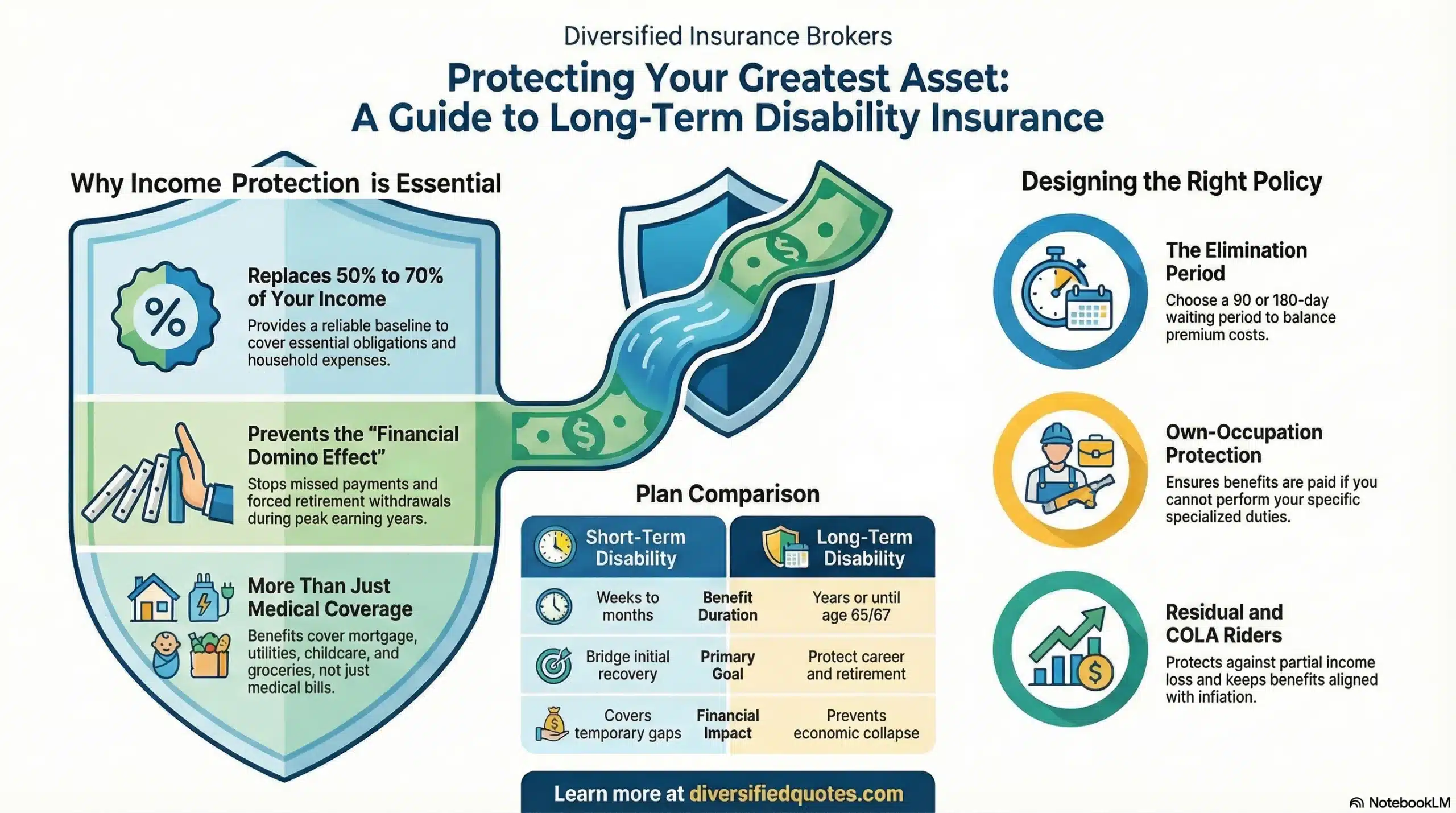
Definition of disability: The definition matters more than most people realize. A strong definition focuses on whether the insured can perform the material duties of their occupation or role. If the key person’s work is highly specialized, the definition becomes even more important. Many professionals evaluate definitions by starting with own-occupation disability insurance concepts because that framework highlights how “ability to work” should be measured against the insured’s real job duties, not a generic job category.
Elimination period (waiting period): This is the time you must wait after disability begins before benefits are payable. Some businesses choose shorter waits for critical roles where disruption is immediate. Others choose longer waits to reduce cost if they have cash reserves and the ability to absorb a short interruption. The correct elimination period is usually tied to how quickly the business experiences pain, and how much liquidity the company has to bridge a gap.
Benefit period: Some designs focus on a defined period that helps the business stabilize, hire, and transition responsibilities. Others are built for longer disruptions. The best fit depends on how quickly your business could realistically replace the key person’s contribution and how long it would take to rebuild performance.
Benefit amount: This is usually tied to the estimated financial impact: revenue at risk, cost to replace, and the time required to recover. We typically start with a simple impact model (discussed below) and refine it to what’s realistic. The goal is not to guess. The goal is to pick a number that can actually fund continuity actions during a disruption.
How Much Coverage Should a Business Consider?
There isn’t one universal number because “key person” means different things across industries. A practical approach is to quantify impact in plain terms and then translate that into a benefit that provides stability. We generally start with three categories: revenue dependency, replacement cost, and recovery time.
1) Estimate revenue dependence. How much annual revenue is directly tied to this person’s work, relationships, or production? Some businesses can answer this quickly (the person manages $2M in accounts). Others need to approximate by looking at sales attribution, book of business responsibility, or project dependencies.
2) Estimate replacement cost. What would it cost to recruit, hire, and ramp a replacement or interim leader? Include recruiter fees, signing incentives, relocation expenses if applicable, and the cost of reduced efficiency during the ramp. Replacement cost is often underestimated because businesses focus only on salary, not the full cost of hiring under pressure.
3) Estimate recovery time. If the person is out for 12 months, how long does it take the business to return to normal performance once they return—or once a replacement is in place? This matters because recovery is rarely instant. Even after replacement, relationships take time, and teams take time to operate smoothly again.
Once those numbers are clear, you can design a coverage amount that matches the risk. This is also where we determine whether BOE coverage should be layered to protect fixed expenses while the key-person plan protects broader continuity. If you want to understand BOE in detail, visit Business Overhead Expense Coverage.
It also helps to avoid a common mistake: assuming the key person plan should “replace payroll.” In many cases, the goal is to fund continuity actions—temporary staffing, client retention activities, leadership support, and operational stabilization. The correct benefit is the benefit that creates options. When the business has options, the odds of long-term damage drop dramatically.
Key Person Disability vs. Buy-Sell Disability Planning
Key person disability insurance protects the business from operational and financial impact when someone critical cannot work. Buy-sell disability planning is about ownership transfer if a partner becomes permanently disabled and cannot return. Some businesses need one; many need both—especially partnerships where one owner’s disability could create long-term imbalance.
Here’s the difference in plain English. Key person disability coverage helps the company function when someone is out. Buy-sell disability planning helps the partners resolve “what happens to ownership” if someone can’t return. In partnerships, disability can create a long-term mismatch: one partner may be doing the work while still sharing ownership economics with a partner who can’t contribute. A properly designed buy-sell disability plan can provide funding and clarity to handle that scenario without damaging relationships or stability.
Even if you aren’t ready to implement every layer immediately, documenting the plan and prioritizing the right layer first is often the most practical way forward. Many businesses start with personal DI and BOE and then add key person and buy-sell layers as the company grows and financial stakes increase.
Who Typically Benefits Most From Key Person Disability Planning?
Key person disability strategies are most valuable in businesses where performance depends heavily on a small number of people. Common examples include professional practices, owner-led companies, specialized roles, and growing companies with lender or investor expectations.
Professional practices: healthcare offices, chiropractic practices, dental practices, law firms, CPA firms, and advisory firms—especially where the key person drives relationships and revenue. Many firms also consider layering individual coverage by role; if your organization includes licensed professionals, it can be helpful to see how DI is tailored by field, such as disability coverage for doctors and physicians or disability coverage for attorneys.
Owner-led companies: businesses where the owner is the primary decision-maker, lead producer, or operational backbone. In these companies, disability risk is often the largest unaddressed business continuity threat because so much sits on one person’s shoulders.
Specialized roles: roles that are difficult to replace quickly—whether due to licensing, technical expertise, or unique relationships. If replacement takes months, continuity planning matters more, and the financial buffer can be the difference between “we survived this” and “we never recovered.”
Growth-stage companies with outside expectations: where continuity is tied to financing terms, expansion plans, or valuation. Key person planning can reduce perceived operational risk and make the business more resilient in the eyes of stakeholders.
Where Key Person Disability Fits in a “Whole Business” Protection Plan
One of the best ways to decide whether key person disability insurance is worth implementing is to map it alongside the other protection layers your business may already have. Most businesses have general liability, workers’ compensation, property coverage, and maybe cyber coverage. Those are important, but they don’t directly solve “income stops because a key person can’t work.”
Key person disability sits alongside business disability layers like BOE and complements personal DI. If the goal is “protect the business,” BOE stabilizes the operating budget and key person DI stabilizes revenue/continuity. If the goal is “protect the household,” personal DI stabilizes the family’s budget and long-term plan. When these layers are coordinated, the business has time to make smart decisions during a disruption instead of reacting under pressure.
This coordination matters even more if your business has multiple key people. Some firms choose to start with the top one or two and build a phased plan over time. The point is not perfection on day one. The point is reducing concentrated vulnerability in a way that fits your budget and growth trajectory.
Get a Key Person Disability Plan Review
We’ll help you quantify the impact, choose the right structure, and compare carriers so the plan matches your business reality.
Common Mistakes Businesses Make with Key Person Disability
Key person disability is simple in concept, but there are several common mistakes that can reduce real-world value. The most common issue is assuming a single policy solves every problem. Another is focusing on premium first without understanding how definitions and benefit structure affect outcomes.
Mistake #1: Treating disability like “it won’t happen to us.” Most key person disability claims don’t begin with a dramatic accident. They often begin with medical issues that require treatment, surgery, or recovery time—events that can happen even to healthy, high-performing people. Businesses that plan for it don’t do so because they’re pessimistic. They do it because they understand that continuity is valuable.
Mistake #2: Ignoring partial disability and reduced capacity risk. A key person may be able to “work a little” but not at the same capacity, speed, or reliability. Reduced capacity can still damage revenue and deadlines. The right policy structure and planning approach should consider that the disruption is not always all-or-nothing.
Mistake #3: Overlooking the time dimension. The elimination period and benefit period matter. If your business would feel pain within 30–60 days, a long waiting period might miss the risk window you actually care about. If your business would struggle during a longer recovery, a short benefit period could end too early. Design should match the actual timeline of business impact.
Mistake #4: Not coordinating BOE with key person planning. BOE is often the “keep the lights on” layer, while key person planning is the “stabilize revenue and continuity” layer. If you need both, implementing only one can leave a major gap.
Mistake #5: Not reviewing or updating as the company grows. Key person risk changes as revenue changes, as the team grows, and as responsibilities shift. Many businesses set protection once and forget it. A simple periodic review is often enough to keep coverage aligned with the current reality.
How Diversified Insurance Brokers Helps
Key person disability planning is not a “one carrier, one quote” decision. The definition of disability, the waiting period, the benefit period, and the way benefits are paid can change outcomes significantly. Our advisors help you design the plan around the business risk first—then we shop carriers and structure the coverage accordingly.
We also help you coordinate key person planning with your broader disability protection strategy. For many owners, the best first step is personal coverage that protects household income. From there, we determine whether BOE is needed to stabilize the business, and whether key person disability coverage is needed to protect continuity and valuation. Explore the full framework here: Disability Insurance.
Protect Your Business from a Key Person Disability
If one person’s absence could change revenue, leadership, or client retention, it’s worth building the plan now.
Talk With an Advisor Today
Choose how you’d like to connect—call or message us, then book a time that works for you.
Schedule here:
calendly.com/jason-dibcompanies/diversified-quotes
Licensed in all 50 states • Fiduciary, family-owned since 1980
FAQs: Key Person Disability Insurance
What is key person disability insurance?
It’s coverage designed to protect a business if a critical owner or employee becomes disabled and can’t perform their role. In many designs, the business owns the policy and receives benefits to help offset financial disruption.
How is this different from personal disability insurance?
Personal disability insurance is meant to replace the individual’s income for household expenses. Key person disability planning is focused on protecting the company—cash flow, continuity, and operational stability—when a key contributor can’t work.
Who should be considered a “key person”?
Anyone whose absence would create a major revenue drop, client loss, operational disruption, or leadership gap—often an owner, partner, top producer, or specialized professional who is difficult to replace quickly.
How do businesses decide the right coverage amount?
A practical approach is to estimate revenue dependence, replacement and training costs, and recovery time. Coverage is then designed around the realistic financial impact of a long-term disability.
Does key person disability insurance replace lost profits?
It can help reduce the financial strain caused by a disability, but the exact structure depends on the policy design and how benefits are paid. Most businesses use it to support continuity costs and stabilize operations during disruption.
Should business owners also consider BOE coverage?
Often, yes. BOE coverage is designed to reimburse fixed operating expenses when an owner is disabled, while key person planning focuses on broader business impact. Many businesses layer both to avoid gaps.
How long is the waiting period before benefits are payable?
Waiting periods vary by policy. The right choice depends on business cash reserves, how quickly disruption becomes financially severe, and how long a replacement would realistically take.
Can key person disability planning be coordinated with buy-sell planning?
Yes. Key person planning protects the business during disability, while buy-sell disability planning focuses on ownership transfer if disability becomes permanent. Coordination helps avoid conflict and financial strain in partnerships.
About the Author:
Jason Stolz, CLTC, CRPC and Chief Underwriter at Diversified Insurance Brokers (NPN 20471358), is a senior insurance and retirement professional with more than two decades of real-world experience helping individuals, families, and business owners protect their income, assets, and long-term financial stability. As a long-time partner of the nationally licensed independent agency Diversified Insurance Brokers, Jason provides trusted guidance across multiple specialties—including fixed and indexed annuities, long-term care planning, personal and business disability insurance, life insurance solutions, Group Health, and short-term health coverage. Diversified Insurance Brokers maintains active contracts with over 100 highly rated insurance carriers, ensuring clients have access to a broad and competitive marketplace.
His practical, education-first approach has earned recognition in publications such as VoyageATL, highlighting his commitment to financial clarity and client-focused planning. Drawing on deep product knowledge and years of hands-on field experience, Jason helps clients evaluate carriers, compare strategies, and build retirement and protection plans that are both secure and cost-efficient. Visitors who want to explore current annuity rates and compare options across multiple insurers can also use this annuity quote and comparison tool.
