
Level-Funded Health Insurance Tax Benefits Explained

Jason Stolz CLTC, CRPC
Level-Funded Health Insurance Tax Benefits Explained — Level-funded health insurance tax benefits explained in plain English start with one simple reality: the way your health plan is funded can materially change your after-tax cost, cash flow timing, and financial predictability. Many employers focus only on premiums when evaluating group health options, but the tax treatment of claims funding, stop-loss premiums, administrative costs, and potential surplus can change the true net cost of coverage more than most people expect.
At Diversified Insurance Brokers, level-funded health insurance tax benefits explained conversations usually start with understanding the employer’s accounting method, entity structure, workforce composition, and risk tolerance. Level-funded plans sit between fully insured and self-funded plans. That hybrid structure is what creates the potential tax advantages, but it also requires thoughtful plan design and coordination with tax advisors to fully capture those benefits.
Level-funded health insurance tax benefits explained properly means evaluating not just deduction eligibility, but also timing, expense classification, surplus treatment, stop-loss structure, and payroll eligibility rules. When these components are aligned correctly, level-funded plans can produce meaningful after-tax cost advantages while still preserving predictable monthly budgeting.
Request a Tax-Aware Level-Funded Comparison
See pre-tax and after-tax cost comparisons between level-funded and fully insured group health plans.
How Level-Funded Health Plans Are Structured From a Tax Perspective
Level-funded plans combine predictable monthly payments with self-funded claim mechanics. Employers typically pay a fixed monthly amount that includes three major components: expected claims funding, fixed administrative costs, and stop-loss insurance premiums. Because these payments are directly tied to providing employee health benefits, many employers treat them as ordinary business expenses.
The predictable payment structure makes budgeting easier than traditional self-funding. From a tax standpoint, the monthly structure also creates consistent expense recognition patterns, which can simplify accounting and forecasting.
Level-funded health insurance tax benefits explained in accounting terms often revolve around whether expenses are deducted when paid versus when incurred. Cash basis taxpayers typically deduct when paid, while accrual basis taxpayers may recognize expenses when liability is incurred. The structure of level-funded payments often fits cleanly into either framework, which is one reason many CPAs prefer them compared to variable self-funded claim spikes.
Claims Funding Contributions and Deductibility
Claims funding contributions represent the portion of monthly payments allocated toward expected medical claims. While these are not technically “premiums,” they are typically treated as part of the cost of providing employee benefits. Many employers deduct these contributions in the year paid, subject to accounting method and advisor guidance.
The predictability of level-funded claims funding often allows better matching of expenses to revenue cycles. Businesses with seasonal income patterns sometimes prefer this predictable funding compared to large unexpected claim spikes seen in traditional self-funded plans.
Stop-Loss Insurance and Tax Treatment
Stop-loss premiums are typically treated similarly to traditional insurance premiums. These premiums protect employers from catastrophic individual claims (specific stop-loss) and high overall claims experience (aggregate stop-loss).
Level-funded health insurance tax benefits explained must include stop-loss because stop-loss structure can influence total cost allocation between premium expense and retained claim risk. While total deductibility often remains similar, the allocation affects volatility and cash-flow predictability.
Administrative Costs and Expense Treatment
Administrative services only (ASO) fees typically cover claims processing, network access, compliance reporting, and customer service infrastructure. These fees are typically expensed as ordinary business costs.
Many level-funded carriers bundle administrative costs into monthly payments, which simplifies expense categorization and forecasting. Employers benefit from consistent expense recognition rather than fluctuating administrative invoices.
Year-End Surplus and After-Tax Cost Impact
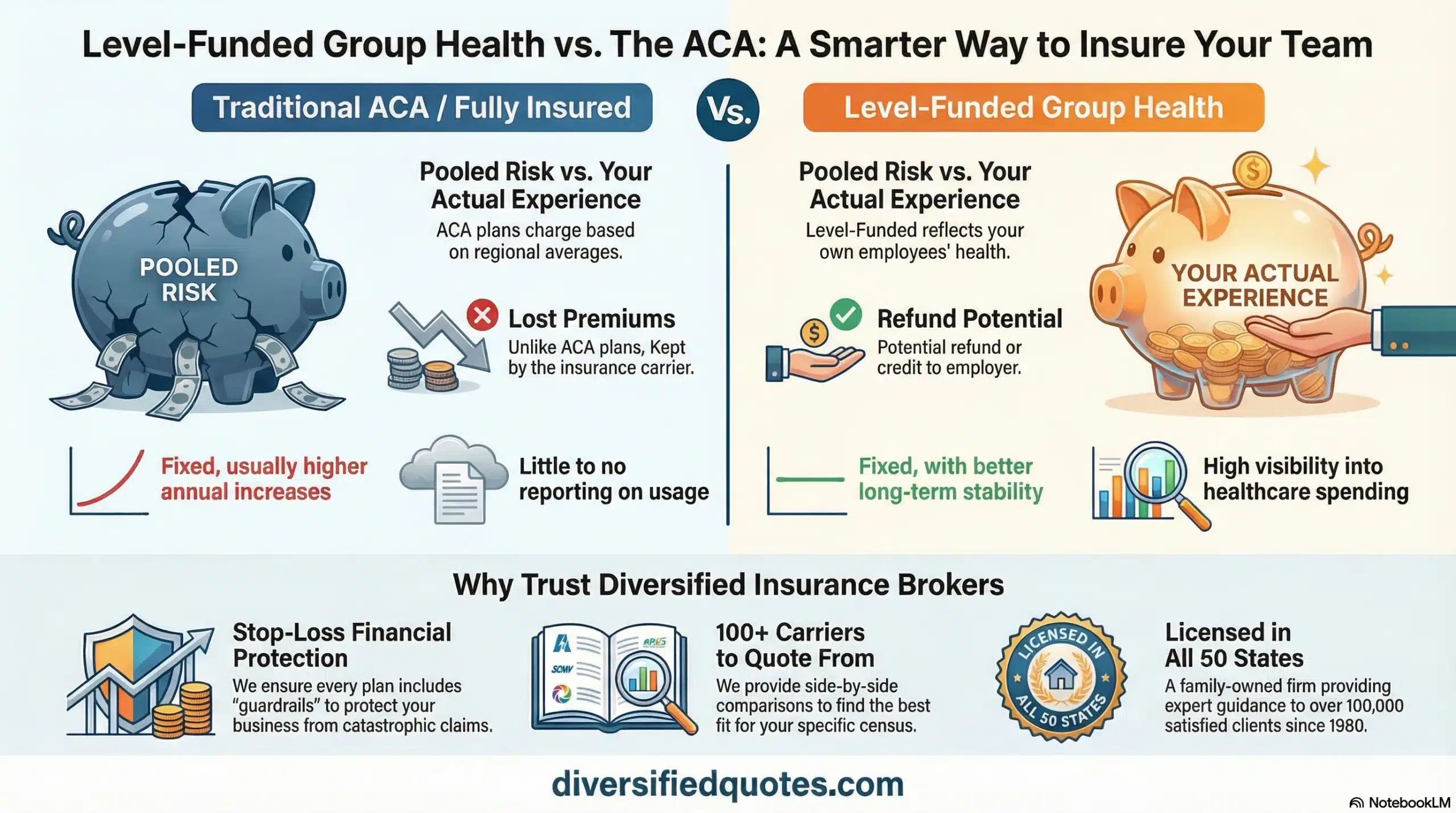
Level-funded health insurance tax benefits explained discussions often focus heavily on surplus potential. When claims run lower than expected, some contracts return unused claims dollars after run-out periods. This is not guaranteed and depends entirely on contract language.
Surplus may be returned as a credit toward future premiums or as a distribution depending on program structure. The tax treatment can vary based on how surplus is applied and accounting treatment of original contributions. Employers should coordinate with tax advisors when surplus is expected.
See If Level-Funded Plans Improve Your After-Tax Cost
We model claims scenarios, surplus potential, and tax treatment side-by-side.
Cash Flow Timing Advantages
Level-funded plans provide predictable monthly expense patterns. This allows employers to forecast healthcare costs more accurately and align expense recognition with revenue cycles.
Contract basis selection, such as 12/12 or extended run-out structures, influences when claims are paid and recognized. While this may not change total deduction over time, it can materially impact year-end financial reporting and budgeting accuracy.
Entity Structure Considerations
Entity structure influences payroll tax interaction, owner participation eligibility, and deduction structure. S-corporations, partnerships, and C-corporations may experience different downstream tax effects based on compensation structure and benefit classification.
Level-funded health insurance tax benefits explained for owner-heavy businesses must evaluate whether owner participation rules impact plan eligibility or contribution structure.
Payroll and Eligibility Impact on Tax Efficiency
Level-funded plans typically require W-2 employee participation. Independent contractors typically cannot participate. This distinction impacts benefit deductibility structure and compliance positioning.
Proper employee classification supports clean tax reporting and avoids compliance complications that can affect both underwriting and tax documentation.
Risk Retention vs Premium Allocation Strategy
Attachment point selection influences risk retention. Lower attachment points increase premium but reduce volatility. Higher attachment points reduce premium but increase retained risk. Employers should model after-tax outcomes under multiple scenarios.
Laser provisions should be evaluated carefully. While they can reduce overall premium cost, they increase retained exposure for specific members.
Request a Level-Funded Risk and Tax Strategy Review
Understand your exposure, surplus potential, and after-tax impact before choosing a funding model.
When Level-Funded Plans Tend to Deliver Maximum Tax Efficiency
Level-funded plans often work best for stable groups with predictable utilization patterns, strong participation, and moderate risk distribution. Groups with strong wellness participation or lower chronic utilization often experience stronger surplus outcomes.
Employers with consistent revenue cycles often benefit from predictable expense patterns and simplified accrual matching.
Common Mistakes That Reduce Level-Funded Tax Advantages
Overestimating surplus likelihood is one of the most common planning mistakes. Surplus should be treated as upside potential, not guaranteed savings. Misaligned payroll eligibility structures can also create compliance complications.
Failing to coordinate plan design with tax advisors early often results in missed planning opportunities.
Long-Term Strategic Value of Level-Funded Planning
Level-funded health insurance tax benefits explained fully means viewing the plan as part of multi-year financial strategy rather than a one-year premium decision. Over multiple renewal cycles, predictable claims patterns and surplus cycles can compound financial advantage.
Employers who actively manage plan performance, claims utilization, and renewal strategy often capture the strongest long-term cost advantages.
Related Level-Funded Health Planning Guides
Continue learning how funding models, stop-loss structure, and employer size influence cost and compliance.
Related Employer Health Cost Strategy Guides
Explore broader strategies for managing employer healthcare cost, eligibility, and funding transitions.
Financial Protection Essentials
Retirement income strategy, business planning, beneficiary considerations, and long-term care flexibility resources.
Talk With an Advisor Today
Choose how you’d like to connect—call or message us, then book a time that works for you.
Schedule here:
calendly.com/jason-dibcompanies/diversified-quotes
Licensed in all 50 states • Fiduciary, family-owned since 1980
FAQs: Level-Funded Health Insurance Tax Benefits Explained
Are level-funded plan payments tax-deductible for employers?
In most cases, employers treat level-funded plan costs as ordinary business expenses. Monthly payments typically include claims funding, administrative fees, and stop-loss premiums. The specific timing and classification (deduct when paid vs. when incurred) depends on your accounting method and how your program is structured, so it’s important to coordinate with your CPA.
Is the “claims fund” portion treated differently than insurance premiums?
It can be. The claims-funding portion is generally considered part of the cost of providing employee benefits rather than a traditional premium. Many employers still expense it as a business cost, but the accounting treatment can differ depending on how the carrier or administrator structures the arrangement and how your CPA prefers to record it.
Are stop-loss premiums deductible?
Stop-loss premiums are commonly treated like other business insurance expenses. Most employers expense stop-loss premiums as part of the cost of providing health benefits. The details matter, especially with contract basis and reimbursement timing, so your advisor should confirm how your plan documents outline the coverage.
How is year-end surplus typically handled for tax purposes?
Surplus treatment depends on the contract and how the surplus is applied. Some programs provide a credit toward future costs, while others may return a portion after claims run-out. Your CPA will determine whether the credit reduces future deductible expense, requires income recognition, or is handled another way based on your accounting method and documentation.
Is surplus guaranteed in level-funded plans?
No. Surplus is never guaranteed. Whether any unused claims dollars are returned depends on actual claims experience, the plan’s stop-loss structure, program rules, run-out provisions, and the specific contract language. A good budgeting approach assumes no surplus and treats any potential credit as upside.
Does contract basis (like 12/12 vs. 12/15) affect tax treatment?
Contract basis primarily affects claim timing and stop-loss protection timing, which can influence cash flow and when reimbursements occur. While that doesn’t always change the overall deductibility of plan costs, it can affect when costs hit your books and how clean your year-end reporting looks.
Can independent contractors (1099s) be covered under a level-funded plan?
Most level-funded programs require W-2 employees for eligibility, and contractors are typically excluded. Misclassifying contractors or attempting to include ineligible participants can create compliance issues and can also cause underwriting or administrative problems. If your workforce is contractor-heavy, your advisor should confirm eligibility before quoting.
Do owners qualify for level-funded coverage?
Owner eligibility depends on the entity type, payroll setup, and carrier rules. Some owners qualify as eligible employees, while others may need alternative arrangements. Because owner participation can intersect with tax treatment, it’s best to confirm eligibility and documentation before implementing the plan.
What plan design choices most influence after-tax cost?
The biggest drivers are stop-loss attachment points (how much risk you retain), contract basis (claims timing), administrative fee structure, and whether your program returns any unused claims dollars. Two plans with similar “headline pricing” can have meaningfully different after-tax outcomes depending on these design choices.
Is level-funded always better than fully insured plans?
Not always. Level-funded plans can be a strong fit for groups that want predictable payments but still want the upside of favorable claims experience. Fully insured plans may fit better when predictability is the only priority or when eligibility/participation rules make level funding difficult. A proper comparison models multiple claims scenarios and looks at after-tax cost, not just premiums.
About the Author:
Jason Stolz, CLTC, CRPC and Chief Underwriter at Diversified Insurance Brokers (NPN 20471358), is a senior insurance and retirement professional with more than two decades of real-world experience helping individuals, families, and business owners protect their income, assets, and long-term financial stability. As a long-time partner of the nationally licensed independent agency Diversified Insurance Brokers, Jason provides trusted guidance across multiple specialties—including fixed and indexed annuities, long-term care planning, personal and business disability insurance, life insurance solutions, Group Health, and short-term health coverage. Diversified Insurance Brokers maintains active contracts with over 100 highly rated insurance carriers, ensuring clients have access to a broad and competitive marketplace.
His practical, education-first approach has earned recognition in publications such as VoyageATL, highlighting his commitment to financial clarity and client-focused planning. Drawing on deep product knowledge and years of hands-on field experience, Jason helps clients evaluate carriers, compare strategies, and build retirement and protection plans that are both secure and cost-efficient. Visitors who want to explore current annuity rates and compare options across multiple insurers can also use this annuity quote and comparison tool.
