
Life Insurance for Smokers

Jason Stolz CLTC, CRPC
If you use nicotine in any form—cigarettes, cigars, chew/dip, vape, or even nicotine replacement—getting life insurance as a “smoker” can feel like a penalty box. The truth is more nuanced. Many insurers do not treat every nicotine exposure the same, and the difference between “smoker rates” and “non-smoker rates” often comes down to how your nicotine use is categorized, how consistently it’s documented, and whether your application is submitted to a carrier whose underwriting rules fit your real-world pattern. At Diversified Insurance Brokers, we shop coverage across a large network of A-rated carriers and focus on one goal: helping you qualify for the best class you can legitimately earn—without unnecessary ratings, misclassification, or avoidable underwriting friction.
This page is built for people who have been told “you’re a smoker, so you’re stuck,” and for people who want to understand why quotes can vary so widely from one company to another. Sometimes the problem isn’t your health. Sometimes the problem is that a carrier uses a blunt definition of “tobacco user,” or an application was submitted without the detail an underwriter needs to assess risk correctly. If you’ve seen a table rating before and want to understand what it means (and how it’s sometimes improved), start with our plain-English primer on life insurance table ratings .
Have Us Shop Smoker vs. Non-Smoker Options
Tell us how you use nicotine (type, frequency, and recency). We’ll match you to carriers whose underwriting rules are most likely to award the best class you can qualify for—and we’ll coordinate the entire underwriting path.
Prefer to call? 800-533-5969
Instant Quotes: Compare Smoker vs. Non-Smoker Classes
Use the tool below to benchmark pricing across term lengths and amounts. Then we’ll apply the underwriting strategy: choosing carriers that define nicotine classes in a way that matches your situation and avoids unnecessary costs.
Why “Smoker Life Insurance” Pricing Varies So Much
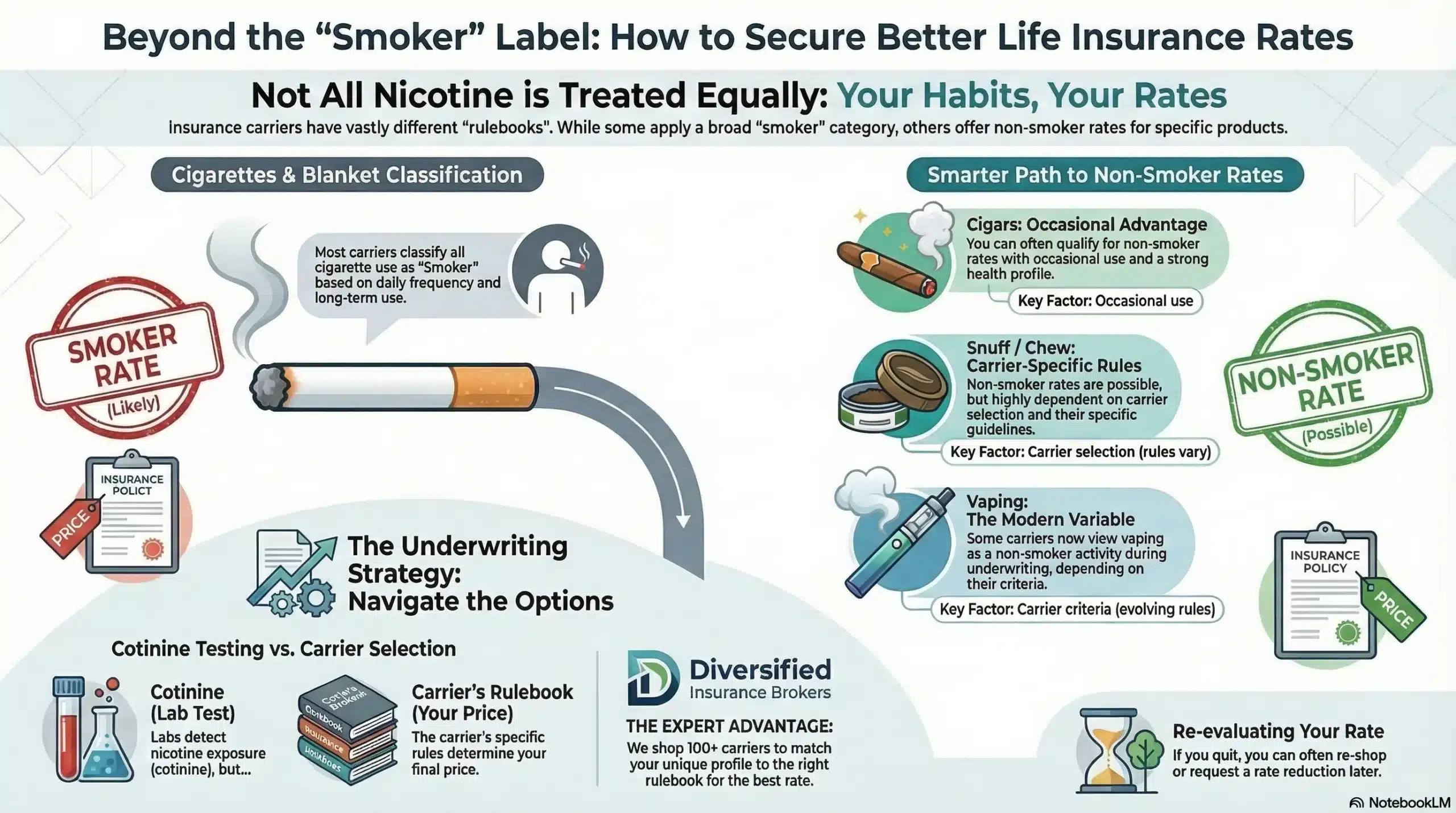
Life insurance companies aren’t pricing nicotine because they’re trying to punish people. They’re pricing what they believe correlates with higher long-term mortality risk. The issue for consumers is that insurers use different definitions, different class names, and different “lookback” periods. One carrier may treat any nicotine as a smoker class for the entire year, while another distinguishes between cigarettes and non-cigarette nicotine, or allows more favorable classes for occasional exposure. That’s why two people with the same exact habits can see two very different quotes depending on where they apply.
This is also why applying “blind” can be expensive. If you submit to a strict carrier first, the offer may come back high—even if other companies would have treated your pattern more favorably. In some cases, the applicant accepts that high offer and assumes it’s the market. In reality, it was one carrier’s interpretation. The better path is to treat nicotine underwriting like any other high-sensitivity underwriting category: match your profile to carrier appetite first, then apply. That’s the same strategy we use when placing complicated medical or lifestyle cases through our high-risk life insurance process.
If you’ve been quoted with a flat extra or you’re trying to understand why an “avocation-style” surcharge showed up on your offer, this resource helps clarify how those add-ons work: what a flat extra is in life insurance. In nicotine cases, a flat extra is less common than a class change, but it can appear depending on carrier and risk layering. Understanding the difference helps you compare offers accurately.
Nicotine Categories That Often Underwrite Differently
Life Insurance for Smokers is one of the most misunderstood underwriting categories. People assume nicotine underwriting is binary: you use nicotine, you’re a smoker. But many carriers break the world into categories that matter. Cigarettes typically receive the strictest treatment because carriers consider both frequency and long-term exposure more predictive of risk. That doesn’t mean cigarettes automatically disqualify you from coverage—it means you need to be realistic about class outcomes and shop the carriers that price your pattern most fairly.
Cigar use is frequently misunderstood. Some insurers treat cigars as cigarette-equivalent no matter what. Others underwrite cigars more flexibly when use is occasional and the rest of the file is strong. The key is that “cigar user” is too vague for underwriting. Underwriters want frequency, recency, and consistency in disclosure. If the application is vague, the carrier often defaults to its strictest category. That’s not a moral judgment; it’s an underwriting shortcut. Our job is to remove ambiguity so you’re evaluated on facts rather than assumptions.
Smokeless tobacco can also be treated separately. Many carriers recognize that the risk profile of chew or dip is not identical to daily cigarette smoking. Some companies still class all nicotine the same, but others have categories that can produce better pricing for smokeless users—especially when there are no major medical risk layers. Again, the carrier rulebook matters more than the label.
Vaping and e-cigarette underwriting is evolving. Some carriers treat vape as nicotine use and classify it as smoker regardless. Others distinguish it from cigarettes. Some focus on nicotine concentration and frequency. From a practical standpoint, this is one of the areas where shopping multiple carriers is most valuable because there is less standardization across the industry.
Nicotine replacement therapy can add confusion. Some carriers see patches or gum as a “quit attempt” and treat it differently than active cigarette smoking. Others simply see nicotine exposure in labs. If you’re using NRT, it’s especially important to align your disclosure with how a carrier categorizes nicotine classes so your underwriting result matches the story you’re presenting.
How Carriers Verify Nicotine (and Why Timing and Consistency Matter)
For many policies—especially larger face amounts—carriers confirm nicotine exposure through a combination of a questionnaire and lab testing. The key marker is often cotinine, a nicotine metabolite that can be detected in blood or urine. Cotinine doesn’t care whether nicotine came from a cigarette, a cigar, a vape, or smokeless tobacco. It simply confirms exposure. That’s why the “category” conversation matters so much: if a carrier treats any nicotine exposure as smoker, a positive cotinine result can lock in smoker classes even if your pattern is occasional and otherwise low risk.
The best approach is not to try to outsmart labs. The best approach is accurate disclosure plus carrier selection. When your disclosure is precise and the carrier’s rulebook fits your pattern, lab results don’t become a surprise— they become confirmation. Where applicants get burned is when disclosures are vague (“occasional”) or inconsistent across forms, then the underwriter assumes the worst-case scenario.
If you’re new to life insurance shopping, the fastest way to avoid mistakes that raise premiums is to understand the application process and how underwriting interprets common answers. This guide is designed to prevent the most expensive errors: common mistakes people make when buying life insurance. Even experienced buyers benefit from a refresh because small wording differences can change underwriting outcomes.
Term vs. Permanent Coverage When You Use Nicotine
For most nicotine users, term life insurance is the starting point because it provides the most death benefit per dollar. If your goal is protecting income, covering a mortgage, or creating a safety net during key family years, term coverage is usually the most efficient structure. Your nicotine class will still matter, but the baseline affordability of term often makes the difference between “some coverage” and “meaningful coverage.”
Permanent coverage can still make sense when your goals extend beyond a defined time window. Some families want a policy that doesn’t expire, or a structure that supports legacy planning. If you’re trying to estimate how much coverage you need before we fine-tune underwriting, run the numbers with the life insurance calculator. A clear target amount makes the shopping process faster and helps you compare term and permanent designs on equal footing.
If you’re a parent, nicotine underwriting becomes even more important because you’re often trying to buy more coverage during the years your children are financially dependent on you. This page helps you think through real expense categories that are easy to underestimate: life insurance for parents with young children. Getting the structure right matters, but so does getting the underwriting class right—because the difference in premium can influence how much coverage you can actually keep long-term.
When Smoking Overlaps With Health Conditions
Nicotine use doesn’t exist in a vacuum. Carriers also consider health factors that often travel with smoking: pulmonary symptoms, cardiovascular risk, blood pressure, cholesterol, and general inflammation. The underwriting outcome is typically the combination of nicotine class plus any medical ratings layered on top. This is where smart shopping matters most, because some carriers are more conservative in how they stack risk factors.
If you have COPD or other chronic lung issues, underwriting can feel discouraging, but there are still pathways. The most important step is matching the case to carriers that evaluate pulmonary stability and treatment compliance in a reasonable way. Start with our COPD overview to understand what carriers usually ask for and what “good” looks like in documentation: life insurance for COPD.
If you have a cardiac history—or risk markers that trigger cardiac scrutiny—this page outlines the common underwriting themes and how we approach submissions: life insurance for heart disease. The goal is not to pretend risk doesn’t exist. The goal is to make sure the underwriter evaluates your current stability and treatment consistency rather than defaulting to a worst-case assumption.
In many cases, the best underwriting move is sequencing: we identify which factor is driving the rating most, then target carriers that are more favorable in that category. That’s why nicotine users with the “same habit” can see different offers—because the carrier’s framework for stacking risk is different.
How Diversified Insurance Brokers Shops Smoker Cases More Effectively
Most “smoker life insurance” shopping is done backwards. People run a quick quote, see a high premium, and assume the market is the market. But nicotine underwriting is rule-driven, and the rules vary more than most buyers realize. Our approach starts with precision: the type of nicotine, the frequency, how recently, and whether there are medical risk layers that could stack. Then we map your profile to carriers whose class definitions are most aligned with your pattern.
This strategy is especially valuable if you’ve been rated or declined in the past. A decline or high rating isn’t always a final verdict. It’s often one carrier’s decision based on how the application was framed, what documentation was available, and how the carrier’s underwriting manual treats nicotine. That’s why we treat many nicotine cases as “high sensitivity” submissions and use the same discipline that drives our high-risk life insurance placements.
If an offer comes back higher than expected, we don’t just accept it. We compare the reason for the class, confirm whether the carrier applied the correct category, and determine whether another carrier would treat the same pattern more favorably. In some situations, we can also plan re-shopping after behavior changes or after medical milestones improve. The point is to keep you in control of the long-term cost—not trapped in a category you don’t need.
Get Your Best Eligible Class (Smoker or Non-Smoker)
We’ll shop carriers based on your exact nicotine profile and help you avoid inflated offers caused by broad assumptions or misclassification.
Call: 800-533-5969
Related Pages
If nicotine underwriting is only one part of your profile, these pages can help you understand common pricing drivers and how to shop smarter.
Compare Term Life Insurance Lengths
Explore different term periods to find coverage that best matches your timeline and budget.
Talk With an Advisor Today
Choose how you’d like to connect—call or message us, then book a time that works for you.
Schedule here:
calendly.com/jason-dibcompanies/diversified-quotes
Licensed in all 50 states • Fiduciary, family-owned since 1980
FAQs: Life Insurance for Smokers
Can I get life insurance if I smoke?
Yes. Most smokers can qualify for coverage. Your price and underwriting class depend on the type of nicotine you use, how often you use it, how recently you used it, your overall health profile, and the carrier’s specific nicotine rules.
Can cigar users qualify for non-smoker rates?
Sometimes. Some insurers treat occasional cigars differently than cigarettes and may offer non-smoker pricing in specific situations. Frequency, recency, disclosure details, and the carrier’s classification rules determine the outcome.
Do chew or dip users always get smoker rates?
Not always. Many carriers classify smokeless tobacco separately from cigarettes, and some may offer non-smoker classes depending on usage patterns and underwriting results. Carrier selection matters.
How do insurers treat vaping or e-cigarettes?
Underwriting varies by company. Some carriers treat vaping as smoker/tobacco use, while others distinguish vape from cigarettes. The best approach is accurate disclosure and targeting carriers whose rules align with your situation.
How do life insurance companies verify nicotine use?
Most carriers use an application questionnaire and may require lab testing for cotinine, a nicotine metabolite found in blood or urine. Positive cotinine indicates nicotine exposure, which can affect your class depending on the carrier’s rules.
If my labs show cotinine, does that automatically mean smoker rates?
Not necessarily. It depends on the carrier and how they define nicotine classes. Some treat any positive cotinine as smoker, while others consider the type of nicotine and usage pattern. This is why carrier selection and consistent disclosure are important.
Should I quit before applying?
It depends. If you can qualify for a better class based on your current use pattern with a favorable carrier, applying now may still make sense. If you plan to stop, we can also discuss timing, carrier lookback windows, and re-shopping options later.
How long do I need to be nicotine-free to qualify as a non-smoker?
It varies by insurer. Many carriers use a “lookback” period, and the definition of nicotine-free can differ across companies. We match your timeline to carriers with the most favorable rules for your situation.
What if I smoke and also have health issues like high blood pressure or COPD?
Coverage may still be available, but underwriting will evaluate both nicotine use and the medical condition(s). The outcome depends on stability, treatment compliance, and how the carrier stacks risks. Strategic carrier targeting can improve results.
Can I improve my rate later if I quit?
Often, yes. If you stop nicotine use and maintain a qualifying period, you may be able to re-shop coverage or request reconsideration depending on the carrier and policy structure. We can help map the best path based on your carrier options.
About the Author:
Jason Stolz, CLTC, CRPC and Chief Underwriter at Diversified Insurance Brokers (NPN 20471358), is a senior insurance and retirement professional with more than two decades of real-world experience helping individuals, families, and business owners protect their income, assets, and long-term financial stability. As a long-time partner of the nationally licensed independent agency Diversified Insurance Brokers, Jason provides trusted guidance across multiple specialties—including fixed and indexed annuities, long-term care planning, personal and business disability insurance, life insurance solutions, Group Health, and short-term health coverage. Diversified Insurance Brokers maintains active contracts with over 100 highly rated insurance carriers, ensuring clients have access to a broad and competitive marketplace.
His practical, education-first approach has earned recognition in publications such as VoyageATL, highlighting his commitment to financial clarity and client-focused planning. Drawing on deep product knowledge and years of hands-on field experience, Jason helps clients evaluate carriers, compare strategies, and build retirement and protection plans that are both secure and cost-efficient. Visitors who want to explore current annuity rates and compare options across multiple insurers can also use this annuity quote and comparison tool.
