
Outpatient Surgery & Rehab Riders: What to Know

Jason Stolz CLTC, CRPC
Cash for Same-Day Surgery & Rehab Visits
Add outpatient surgery and rehab riders to turn copays and coinsurance into predictable cash paid directly to you.
Outpatient surgery riders and rehab/therapy riders are among the most practical add-ons on hospital indemnity and supplemental health plans because they’re built for how modern healthcare actually works. Many “big” medical events no longer happen through long inpatient stays. Instead, the system increasingly moves people through same-day procedures, outpatient hospital departments, ambulatory surgery centers, and then a predictable rhythm of follow-up appointments and therapy visits. That model can be clinically efficient, but it often creates a frustrating financial experience, because you may be responsible for copays, coinsurance, facility fees, and a long string of therapy visit charges that don’t feel large individually—yet add up quickly over weeks. These riders exist to reduce that friction by paying fixed cash benefits directly to you when qualifying events occur.
The most important mindset shift is understanding what these riders are and what they are not. They are not a replacement for major medical coverage. They are not “extra insurance that pays the doctor.” They are cash benefits that can help you manage what your medical plan leaves behind. If your primary plan is strong, these riders can help soften the practical costs around an episode of care. If your primary plan is cost-sharing heavy, these riders can help you turn unpredictable bills into a more predictable cash flow. The benefit is paid to you, which means you can apply it to whatever problem is most urgent—procedure copays, therapy visit copays, prescriptions, transportation, time off work, or household bills that still need to be paid while you’re recovering.
Outpatient is a label that confuses people because it sounds like “minor.” In real life, outpatient can involve major repairs, invasive interventions, advanced imaging with sedation, and procedures that are medically significant even when you go home the same day. A common reason people feel unprepared financially is that they equate “outpatient” with “cheap,” and then they see a coinsurance percentage applied to a large outpatient facility charge. Even when your plan is doing what it’s supposed to do, the math can be unpleasant. An outpatient surgery rider is designed to send you a lump-sum benefit for qualifying outpatient procedures so you have money on hand when the cost-sharing hits.
Rehab and therapy riders focus on the second phase of the story: what happens after the procedure or diagnosis. Physical therapy, occupational therapy, speech therapy, and other forms of rehab are often prescribed in clusters. That “cluster” is what creates financial fatigue. A single therapy visit copay may not seem like a big deal, but two or three visits per week for multiple weeks can create a steady drain, especially if your deductible is still being met or your plan requires coinsurance. Rehab riders typically pay per visit, up to a plan-defined cap. Done correctly, they help you budget recovery instead of feeling like you’re being charged repeatedly for doing the very thing your doctor told you to do.
If you want the broader foundation for how these plans work, start with Hospital Indemnity Insurance: What It Covers & Costs. That overview helps you see the larger “cash benefit” framework and how riders layer on top of it. Outpatient and rehab riders are most effective when they’re not chosen in isolation. They work best when they’re designed to match how you typically enter the system (ER or urgent care, direct specialist referral, planned procedure), how your plan bills you (copay vs coinsurance, facility fee patterns), and how your recovery is likely to look (light follow-up vs multi-week therapy).
What Outpatient Surgery Riders Cover (and Why Setting Matters)
Outpatient surgery riders are designed to pay when a qualifying procedure is performed in an eligible setting. The two settings you’ll see most often are a hospital outpatient department and an ambulatory surgery center (ASC). The setting matters because billing differs. Hospital outpatient departments often carry higher facility charges, and many plans apply coinsurance percentages to those charges. ASCs may have different contracted rates and different cost-sharing structures depending on your plan. Because of that, many rider designs pay different benefits based on setting. That’s not marketing fluff; it reflects the reality that the same procedure can create different out-of-pocket exposure depending on where it was performed.
These riders are commonly used for procedures like cataract surgery, arthroscopic repairs, endoscopy and colonoscopy with interventions, certain vascular procedures, outpatient orthopedic surgeries, and many other same-day interventions that are more common than people realize. The carrier typically defines what qualifies through procedure categories, plan definitions, and sometimes lists or coding rules. The core idea is simple: if the procedure meets the contract definition and occurs in the correct setting, a fixed benefit pays. That fixed benefit can help cover what your plan asks you to pay, but it can also be used for the “edges” of the episode—medications, transportation, and life disruption expenses.
A rider feels most valuable when it matches your plan’s pain points. If your plan has a small copay for outpatient surgery but a heavy therapy copay schedule, then the rehab rider may be the more important piece. If your plan has high coinsurance for hospital outpatient procedures, then the outpatient surgery rider often becomes the anchor benefit. The “best” rider is not the one with the highest number. It’s the one that makes the episode easier financially based on how you’re actually billed.
Another reason setting matters is that many episodes do not begin with a planned surgery. They begin with a symptom, then an urgent care or ER visit, then imaging, then a specialist referral, and then a procedure. If you want your coverage to feel complete, outpatient benefits should be paired with front-end benefits like ER and urgent care. That’s why we often point people to ER & Urgent Care: When Hospital Indemnity Pays early in the design conversation. Many families don’t mind the copay for the surgery itself, but they’re surprised by the cascade of costs leading up to it.
How Benefits Are Triggered (So You Know What Counts)
A rider is only as good as your understanding of how it triggers. Most outpatient surgery riders pay when a qualifying procedure is performed by a licensed provider in a qualifying facility. The claim decision is typically not about whether the procedure was “serious.” It’s about whether it matches the contract definition. That definition often relies on the place-of-service and the documented status. In plain terms, the carrier wants to see that the procedure occurred, where it occurred, and how it was billed or classified. The better you understand these categories, the less likely you are to experience a frustrating “I thought it would pay” moment.
The single most confusing classification for consumers is observation. People spend the night in the hospital and assume that means they were admitted as an inpatient. But observation is a status category that can be billed differently, and certain benefits are triggered differently depending on whether you were observation or inpatient. This matters because some people buy benefits thinking they’re covered for “a hospital stay,” when the plan language is specifically tied to inpatient admission. If you want a clear explainer that helps avoid that mismatch, use Observation vs. Inpatient: How Cash Benefits Pay. That page is one of the best ways to understand why people sometimes think their coverage “failed,” when in reality the event fell into a different category than they assumed.
Another trigger question is whether the outpatient surgery rider requires a prior ER/urgent care event or whether it stands alone based on the procedure itself. Some designs are straightforward and pay based solely on the procedure meeting the contract definition. Others coordinate with other benefits in a way that can create a more complete payout across the episode. The best strategy is to design the rider stack to match typical care sequences so that whether your episode begins with a planned consult or an unexpected ER trip, the cash benefits still feel cohesive.
Rehab & Therapy Riders (PT/OT/ST and Beyond)
Rehab and therapy riders are often the difference between “I’m glad I bought this” and “I don’t think it did much.” That’s because the rehab phase is where cost-sharing becomes repetitive. Therapy is rarely one visit. It’s usually a plan of care: a schedule of visits over time that’s designed to restore function, reduce pain, build strength, and prevent re-injury. That schedule can be 6 visits, 12 visits, 20 visits, or more depending on the event and your response. If your plan requires copays or coinsurance per session, the cost accumulates quickly and unpredictably. A rehab rider pays a fixed benefit per covered visit so that the schedule becomes financially easier to maintain.
Therapy riders vary more than most people expect. Some are strictly outpatient therapy, paying per visit for PT, OT, or speech therapy. Others include related rehab categories that may matter depending on how your provider approaches your recovery. Some plans distinguish between therapy following surgery versus therapy for injury. Some apply caps per incident and others per year. The visit cap is a make-or-break factor, not because you must max it out, but because you want the rider to feel meaningful. If your typical therapy prescription is 2–3 visits per week for several weeks, you’ll want enough covered visits that the benefit continues during the core of recovery rather than stopping after the first week.
A strong rehab rider can also protect the outcome of the procedure itself. When people skip therapy because it’s expensive, recovery can take longer or outcomes can be worse. That can create additional medical utilization later. The therapy rider is not just a money tool; it can be a behavior tool. It reduces the pressure to skip care and helps you follow the plan your provider recommends. That’s one reason many families consider therapy benefits an essential component of their rider design, especially if they have a history of orthopedic issues, chronic pain patterns, prior injuries, or jobs that make physical recovery more challenging.
Therapy riders also matter for Medicare planning decisions because your out-of-pocket patterns can change based on coverage structure. If Medicare is part of your decision environment, you may want to review the broader Medicare landscape before assuming what your rehab exposure will be. If you need a starting point for that, see Medicare planning services and then design riders based on the actual cost-sharing patterns you’re living with.
Designing Riders Around Real-Life Care Pathways
The easiest way to design outpatient surgery and rehab riders is to stop thinking in terms of individual benefits and start thinking in terms of care pathways. A pathway is the full arc of what happens to you: the first visit, the diagnosis, the procedure, the follow-up, and the rehab. Most people don’t experience a single isolated bill. They experience a string of costs that show up in clusters. When riders are designed around those clusters, the plan feels like it was made for real life. When riders are designed as random add-ons, people often feel like the plan “pays sometimes” but doesn’t meaningfully reduce stress.
A common pathway is “urgent injury → evaluation → imaging → outpatient repair → therapy.” Another is “planned procedure → facility bill → short follow-up schedule → short therapy schedule.” Another is “symptom → ER/urgent care → observation monitoring → outpatient intervention → extended therapy.” The rider stack should be built so that regardless of which pathway occurs, the cash benefits still support the arc. That’s one reason pairing matters. An outpatient surgery rider might pay well for the procedure day, but if your episode began with an ER visit and an observation period, the plan feels more complete if you also have benefits designed for those categories.
This is also where the Skilled Nursing Facility rider can enter the conversation, not because it overlaps with outpatient surgery, but because some recoveries extend beyond outpatient therapy and move into skilled rehab environments after more complex events. If you’re designing with “full arc” thinking, the skilled nursing rider is one of the clearest examples of a benefit that fills a specific phase of recovery. If that’s part of your risk profile, the focused explainer is here: Skilled Nursing Facility Rider Explained. You don’t add it because it sounds good; you add it because you want to reduce exposure during the rehab phase that can become costly in certain plan structures.
Another helpful planning concept is “what would be disruptive?” Some people can handle a $300 copay but not a repeated $50 copay three times a week for eight weeks while also missing work. Some people can handle therapy costs but get hit hard by coinsurance on a hospital outpatient facility charge. The best rider design identifies what would be financially disruptive for your household and then targets that disruption. That’s why we treat rider design more like budgeting and less like shopping for the biggest list of add-ons.
Match Rider Benefits to How Your Plan Actually Bills
We’ll align outpatient and therapy benefit amounts with your copays, coinsurance, and realistic rehab schedules so the coverage feels useful when you need it.
Why These Riders Feel “Worth It” for Many Families
These riders feel worth it when they reduce decision stress. Medical decisions are hard enough without financial uncertainty layered on top. When a plan sends cash benefits after qualifying events, it reduces the feeling that every appointment is a budget problem. It also reduces the pressure to delay care or shorten therapy because of costs. That matters because recovery is often about consistency. A therapy plan works best when you follow it. A rider that helps you stay consistent can improve how you experience the entire episode.
Another reason these riders are popular is that they create flexibility. A fixed cash benefit is not a “coupon” for one exact bill. It can solve different problems depending on what your episode looks like. Some people use it to cover a facility copay. Others use it for transportation and prescriptions. Others use it to keep up with monthly bills while they take time off work. That flexibility makes the benefit feel more relevant to real life than a benefit that only pays a provider.
Outpatient and rehab riders also help with “surprise pattern” scenarios. Many people assume the biggest cost will be the procedure itself, but the surprise is often the add-on costs: imaging, follow-up consults, repeat visits, therapy schedules, and the time it takes to recover. A plan that pays cash benefits in multiple places across that pattern feels more complete. That’s why people often build these riders as part of a stack rather than relying on one single lump-sum benefit.
Common Mistakes That Make Riders Feel Useless
The most common mistake is designing riders without checking how your primary plan charges you. If your plan has an outpatient coinsurance percentage and you pick a small outpatient surgery benefit, the rider might not feel meaningful during a high-cost outpatient event. If your plan has repeated therapy copays and you choose a rehab rider with a very low visit cap, the benefit may stop early in the recovery schedule and feel like it didn’t do much. These are not “bad riders.” They are mismatched riders. The solution is aligning amounts and caps to your plan’s cost-sharing pattern and your likely utilization.
The second common mistake is ignoring observation. People expect inpatient benefits when they spend time in a hospital bed. Observation status can change what triggers, what pays, and how the claim is categorized. If you want to prevent that misunderstanding from ruining your experience, the cleanest education resource is Observation vs. Inpatient: How Cash Benefits Pay. It’s one of the most important pages to read before choosing hospital-related riders, because it explains why the labels on your medical record matter.
The third mistake is overbuying, which seems counterintuitive. People assume more riders and higher benefits are always better. But if you buy benefits you’re unlikely to use, you increase premium without improving real-world protection. The best design is focused. It targets what is most likely to disrupt your finances, not what looks impressive on a list. That’s also why internal education pages matter. They help you decide what to add and what to skip rather than buying everything and hoping it works out.
How to Think About Value Without Guessing the Future
A practical way to evaluate outpatient and rehab riders is to think about “repeatability.” Outpatient care and therapy are repeatable patterns in healthcare. People undergo multiple outpatient procedures over time. People frequently use therapy after injuries, surgeries, and chronic conditions. That repeatability is why these riders can feel valuable even if you never experience a dramatic inpatient event. They’re built for the ordinary realities of care: same-day procedures, repeated visits, and recovery schedules.
Another way to evaluate value is to think about “timing.” The timing of costs is what hurts. A large bill months later is unpleasant, but repeated smaller bills during a recovery schedule can be more disruptive because they hit while you’re also dealing with time off work, medications, and changing routines. Cash benefits that arrive during the recovery window can reduce that timing pressure. That’s why people often describe these riders as “helping us keep life normal” rather than “paying off the medical bill.”
Finally, value can be evaluated by how well the rider matches your lifestyle. If your job is physical, therapy is more likely after injury. If you have a history of orthopedic issues, therapy is more likely. If your plan tends to push procedures into outpatient settings, the outpatient surgery benefit becomes more relevant. If you know your plan’s cost-sharing is heavy in outpatient hospital departments, the facility-oriented payout becomes more important. The goal is not to predict the exact event. The goal is to design a rider stack that makes the most likely patterns easier.
Quote Outpatient Surgery & Rehab Riders
We’ll align benefit amounts and visit caps with the way your plan actually bills—so the coverage feels useful when you need it.
Helpful Resources (Internal Links)
If you’re building a plan that reduces out-of-pocket exposure without guessing, the pages below help clarify how cash benefits typically pay across common care settings and recovery phases. They also help you avoid the most common misunderstandings that cause people to buy the wrong rider for the wrong scenario.
Start with the foundation: Hospital Indemnity Insurance: What It Covers & Costs. Then, if you want to understand how many episodes begin, read ER & Urgent Care: When Hospital Indemnity Pays. To avoid the biggest classification confusion, review Observation vs. Inpatient: How Cash Benefits Pay. And if you’re planning for longer rehab phases that can follow certain events, see Skilled Nursing Facility Rider Explained.
Related Hospital Indemnity Pages
Continue building a complete cash-benefit plan by understanding how common riders trigger and coordinate across an episode of care.
Hospital Indemnity Insurance: What It Covers & Costs ER & Urgent Care: When Hospital Indemnity Pays Observation vs. Inpatient: How Cash Benefits Pay Skilled Nursing Facility Rider ExplainedRelated Recovery & Rider Planning
If your plan design includes rehab or longer recovery phases, these pages help you coordinate cash benefits across the full timeline.
Medicare Planning Services Travel, Lodging & Pet Care Benefits Explained Increasing Daily Benefit Rider (5% Step-Ups) Heart Attack & Stroke Cash Benefit Rider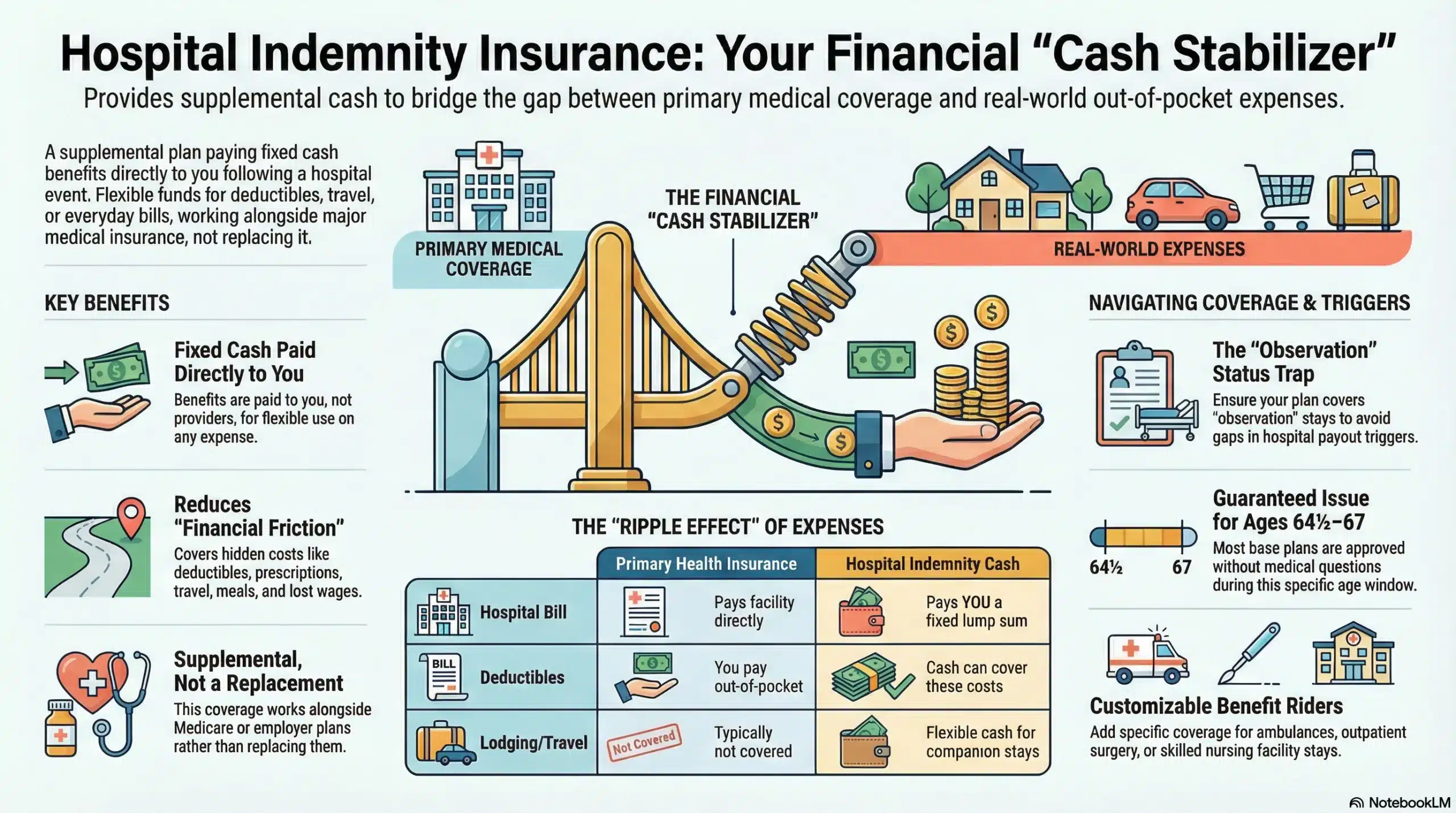
Talk With an Advisor Today
Choose how you’d like to connect—call or message us, then book a time that works for you.
Schedule here:
calendly.com/jason-dibcompanies/diversified-quotes
Licensed in all 50 states • Fiduciary, family-owned since 1980
FAQs: Outpatient Surgery & Rehab Riders
What is an outpatient surgery rider and what does it pay?
An outpatient surgery rider is a supplemental cash benefit that can pay a lump sum when an approved same-day procedure is performed in a qualifying setting (often an ambulatory surgery center or hospital outpatient department). The payment is typically a fixed amount, and you can use it for copays, coinsurance, prescriptions, transportation, or household bills while you recover.
Does it pay differently for an ambulatory surgery center (ASC) vs. hospital outpatient?
Many plans do. It’s common to see one benefit level for an ASC and a higher benefit for hospital outpatient, because billed charges and patient cost-sharing can differ by facility type. The exact structure depends on the carrier and the rider design.
How do rehab or therapy riders work?
Rehab/therapy riders usually pay a fixed cash amount per covered visit for physical therapy (PT), occupational therapy (OT), and/or speech therapy (ST). Some designs also include inpatient rehab days or specialized rehab categories. Most riders include a visit cap per year or per incident, so it’s important to match the cap to realistic therapy plans.
What documentation is typically needed to trigger the benefit?
Most carriers want proof that a covered procedure or visit occurred—commonly a bill, explanation of benefits (EOB), or visit summary that shows the date of service, the facility type (ASC vs. hospital outpatient), and the procedure/therapy performed. Requirements vary by carrier and state.
Will this pay if I’m kept in “observation” overnight?
Observation is often treated differently than an inpatient admission. Some plans have a specific observation benefit, while others tie payment to inpatient status or procedure category. If your plan includes an observation rider, that’s usually the cleanest way to handle the common “monitored overnight” scenario.
Is inpatient rehab the same as outpatient therapy visits?
No. Inpatient rehab benefits typically pay per day when you’re in a rehabilitation facility after a hospital event. Outpatient therapy benefits pay per visit at a clinic. Some families carry both because they cover different recovery paths.
Can I add these riders later?
Often yes, but adding riders later may restart waiting periods or require additional underwriting depending on the plan. Many people add them up front so they’re in place before an unexpected procedure or therapy schedule begins.
How do I choose benefit amounts without overbuying?
A good approach is to match the rider amounts to your most likely out-of-pocket exposure: typical copays/coinsurance for outpatient procedures and realistic therapy visit counts based on common recovery plans. The goal is predictable help where you actually feel the costs, not the highest benefit numbers on a brochure.
About the Author:
Jason Stolz, CLTC, CRPC and Chief Underwriter at Diversified Insurance Brokers (NPN 20471358), is a senior insurance and retirement professional with more than two decades of real-world experience helping individuals, families, and business owners protect their income, assets, and long-term financial stability. As a long-time partner of the nationally licensed independent agency Diversified Insurance Brokers, Jason provides trusted guidance across multiple specialties—including fixed and indexed annuities, long-term care planning, personal and business disability insurance, life insurance solutions, Group Health, and short-term health coverage. Diversified Insurance Brokers maintains active contracts with over 100 highly rated insurance carriers, ensuring clients have access to a broad and competitive marketplace.
His practical, education-first approach has earned recognition in publications such as VoyageATL, highlighting his commitment to financial clarity and client-focused planning. Drawing on deep product knowledge and years of hands-on field experience, Jason helps clients evaluate carriers, compare strategies, and build retirement and protection plans that are both secure and cost-efficient. Visitors who want to explore current annuity rates and compare options across multiple insurers can also use this annuity quote and comparison tool.
