
Tax Benefits of Long-Term Care Insurance

Jason Stolz CLTC, CRPC
Tax Benefits of Long-Term Care Insurance are one of the biggest reasons many families choose to plan early—because the right long-term care (LTC) strategy can reduce after-tax cost while also protecting retirement income, assets, and lifestyle. Long-term care expenses are usually not a “one-time bill.” They tend to be recurring and they often rise over time as care needs increase. That means the tax layer matters, especially if you want to avoid pulling extra taxable dollars from retirement accounts, investment income, or other sources at the worst possible time.
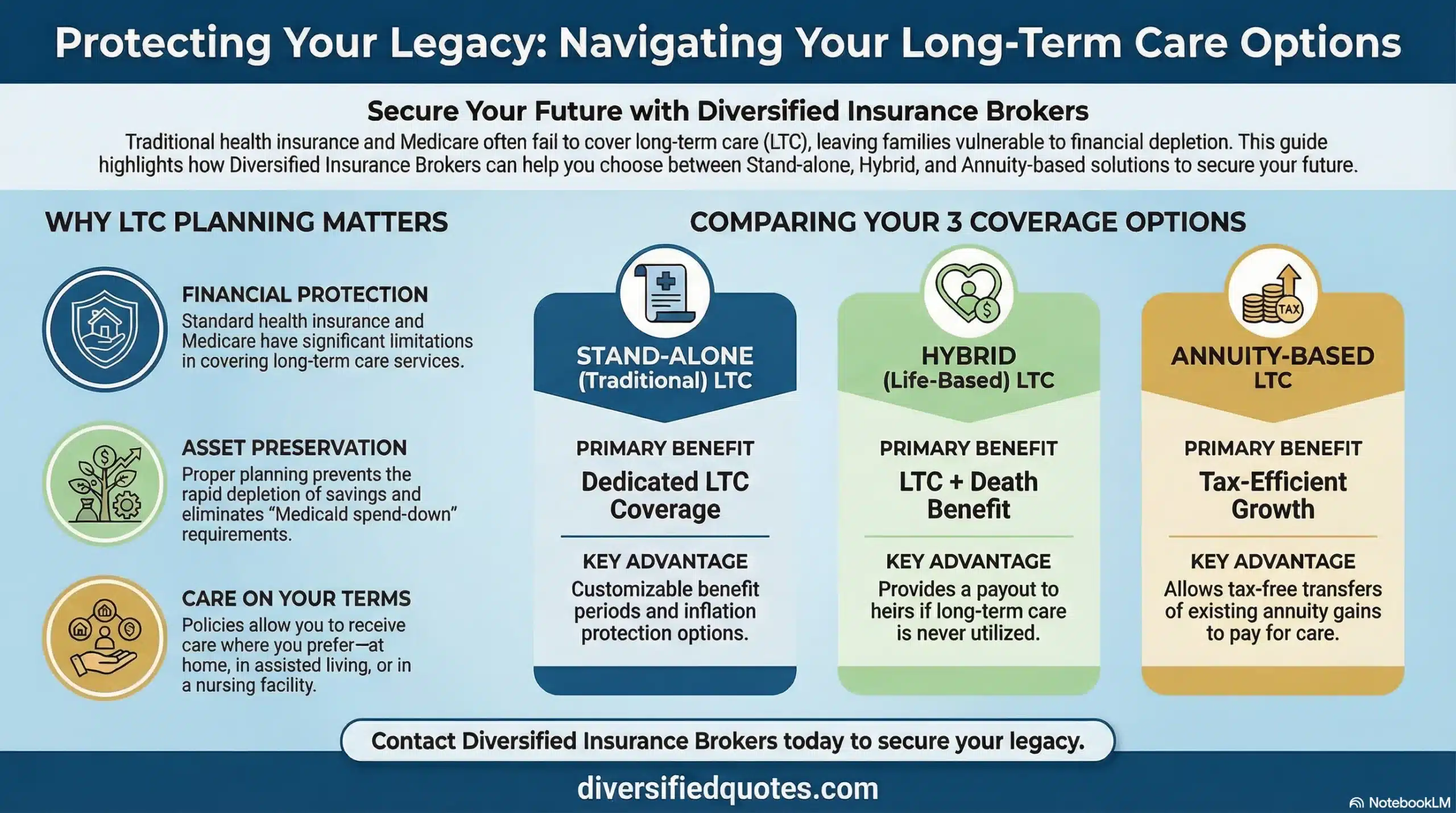
At Diversified Insurance Brokers, we help clients in all 50 states compare traditional LTC coverage with hybrid life + LTC policies and annuity-based LTC planning strategies. The goal is not to overwhelm you with tax jargon. The goal is to understand your options clearly, model the net cost, and choose a design that fits your goals—whether you want maximum leverage, maximum predictability, or a balanced approach that preserves flexibility. If you’re still deciding which type of policy structure fits you best, you can explore Affordable Hybrid Long-Term Care Policies or review value-protection features such as Long-Term Care Insurance with Return of Premium.
See Your LTC Plan After Taxes
We’ll compare traditional, hybrid, and annuity-based options and show how tax rules may reduce your net cost over time.
How the IRS generally treats qualified long-term care coverage
The tax benefits you hear about typically relate to tax-qualified long-term care coverage. When a policy meets certain federal guidelines, premiums may be treated as medical expenses in specific situations, and benefits paid for qualified long-term care services are commonly received tax-free. In practical terms, that means LTC planning can be different from many other insurance decisions because the policy may reduce the tax impact both before a claim (premium funding and possible deductions) and during a claim (tax-free benefit payments).
That said, “deductible premiums” is often misunderstood. For many households, the deduction opportunity depends on filing situation, income, and total medical expenses for the year. For others—especially certain business owners—the tax treatment can be more direct. The right move is not to assume a deduction exists, but to plan in a way where the after-tax result makes sense based on your real-world situation.
Premiums as medical expenses: where deductions may come from
In many cases, traditional LTC premiums are treated as eligible medical expenses up to certain age-based limits. Those eligible amounts can potentially become deductible depending on how you file and whether your total medical expenses meet the applicable thresholds for deductibility. The key point is that the tax benefit is not always “automatic,” but it is real for many households, especially those with higher medical expenses or those who structure their coverage thoughtfully.
For planning purposes, premium deductions tend to be most relevant when you are choosing between a policy that is “pure care coverage” (traditional LTC) and a policy that is “blended value” (hybrid life + LTC or annuity-based). Traditional policies are usually the simplest place to start when the conversation is specifically about premiums as medical expenses. Hybrid designs can still be tax-efficient, but the “tax benefit” story often shifts from premium deductions to other advantages, like tax-favored value access, repositioning strategies, and tax-free care benefits.
Tax-free long-term care benefits: the most meaningful advantage for many families
For many clients, the biggest benefit isn’t the deduction—it’s the ability to receive long-term care benefits tax-free when care is needed. That matters because long-term care events are often the same time families start making difficult decisions about retirement income. If you have to pay out of pocket, you may be forced to accelerate distributions from retirement accounts, sell investments, or disrupt income strategies.
When a policy pays benefits tax-free for qualified care, it can reduce the need for taxable withdrawals. That can help stabilize retirement cash flow, reduce bracket creep, and protect the healthy spouse from having to “spend down” the plan faster than expected. To connect tax-free benefits to the real-world mechanics of a claim, it helps to understand who generally qualifies for benefits in the first place—see Guaranteed Issue Long-Term Care Insurance if medical underwriting is a concern, or explore how value-return options fit into planning with Long-Term Care Insurance with Return of Premium.
Hybrid life + LTC policies: tax efficiency plus legacy flexibility
Hybrid life insurance policies with long-term care benefits are often chosen for one reason: they can provide a long-term care benefit if you need care, and a death benefit if you do not. That structure can feel more emotionally satisfying than paying premiums for pure care coverage—especially for people who strongly want “something” to be paid if care is never needed.
From a tax perspective, hybrids are often discussed in terms of tax-efficient access to benefits for qualified care and tax-efficient transfers to beneficiaries if care is never used. While the exact mechanics depend on the contract, the broader planning point is that a hybrid can function as both a care plan and a legacy plan. If you want a broader overview of why people choose hybrids and how they’re structured, start with Affordable Hybrid Long-Term Care Policies and then compare it to return-of-premium approaches like Long-Term Care Insurance with Return of Premium.
Annuity-based LTC strategies: turning taxable growth into tax-free care benefits
Many retirees own non-qualified annuities with gains that would normally be taxed as ordinary income when withdrawn. The planning opportunity is that certain LTC-linked annuity designs can allow those dollars to be used more efficiently when applied to qualified long-term care benefits. This is where “tax benefits” become very real: you may be converting a pool of dollars that would have created taxable income into a pool of benefits that can potentially be paid tax-free when used for care.
One common strategy is repositioning an existing non-qualified annuity into a new annuity or hybrid structure that is designed for long-term care planning. In many cases, repositioning can be done using a tax-deferred exchange structure so the move itself does not trigger immediate taxation. Then, when benefits are used for qualified care, the tax treatment can be significantly improved compared to traditional taxable withdrawals.
If you want to explore this route from an education standpoint, compare annuity repositioning options and current interest-rate environments using Current Annuity Rates, and review accumulation or repositioning concepts on Best Upfront Bonus Annuity as a reference point for how different annuity designs may fit into planning goals.
Business owners: potential deduction opportunities and planning flexibility
Business owners often have additional ways to structure long-term care coverage efficiently because the premium payments may be coordinated with business deductions and executive benefit planning. The “right” structure depends on entity type, ownership status, and how the business handles health-related benefits. While some situations allow for stronger deduction opportunities than a typical W-2 household would have, the most important step is making sure the coverage is structured correctly and fits into the broader plan.
Business owners also tend to evaluate long-term care planning in terms of continuity: protecting household assets is one part, but protecting the business and reducing financial disruption is another. In that broader executive context, some owners also compare protection tools for key employees—if that is part of your planning universe, you can review a related concept here: Disability Income Insurance for Key Employees.
How to maximize the tax benefits without overbuying coverage
The tax benefits only matter if the plan is affordable and sustainable. A “perfect” tax strategy is not helpful if it causes you to buy more coverage than you need or choose a structure you won’t keep long-term. The best long-term care plan is usually the one that fits your budget and realistically reduces the risk you care about most—protecting the healthy spouse, preserving retirement income, and reducing the chance of forced withdrawals or asset liquidation.
Many families try to find an ideal middle ground by choosing a reasonable benefit pool, pairing it with inflation protection, and using a funding strategy that preserves flexibility. Others prefer a value-return feature so the plan does not feel wasted if care is never needed. If “right-sizing” is part of your next step, revisit Long-Term Care Insurance with Return of Premium and compare it to the hybrid approach in Affordable Hybrid Long-Term Care Policies.
Build a Tax-Smart LTC Plan
We’ll match you to policy types that fit your goals and show how funding choices can change your net cost over time.
How we help at Diversified Insurance Brokers
Most people do not need a complicated plan. They need a clear explanation of options and a design that holds up over time. We help you compare traditional LTC coverage, hybrid life + LTC policies, and annuity-based strategies, then we translate the tax impact into simple terms: what you pay, what you protect, and what a claim would look like from a cash flow and tax perspective.
Because underwriting and eligibility can influence which plans you can actually buy, we also help you avoid wasted applications and misaligned expectations. If you’re planning soon and want to understand what tends to affect approval, start with educational resources like Affordable Hybrid Long-Term Care Policies and then we can narrow the conversation to the plans that are realistic for your age, health profile, and goals.
Request Your LTC Tax Strategy Review
Tell us your age, state, and goals. We’ll respond with a few plan designs and the most tax-efficient funding path.
Related Pages
Related Long-Term Care & Annuity Pages
Explore these next if you want to compare policy structures and funding options.
Talk With an Advisor Today
Choose how you’d like to connect—call or message us, then book a time that works for you.
Schedule here:
calendly.com/jason-dibcompanies/diversified-quotes
Licensed in all 50 states • Fiduciary, family-owned since 1980
FAQs: Tax Benefits of Long-Term Care Insurance
Are long-term care insurance premiums tax deductible?
Yes. For tax-qualified policies, the IRS allows partial deductions based on age. Business owners may qualify for larger or full deductions.
How does the Pension Protection Act affect long-term care annuities?
The Pension Protection Act allows you to use taxable annuity earnings tax-free for qualified LTC expenses through an LTC-linked annuity.
Can I use an existing annuity to pay for long-term care?
Yes. You can perform a 1035 exchange to move your annuity into an LTC-qualified contract. Withdrawals for care then become tax-free.
Do hybrid LTC policies offer tax advantages?
Yes. Hybrid life/LTC policies provide tax-free benefits for care and tax-free death benefits for beneficiaries if care isn’t needed.
Are LTC benefits themselves taxable?
No. LTC benefits paid for qualified services are generally tax-free under section 7702B of the IRS code.
About the Author:
Jason Stolz, CLTC, CRPC and Chief Underwriter at Diversified Insurance Brokers (NPN 20471358), is a senior insurance and retirement professional with more than two decades of real-world experience helping individuals, families, and business owners protect their income, assets, and long-term financial stability. As a long-time partner of the nationally licensed independent agency Diversified Insurance Brokers, Jason provides trusted guidance across multiple specialties—including fixed and indexed annuities, long-term care planning, personal and business disability insurance, life insurance solutions, Group Health, and short-term health coverage. Diversified Insurance Brokers maintains active contracts with over 100 highly rated insurance carriers, ensuring clients have access to a broad and competitive marketplace.
His practical, education-first approach has earned recognition in publications such as VoyageATL, highlighting his commitment to financial clarity and client-focused planning. Drawing on deep product knowledge and years of hands-on field experience, Jason helps clients evaluate carriers, compare strategies, and build retirement and protection plans that are both secure and cost-efficient. Visitors who want to explore current annuity rates and compare options across multiple insurers can also use this annuity quote and comparison tool.
