
Travel and Medical Insurance for High Risk Travel

Jason Stolz CLTC, CRPC
Travel and medical insurance for high risk travel is built for trips where “basic travel insurance” can leave major gaps. If you’re traveling to a remote region, an area with limited hospital resources, or a destination where access to quality care can change quickly, the risk is not just inconvenience—it’s the cost of urgent medical treatment, the complexity of coordinating care in a foreign system, and the financial impact of evacuation when local treatment isn’t enough.
At Diversified Insurance Brokers, we help travelers secure travel medical coverage that’s designed for real-world emergencies. When you’re far from home, the most important protection is the type that responds to hospital bills, specialist treatment, emergency procedures, and the logistics of getting you to the right facility if your location can’t handle the situation. That’s exactly what high risk travel medical insurance is meant to do.
Many travelers assume “high risk” only applies to extreme sports or war zones, but the reality is broader. A trip can become higher-risk simply because the closest advanced hospital is hours away, local providers require payment upfront, language barriers slow down care, or the destination has limited medical infrastructure. Even a healthy traveler can run into a crisis abroad that becomes expensive and stressful fast without the right insurance structure in place.
High Risk Travel Medical Insurance
Get coverage designed for higher-risk destinations, medical needs, and emergency evacuation.
What Makes Travel “High Risk”?
Insurance carriers generally consider travel higher risk when it involves limited healthcare access, locations with fewer medical resources, extended stays abroad, or destinations where reaching a modern hospital may require long ground transport or flight coordination. Some trips are labeled high risk because of political unrest or security concerns, but many are considered higher risk simply because emergency care is less accessible, slower to reach, or less equipped for complex injuries and illnesses.
High risk travel is also common for travelers who will be far from major cities, staying for long periods, working abroad, volunteering internationally, or spending time in regions where medical standards can vary widely between facilities. In those scenarios, the purpose of insurance is not “nice to have coverage.” It’s having the ability to get meaningful treatment without being trapped by limited options or unexpected costs.
For many travelers, the risk is not only the medical event itself, but the chain reaction that comes after it. Hospital admission can require deposits, care decisions can be delayed while providers validate coverage, and evacuation is often not something a traveler can coordinate alone in the middle of a true emergency. That is why specialized travel medical insurance matters most when the trip environment is less predictable.
Why Standard Travel Insurance Often Falls Short
Many “standard travel insurance” plans are designed around trip interruptions, delays, and cancellation issues. Those benefits can still be useful, but in high risk travel scenarios, the biggest exposure is usually medical and evacuation. The problem is that basic travel policies often carry lower medical maximums, narrow emergency definitions, exclusions that limit coverage in specific regions, or evacuation language that focuses on “nearest facility” rather than the “right facility.”
When you’re traveling in a high risk setting, you want a plan that treats medical coverage as the centerpiece. A single emergency room visit in the wrong location can snowball into specialist care, imaging, hospital admission, medication costs, and follow-up treatment. That’s before considering evacuation logistics, which can become the highest cost item of all if you need transport to a better hospital or back to a location where you can safely recover.
This is why many high risk travelers start by comparing dedicated travel medical plans rather than relying on a basic trip policy. If you’re trying to see how travel coverage options differ from one another, it may also help to review our broader travel planning pages like travel medical insurance and our overview of international health insurance, since travelers often confuse these categories when shopping for protection.
What High Risk Travel Medical Insurance Is Designed to Do
High risk travel medical insurance is designed to respond when you have a legitimate medical emergency and need care that is expensive, urgent, or difficult to coordinate overseas. It is less focused on the travel logistics of your flight and more focused on the consequences of injury or illness when you are out of your home system.
Most plans built for higher-risk travel scenarios emphasize emergency medical treatment, inpatient hospital services, physician visits, emergency transportation, diagnostic testing, and prescriptions tied to a covered condition. The best plans also include coordination services that help solve real problems like locating an appropriate hospital, arranging medical transport, and organizing evacuation if needed. These are the features that actually matter when you’re faced with an unfamiliar healthcare system abroad.
One of the most overlooked benefits in travel medical coverage is access to assistance teams that handle coordination. Many travelers imagine insurance as a reimbursement tool, but in a true emergency you don’t want to fight through paperwork, call around for providers, or try to schedule transport yourself. High risk travel medical insurance is most valuable when it functions as a real-time safety net, not just a “maybe we’ll reimburse you later” product.
Medical Evacuation: The Most Critical Coverage for High Risk Travel
For many higher-risk trips, emergency medical evacuation is the benefit that changes everything. In certain locations, the medical issue is not whether care exists at all—it’s whether the care that exists is appropriate for the condition. A traveler might need evacuation because the local facility cannot provide the level of treatment required, cannot safely perform the necessary procedure, or lacks the staff and equipment to handle complications.
Evacuation is expensive because it is not simply “a flight.” It can involve medical staff, equipment, specialized aircraft, international clearances, destination hospital acceptance, and logistics that must be executed quickly. When a traveler needs evacuation, it is often one of the most financially dangerous moments of the trip. That’s why coverage built for high risk travel treats evacuation as a foundation rather than an afterthought.
If evacuation is a priority for your trip, you may also want to compare options on our dedicated page for emergency medical evacuation insurance, since travelers often underestimate how quickly evacuation costs can exceed basic medical limits in standard plans.
When High Risk Travel Medical Coverage Makes the Most Sense
High risk travel medical insurance is often a strong fit when you are traveling to destinations with limited hospital infrastructure, traveling far away from major cities, or spending time in regions where emergency care could require significant coordination. It is also commonly used for travelers who are working abroad, participating in volunteer or humanitarian missions, traveling for extended durations, or visiting multiple countries on one long itinerary where medical access will vary.
This type of coverage also matters when you are traveling in a way that increases exposure to emergencies, such as traveling during hurricane season, going to locations with challenging terrain, or taking trips where medical transport is not straightforward. In those situations, insurance is not just about paying a bill. It is about being able to get the right care without delay and without being financially cornered into the wrong decision.
Even short trips can justify higher-risk medical coverage if the destination is remote or if the traveler is intentionally going somewhere where the risk environment is elevated. A traveler does not need to be “high risk” personally for a trip to be high risk from an insurance perspective. Often it’s the environment that drives the need for stronger coverage.
Pre-Existing Conditions and High Risk Travel
Pre-existing condition rules are one of the biggest differences between travel medical plans, and they matter even more in high risk travel because a flare-up in the wrong location can quickly become expensive. Some travel medical plans exclude pre-existing conditions entirely. Others may provide limited protection for an unexpected and acute flare-up, especially when the condition was stable prior to the trip. Some plans have lookback windows, stability requirements, or strict definitions that determine whether a claim is covered.
It’s important not to assume “I have coverage” without confirming how the plan defines a pre-existing condition and how the plan treats care related to that condition while traveling. This is especially important for travelers who have ongoing prescriptions, chronic conditions, or a medical history that could create ambiguity during a claim. In many situations, the right planning move is not choosing “the biggest plan.” It’s choosing a plan with language that fits your scenario clearly.
High risk travel does not always mean pre-existing conditions, but the overlap is common. A traveler with medical history who is traveling to a higher-risk destination should be more careful than most about coverage definitions, emergency requirements, and the process the carrier uses to confirm eligibility during a crisis. Our role is to help travelers read those details before departure so there are no surprises later.
How High Risk Travel Medical Insurance Is Priced
Travel medical plans are usually priced based on the traveler’s age, the destination or region, the length of the trip, the medical limit selected, the evacuation limit included, and the deductible. In general, higher limits cost more, but the goal is not to buy the most expensive option. The goal is to reduce the financial exposure of a single emergency to a manageable level.
Many travelers are surprised by how affordable strong travel medical coverage can be compared to the cost of even a short overseas hospital stay. Unlike domestic health insurance, these plans are built for short-term travel risk, not year-round use. That’s why the structure feels different, and why selecting coverage should be based on the worst-case scenario rather than on “what do I think will happen.”
High risk travel insurance can also be priced differently depending on whether it includes special features, optional upgrades, or enhanced evacuation. Even when the premium increases, the most important comparison is still the value of the benefit limits relative to the potential cost of care. It does not take a dramatic emergency for overseas costs to become financially disruptive.
What High Risk Travelers Should Watch for in a Policy
High risk travel medical insurance is only as good as the wording inside the contract. Travelers should pay attention to how emergency medical care is defined, how evacuation is authorized, what restrictions apply by location, and whether there are exclusions that could affect high risk travel environments. For example, the difference between evacuation to “the nearest adequate facility” versus evacuation to “the most appropriate facility” can matter when the nearest location is technically capable of stabilizing you but not capable of providing the treatment you actually need.
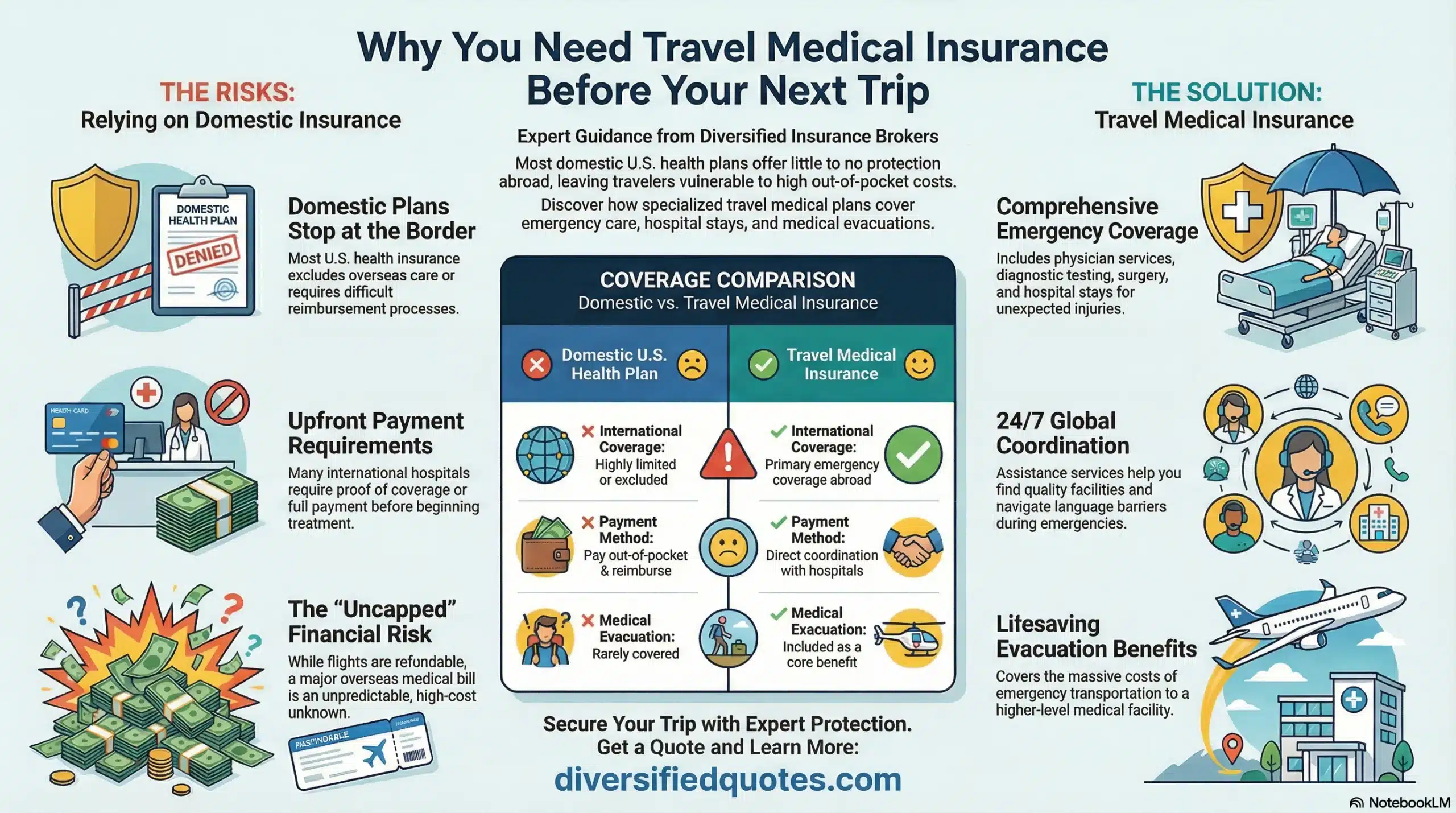
Another key point is whether the plan coordinates evacuation directly or merely reimburses. For high risk travel, reimbursement-only structures can leave the traveler financially exposed in the moment when time matters most. Coordinated assistance is often the difference between an organized response and a crisis that becomes a logistical nightmare.
Travelers should also be careful about assumptions related to “adventure” or “higher risk activities.” Some plans include broader language for recreational activities, while others exclude many things unless you purchase an upgrade. The best approach is to choose coverage based on what you are actually doing and where you are actually going, not what you think a generic travel plan might cover.
How Claims Typically Work During High Risk Travel
In an emergency abroad, the most important goal is to get care fast, and then use the plan’s assistance resources to coordinate what happens next. Depending on the facility and the situation, hospitals may request payment arrangements, proof of coverage, or authorization before proceeding with certain treatments. This is where travel assistance services can make the process smoother, especially for larger hospital stays or evacuation situations.
For less severe issues, the traveler may pay out of pocket and seek reimbursement later. For more severe medical events, coordination and authorization can become central to the process. That is why high risk travelers should not only compare dollar limits, but also compare what level of assistance and real-time coordination the plan provides.
Claims also go better when documentation is clear. Medical records, receipts, treatment summaries, and physician notes matter. High risk travel can create complicated medical scenarios, and strong documentation can reduce delays and confusion later. The planning goal is to choose coverage that fits the risk environment so the claim aligns naturally with the plan’s definitions and requirements.
High Risk Travel Medical Insurance vs. Other Coverage Types
Travelers often compare travel medical insurance to international health insurance or to comprehensive travel plans that include trip cancellation. These products can overlap, but they are not identical. Travel medical insurance is often designed for emergency scenarios while you are outside your home country for a limited period, especially when you need urgent care or evacuation protection.
International health insurance can make more sense for longer stays or travelers who want a broader “health plan” structure while living abroad rather than traveling temporarily. Meanwhile, trip-focused travel insurance often emphasizes cancellation, interruption, and baggage-related benefits. For high risk travel, medical and evacuation are often the highest priority, which is why travel medical plans are frequently the centerpiece solution.
If you want a broader look at coverage categories, you can explore international health insurance and compare it against travel medical plans that are structured more for emergency events. Many travelers end up combining solutions depending on their length of travel and the risk level of their destination.
Why Work With Diversified Insurance Brokers?
Choosing the wrong travel plan for a high risk destination can feel fine right up until it matters. The reason people work with Diversified Insurance Brokers is simple: we help you match coverage to the real risk you’re taking, not the marketing description on a generic policy page.
Since 1980, we’ve helped clients navigate complex insurance needs by comparing real plan differences, explaining exclusions in plain language, and focusing on what matters when you are the one facing an emergency far from home. For high risk travel, that means prioritizing emergency medical limits, evacuation strength, and dependable support services that function during stressful situations.
We also help travelers avoid common mistakes, like buying coverage that looks strong on paper but has narrow definitions, low evacuation protection, or exclusions that apply directly to the destination. In many cases, the best protection is not “more coverage.” It’s choosing the correct coverage structure before you leave.
Get Protected Before You Go
High risk travel requires proactive planning because coverage gaps cannot be fixed after the trip begins. Once an emergency happens abroad, you cannot retroactively add evacuation benefits, increase medical limits, or adjust exclusions. The correct time to do it is before departure, while you still have control over the plan selection.
If you are traveling to an elevated risk destination, staying abroad longer than a typical trip, or you simply want higher confidence that medical care and evacuation will be handled correctly, travel medical insurance built for high risk travel can be one of the smartest purchases you make for the entire trip.
Explore High Risk Travel Medical Insurance
Compare medical and evacuation coverage options built for higher-risk travel situations.
Talk With an Advisor Today
Choose how you’d like to connect—call or message us, then book a time that works for you.
Schedule here:
calendly.com/jason-dibcompanies/diversified-quotes
Licensed in all 50 states • Fiduciary, family-owned since 1980
Frequently Asked Questions
What is travel and medical insurance for high risk travel?
It is specialized travel medical coverage designed for destinations, activities, or situations where standard travel insurance may not provide enough protection, especially for emergency medical care and evacuation.
What makes a trip “high risk” for insurance purposes?
Travel may be considered high risk due to remote locations, limited medical infrastructure, political instability, extended stays abroad, or increased likelihood of emergency evacuation.
Does high risk travel insurance cover emergency evacuation?
Most plans include emergency medical evacuation and repatriation when adequate local care is unavailable, which is a critical benefit for high risk travel scenarios.
Is this the same as trip cancellation insurance?
No. These plans focus primarily on medical treatment and evacuation rather than trip delays, cancellations, or lost baggage.
Are pre-existing conditions covered?
Coverage varies by plan. Some policies exclude pre-existing conditions, while others may cover sudden or acute flare-ups. Plan details should be reviewed carefully before travel.
Who should consider high risk travel medical insurance?
Travelers visiting remote or developing regions, participating in higher-risk activities, staying abroad long-term, or seeking stronger emergency protection should consider this type of coverage.
How is high risk travel medical insurance priced?
Pricing is typically based on age, destination, trip length, medical and evacuation limits, and deductible options.
Do I need this if I already have health insurance?
Many domestic health plans offer little or no coverage outside your home country. Travel medical insurance fills those gaps and adds evacuation benefits.
When should I purchase coverage?
Coverage should be purchased before departure. Benefits generally do not apply to incidents that occur before the policy start date.
About the Author:
Jason Stolz, CLTC, CRPC and Chief Underwriter at Diversified Insurance Brokers (NPN 20471358), is a senior insurance and retirement professional with more than two decades of real-world experience helping individuals, families, and business owners protect their income, assets, and long-term financial stability. As a long-time partner of the nationally licensed independent agency Diversified Insurance Brokers, Jason provides trusted guidance across multiple specialties—including fixed and indexed annuities, long-term care planning, personal and business disability insurance, life insurance solutions, Group Health, and short-term health coverage. Diversified Insurance Brokers maintains active contracts with over 100 highly rated insurance carriers, ensuring clients have access to a broad and competitive marketplace.
His practical, education-first approach has earned recognition in publications such as VoyageATL, highlighting his commitment to financial clarity and client-focused planning. Drawing on deep product knowledge and years of hands-on field experience, Jason helps clients evaluate carriers, compare strategies, and build retirement and protection plans that are both secure and cost-efficient. Visitors who want to explore current annuity rates and compare options across multiple insurers can also use this annuity quote and comparison tool.
