
Travel Medical and Evacuation Insurance for Afghanistan

Jason Stolz CLTC, CRPC
For individuals and families traveling to or living in higher-risk environments like Afghanistan, access to travel medical and evacuation insurance is not a “nice to have.” It is the difference between hoping a local clinic can handle your emergency and having a professional assistance team that can coordinate care, secure treatment, and move you to the nearest appropriate facility when local capability falls short. A serious illness, injury, or sudden medical complication can become expensive and logistically complex very quickly in destinations where hospital resources are inconsistent and transportation can be limited. That is why this page focuses on travel medical benefits paired with emergency evacuation support, so you have a clear plan for what happens if the unexpected occurs.
Travel medical coverage is designed to help pay for eligible emergency medical treatment while you are abroad, including urgent physician services, diagnostics, hospitalization, and medically necessary procedures. Evacuation coverage adds the “continuity of care” layer: when the nearest facility cannot deliver the level of care your condition requires, evacuation benefits can help coordinate medically necessary transport to the nearest appropriate hospital—often outside the country—so you can receive proper treatment without having to solve complicated logistics while you are ill or injured. If you want a broader overview of how evacuation works, what triggers it, and why the assistance team matters as much as the benefit limit, start with our Emergency Medical Evacuation Insurance page.
At Diversified Insurance Brokers, we help travelers compare international plans designed for complex destinations where medical access and evacuation logistics need to be planned before departure. If you are traveling for humanitarian missions, contracting work, journalism, family obligations, or academic programs, you do not want the first time you learn how your coverage works to be from a clinic waiting room. If your trip profile is higher-risk due to location, duration, remoteness, or operational realities, you can also review our High Risk Travel Insurance guide and our deeper resource on Travel and Medical Insurance for High Risk Travel to match coverage to the realities on the ground.
Why Travel Medical Coverage Matters in Afghanistan
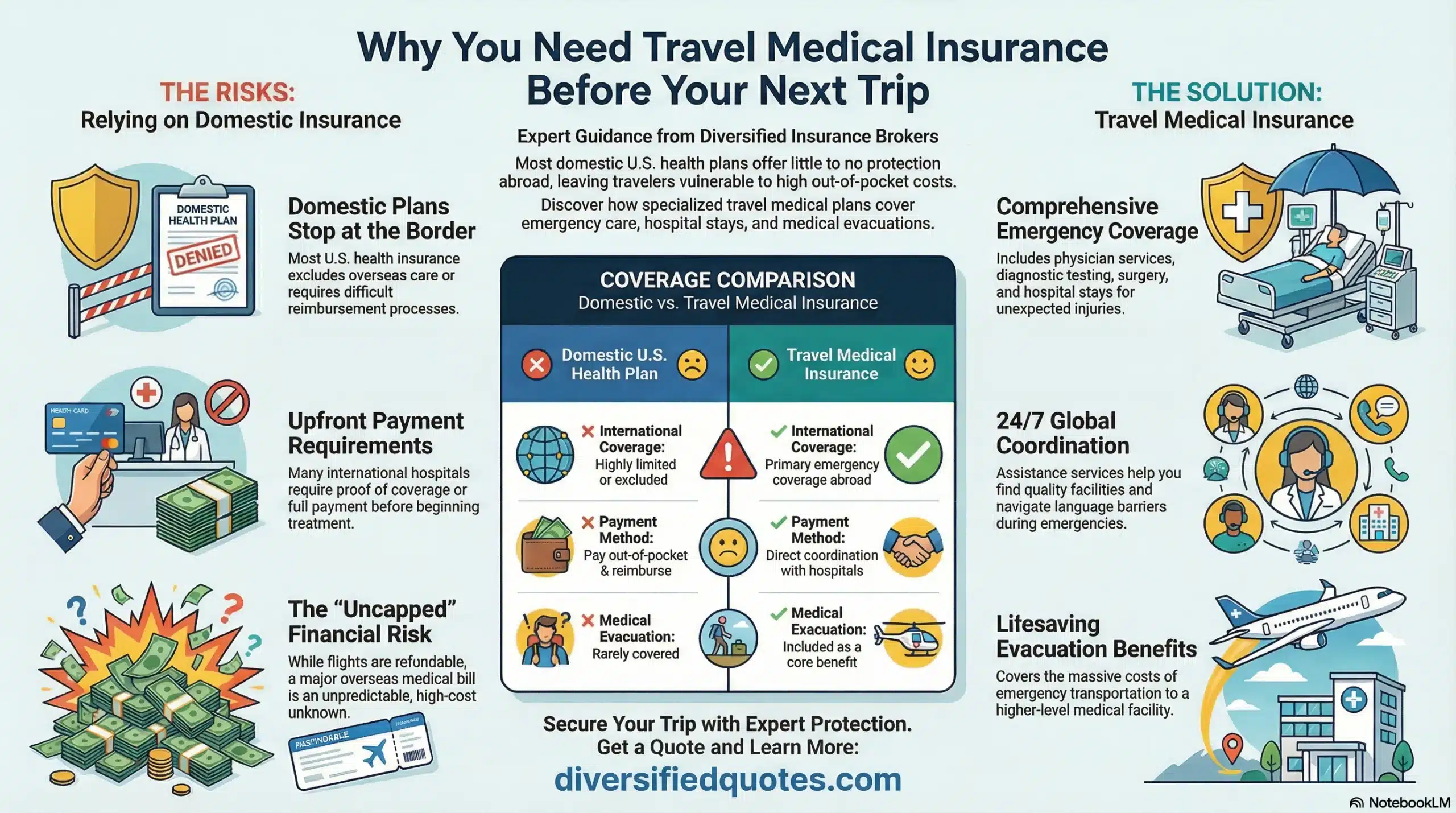
Many travelers assume their domestic health insurance will protect them overseas. In practice, most U.S. plans provide limited coverage outside the country, and even when some reimbursement exists, it rarely includes coordinated emergency evacuation. In Afghanistan, that gap can become expensive and dangerous quickly because serious events are not just about treatment costs. They are also about access, speed, coordination, and getting to an appropriate level of care when local capability is insufficient.
Emergency medical access can be inconsistent. Even when care is available, travelers may face limitations with diagnostics, specialist availability, medication continuity, and surgical or ICU capacity. In a serious event—trauma, infection complications, cardiac symptoms, or acute abdominal issues—your outcome can depend on how quickly you can be stabilized and moved to a facility that can deliver the required level of care.
Evacuation costs can be extreme without coverage. Air ambulance services, medical escorts, cross-border coordination, receiving-hospital arrangements, and ground transfers can add up rapidly. It is not unusual for a medically necessary evacuation and transfer chain to reach five figures, and in certain scenarios it can go well beyond that. Coverage does not just help pay; it helps coordinate the response through a 24/7 assistance team.
Medical evacuation is a medical decision, not a preference. Evacuation benefits typically require medical necessity. That means the assistance provider (often working with treating physicians) determines that appropriate care is not available locally or that staying locally would significantly increase medical risk. Evacuation is then coordinated to the nearest appropriate facility, which may be in a neighboring country depending on your condition and location.
Non-medical evacuation is different. Many travelers hear “evacuation” and think it includes security extraction, political evacuation, or a general relocation when conditions deteriorate. Most travel medical policies are focused on medical events. If your concern is non-medical extraction, that is typically addressed through separate security-evac services or specialty add-ons and is not the same as medical evacuation. This page is focused on medical benefits and medically necessary evacuation coordination.
How Medical Evacuation Works in Real Life
Medical evacuation is best understood as a coordinated medical service rather than a single flight. It usually begins with triage and stabilization at the nearest appropriate facility. From there, the assistance team evaluates whether the facility can deliver the care your condition requires. If the answer is “no,” the team coordinates the safest transfer path to an appropriate facility. Depending on severity and medical clearance, that transfer might be a ground ambulance, a dedicated air ambulance, or scheduled commercial transport with a medical escort.
In higher-risk environments, the assistance team matters because they are coordinating more than transport. They are coordinating the clinical handoff between facilities, confirming the receiving hospital can accept you, managing logistics, and helping your travel companion or employer understand next steps. In the middle of a medical emergency, it is difficult for travelers to do this alone, especially when communications, local infrastructure, or logistics are challenging.
If you are planning an extended assignment and want broader non-emergency access (including more comprehensive ongoing care options), you may also want to compare the structure of longer-term international medical plans on our International Health Insurance page, which can be a better fit for long stays than short-term travel medical plans.
What Travel Medical Coverage Can Help With
Emergency medical benefits are designed for unexpected events, not routine checkups. In practical terms, this can include urgent care visits, physician evaluation, diagnostics such as labs or imaging, hospitalization, surgery when needed, and eligible prescriptions. In many situations, travelers seek private or higher-quality care when available, and coverage can help reduce the risk of a major out-of-pocket event.
In complex destinations, medical events also create secondary issues: delays in getting imaging, limited specialist coverage, inconsistent medication supply, and difficulty securing admission. Medical benefits can help pay eligible costs, while the assistance team helps navigate where to go and how to secure appropriate care. The value is not just financial. It is operational—having a system in place when decisions must be made quickly.
Example Scenario: Why Coverage Matters
Imagine an aid worker in Afghanistan who develops sudden symptoms consistent with a serious medical emergency. A local facility can perform an initial evaluation, but advanced diagnostics and specialist treatment are not reliably available in their area. With a travel medical and evacuation plan, the traveler contacts the 24/7 assistance line, is guided to the nearest appropriate facility for stabilization, and—if medically necessary—an evacuation is coordinated to the nearest hospital that can provide the required level of care. Without coverage, the traveler may face large upfront deposits, major out-of-pocket medical bills, and the full cost of medically supervised transport, which can easily exceed $100,000 in a complex evacuation scenario.
This is why travelers should view travel medical + evacuation coverage as a single integrated strategy. The medical coverage helps with eligible treatment costs. The evacuation component addresses the “continuity of care” problem when local capability is not enough.
Secure International Medical Coverage
Protect yourself and your loved ones with travel medical coverage and evacuation support for Afghanistan.
Coverage Highlights: What to Look For
24/7 emergency assistance is the core feature. In a serious event, you want a hotline that is staffed 24/7 and capable of coordinating care, arranging transfers, and guiding you to appropriate facilities. The assistance provider is the operational engine that turns your policy into a real response.
Evacuation wording should be broad and medically clear. The best evacuation benefits focus on medically necessary transfer to the nearest appropriate facility. Travelers should pay attention to how “medical necessity” is determined, whether the assistance team must coordinate the evacuation, and how repatriation is addressed when you are medically cleared.
Emergency medical limits should match your trip profile. Many travelers target meaningful emergency medical limits because hospitalization, diagnostics, and procedures can add up quickly—especially when private care is involved. The “right” number depends on trip length, risk profile, and the level of care you want access to if something happens.
Pre-existing condition rules matter. Some plans exclude pre-existing conditions entirely. Others offer limited coverage for conditions that meet stability requirements. If you have any meaningful medical history, it is important to understand how the policy treats pre-existing conditions so expectations are realistic before you depart.
If you are trying to balance cost with real protection, our Cheap Travel Insurance resource helps explain where lower-priced plans sometimes reduce the exact benefits travelers rely on in serious emergencies. If you are coordinating coverage for a team or organization, you can also review Cheap Group Travel Insurance to compare group-friendly options.
Who Should Consider Travel Medical and Evacuation Coverage for Afghanistan
This type of coverage is commonly used by humanitarian workers, contractors, and aid staff who need a medical safety net in a destination where care may be limited or disrupted depending on location. It is also important for journalists and professionals on assignment who may travel between regions or operate in challenging conditions where access to advanced care can be uncertain.
Families connected to expatriate work, academic programs, or long-term projects also benefit from having a structured emergency plan. When a spouse or child becomes ill, decisions need to be made quickly, and having an assistance team guiding the process can reduce confusion and delay. For travelers who will spend time outside urban centers, evacuation planning becomes even more important because the distance to advanced care may be significant.
Practical Pre-Travel Planning Steps
Before departure, make sure your coverage dates match your full travel window, including travel days and potential delays. Save your policy number and emergency assistance contact in multiple places—on your phone, in a printed copy, and shared with a trusted contact. If you take prescription medications, bring enough supply for your stay plus a buffer, and keep copies of prescriptions in case replacement is needed.
It is also smart to plan for the reality that some facilities may request deposits or upfront payment. Having a payment method available and knowing how your policy handles reimbursement can reduce stress. Most importantly, treat the assistance hotline as your first call during serious events. Early coordination is often the difference between a smooth transfer and a delayed response.
Get Covered Before You Travel
Apply online in minutes to secure travel medical and evacuation coverage for Afghanistan.
Related Travel Medical Pages
Explore related resources to compare travel medical benefits, evacuation planning, and coverage options for higher-risk itineraries.
Talk With an Advisor Today
Choose how you’d like to connect—call or message us, then book a time that works for you.
Schedule here:
calendly.com/jason-dibcompanies/diversified-quotes
Licensed in all 50 states • Fiduciary, family-owned since 1980
Travel Medical & Evacuation Insurance for Afghanistan (FAQ)
Do I need travel medical and evacuation insurance for Afghanistan?
In most cases, yes. Medical access can be inconsistent, and serious events may require coordinated transfer to a higher level of care. A travel medical plan helps with eligible emergency treatment, while evacuation support helps coordinate medically necessary transport when local capability is not sufficient.
What does “medical evacuation” mean in a travel medical policy?
Medical evacuation is a coordinated medical service. If you cannot receive appropriate care locally, the assistance team evaluates your situation and—when medically necessary—arranges transport to the nearest appropriate facility that can treat your condition. The transport method can vary (ground ambulance, air ambulance, or commercial transport with a medical escort) depending on severity and medical clearance.
Is evacuation included if I want to leave for safety reasons?
Typically not. Medical evacuation benefits generally require medical necessity. Non-medical evacuation (security, political unrest, or “get me out” events) is usually not covered under medical-only evacuation benefits unless you have separate security-evac coverage or a specialized add-on.
How much emergency medical coverage should I consider?
The right limit depends on trip length, activities, remoteness, and the level of care you may need access to if something happens. Many travelers choose higher limits for complex destinations because hospitalization, diagnostics, and procedures can add up quickly—especially when private or cross-border care is involved.
How much evacuation coverage should I consider?
Evacuation limits can matter as much as medical limits in higher-risk locations. Transport logistics, aircraft availability, medical escorts, and cross-border coordination can be expensive. Many travelers aim for strong evacuation limits and a reputable assistance provider so transfers can be handled quickly when medically necessary.
Will a hospital bill my insurer directly?
Direct billing varies by location and facility. Some providers may require deposits or payment up front. Keep your policy details and assistance hotline available, follow the assistance team’s guidance, and retain all medical records and receipts for claims processing.
Are pre-existing conditions covered?
It depends on the plan. Some policies exclude pre-existing conditions entirely. Others may provide limited benefits or coverage under stability rules (with look-back and stability requirements). If you have medical history, confirm how the policy defines a pre-existing condition and what limitations apply before you travel.
What should I do first if I have a serious illness or injury?
Seek immediate local care for stabilization, then contact the 24/7 assistance team as soon as you can. Early coordination helps the assistance provider guide you to appropriate facilities, confirm eligibility, and arrange medically necessary transport if local care cannot meet your needs.
What documents should I carry to make an emergency easier?
Carry your insurance certificate and policy number, the 24/7 assistance contact details, passport/visa, a list of medications with prescriptions, and digital backups of key documents. Share your policy details with a trusted contact at home or with your organization.
When should I purchase coverage and how long should it last?
Purchase before departure and ensure coverage spans your entire travel period, including transit days and potential delays. For longer stays, confirm the policy territory, benefit limits, and assistance capabilities align with where you will be located.
About the Author:
Jason Stolz, CLTC, CRPC and Chief Underwriter at Diversified Insurance Brokers (NPN 20471358), is a senior insurance and retirement professional with more than two decades of real-world experience helping individuals, families, and business owners protect their income, assets, and long-term financial stability. As a long-time partner of the nationally licensed independent agency Diversified Insurance Brokers, Jason provides trusted guidance across multiple specialties—including fixed and indexed annuities, long-term care planning, personal and business disability insurance, life insurance solutions, Group Health, and short-term health coverage. Diversified Insurance Brokers maintains active contracts with over 100 highly rated insurance carriers, ensuring clients have access to a broad and competitive marketplace.
His practical, education-first approach has earned recognition in publications such as VoyageATL, highlighting his commitment to financial clarity and client-focused planning. Drawing on deep product knowledge and years of hands-on field experience, Jason helps clients evaluate carriers, compare strategies, and build retirement and protection plans that are both secure and cost-efficient. Visitors who want to explore current annuity rates and compare options across multiple insurers can also use this annuity quote and comparison tool.
