
Travel Medical and Evacuation Insurance for Gaza

Jason Stolz CLTC, CRPC
Travel medical and evacuation insurance for Gaza is not optional planning—it is emergency planning. Whether you are traveling into Gaza for journalism, humanitarian work, contracting, family obligations, or short-term business support, the biggest risk is not just getting sick or injured. The biggest risk is what happens after that: where you can actually receive appropriate treatment, how quickly you can be stabilized, and how difficult it may be to coordinate care when local access is limited or conditions change fast. This is why a travel medical policy paired with medically necessary evacuation support is so important in Gaza. It helps cover eligible emergency treatment and gives you access to a 24/7 assistance team that can guide you, coordinate care, and arrange medically necessary transport to the nearest appropriate facility when local capability is not enough.
This page is focused on emergency medical coverage and medical evacuation coordination. It is not the same thing as security extraction or political evacuation. Many travelers hear “evacuation” and assume it means “remove me from danger,” but most travel medical plans are built around medical events. Evacuation generally requires medical necessity, and it is typically coordinated by the plan’s assistance provider based on your condition, the resources available where you are, and the safest path to a facility that can treat you. If you want a clearer overview of what counts as medical evacuation, why the assistance team matters, and how evacuation decisions are usually made, start with our Emergency Medical Evacuation Insurance guide.
At Diversified Insurance Brokers, we help travelers compare plans designed for complicated destinations where the “care pathway” matters as much as the medical limit. If your trip profile is higher-risk due to location, remoteness, length of stay, or operational realities, you can also compare coverage considerations on our High Risk Travel Insurance page and our deeper planning resource on Travel and Medical Insurance for High Risk Travel. The goal is simple: you should not be learning how your policy works from a clinic waiting room.
Secure Travel Medical & Evacuation Coverage for Gaza
Apply online today and put emergency medical and medically necessary evacuation support in place before you travel.
Why Travel Medical Coverage Matters in Gaza
Gaza travel planning has a reality that many travelers underestimate: a medical emergency is not just about finding a doctor. It is about access, capacity, speed, and coordination. In higher-risk regions, even a straightforward emergency—fracture, appendicitis, severe infection, asthma flare, dehydration complications, or cardiac symptoms—can become complicated if local treatment options are limited, if diagnostics are delayed, or if specialty care is not available at the moment you need it. Travel medical coverage is built to help pay eligible emergency treatment costs, and just as importantly, it connects you to an assistance team that can help direct you to appropriate care and coordinate next steps.
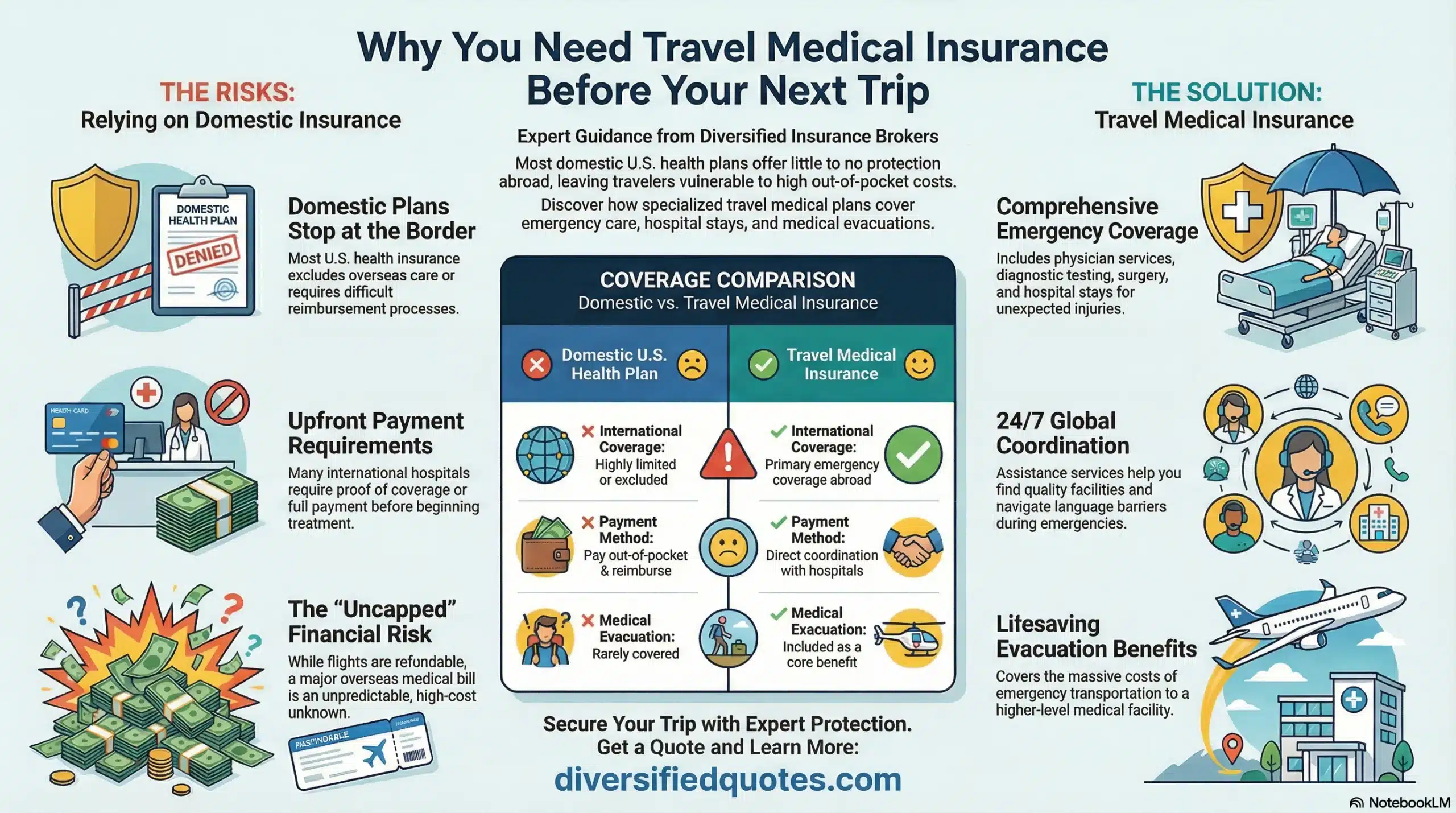
Many travelers also assume their domestic health insurance will protect them abroad. In practice, most U.S. plans provide limited coverage outside the country, and even when reimbursement exists, it rarely includes coordinated evacuation services. That gap can be costly anywhere, but it matters more in Gaza because serious events may require moving to a higher level of care. Evacuation and transfer logistics can be expensive, and coordination can be difficult if you do not have a professional assistance provider managing it. If you want a clearer comparison of how “low price” plans sometimes trim the exact benefits that matter most in serious events, review our Cheap Travel Insurance resource.
Finally, it is critical to understand the difference between medical evacuation and non-medical evacuation. Most standard travel medical plans respond to medical events. If your primary concern is security extraction or relocation due to non-medical threats, that is typically addressed through specialized security-evac services, not standard medical evacuation benefits. This page focuses on medical coverage and medically necessary evacuation coordination so expectations are clear.
How “Medical Evacuation” Actually Works
Medical evacuation is best understood as a coordinated medical service, not a simple flight booking. In a real emergency, the process usually starts with triage and stabilization at the nearest appropriate facility that can safely evaluate you. Once you are stable enough for transfer (if transfer is needed), the assistance team works with treating clinicians to determine whether appropriate care is available locally. If it is not, and if moving you is medically appropriate, the team coordinates evacuation to the nearest appropriate facility that can treat your condition. That destination might be within the region or it might be outside the area depending on your medical needs and what is realistically available.
The transport method depends on medical severity and clearance. In some cases, it is ground transport to a better-equipped facility. In other cases, it could be an air ambulance, or commercial transport with a medical escort when you are stable enough for that type of transfer. The point is not the method—the point is that you have a system that can coordinate the handoff, confirm receiving-facility acceptance, manage logistics, and keep the process moving while you focus on getting treated. If you want a fuller breakdown of what typically triggers evacuation, how “medical necessity” is handled, and why the assistance provider can matter as much as the benefit limit, our Medical Evacuation Insurance page is the best place to start.
If you are traveling for an extended assignment and want broader access beyond emergencies, you may also want to compare longer-term coverage structures on our International Health Insurance page. For many long stays, international medical plans can be a better fit than short-term travel medical policies because they are designed with longer-term care access in mind.
What Travel Medical Coverage Can Help Pay For
Travel medical insurance is designed for unexpected events, not routine checkups. In practical terms, eligible emergency benefits may include physician evaluation, urgent care visits, diagnostics such as labs and imaging, hospitalization, medically necessary procedures, and eligible prescriptions related to a covered illness or injury. The value is straightforward: you avoid a large out-of-pocket expense in a moment where care decisions should be driven by medical need rather than cost.
In higher-risk areas, the value is also operational. Travelers can run into issues that have nothing to do with the diagnosis itself—delays to get imaging, gaps in specialist availability, difficulty securing admission, and inconsistent access to medications. A good plan pairs the medical benefit with a 24/7 assistance team that can help you figure out where to go, how to get admitted, and how to coordinate next steps if local care is not sufficient.
It is also helpful to set expectations about billing. Even with insurance, some facilities may request deposits or upfront payment. Having a policy in place, keeping your documents accessible, and contacting the assistance team early can make it easier to navigate those demands, especially when the situation is urgent and time matters.
Example Scenario: Why This Coverage Matters
Imagine a journalist or contractor working in Gaza who develops symptoms consistent with a serious medical emergency. The first step is immediate evaluation and stabilization. But if appropriate diagnostics or specialty care is not available where they are, the problem becomes “Where can this person receive the right level of treatment?” Without coverage, the traveler may face large upfront costs, limited guidance on where to go next, and the full cost of medically supervised transport. With travel medical and evacuation coverage, the traveler can contact the assistance team, receive guidance on care options, and—if medically necessary—have evacuation coordinated to the nearest appropriate facility that can deliver the required treatment. In complex situations, that coordination is often the difference between a manageable event and a chaotic, expensive one.
If you are comparing similar coverage for other complex destinations, you may also want to review our destination page for Travel Medical and Evacuation Insurance for Afghanistan or our overview for Travel Medical and Evacuation Insurance for Ukraine. These pages are designed to help travelers understand how evacuation planning changes when local medical capability may be limited or disrupted.
What to Look For When Buying Coverage for Gaza
1) A strong 24/7 assistance provider. In high-stress situations, the assistance team is the operational engine that turns your policy into a real-world response. This is why travelers should not evaluate a plan only by price or medical limit. The response system matters. You want a team that can coordinate care, confirm facility acceptance, manage transfers, and guide you through next steps with clarity.
2) Clear medical evacuation language. The best evacuation benefits focus on medically necessary transfer to the nearest appropriate facility capable of treating your condition. Pay attention to how medical necessity is determined, whether the assistance team must coordinate the evacuation, and what the policy says about repatriation when you are medically cleared. If evacuation language is vague or overly restrictive, that can matter most in the very scenarios where you are counting on the benefit.
3) Meaningful emergency medical limits. The “right” limit depends on your trip profile, length of stay, and how remote your work is. Many travelers choose higher limits because hospitalization and procedures can add up quickly, especially when private care is involved. The point is to match your limit to a realistic worst-case scenario, not a best-case scenario.
4) Pre-existing condition rules that match your health profile. Some plans exclude pre-existing conditions entirely. Others offer limited coverage based on stability rules and look-back requirements. If you have medical history, it is important to understand how the policy defines a pre-existing condition and what is excluded or limited before you travel. That way, you know the plan’s boundaries and can plan accordingly.
5) A plan that fits how you are traveling. If you are traveling with a team, organization, or group deployment, you may want to compare group-friendly structures on our Cheap Group Travel Insurance page. If you are balancing cost with meaningful benefits, start with Cheap Travel Insurance so you understand what the lower-priced options often reduce first (and why that can matter in a serious emergency).
Who Typically Buys Travel Medical and Evacuation Coverage for Gaza
This coverage is commonly used by professionals who have elevated exposure simply because of where they are going and what their daily environment looks like. Journalists and media crews often want a plan that provides emergency care and medically necessary evacuation coordination, especially when they are moving between locations or working under tight timelines. Humanitarian and NGO staff often need a medical safety net that can handle the reality that the nearest appropriate treatment facility may not be close. Contractors and specialized professionals may have shorter assignments but still face meaningful medical access risks if something happens during the trip.
Families traveling for personal reasons also benefit from having a structured emergency plan. When a spouse or child becomes ill, decisions need to be made quickly and confidently. A policy with strong assistance coordination can reduce confusion and delay when time matters most.
Practical Pre-Travel Steps That Make Insurance Work Better
Travel insurance is most effective when it is treated as a system, not a PDF. Before you leave, confirm your coverage dates include travel days and potential delays. Save your policy number and assistance hotline in multiple places: on your phone, in an email, and in a printed copy. Share those details with a trusted contact or with your organization so someone else can help communicate if you cannot.
If you take prescription medication, bring enough supply for your full stay plus a buffer. Keep copies of prescriptions and a basic medication list in case replacement is needed. Plan for the practical reality that some facilities may request deposits or payment up front. Having a payment method available and understanding how reimbursement works can reduce stress during urgent events.
Most importantly, treat the assistance hotline as your first call during serious events (after immediate stabilization needs are addressed). Early coordination is often the difference between a smooth transfer and a delayed response. The sooner the assistance provider is involved, the sooner they can guide you to appropriate facilities and coordinate a medically necessary transfer if local care cannot meet your needs.
If you are also comparing regional planning for nearby or similarly complex destinations, you can use our destination pages as reference points for how evacuation planning changes by location, including Afghanistan, Ukraine, and Venezuela.
Apply Online in Minutes
Secure travel medical coverage and medically necessary evacuation support for Gaza before you travel.
Related Travel Medical Pages
Explore related resources to compare emergency medical benefits, evacuation planning, and coverage options for higher-risk itineraries.
Related Destination Pages
If you’re traveling to multiple higher-risk regions, these destination pages highlight why evacuation planning matters and what to look for.
Talk With an Advisor Today
Choose how you’d like to connect—call or message us, then book a time that works for you.
Schedule here:
calendly.com/jason-dibcompanies/diversified-quotes
Licensed in all 50 states • Fiduciary, family-owned since 1980
Travel Medical & Evacuation Insurance for Gaza (FAQ)
Do I need travel medical and evacuation insurance for Gaza?
In most cases, yes. The biggest risk is not only a medical event—it is limited access to appropriate care and the difficulty of coordinating next steps quickly. Travel medical coverage can help with eligible emergency treatment, while evacuation support helps coordinate medically necessary transfer when local capability is not sufficient.
Does this cover non-medical evacuation (security or political extraction)?
Typically no. Most travel medical policies focus on illness and injury. Medical evacuation usually requires medical necessity. Non-medical evacuation is generally handled through separate security-evac coverage or specialty services, not standard medical evacuation benefits.
What does “medical evacuation” mean in real life?
It is a coordinated medical service. The process often begins with evaluation and stabilization at the nearest appropriate facility. If appropriate care is not available locally and transfer is medically necessary, the assistance team coordinates transport to the nearest appropriate facility that can treat your condition, using the safest method based on your medical status.
How much emergency medical coverage should I consider?
The right limit depends on your trip profile, length of stay, and the level of care you may need. Many travelers choose higher limits for complex destinations because hospitalization, diagnostics, and procedures can add up quickly, especially when private care is involved.
How much evacuation coverage should I consider?
Evacuation can be expensive due to transport logistics, medical escort needs, and coordination. Many travelers prioritize strong evacuation limits and a reputable assistance provider so medically necessary transfers can be coordinated efficiently when local capability falls short.
Will a clinic or hospital require payment up front?
It can happen. Some facilities may request deposits or immediate payment. Keep your policy details accessible, contact the assistance team early, and retain all receipts and medical records for claims processing.
Are pre-existing conditions covered?
It depends on the plan. Some policies exclude pre-existing conditions entirely, while others may provide limited coverage based on stability rules and look-back requirements. If you have medical history, confirm how the policy defines pre-existing conditions before you travel.
What should I do first during a serious medical event?
Get immediate local evaluation and stabilization, then contact the 24/7 assistance team as soon as possible. Early involvement helps the assistance provider guide care decisions and coordinate medically necessary transport if local treatment cannot meet your needs.
What documents should I carry?
Carry your policy certificate and policy number, the 24/7 assistance contact details, passport/ID, medication list with prescriptions, and digital backups. Share your policy details with a trusted contact or your organization.
When should I buy coverage and how long should it last?
Purchase before departure and ensure it covers your entire travel window, including transit days and potential delays. For longer stays, confirm policy territory and renewal options in advance.
About the Author:
Jason Stolz, CLTC, CRPC and Chief Underwriter at Diversified Insurance Brokers (NPN 20471358), is a senior insurance and retirement professional with more than two decades of real-world experience helping individuals, families, and business owners protect their income, assets, and long-term financial stability. As a long-time partner of the nationally licensed independent agency Diversified Insurance Brokers, Jason provides trusted guidance across multiple specialties—including fixed and indexed annuities, long-term care planning, personal and business disability insurance, life insurance solutions, Group Health, and short-term health coverage. Diversified Insurance Brokers maintains active contracts with over 100 highly rated insurance carriers, ensuring clients have access to a broad and competitive marketplace.
His practical, education-first approach has earned recognition in publications such as VoyageATL, highlighting his commitment to financial clarity and client-focused planning. Drawing on deep product knowledge and years of hands-on field experience, Jason helps clients evaluate carriers, compare strategies, and build retirement and protection plans that are both secure and cost-efficient. Visitors who want to explore current annuity rates and compare options across multiple insurers can also use this annuity quote and comparison tool.
