
What If You’re Denied Life Insurance? Here’s What to Do Next
A life insurance denial can feel like a door slammed shut—but in reality, it is usually a redirection, not a final answer. Insurance underwriting is not black and white. It is carrier-specific, condition-specific, and often highly subjective. If you’ve been declined for coverage, rated heavily, or postponed, that does not automatically mean you are uninsurable. It usually means the application was submitted to the wrong carrier, with the wrong structure, or without a strategy tailored to your specific medical profile. The difference between a decline and an approval often comes down to experience and carrier alignment. That is where working with a broker who understands complex medical underwriting strategy becomes critical.

At Diversified Insurance Brokers, we specialize in navigating high-risk underwriting cases. We routinely work with clients who have been declined due to diabetes, heart disease, sleep apnea, anxiety or depression, elevated liver enzymes, past alcohol use, controlled bipolar disorder, build concerns, or neurological conditions. For example, certain carriers are more understanding when evaluating cases involving Parkinson’s progression and medication stability, while others may immediately decline. Understanding those nuances is everything. If you are managing a condition such as Parkinson’s, you can review underwriting considerations here: Life Insurance for Parkinson’s. Each medical profile must be matched carefully to carriers that historically price those risks fairly.
High-risk underwriting is not about hiding information. It is about presenting it correctly. Many declines occur because an application was submitted without proper pre-underwriting or informal inquiry. A well-prepared case includes physician statements, stability timelines, medication lists, lab trends, and evidence of compliance. Carriers want to see control, consistency, and improvement—not surprises. Even lifestyle factors like controlled alcohol recovery can be underwritten favorably when documented properly. If alcohol history is part of your file, reviewing underwriting nuances here may help: Life Insurance for Alcohol Use. Context and stability matter.
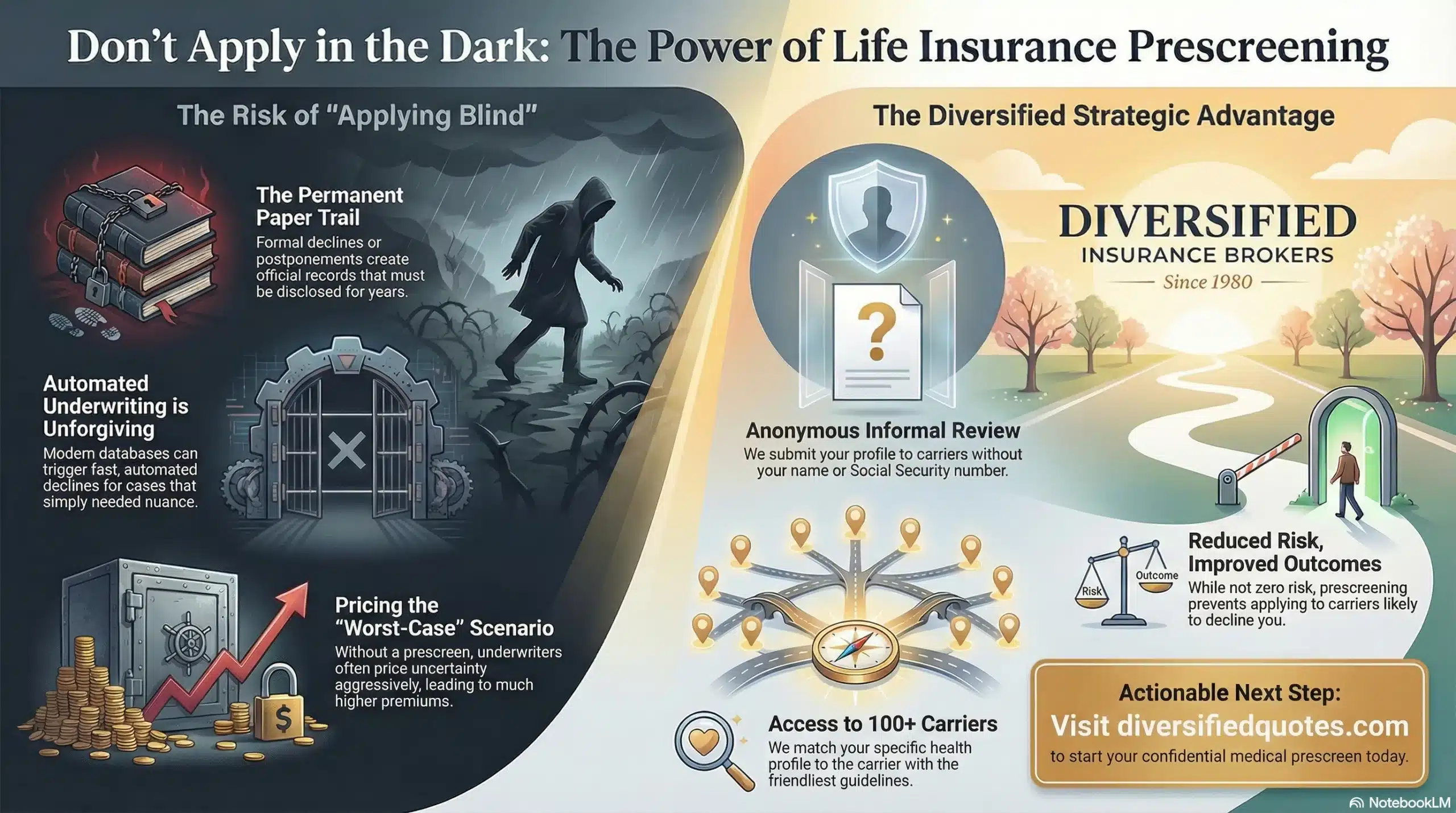
If you’ve already been declined, your next steps matter. First, request a copy of your underwriting decision and your MIB (Medical Information Bureau) report. The MIB is essentially a shared reporting system carriers use to record coded medical information. Errors do occur. Incorrect prescription coding, outdated diagnoses, or incomplete follow-up notes can trigger unnecessary declines. Second, gather updated medical records from your primary care physician or specialist. Third, do not reapply blindly with another direct carrier. Multiple declines compound difficulty because each denial is recorded. Instead, work with a broker who can perform an informal inquiry before formally submitting another application.
There are multiple coverage paths beyond fully underwritten traditional policies. In some cases, we pursue simplified issue coverage, where no medical exam is required and underwriting is based on health questions and prescription databases. In other cases, graded death benefit policies may provide partial coverage during an initial waiting period before transitioning to full benefit. While not ideal for every situation, these structures can offer meaningful protection when traditional underwriting is not available. The key is structuring expectations correctly and aligning product type with insurability reality.
Recently Declined? Let’s Reassess Strategically
A decline is not the end of the road. Submit your information for a confidential review, and we’ll match your case with carriers that align with your medical profile.
📋 Request a High-Risk Case Review
Or call us directly at 800-533-5969.
It is also important to understand why different carriers evaluate the same condition differently. Insurance companies operate on actuarial modeling, but they also build proprietary underwriting guidelines based on internal experience. One carrier may heavily penalize controlled hypertension, while another may offer standard rates if readings remain stable under medication. Sleep apnea with CPAP compliance may be considered mild risk at one carrier and moderate risk at another. Mental health histories are another area where carrier philosophy varies widely. Stability, treatment adherence, and absence of hospitalization are often key differentiators.
Body mass index (BMI) is another frequent trigger for declines or heavy ratings. However, not all carriers use identical build charts. Some carriers are significantly more lenient for muscular builds or gradual weight trends. Others strictly adhere to older actuarial tables. Understanding which carriers provide flexibility can prevent unnecessary rejections. If your previous application did not account for these nuances, a restructured approach can dramatically improve the outcome.
Clients sometimes assume that if one agent could not secure coverage, no one can. In reality, many agents represent only a handful of carriers. Independent brokerage access dramatically expands options. Instead of forcing your case into a limited carrier lineup, we shop your medical profile confidentially across multiple companies through informal underwriting channels. This avoids triggering additional formal declines and allows us to gauge probable rate classifications before submitting an application.
In certain cases, timing is critical. Some medical conditions improve with documented stability over 6–24 months. Elevated A1C levels, recent medication adjustments, cardiac events, or newly diagnosed mental health conditions may require a waiting period before favorable underwriting is possible. In these situations, we often create a short-term bridge strategy using simplified issue coverage while monitoring insurability improvement. This proactive planning ensures your family is not left unprotected during a recovery period.
Beyond medical risk, financial underwriting also matters. Large face amounts require income and asset justification. Business owners, key executives, and estate planning cases may require additional documentation. Structuring the application correctly from both a medical and financial standpoint improves approval odds and reduces delays. Our process addresses both simultaneously.
Secure Coverage Others Couldn’t
We work with carriers experienced in underwriting complex medical histories. Let’s explore realistic solutions that fit your situation.
📋 Start Your Coverage Reassessment
Call 800-533-5969 to speak with a licensed advisor.
High-risk life insurance planning also intersects with broader financial strategy. Some clients seeking coverage are simultaneously evaluating retirement income solutions or principal-protected growth vehicles. If you are comparing long-term financial protection tools, you may also wish to review current annuity rate options for guaranteed income planning. Coordinating protection and income planning together often strengthens overall financial resilience.
The most important takeaway is this: a decline is data, not destiny. It provides insight into what went wrong, which carrier guidelines were triggered, and how to restructure your case. With the right documentation, carrier alignment, and strategy, many previously declined applicants ultimately secure meaningful coverage. The key is patience, preparation, and professional alignment. Insurance underwriting is complex—but it is navigable with experience.
Contact Us Today:
Ready to explore insurance and annuity options that offer guaranteed income, principal protection, disability, life insurance, Social Security and Medicare reviews, and long-term financial growth? Let the expert advisors at Diversified Insurance Brokers help you find the right strategy for your retirement goals.
📞 Call us at 800-533-5969
🔗 Visit our annuity rate page here
📍 Contact Us Page
Related Pages
Financial Protection Essentials
Explore annuity interest examples and retirement planning insights to understand how different investment sizes can affect income potential.
Talk With an Advisor Today
Choose how you’d like to connect—call or message us, then book a time that works for you.
Schedule here:
calendly.com/jason-dibcompanies/diversified-quotes
Licensed in all 50 states • Fiduciary, family-owned since 1980
FAQs: What If You’re Denied Life Insurance? Here’s What to Do Next
Why do life insurance applications get denied?
Applications are most commonly denied due to medical history, high-risk occupations or hobbies, recent diagnoses, prescription history, or incomplete or inaccurate application information. Financial underwriting issues can also trigger a denial.
Does a life insurance denial mean I’m uninsurable?
No. A denial from one carrier does not mean all insurers will decline you. Each insurance company has different underwriting guidelines, and many specialize in higher-risk cases.
Will a denial show up on future applications?
Yes. Prior declines are typically disclosed on future applications. However, an experienced broker can help position your case properly so prior declines don’t automatically lead to another denial.
Should I apply again right away after being denied?
Not without strategy. Reapplying too quickly without addressing the reasons for denial can result in repeated declines. It’s usually better to review the underwriting decision, gather documentation, and target more suitable carriers.
What alternatives exist if traditional life insurance isn’t approved?
Options may include simplified-issue policies, guaranteed-issue life insurance, smaller face amounts, graded benefit policies, or waiting and reapplying once health or risk factors improve.
Can a denial be reversed or reconsidered?
In some cases, yes. If new medical records, test results, or clarifications are provided, insurers may reconsider. Appeals are more effective when handled by a broker experienced in underwriting negotiations.
How can working with a broker help after a denial?
Brokers can analyze why the denial occurred, identify insurers with more favorable underwriting, pre-shop your case anonymously, and help avoid unnecessary declines going forward.
Is it better to wait before applying again?
Sometimes. If the denial was due to a recent diagnosis, surgery, or unstable condition, waiting 6–24 months can significantly improve approval odds and pricing.
About the Author:
Jason Stolz, CLTC, CRPC and Chief Underwriter at Diversified Insurance Brokers (NPN 20471358), is a senior insurance and retirement professional with more than two decades of real-world experience helping individuals, families, and business owners protect their income, assets, and long-term financial stability. As a long-time partner of the nationally licensed independent agency Diversified Insurance Brokers, Jason provides trusted guidance across multiple specialties—including fixed and indexed annuities, long-term care planning, personal and business disability insurance, life insurance solutions, and short-term health coverage. Diversified Insurance Brokers maintains active contracts with over 100 highly rated insurance carriers, ensuring clients have access to a broad and competitive marketplace.
His practical, education-first approach has earned recognition in publications such as VoyageATL, highlighting his commitment to financial clarity and client-focused planning. Drawing on deep product knowledge and years of hands-on field experience, Jason helps clients evaluate carriers, compare strategies, and build retirement and protection plans that are both secure and cost-efficient. Visitors who want to explore current annuity rates and compare options across multiple insurers can also use this annuity quote and comparison tool.
