
What is an Immediate Annuity

Jason Stolz CLTC, CRPC
What is an immediate annuity? An immediate annuity—often called a Single Premium Immediate Annuity (SPIA)—is a contract that converts a lump sum into guaranteed income payments that begin quickly, usually within 30 days and typically no later than the first year after purchase. It’s designed for retirees and near-retirees who want a steady, predictable paycheck that can last as long as they do, without relying on market performance to fund those payments.
Immediate annuities are simple on purpose. You deposit a single premium, you choose how payments should be structured (monthly, quarterly, or annual), and the insurance company guarantees the payment amount based on your age, the payout option you select, and current pricing. Unlike many deferred annuities, there’s no long accumulation phase and no waiting years for income to start. An immediate annuity is built for people who want the income stream now—or very soon.
At Diversified Insurance Brokers, our advisors compare immediate annuity payouts from top-rated carriers so you can see what your money can pay you—today and for life. Whether you’re funding the annuity with IRA dollars, 401(k) rollover funds, or personal savings, an immediate annuity can simplify retirement income and reduce the stress of “what if the market drops right when I retire?”
Compare Immediate Annuity Payouts
Find out what your lump sum could pay you as guaranteed income—starting within the first year (often within 30 days).
How an Immediate Annuity Works
When you buy an immediate annuity, you make a single premium payment to an insurance company. In exchange, the insurer commits to paying you income under the payout structure you choose. Payments typically begin quickly—sometimes as soon as 30 days after issue—and they continue either for a set period, for your lifetime, or for two lifetimes if you choose a joint option.
The reason immediate annuities are often described as “pension-like” is that they take a pool of money and turn it into a predictable cash flow. You no longer have to guess what you can safely withdraw from an investment account each year. You don’t have to watch the market and worry about sequence-of-returns risk. You know what the income is, you know when it arrives, and you can build the rest of your plan around that floor.
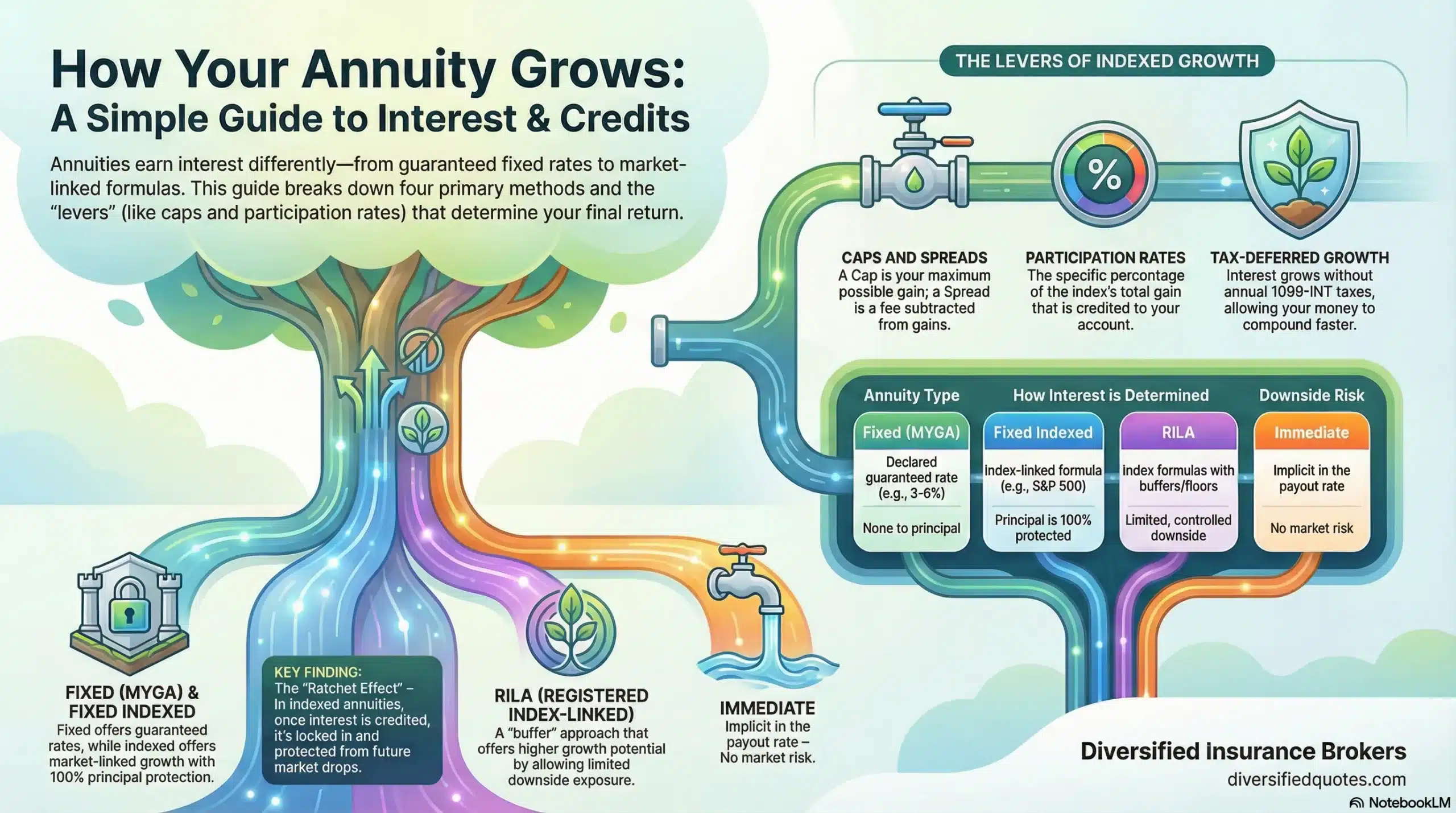
Immediate annuities can be purchased with after-tax savings or retirement dollars. If you’re funding from a 401(k) or IRA, the contract is typically held as a qualified annuity and the payments are generally taxed as ordinary income. If you fund with non-qualified money, a portion of each payment may be treated as return of principal (not taxed) and a portion as gain (taxed), which creates a smoother tax experience for many retirees. We cover the basics of annuity interest and taxation concepts in how annuities earn interest, and then tailor the comparison to your exact funding source.
What an Immediate Annuity Is Not
Most misunderstandings come from confusing immediate annuities with deferred annuities. An immediate annuity is not designed for long-term accumulation. It is not primarily an “interest rate product” in the way a MYGA is. And it is not built for frequent withdrawals or flexible liquidity. It is built to do one job well: convert a lump sum into a guaranteed income stream.
That doesn’t mean you “lose control” in a careless way. It means you’re making a trade: you give up access to the lump sum in exchange for contractual income certainty. The key is choosing an income option that protects your household properly—especially around survivor needs and early-death scenarios—so the trade is intentional, not accidental.
Common Immediate Annuity Payout Options
Immediate annuities can be structured in several ways, and the payout option you choose is one of the biggest drivers of the payment amount. Generally, the more protection you add for beneficiaries or a surviving spouse, the lower the monthly income will be—because the insurer is taking on a larger obligation.
Life only: Pays as long as you live. It typically offers the highest monthly income, but payments stop at death and there is usually no remaining value for beneficiaries.
Life with period certain: Pays for life, but also guarantees a minimum number of years of payments (often 10 or 20). If you pass away before that period ends, the remaining guaranteed payments continue to your beneficiary for the rest of the period.
Joint life (two lives): Pays as long as either spouse is alive (or for two joint annuitants). Many couples choose a continuation percentage—such as 100% or 50%—to define how much income continues for the surviving spouse.
Cash refund option: If you die before receiving payments equal to your premium, the difference is paid to your beneficiary as a refund (often as a lump sum, depending on contract provisions).
Choosing among these is less about “what’s best” and more about matching your plan. If you’re covering essential living expenses, you may prioritize a joint payout for spouse protection. If you’re layering income on top of Social Security, you may prioritize higher payments with a leaner guarantee. If legacy is a primary goal, you may prefer a refund design or a different planning approach.
Immediate Annuity vs. Deferred Annuity (Quick Comparison)
Immediate and deferred annuities solve different problems. An immediate annuity solves “I want income soon.” A deferred annuity solves “I want protection and growth now, income later.” Understanding the difference helps you avoid choosing the wrong tool for your timeline.
With a deferred annuity, you typically have an accumulation phase where the account value can grow, and you may have options like free withdrawals or income riders. With an immediate annuity, you’re annuitizing immediately (or nearly immediately) and payments start right away. If you want a broader definition of deferred structures, start with what is a deferred annuity.
Why Retirees Use Immediate Annuities
The biggest reason immediate annuities remain relevant is that retirement has changed. Many retirees no longer have a traditional pension. They have a 401(k), an IRA, and the job of turning that pile of savings into income that lasts. That creates three core risks: market risk, longevity risk, and behavioral risk.
Market risk: If withdrawals begin during a major market decline, the portfolio may recover more slowly or never fully recover because withdrawals lock in losses. This is one reason people explore “income floors” that are not tied to the market.
Longevity risk: If you live longer than expected, a “safe” withdrawal plan may not stay safe forever, especially with inflation and healthcare costs. Immediate annuities can shift longevity risk to the insurer in exchange for reduced liquidity.
Behavioral risk: Many people make income decisions emotionally. In down markets they may reduce spending, sell at the wrong time, or abandon a plan. A predictable income payment can reduce anxiety and stabilize decisions around the rest of the portfolio.
Immediate annuities can also be used strategically to cover “non-negotiable” expenses like housing, utilities, insurance, and basic living costs. That lets other assets remain invested for growth or used for discretionary goals. In many plans, it’s not an “all or nothing” choice—it’s a portion of savings used to create a stable base.
See How Income Compares Across Options
Immediate annuities are one income tool. It’s often smart to compare them against fixed and bonus annuity designs using the same premium and age.
What Determines an Immediate Annuity Payout?
Immediate annuity payouts are not “one-size-fits-all.” The payment you receive is a function of several variables that interact. Understanding these variables helps you compare quotes accurately and avoid apples-to-oranges decisions.
Age: In general, older annuitants receive higher payments because the expected payment duration is shorter. The difference between age 60 and 70 can be meaningful.
Gender (where applicable): In some states and product contexts, gender may influence payout calculations. In other contexts, pricing is unisex. Your state and carrier rules determine this.
Interest rate environment: Payouts often look better when interest rates are higher because insurers can support stronger income offers from general account yields.
Payout option: Life-only typically pays the most. Adding a period certain, cash refund, or joint continuation usually reduces the monthly payment because it increases the insurer’s obligation.
Payment frequency: Monthly vs. annual can change the premium requirement in some quote structures and can slightly affect payout math. Frequency also matters for budgeting and for control of cash flow in retirement.
Start date: Some immediate annuities allow you to choose an income start date that’s near-term but not immediate (such as 6–12 months). That timing can change the payment level.
Because these variables interact, the right way to evaluate an immediate annuity is with side-by-side comparisons that hold the important inputs constant: same premium, same annuitant ages, same payout option structure, and same start date range. That’s how you can identify which carrier is truly more competitive for your specific scenario.
Immediate Annuity Liquidity and “Irrevocability” in Plain English
One of the most important realities of an immediate annuity is liquidity. In most cases, once the contract is annuitized, the lump sum is converted into the income promise and is no longer available as a withdrawal account. That is not a “gotcha.” It’s the core design feature that allows the insurer to guarantee the payout stream.
This is why we often discuss immediate annuities as part of a broader plan. If all of your liquid savings are inside the annuity, you may feel trapped if a large unexpected expense arrives. But if you keep a cash reserve and other liquid assets for flexibility, an immediate annuity can cover your baseline expenses and remove pressure from the rest of the portfolio.
If liquidity flexibility is a primary requirement, we often compare immediate annuities to deferred annuities with structured free-withdrawal rules and/or income riders. Those designs can provide a different balance of liquidity and guarantees. If you’ve never reviewed the free-withdrawal concept, this page is useful context: annuity free withdrawal rules.
Inflation and COLA Options
Another key consideration is inflation. Standard immediate annuity payments are fixed. That can be exactly what you want if the goal is to cover a predictable baseline expense such as rent, mortgage, or utilities. But retirees also worry about rising costs over a long retirement.
Some immediate annuities offer an inflation adjustment option (sometimes described as COLA features), which can increase payments over time. The tradeoff is that initial payments usually start lower. That can still be attractive if you have other income sources today and want a growing stream later, or if you’re building a plan designed to keep pace with rising costs.
If you want to understand inflation-adjustment concepts in annuities more generally, this related explanation can help clarify the idea: what is COLA on an annuity.
Immediate Annuity Death Benefits and Legacy Planning
People often assume immediate annuities “lose the money” if the annuitant dies early. That’s only true in the pure life-only structure. Many retirees choose optional guarantees specifically to protect against early death outcomes.
A period certain option ensures payments continue for a minimum number of years. A cash refund option ensures that if you die before receiving payments equal to your premium, your beneficiary receives the difference. A joint life structure ensures income continues for a surviving spouse. Each feature typically reduces the initial monthly payout because it adds protection. The question becomes: which protection matters most for your household?
For some families, legacy goals are better met by keeping more assets liquid, using a different annuity structure, or pairing income planning with life insurance. When legacy is a priority, it can be helpful to understand how beneficiary rules work in annuities generally: annuity beneficiary death benefits.
Using Immediate Annuities to Build an “Income Floor”
Many strong retirement plans begin with a simple question: “What are our required expenses, and what guaranteed income already covers them?” Guaranteed income might include Social Security, pensions, and in some households, rental income. The gap between required expenses and guaranteed income is where stress and market dependence often live.
An immediate annuity can fill part of that gap by creating an income floor that is not tied to investment returns. When that floor is established, the rest of the portfolio can be managed with a clearer purpose—growth, flexibility, healthcare, travel, or legacy—rather than as the sole engine of monthly living expenses.
Immediate annuities are also sometimes used as a “bridge” tool: a retiree annuitizes a portion of savings to cover a known gap for a period of years, while waiting to claim Social Security at a later age or while delaying withdrawals from certain accounts. The exact best structure depends on income timing, taxes, and household priorities.
Tax Treatment of Immediate Annuity Payments
Tax treatment depends primarily on whether the annuity is funded with qualified (pre-tax) dollars or non-qualified (after-tax) dollars.
Qualified immediate annuity (IRA / 401(k) funds): Payments are generally taxed as ordinary income because the contributions were not taxed when deposited into the retirement account. In retirement planning, this is often viewed as “expected taxation,” not a penalty—because it’s the same tax treatment that would apply to most IRA distributions.
Non-qualified immediate annuity (after-tax savings): A portion of each payment may be treated as return of principal (not taxed) and the remainder is taxed as gain. This concept is often referred to as the exclusion ratio. The result is typically smoother taxation over time than taking large withdrawals in uneven amounts.
Because taxes can influence the net income you actually keep, we typically compare immediate annuity quotes alongside your broader income plan and account structure. The goal is not just “highest payment,” but “best payment for your after-tax lifestyle and long-term security.”
Immediate Annuity vs. GLWB Income Rider Strategies
Many people comparing immediate annuities are also researching deferred annuities with a Guaranteed Lifetime Withdrawal Benefit (GLWB) rider. These are not interchangeable tools. A GLWB strategy typically allows for an accumulation phase with an income base that grows, and then income can begin later while keeping some account value and liquidity mechanics intact. An immediate annuity starts the income now, often with less liquidity but more simplicity.
In plain terms: immediate annuities are often the simplest way to purchase guaranteed income. GLWB strategies are often the more flexible way to structure guaranteed income later. If you want to understand GLWB mechanics clearly, this is the best starting point: how a GLWB works.
When an Immediate Annuity May Be a Strong Fit
An immediate annuity may make sense when you want income soon and you value certainty more than liquidity on the dollars you annuitize. Common examples include retirees who want to cover essential expenses, households that want to reduce market dependence, and people who prefer a “set it and forget it” approach to a portion of their retirement cash flow.
It can also be a practical fit when you are trying to simplify a complex retirement picture. Many retirees have multiple accounts, multiple distribution rules, and conflicting advice about safe withdrawal rates. An immediate annuity can be used as a stabilizing piece—one predictable deposit to the bank each month—so the rest of the plan can be managed more calmly.
When an Immediate Annuity May Not Be Ideal
An immediate annuity may not be the right choice when liquidity is critical, when you anticipate large variable expenses that require lump sums, or when you want significant upside growth potential tied to markets. It may also be less appealing if you are concerned about inflation and do not want a fixed payment, unless you’re comfortable with a COLA structure that starts lower.
This is why many plans use partial annuitization rather than moving all assets into one income stream. The goal is balance: enough guaranteed income to reduce stress, and enough liquidity and growth potential to support flexibility and future needs.
Lifetime Income Calculator
Estimate your guaranteed income range, then compare immediate annuity payouts with other income approaches.
Use this as a planning tool, then confirm exact payouts with carrier illustrations for your state, age, and payout option.
How Diversified Insurance Brokers Helps You Shop Immediate Annuities
Immediate annuities are quote-driven products. Small changes in age, payout option, and start date can change income meaningfully. That’s why “one quote” is rarely enough. Our process focuses on clarity and fit. We compare payouts across carriers, align the payout option to your household’s survivor needs, and make sure the income stream integrates with Social Security timing and the rest of your retirement plan.
We also help you avoid common comparison mistakes, like mixing life-only quotes with life-plus-period-certain quotes, or comparing different start dates, or comparing single-life payouts to joint-life payouts without acknowledging the tradeoffs. The goal is to make the comparison fair, then choose the structure that supports your real outcome: income you can rely on, with the protections your family needs.
If you’re still exploring how different annuity types fit into retirement protection, these resources can help expand the picture: how to protect your funds in retirement and what is a GLWB.
Get Immediate Annuity Quotes Built for Your Goals
We’ll compare payout options (single life, joint life, period certain, refund) across carriers so you can choose the right income structure.
Talk With an Advisor Today
Choose how you’d like to connect—call or message us, then book a time that works for you.
Schedule here:
calendly.com/jason-dibcompanies/diversified-quotes
Licensed in all 50 states • Fiduciary, family-owned since 1980
FAQs: Immediate Annuity
When do payments from an Immediate Annuity start?
Payments typically begin within 30 days to one year after purchase, depending on contract setup.
Can I change the payout option after income begins?
No. Once annuitized, the income stream is fixed and cannot be altered or surrendered for cash.
Is my money safe in an Immediate Annuity?
Funds are backed by the issuing insurer’s claims-paying ability and protected up to state guaranty limits.
How are payments taxed?
Qualified contracts (IRA/401k) are fully taxable; non-qualified contracts use the exclusion ratio to reduce taxes on each payment.
Can I add a cost-of-living adjustment (COLA)?
Yes, some carriers offer COLA riders that increase income annually by a fixed percentage to offset inflation.
About the Author:
Jason Stolz, CLTC, CRPC and Chief Underwriter at Diversified Insurance Brokers (NPN 20471358), is a senior insurance and retirement professional with more than two decades of real-world experience helping individuals, families, and business owners protect their income, assets, and long-term financial stability. As a long-time partner of the nationally licensed independent agency Diversified Insurance Brokers, Jason provides trusted guidance across multiple specialties—including fixed and indexed annuities, long-term care planning, personal and business disability insurance, life insurance solutions, Group Health, and short-term health coverage. Diversified Insurance Brokers maintains active contracts with over 100 highly rated insurance carriers, ensuring clients have access to a broad and competitive marketplace.
His practical, education-first approach has earned recognition in publications such as VoyageATL, highlighting his commitment to financial clarity and client-focused planning. Drawing on deep product knowledge and years of hands-on field experience, Jason helps clients evaluate carriers, compare strategies, and build retirement and protection plans that are both secure and cost-efficient. Visitors who want to explore current annuity rates and compare options across multiple insurers can also use this annuity quote and comparison tool.
