
What Is the Best Retirement Income Annuity?

Jason Stolz CLTC, CRPC
The best retirement income annuity is the one that turns your savings into predictable, guaranteed income for as long as you live — without exposing your essential retirement budget to market volatility. For many retirees, that means creating a private pension using a carefully structured income annuity that delivers stability, clarity, and contractual guarantees.
When paychecks stop, your financial life changes permanently. You no longer measure success by account growth alone. Instead, the focus shifts to sustainability, reliability, and protection against longevity risk — the risk of outliving your money. The best retirement income annuity addresses that risk directly by providing payments that continue for life, regardless of market conditions.
At Diversified Insurance Brokers, we compare income annuity options from over 100 A-rated carriers nationwide. Whether you are rolling over a 401(k), repositioning IRA funds, or allocating part of a brokerage account for guaranteed income, selecting the right annuity structure can significantly improve retirement confidence and long-term income security.
Ensure You Are Receiving the Absolute Top Rates
Compare today’s highest income annuity payouts, fixed rates, and bonus structures — then run your own lifetime income projections below.
Lifetime Income Calculator
💡 Note: Calculator supports premiums up to $2,000,000. Larger investments scale proportionally.
What Makes an Income Annuity the “Best” for Retirement?
The best retirement income annuity is not a universal product — it is a strategic fit. It depends on when you need income to begin, how much liquidity you want to retain, whether you are planning for a spouse, and how much of your essential expenses you want guaranteed.
For some retirees, “best” means maximizing immediate monthly income starting right now. For others, it means deferring income for five to ten years to lock in higher payout rates. Still others want a hybrid approach that allows continued growth with downside protection before income begins. Understanding the structural differences between annuity types is critical before making a long-term decision.
Most retirement income annuities fall into one of three broad categories: immediate income annuities, deferred income annuities, and fixed indexed annuities with income riders. Each structure solves the income problem differently, and each comes with trade-offs involving liquidity, growth potential, and income timing.
Single Premium Immediate Annuities (SPIAs): The Pure Pension Replacement
A Single Premium Immediate Annuity, commonly called a SPIA, is often considered the most straightforward retirement income annuity available. You deposit a lump sum, and income typically begins within 30 to 60 days. Payments continue for life, or for a guaranteed period you select, such as 10 or 20 years. Because the insurer does not need to provide liquidity after payments begin, SPIAs often generate some of the highest immediate payout rates available.
For retirees without a traditional pension, a SPIA can function as a personal pension replacement. It converts a portion of your savings into predictable income that does not fluctuate with stock market performance. That predictability is powerful. It allows retirees to cover housing, food, insurance premiums, and other non-negotiable expenses with contractual income rather than market withdrawals.
The trade-off with a SPIA is liquidity. Once funds are annuitized, they are no longer accessible as a lump sum. This makes SPIAs best suited for money earmarked specifically for lifetime income rather than emergency reserves.
Deferred Income Annuities (DIAs): Higher Income Later
A Deferred Income Annuity operates similarly to a SPIA but delays the start of payments. By postponing income — often five to ten years — retirees can secure significantly higher future payout rates. This makes DIAs particularly attractive for individuals retiring in their early 60s who want to create a larger guaranteed income stream beginning at age 70 or later.
The strength of a DIA lies in its longevity protection. The longer you defer income, the greater the insurance leverage embedded in the payout. For retirees concerned about living into their 90s or beyond, a DIA can act as powerful late-life income insurance.
However, as with SPIAs, liquidity is limited once the contract is in force. DIAs are most appropriate for assets specifically allocated to future guaranteed income rather than flexible retirement spending.
Fixed Indexed Annuities with Income Riders: Flexibility and Protection
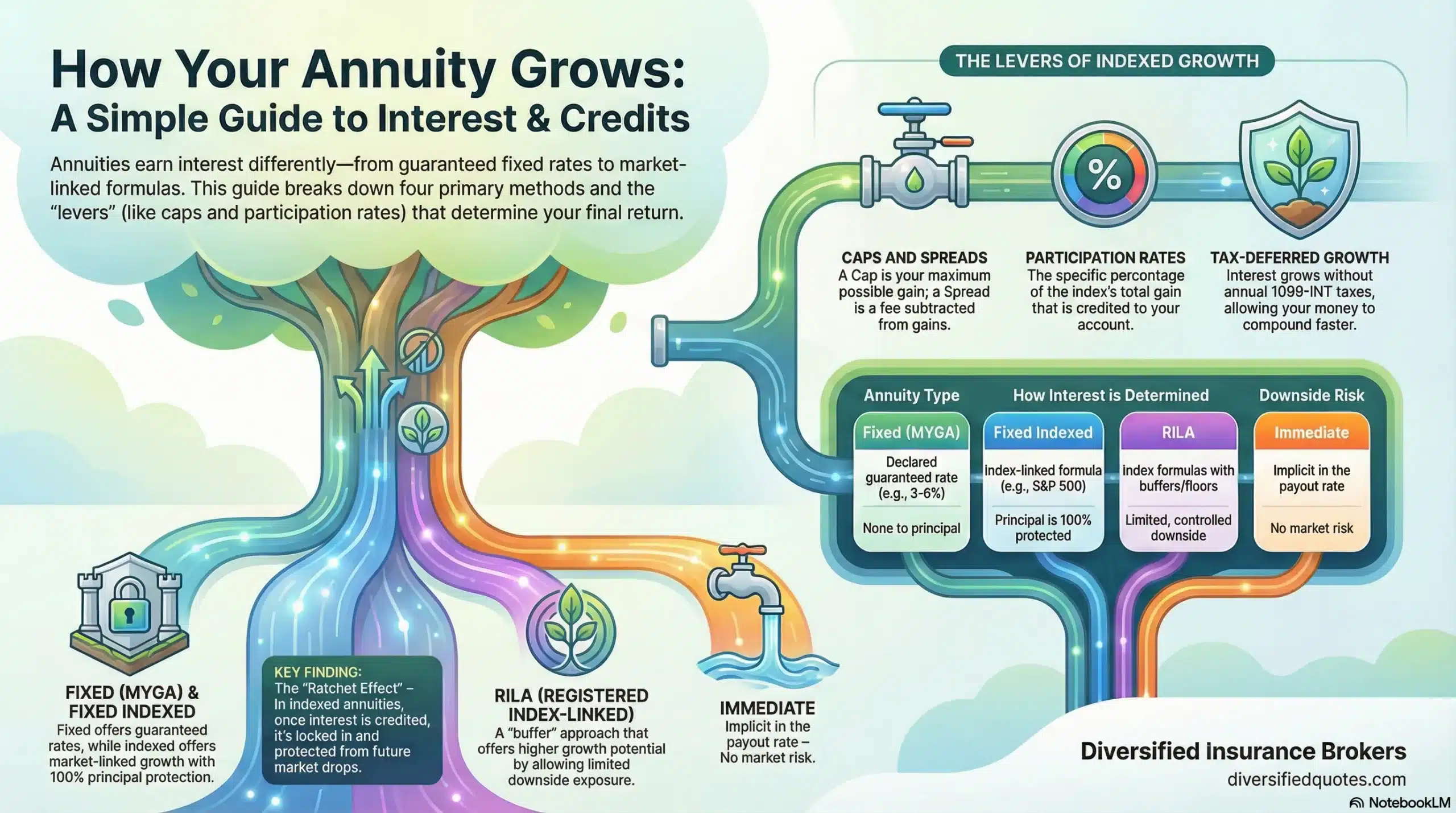
Fixed Indexed Annuities (FIAs) with lifetime income riders represent a more flexible approach to retirement income planning. Instead of converting assets directly into payments, FIAs allow funds to grow with index-linked crediting while protecting principal from market losses. An optional income rider then guarantees lifetime withdrawals based on contractual payout percentages.
This structure appeals to retirees who want principal protection, potential interest growth, and future income flexibility. Unlike a SPIA, funds generally remain accessible within surrender charge rules. Income can begin when you choose, often years after the contract is issued.
Because FIAs include moving parts such as caps, participation rates, and rider fees, they require careful comparison. When properly structured, they can produce competitive lifetime income while preserving some account value and liquidity — a balance many retirees find attractive.
Inflation Considerations in Retirement Income Planning
No retirement income discussion is complete without addressing inflation. Even modest inflation erodes purchasing power over a 20- or 30-year retirement. Some income annuities offer cost-of-living adjustments, while others allow increasing payout options or index-linked growth strategies designed to offset inflation risk.
For example, a fixed indexed annuity with inflation protection may offer rising income over time, while certain SPIAs provide inflation-adjusted payment structures. Choosing the right approach requires balancing starting income with long-term growth potential.
Building a Retirement Income Floor
Many retirees do not allocate all assets to annuities. Instead, they use annuities strategically to build what planners call an “income floor.” This floor covers essential expenses with guaranteed income from Social Security and annuities. Remaining assets stay invested for discretionary spending, legacy goals, or growth.
Layering guaranteed income reduces sequence-of-returns risk — the danger that early retirement market declines permanently impair portfolio longevity. By covering core expenses with predictable income, retirees gain flexibility to weather market volatility without panic selling.
Tax Efficiency of Retirement Income Annuities
Income annuities funded with qualified accounts such as IRAs or 401(k) rollovers produce taxable distributions as ordinary income. Non-qualified annuities, funded with after-tax dollars, distribute income using exclusion ratios that partially defer taxation. The tax-deferred growth component of annuities can complement other retirement strategies, particularly when structured thoughtfully alongside Social Security and required minimum distributions.
For retirees seeking long-term tax efficiency, exploring tax-deferred annuity strategies can reveal planning opportunities that extend beyond simple payout comparisons.
How to Compare Retirement Income Annuities Properly
Comparing retirement income annuities requires more than reviewing payout illustrations. Financial strength ratings, rider costs, surrender schedules, income start flexibility, joint-life provisions, and death benefit options all influence suitability. The highest payout today is not automatically the best solution if flexibility or survivor protection is compromised.
Independent comparison across carriers ensures competitive rates while maintaining appropriate contract structure. Reviewing side-by-side projections allows retirees to understand trade-offs clearly before committing assets.
Compare the Best Retirement Income Annuities Today
See side-by-side income projections from leading A-rated carriers and determine which annuity structure creates the strongest guaranteed retirement paycheck for your situation.
Request Personalized Income QuotesRelated Pages
Explore additional retirement income planning resources:
Talk With an Advisor Today
Choose how you’d like to connect—call or message us, then book a time that works for you.
Schedule here:
calendly.com/jason-dibcompanies/diversified-quotes
Licensed in all 50 states • Fiduciary, family-owned since 1980
FAQs: Best Retirement Income Annuity
What is the best retirement income annuity for guaranteed lifetime income?
Are income annuities better than 401(k) withdrawals?
Can I add an inflation rider to my income annuity?
Is an annuity a good idea for early retirees?
What happens to my annuity when I pass away?
About the Author:
Jason Stolz, CLTC, CRPC and Chief Underwriter at Diversified Insurance Brokers (NPN 20471358), is a senior insurance and retirement professional with more than two decades of real-world experience helping individuals, families, and business owners protect their income, assets, and long-term financial stability. As a long-time partner of the nationally licensed independent agency Diversified Insurance Brokers, Jason provides trusted guidance across multiple specialties—including fixed and indexed annuities, long-term care planning, personal and business disability insurance, life insurance solutions, Group Health, and short-term health coverage. Diversified Insurance Brokers maintains active contracts with over 100 highly rated insurance carriers, ensuring clients have access to a broad and competitive marketplace.
His practical, education-first approach has earned recognition in publications such as VoyageATL, highlighting his commitment to financial clarity and client-focused planning. Drawing on deep product knowledge and years of hands-on field experience, Jason helps clients evaluate carriers, compare strategies, and build retirement and protection plans that are both secure and cost-efficient. Visitors who want to explore current annuity rates and compare options across multiple insurers can also use this annuity quote and comparison tool.
