
What is the Interest Rate on an Annuity

Jason Stolz CLTC, CRPC
Annuities are often evaluated based on their interest rate because the credited rate directly influences how quickly the account value grows during the accumulation phase. When individuals research annuities, one of the first questions they ask is: what interest rate does an annuity pay? The answer depends on several factors including the type of annuity, the structure of the contract, and the broader interest rate environment. Unlike many traditional investments, annuities are insurance contracts designed to provide stability, income security, and long-term financial predictability.
Annuity interest rates differ from the yields associated with bank savings accounts, bonds, or stock market investments. Rather than fluctuating daily with market conditions, many annuities credit interest based on guaranteed rates, index performance formulas, or structured crediting strategies established by the issuing insurance company. These crediting methods allow annuities to provide a combination of growth potential and protection from market volatility.
For individuals planning retirement income, understanding how annuity interest rates work is important because these rates can influence both the growth of the account value and the amount of income an annuity may eventually provide. Some retirees prioritize growth during the accumulation phase, while others focus primarily on income guarantees. Because annuities can address both objectives, they are frequently used as part of broader retirement strategies that combine growth investments with stability-focused financial products.
When evaluating annuities as part of a retirement strategy, investors often compare them with other income-focused investments and conduct broader reviews such as investment risk analysis to determine how much market exposure they want within their financial plan. Annuities can provide a stable component within a diversified portfolio, especially for individuals approaching retirement who want to reduce exposure to large market swings.
Request a Quote
How Annuity Interest Rates Work
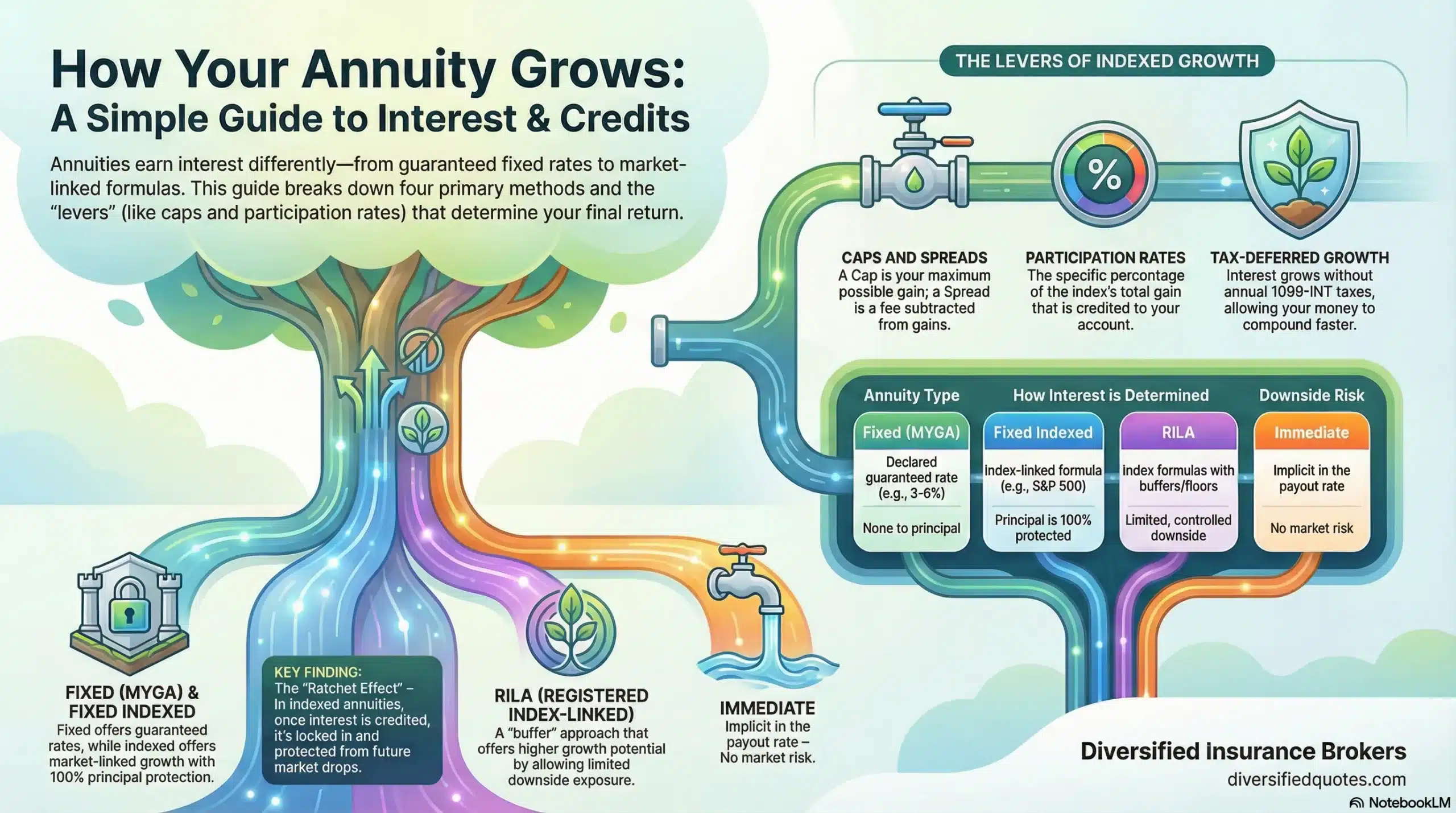
Annuity interest rates represent the amount of growth credited to the contract value over a specific period. The method used to determine this interest varies depending on the type of annuity purchased. Fixed annuities typically provide a guaranteed interest rate for a defined period of time, while indexed annuities credit interest based on the performance of a market index using formulas that may include participation rates, caps, or spreads.
Because annuities are issued by insurance companies rather than banks, the insurer is responsible for managing the underlying investment portfolio that supports the contract guarantees. Insurance companies typically invest annuity premiums in diversified portfolios consisting of high-quality bonds, government securities, and other income-producing assets. The yield generated from those investments allows the insurer to credit interest to annuity contracts while maintaining contractual guarantees.
Many investors are surprised to learn that annuity interest rates do not function exactly like the interest rates associated with traditional bank products. In many cases, the credited rate may change over time depending on market conditions, but contracts often include minimum guarantees designed to protect the account value from extremely low returns.
For retirees who prioritize stability, this structure can provide peace of mind. Even when financial markets experience volatility, fixed annuities generally maintain their guaranteed crediting structure while indexed annuities protect the principal from direct market losses.
Types of Annuities and How Their Interest Is Calculated
Not all annuities calculate interest in the same way. The structure of the annuity contract determines how interest is credited and how growth is accumulated over time. Understanding the differences between the major annuity categories can help investors determine which type aligns best with their financial objectives.
Fixed Annuities
Fixed annuities credit interest at a guaranteed rate for a defined period of time. These products function similarly to long-term certificates of deposit but are issued by insurance companies rather than banks. Because the rate is guaranteed for a specified term, investors know exactly how much interest their contract will earn during that period.
Fixed annuities are often used by retirees who want predictable growth and protection from market volatility. Many individuals researching conservative retirement income strategies also evaluate topics such as downside protection strategies in bear markets to determine how annuities may help reduce portfolio risk.
Indexed Annuities
Indexed annuities credit interest based on the performance of a market index such as the S&P 500. However, the contract does not directly invest in the stock market. Instead, the insurance company uses a crediting formula that determines how much of the index performance is credited to the contract.
These formulas may include participation rates, caps, or spreads that limit the maximum credited interest in exchange for protecting the principal from losses during market downturns.
Immediate Annuities
Immediate annuities function differently because they convert a lump sum into a stream of income payments rather than focusing primarily on accumulation interest rates. The payout is determined by interest assumptions, life expectancy factors, and the selected payout structure.
Individuals exploring income strategies often review examples such as how much income large annuities may generate to better understand how annuity payments translate into real retirement income.
Example of Annuity Growth Using a Hypothetical Interest Rate
The example below illustrates how an annuity account value might grow over time using a sample interest rate. These numbers are for illustration purposes only and demonstrate the effect of compound growth over a long investment horizon.
| Year | Account Value (Example 6.20% Growth) | Annual Interest Earned |
|---|---|---|
| 1 | $106,200 | $6,200 |
| 5 | $134,876 | $7,882 |
| 10 | $181,714 | $10,622 |
| 15 | $244,728 | $14,302 |
| 20 | $329,562 | $19,260 |
This example highlights how compound interest can accelerate growth over time. Because earnings remain within the annuity and continue generating additional interest each year, the compounding effect becomes increasingly powerful over long periods.
Factors That Influence Annuity Interest Rates
Several factors influence the interest rates offered by insurance companies on annuity contracts. These include overall bond yields, interest rate trends within financial markets, contract structure, and the financial strength of the issuing insurer.
Insurance companies invest annuity premiums into diversified portfolios that typically include government bonds, corporate bonds, and other fixed-income investments. Because annuities are long-term contracts, the yields available in these bond markets play a significant role in determining how much interest insurers can credit to annuity accounts.
Contract design also influences the credited rate. Some annuities include additional features such as income riders, enhanced death benefits, or bonus credits. These features may affect the interest rate structure because they provide additional guarantees within the contract.
Individuals evaluating these options often review broader financial planning topics such as Social Security planning strategies to determine how annuities may complement other retirement income sources.
Request a Quote
Why Interest Rates Are Only One Part of the Decision
While interest rates are important, they are only one factor to consider when evaluating annuities. The long-term value of an annuity also depends on features such as lifetime income options, inflation protection riders, contract flexibility, and tax advantages.
Many retirees combine annuities with other financial planning strategies such as annuities designed to address inflation risk in order to protect purchasing power over time.
Ultimately, the purpose of most annuities is not simply to achieve the highest possible interest rate but to create financial stability during retirement. By combining growth potential with contractual guarantees, annuities can help individuals build income streams that continue regardless of market conditions.
Ensure you are receiving the absolute top rates
Current Fixed Annuity Rates
Compare today’s best fixed annuity rates from top carriers.
View Current RatesCurrent Bonus Annuity Rates
See which annuities offer the highest upfront bonus today.
View Bonus RatesRequest an Annuity Quote
Submit our annuity request form to get personalized rate options.
Quote Request FormLifetime Income Calculator
Use our calculator to see how much guaranteed income your annuity can provide.
Related Pages
Financial Protection Essentials
Talk With an Advisor Today
Choose how you’d like to connect—call or message us, then book a time that works for you.
Schedule here:
calendly.com/jason-dibcompanies/diversified-quotes
Licensed in all 50 states • Fiduciary, family-owned since 1980
Annuity interest rates vary depending on the type of annuity, the contract length, and overall market conditions. Fixed annuities often provide guaranteed interest rates for a set period, while indexed annuities credit interest based on the performance of a market index. Because insurance companies structure these contracts differently, the credited rate can vary widely between products.
Yes. Many annuities offer an initial guaranteed interest rate for a specific period such as one, three, five, or ten years. After that period ends, the insurance company may reset the crediting rate based on current market conditions. Most contracts also include a minimum guaranteed rate that protects the account from extremely low interest crediting.
In some cases annuity interest rates may be competitive with or higher than certificates of deposit depending on the contract structure and interest rate environment. However, annuities also offer additional features such as tax-deferred growth and optional lifetime income benefits that traditional bank products do not provide.
Fixed annuities credit interest at a guaranteed rate for a defined period. During this time the account grows at the specified rate regardless of market fluctuations. Once the guaranteed period ends, the insurer may adjust the rate according to prevailing interest rate conditions while still honoring the contract’s minimum guarantees.
Indexed annuities do not have a traditional fixed interest rate. Instead, they credit interest based on the performance of a market index using formulas that may include participation rates, caps, or spreads. While these formulas limit the maximum credited interest, they also protect the principal from market losses.
The interest credited to an annuity during the accumulation phase can influence the total contract value available when income payments begin. A higher accumulation value can potentially increase the income payments generated by the annuity depending on the payout structure and age of the annuitant.
Some annuities include guaranteed interest rates for defined periods. Fixed annuities typically guarantee the crediting rate during the initial contract term. Indexed annuities guarantee principal protection but may have variable crediting formulas that determine the interest credited each year.
About the Author:
Jason Stolz, CLTC, CRPC and Chief Underwriter at Diversified Insurance Brokers (NPN 20471358), is a senior insurance and retirement professional with more than two decades of real-world experience helping individuals, families, and business owners protect their income, assets, and long-term financial stability. As a long-time partner of the nationally licensed independent agency Diversified Insurance Brokers, Jason provides trusted guidance across multiple specialties—including fixed and indexed annuities, long-term care planning, personal and business disability insurance, life insurance solutions, and short-term health coverage. Diversified Insurance Brokers maintains active contracts with over 100 highly rated insurance carriers, ensuring clients have access to a broad and competitive marketplace.
His practical, education-first approach has earned recognition in publications such as VoyageATL, highlighting his commitment to financial clarity and client-focused planning. Drawing on deep product knowledge and years of hands-on field experience, Jason helps clients evaluate carriers, compare strategies, and build retirement and protection plans that are both secure and cost-efficient. Visitors who want to explore current annuity rates and compare options across multiple insurers can also use this annuity quote and comparison tool.
