
How do Annuities Earn Interest

Jason Stolz CLTC, CRPC
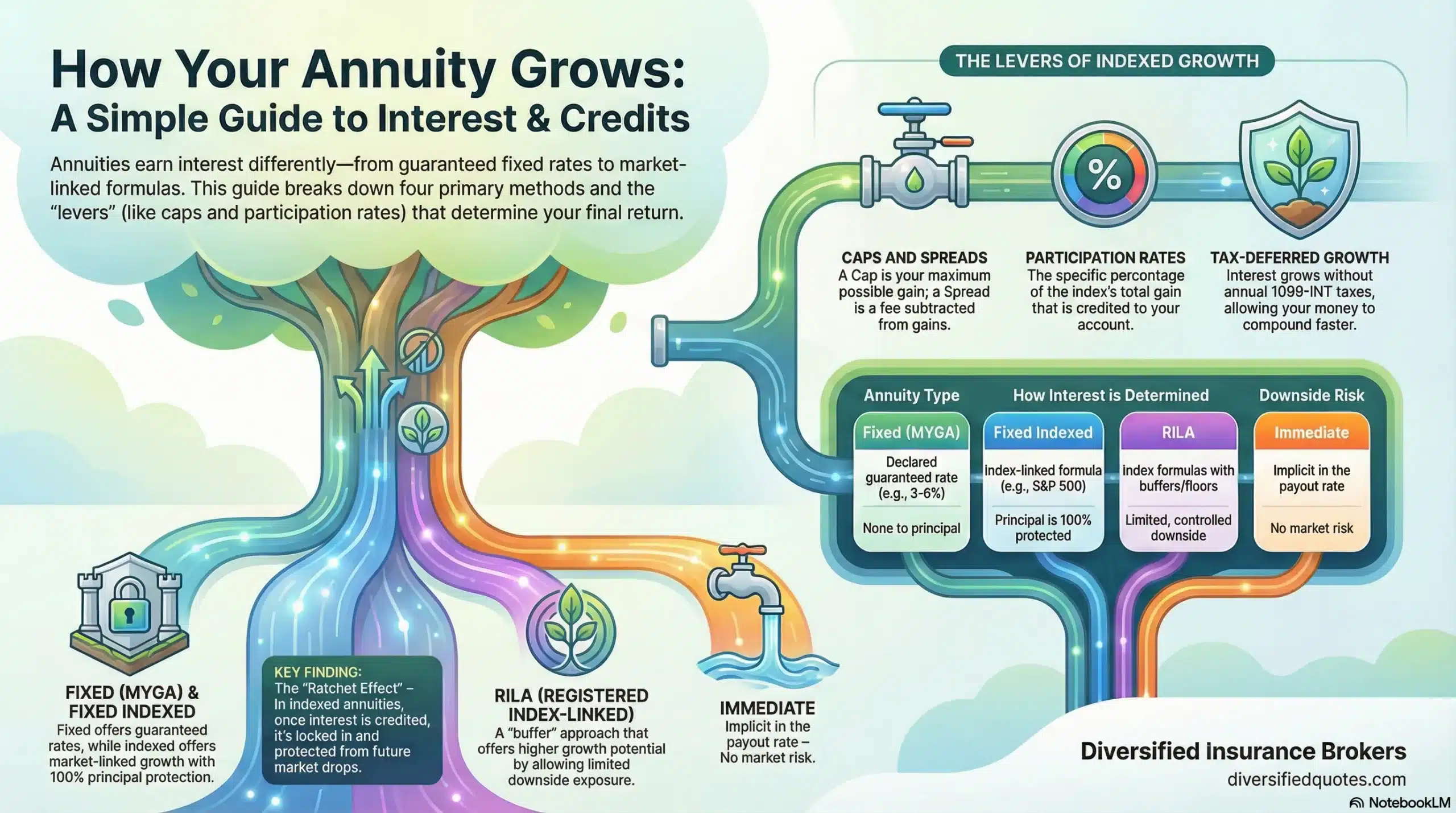
When someone asks, “How do annuities earn interest?” what they are really asking is how insurance companies transform deposited premium into credited growth without exposing the contract owner to the same risks found in traditional market investing. The answer depends on the type of annuity selected, the crediting structure built into the contract, and the economic environment at the time of issue and renewal. A traditional fixed annuity credits a declared rate for a set term, very similar in concept to a bank CD but issued by an insurance carrier and typically offering tax-deferred growth. A fixed indexed annuity links potential interest credits to the performance of an external index while protecting principal from market loss, applying contractual tools such as caps, participation rates, and spreads to determine how much of the index movement is credited. Immediate and income annuities embed an internal rate of return within their payout calculation, converting a lump sum into guaranteed payments. Understanding these distinctions is critical before comparing products side by side on our current annuity rates page or evaluating enhanced designs such as a bonus annuity that may offer upfront premium credits. Insurance carriers earn money by investing their general account assets—primarily in high-quality bonds and other conservative instruments—and then pass a portion of that yield back to contract owners through declared rates or index crediting formulas. In a multi-year guaranteed annuity, often referred to as a MYGA, the insurer locks in a specific interest rate for a defined period, commonly three to seven years, creating predictable accumulation with annual compounding and no exposure to market volatility. In a fixed indexed annuity, by contrast, interest is credited based on how an index performs over a measurement period, but the contract prevents negative credits during downturns, meaning a bad market year typically results in a zero percent credit rather than a loss of principal. The tradeoff for that protection is that the full upside of the index is not credited; instead, the insurer applies a cap that limits the maximum credit, a participation rate that credits only a percentage of the gain, or a spread that subtracts a fixed amount from the index return. These mechanisms allow the carrier to hedge market exposure while still offering growth potential. Over time, credited interest compounds, and in indexed designs, previously locked-in gains cannot be taken away in future downturns, creating a ratchet effect that steadily builds protected value. For investors who prioritize safety and predictable yield, reviewing today’s fixed annuity options can provide clarity on guaranteed terms, while those seeking growth potential with downside protection often compare indexed structures and examine how indexed annuity rates change at renewal. Tax treatment further enhances long-term growth because interest inside an annuity is not taxed annually; it compounds until withdrawn, which can significantly increase net accumulation over decades compared to taxable alternatives. Renewal dynamics also matter. While a MYGA locks a rate for its full term, indexed annuities reset caps and participation rates periodically within contractual minimum guarantees, meaning long-term performance depends not only on initial illustrations but also on the carrier’s financial strength and renewal philosophy. For that reason, evaluating insurer stability alongside product design is just as important as comparing headline rates. Ultimately, annuities earn interest through disciplined insurer investment management combined with contractual crediting formulas that define how much of that yield is passed to policyholders. The structure you choose determines whether your priority is certainty, growth potential with protection, or immediate income conversion, and the right choice depends on time horizon, liquidity needs, and income goals.
Compare Today’s Fixed Annuity Rates
Review competitive MYGA terms and guaranteed rates from top carriers nationwide.
View Fixed RatesHow Different Annuities Credit Interest
| Annuity Type | How Interest Is Credited | Market Loss Exposure | Best For |
|---|---|---|---|
| Fixed (MYGA) | Declared guaranteed rate for a set term (e.g., 3–10 years) | None if held to term | CD alternative, stable accumulation |
| Fixed Indexed | Index-linked formula with cap, spread, or participation rate | No principal loss (0% floor typical) | Growth with downside protection |
| Immediate / Income | Premium converted into guaranteed payments | No market exposure | Lifetime paycheck creation |
Example: Indexed Annuity Crediting With Downside Protection
This simplified example assumes a 6% annual cap. Notice how negative market years do not reduce the account value — they credit 0% instead.
To better visualize how crediting works in indexed annuities, consider a simplified annual point-to-point example. If an external index rises 10 percent during a one-year term and the contract carries a 6 percent cap, the credited rate will be 6 percent. If the index gains 4 percent, the credited rate will be 4 percent. If the index declines 15 percent, the credited rate will be zero rather than negative. This asymmetry—limited upside with protected downside—is the defining characteristic of fixed indexed annuities and explains why they are frequently used as a conservative growth component inside retirement portfolios. Over multiple years, credited gains lock in and compound, creating a staircase pattern rather than the jagged volatility of direct market investment. The clarity of that structure often appeals to retirees who want participation potential without fearing a large drawdown just before income activation. Below is a simplified illustration of how that crediting pattern might look over time.
In this simplified scenario, the account begins at $100,000. A positive year credits growth up to the cap, a negative year credits zero but does not reduce prior gains, and subsequent positive years build on the higher protected base. While real-world results vary based on actual caps, participation rates, spreads, and index performance, the key takeaway is that indexed annuities credit interest in a way that emphasizes protection first and opportunity second. Those who prefer pure guarantees without cap limitations may instead focus on multi-year fixed contracts, whereas those comfortable with measured market linkage often explore indexed designs. Some investors layer strategies, allocating a portion to guaranteed fixed rates while directing another portion toward indexed crediting formulas to balance certainty and upside potential. Others enhance accumulation with premium bonuses, comparing structures on the bonus annuity page to determine whether the long-term value justifies any associated tradeoffs. As retirement approaches, many individuals transition from accumulation analysis to income planning, examining how credited growth can later convert into guaranteed withdrawals. That is where modeling tools become especially helpful. Rather than relying solely on theoretical growth rates, you can project how credited interest translates into future income using the calculator below and then align your strategy with your retirement timeline. Annuities ultimately earn interest through insurer investment management and structured crediting formulas, but their real value is revealed when that accumulated growth supports dependable lifetime income.
Explore Bonus Annuity Opportunities
See how premium bonuses and enhanced crediting structures compare in today’s market.
View Bonus OptionsEstimate Future Guaranteed Income
Use the calculator below to model how different crediting approaches can translate into retirement income.
Related Pages
Continue exploring annuity structures, rate comparisons, and income planning strategies:
Talk With an Advisor Today
Choose how you’d like to connect—call or message us, then book a time that works for you.
Schedule here:
calendly.com/jason-dibcompanies/diversified-quotes
Licensed in all 50 states • Fiduciary, family-owned since 1980
Frequently Asked Questions
Do fixed annuities compound at a guaranteed rate?
Yes. Fixed and MYGA annuities credit a declared rate that compounds over the guarantee term. At renewal, you can withdraw, renew, or exchange.
Can fixed indexed annuities lose money in a down market?
No market-loss to principal when held per contract terms. In negative index years, the credit is typically 0%, not negative.
What’s the difference between a cap, spread, and participation rate?
A cap is a maximum credited return, a spread is a percentage subtracted from gains, and a participation rate is the portion of the index gain you receive.
How do rider roll-ups relate to interest earnings?
Income riders often credit a separate roll-up rate on an income base used to calculate future payouts. It’s different from cash value growth.
Where can I compare today’s crediting options?
Start with our annuity rates and options page, then request personalized quotes based on age, state, and goals.
About the Author:
Jason Stolz, CLTC, CRPC, is a senior insurance and retirement professional with more than two decades of real-world experience helping individuals, families, and business owners protect their income, assets, and long-term financial stability. As a long-time partner of the nationally licensed independent agency Diversified Insurance Brokers, Jason provides trusted guidance across multiple specialties—including fixed and indexed annuities, long-term care planning, personal and business disability insurance, life insurance solutions, and short-term health coverage. Diversified Insurance Brokers maintains active contracts with over 100 highly rated insurance carriers, ensuring clients have access to a broad and competitive marketplace.
His practical, education-first approach has earned recognition in publications such as VoyageATL, highlighting his commitment to financial clarity and client-focused planning. Drawing on deep product knowledge and years of hands-on field experience, Jason helps clients evaluate carriers, compare strategies, and build retirement and protection plans that are both secure and cost-efficient.
