
Can You Use Qualified Funds for Long Term Care Insurance

Jason Stolz CLTC, CRPC
Can you use qualified funds for long term care insurance? Yes — but not by simply writing a check directly from your IRA to a traditional long-term care policy. The strategy requires proper structuring. When implemented correctly, you can reposition retirement dollars into an annuity, then systematically distribute those funds over a defined period (often 10 years) to fund a life insurance policy with long-term care benefits. This approach helps accomplish two major objectives at the same time: it spreads out the taxation of qualified withdrawals and creates leveraged long-term care protection with a death benefit if care is never needed.
For many retirees, a large portion of wealth sits inside tax-deferred accounts such as IRAs or 401(k)s. Required minimum distributions, SECURE Act rules, and eventual taxation to heirs often create planning pressure. Rather than taking large lump-sum withdrawals and accelerating taxes, this structured strategy allows you to reposition a portion of qualified funds into an annuity designed to distribute income over a 10-year period. Those distributions are then used to pay premiums on a life insurance policy that includes long-term care benefits. The result is a controlled tax timeline, potential leverage for care expenses, and preservation of legacy value.
Use Retirement Funds to Create Long-Term Care Protection
Discover how a structured 10-year distribution strategy can reposition IRA assets into long-term care benefits while spreading taxation.
The reason this structure works comes down to tax mechanics and contract design. Qualified accounts have never been taxed. Any withdrawal is taxed as ordinary income. If you were to pull $200,000 out in one year, you could trigger a significant tax event and potentially push yourself into a higher bracket. By contrast, distributing $20,000–$25,000 per year over 10 years smooths the tax impact. Each year’s distribution is taxable, but it is controlled and predictable. Meanwhile, those dollars are being redirected toward a policy that can provide substantial long-term care benefits for life, along with a tax-free death benefit if care is never needed.
At the core, the strategy involves three coordinated steps. First, a portion of IRA or qualified funds is transferred into a tax-deferred annuity. Second, the annuity is structured with an income rider or systematic withdrawal design to distribute a fixed amount annually for ten years. Third, those annual distributions are used to fund a life insurance policy that includes long-term care benefits. Because the annuity spreads out distributions, taxation is controlled rather than concentrated. Because the life policy includes long-term care features, the premiums are converting taxable retirement dollars into leveraged, multi-purpose protection.
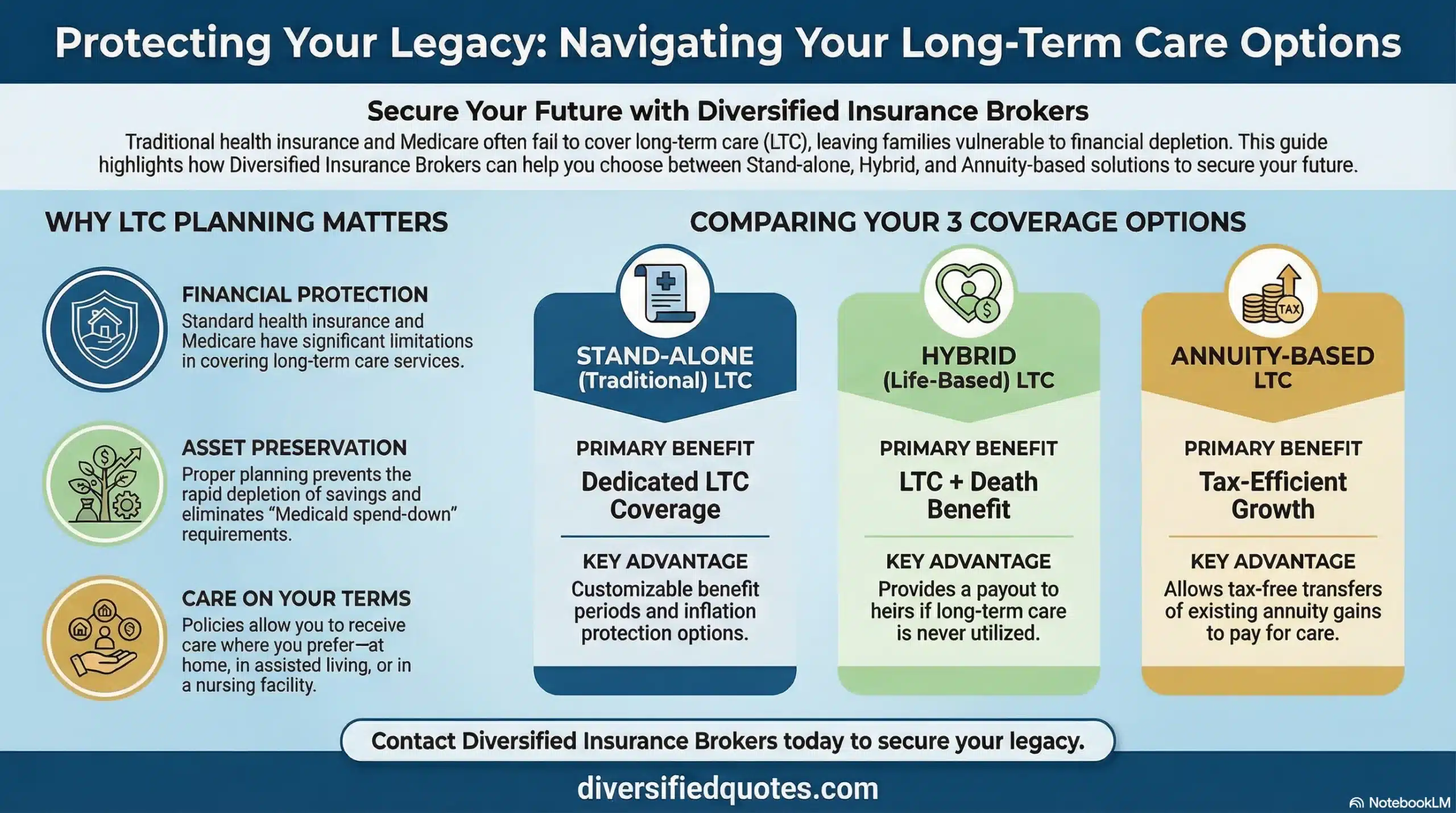
Why not simply buy traditional long-term care insurance directly with IRA withdrawals? You could — but the tax impact may be less efficient, and traditional LTC policies typically do not provide a death benefit if care is never used. Many retirees dislike the “use it or lose it” structure. A life insurance policy with long-term care benefits provides dual outcomes: either the policy pays for qualifying care expenses, or it pays a tax-free death benefit to beneficiaries. That flexibility often makes the strategy attractive for clients concerned about legacy, tax exposure, and healthcare costs simultaneously.
This approach also intersects with broader retirement income planning. Many retirees are already evaluating how annuities fit into their portfolio. For example, some families explore laddering annuities to create structured income timelines. Others review the tax consequences of repositioning qualified funds through guides like how to transfer an IRA to an annuity. When long-term care planning is layered into that conversation, the 10-year distribution strategy becomes a powerful hybrid solution rather than a standalone insurance purchase.
One of the most compelling elements is leverage. In a properly structured case, repositioning $200,000 of qualified funds might generate substantially higher available long-term care benefits over time compared to simply holding the IRA and self-funding care. Additionally, if care is never needed, beneficiaries receive a life insurance payout. That shifts the retirement dollars from “fully taxable someday” to “potentially tax-advantaged protection now.”
From a tax standpoint, spreading withdrawals across ten years can help prevent bracket creep, reduce Medicare premium surcharges triggered by higher income, and potentially improve overall retirement tax coordination. It can also align strategically with other income decisions, such as whether you are weighing annuity vs 401(k) planning decisions or determining what to do with deferred compensation after retirement. The key is integration — not isolation.
Long-term care costs continue to rise, and many families underestimate how extended care expenses can affect retirement security. Without planning, a significant health event can quickly erode retirement savings. By repositioning a defined slice of qualified assets into a structured funding strategy, you effectively convert a taxable asset into a benefit pool designed specifically for care. That can preserve other portfolio assets for income, legacy, or spouse protection.
Importantly, this is not a loophole or tax avoidance scheme. IRA distributions remain taxable as ordinary income. The advantage lies in timing and coordination. Rather than accelerating taxation unnecessarily, the 10-year funding window allows for predictability. That predictability becomes especially valuable for retirees managing Social Security timing, pension income, annuity income, and required minimum distributions.
Some clients also appreciate that this strategy can help address generational wealth concerns. With significant retirement assets projected to transfer over the coming decades, heirs may inherit large taxable IRAs subject to distribution rules. Redirecting a portion toward leveraged long-term care and life insurance benefits can create more tax-efficient legacy outcomes compared to leaving the entire balance exposed to future distribution taxation.
Turn IRA Dollars into Long-Term Care & Legacy Protection
See how a structured annuity-to-LTC funding design can protect retirement assets while managing tax exposure.
Eligibility depends on health underwriting for the life insurance portion, as well as suitability and funding mechanics for the annuity portion. Not all retirement accounts or personal health situations qualify. That is why detailed case design matters. We evaluate tax bracket projections, distribution pacing, age, care concerns, and long-term objectives before recommending this approach.
It is also worth comparing this strategy against other liquidity or asset planning alternatives. Some individuals consider litigation advances such as advance on a pending lawsuit or getting cash before a case settles when liquidity is tight, but those are short-term tools. Long-term care funding is a retirement structural decision — not a temporary bridge. Similarly, retirement tax positioning tools like understanding the annuity exclusion ratio can help optimize income streams, but they do not directly solve extended care exposure. The qualified-funds-to-LTC strategy specifically addresses longevity and healthcare cost risk in one coordinated design.
Ultimately, the question is not simply “Can you use qualified funds for long term care insurance?” The better question is: “How can you reposition retirement dollars to create maximum protection with controlled taxation?” When structured properly, rolling retirement funds into an annuity and distributing them over ten years to fund life insurance with long-term care benefits can transform idle, taxable assets into leveraged, multi-purpose protection — while smoothing tax impact and preserving legacy flexibility.
Related Planning Topics
Explore retirement income coordination, tax positioning, and annuity integration strategies.
Financial Protection Essentials
High-risk life insurance strategies, disability income education, and international travel protection solutions to strengthen financial security.
Talk With an Advisor Today
Choose how you’d like to connect—call or message us, then book a time that works for you.
Schedule here:
calendly.com/jason-dibcompanies/diversified-quotes
Licensed in all 50 states • Fiduciary, family-owned since 1980
FAQs: Using Qualified Funds for Long Term Care Insurance
Can I pay long-term care insurance premiums directly from my IRA?
Not directly without triggering taxation. IRA withdrawals are taxed as ordinary income. A structured strategy often works better: transferring qualified funds into an annuity and distributing them over 10 years to fund a life insurance policy with long-term care benefits. Learn more about how to transfer an IRA to an annuity.
Why use an annuity in the funding strategy?
The annuity allows you to spread taxable distributions over time rather than taking a large lump sum. This helps manage tax brackets and retirement income coordination. Some retirees also compare broader positioning strategies like laddering annuities when designing structured income plans.
How does this strategy help with taxes?
Instead of accelerating taxation in one year, distributions are taken gradually—often across 10 years. This can reduce bracket spikes and improve retirement income efficiency. Understanding concepts like the annuity exclusion ratio can also help clarify how different annuity income streams are taxed.
What happens if I never need long-term care?
When structured using life insurance with long-term care benefits, the policy typically pays a tax-free death benefit to beneficiaries if care is never used. This dual-purpose design helps convert taxable retirement dollars into leveraged protection rather than a “use it or lose it” expense.
Is this better than leaving funds inside my 401(k)?
It depends on your goals. Some retirees compare retirement positioning strategies such as annuity vs. 401(k) planning to determine whether repositioning a portion of assets improves tax control, legacy planning, and long-term care protection.
Does this strategy work with deferred compensation plans?
Possibly. Distribution timing and rollover eligibility must be evaluated carefully. If you’re nearing retirement, reviewing what to do with a deferred comp plan after retirement can help determine whether repositioning funds for long-term care planning makes sense.
About the Author:
Jason Stolz, CLTC, CRPC and Chief Underwriter at Diversified Insurance Brokers, is a senior insurance and retirement professional with more than two decades of real-world experience helping individuals, families, and business owners protect their income, assets, and long-term financial stability. As a long-time partner of the nationally licensed independent agency Diversified Insurance Brokers, Jason provides trusted guidance across multiple specialties—including fixed and indexed annuities, long-term care planning, personal and business disability insurance, life insurance solutions, and short-term health coverage. Diversified Insurance Brokers maintains active contracts with over 100 highly rated insurance carriers, ensuring clients have access to a broad and competitive marketplace.
His practical, education-first approach has earned recognition in publications such as VoyageATL, highlighting his commitment to financial clarity and client-focused planning. Drawing on deep product knowledge and years of hands-on field experience, Jason helps clients evaluate carriers, compare strategies, and build retirement and protection plans that are both secure and cost-efficient.
