
Group Health Insurance for Accounting Firms

Jason Stolz CLTC, CRPC
Group Health Insurance for Accounting Firms
Compare fully insured, level-funded, and self-funded options built for CPA firms and accounting practices—so you can control costs and keep great people.
Accounting firms operate on tight timelines, predictable busy seasons, and a talent market where benefits can make or break retention. Whether you run a partner-led CPA firm, a growing bookkeeping practice, or a multi-office advisory group, your health plan has to do three things well: stay stable at renewal, keep payroll predictable, and support recruiting when you need to hire quickly. The best approach usually starts with a clear understanding of the main plan categories—fully insured, level-funded, and self-funded—and then matching them to your firm’s size, cash flow, and risk tolerance.
At Diversified Insurance Brokers, we help professional service firms compare plan structures side-by-side so the decision is practical—not theoretical. If you’re starting from scratch, our group medical insurance overview is a helpful baseline because it frames the core choices: networks, contribution strategy, eligibility rules, and how renewals tend to behave across different plan types.
Accounting firms are also a unique case because the day-to-day employee experience matters as much as the numbers. If your plan causes confusion, surprises, or “provider problems” during busy season, it impacts productivity and morale immediately. The goal isn’t just “a plan.” The goal is a plan your team understands and uses confidently—and a renewal strategy that stops feeling like an emergency.
Who This Page Is For
This guide is designed for accounting firms that want better control over medical costs without sacrificing recruiting power. We see the strongest fit in firms that have a stable full-time core, consistent payroll, and a willingness to make benefits a “system” instead of a once-a-year scramble. That can mean a partner-led practice adding its first true employee plan, or an established firm tired of double-digit renewals and ready for more levers and better information.
If your firm is very small and you’re unsure whether you even qualify for a true group plan, start with the practical thresholds and options in our minimum employees for group health insurance guide. It outlines common carrier requirements and the typical paths for small teams that still want group-style enrollment and pricing.
If you’re a mid-size firm, this page will help you evaluate whether you should remain fully insured, shift into a level-funded structure to gain more efficiency and potential savings, or explore self-funding for maximum control and transparency. The “right” answer depends less on buzzwords and more on your firm’s structure, stability, and priorities.
What’s Different About Accounting Firms
Accounting firms share a unique mix of workforce traits that influence plan selection. Recruiting is competitive, and employees compare your benefits to other firms—often in the same geographic area and with similar career paths. That comparison is not only about premium cost. It’s about whether the plan feels easy, whether provider access is strong, and whether there are “surprise” pain points like narrow networks or confusing pharmacy rules.
Busy season changes everything. Long hours and stress can increase urgent care and mental health utilization, and it can make it harder for employees to deal with administrative friction. A plan that creates billing confusion, ID card delays, or unclear coverage rules can become a productivity issue. For accounting firms, stability matters—not just financially, but operationally.
Accounting firms also commonly have multiple classes of workers—partners, CPAs, staff accountants, admin, and sometimes seasonal support. That creates a real question: how do you structure contributions and eligibility in a way that is fair, compliant, easy to administer, and supportive of retention? The best plans take that reality seriously and design around it rather than pretending every employee is identical.
Finally, accounting firms often have a stronger “financial literacy culture” than many businesses. That can be an advantage. When you explain the plan clearly—especially around deductibles, HSAs, and total compensation—employees tend to engage and make smarter choices. That employee behavior, over time, directly influences claims efficiency and renewal stability.
If your firm is building a full benefits “stack,” it can help to align your health plan decisions with the overall employee experience. Some firms explore optional benefits and broader support through our general services resources and then choose the group health structure that best complements that retention strategy.
Plan Types: Fully Insured vs Level-Funded vs Self-Funded
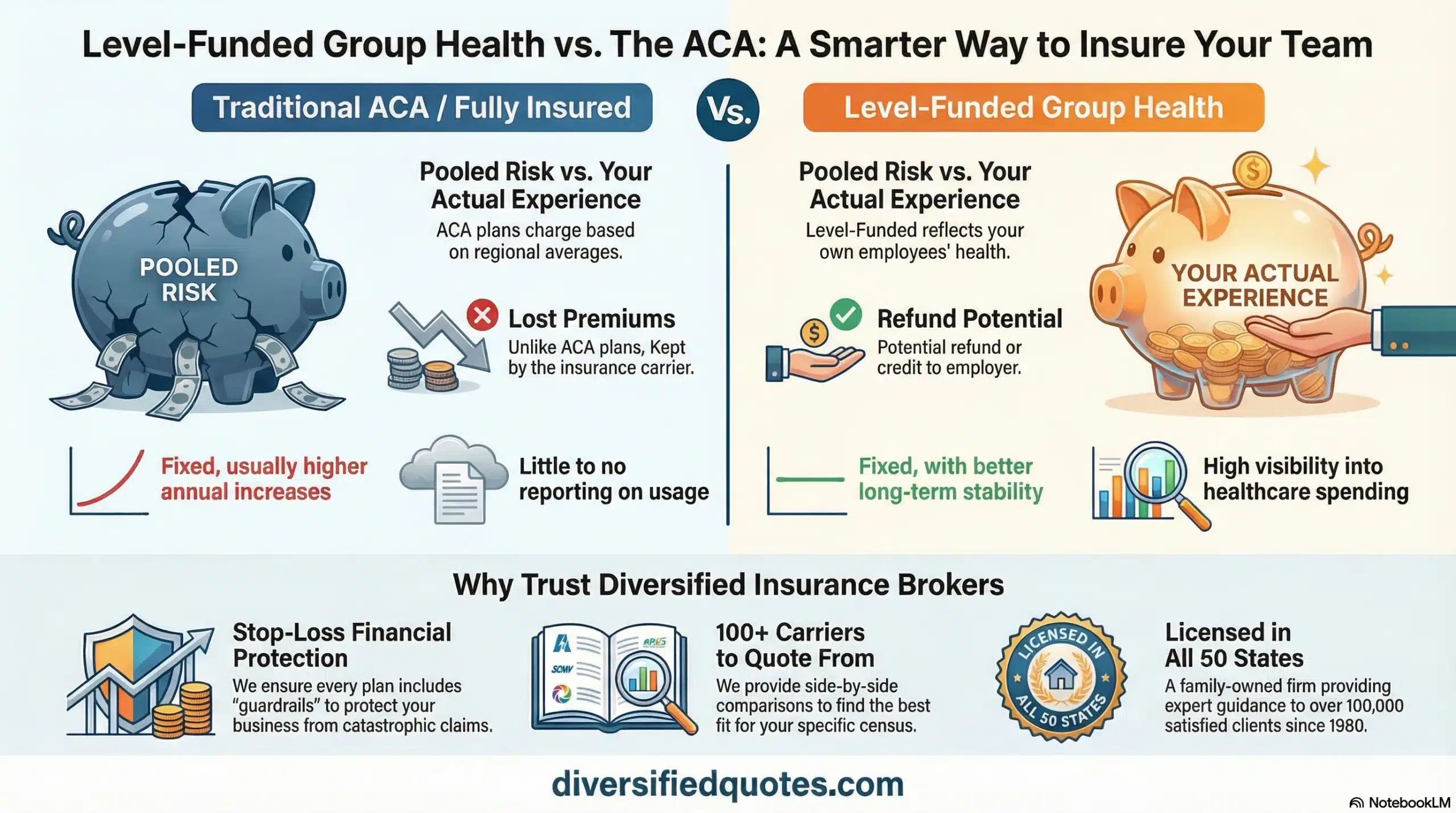
Most accounting firms start fully insured because it’s familiar and easy to implement. But “easy” doesn’t always mean “best,” especially when renewal increases become unpredictable or when leadership feels like they’re paying more without understanding why. The right plan type depends on how much transparency you want, whether you prefer fixed monthly costs, and how comfortable you are sharing risk with a carrier or a stop-loss partner.
Fully Insured Plans
A fully insured plan is the classic model: you pay fixed premiums to a carrier, the carrier pays claims, and your renewal is adjusted based on your group’s experience and broader market factors. Many accounting firms choose fully insured plans when they’re smaller, when administrative capacity is limited, or when leadership wants maximum risk transfer and simple accounting.
The tradeoff is that fully insured premiums can include conservative pricing assumptions and carrier margins. For firms with stable demographics and reasonably efficient utilization, that can lead to overpayment over time. Our small business group health insurance page walks through how carriers often price these plans and which underwriting inputs tend to drive renewals.
Level-Funded Plans
Level-funded plans are often a strong fit for accounting firms because they combine predictable monthly payments with a structure that can reward efficient claims experience. You pay a stable monthly amount (similar to fully insured), but the plan is typically built on a self-funded chassis with stop-loss protection and clearer cost visibility.
When claims run favorably, some level-funded structures can create a pathway to savings or refunds (depending on plan terms). This tends to appeal to accounting firms because the workforce is often stable and the firm prefers predictable budgeting with better “why” behind the numbers.
Self-Funded Plans
Self-funded plans give employers the most control and the most responsibility. The firm pays claims (often through a third-party administrator), and stop-loss coverage protects against catastrophic exposure. The upside is visibility and flexibility; the challenge is that claims variability is real—so the plan must be designed carefully and governed intentionally.
If you’re considering this route, read what is self-funded group health insurance and then pressure-test the tradeoffs with the pros and cons of self-funded group health. Those resources help you determine whether the added control and transparency is worth it for your firm’s stage and cash flow expectations.
One of the most common patterns we see is an accounting firm moving from fully insured to level-funded once they’re large enough to benefit from better pricing mechanics, and then later evaluating self-funding when they’ve built the internal processes and vendor stack that supports long-term governance.
Network and Carrier Selection for Professional Firms
For accounting firms, network quality is not a “nice to have.” It directly affects retention because accounting professionals often prioritize stable provider access and predictability. A plan that looks cheaper on paper can become expensive if it creates network disruption, pushes employees out of network, or forces provider changes that create frustration during the busiest time of year.
A strong strategy usually starts by selecting a network that fits where employees live and where they actually seek care. That sounds obvious, but many firms only discover network mismatch after enrollment—when employees begin reporting provider access problems. Preventing that friction is often a higher ROI decision than shaving a small amount off premium.
Carrier selection matters too, but not for the reasons most employers assume. In mid-market plans, the “carrier name” is less important than network contracts, plan design, and the administrative experience. What you want is a structure that supports clear member communications, smooth claims processing, and practical tools that reduce confusion. Accounting teams appreciate clarity—and employees value benefits that feel simple and dependable.
When we build proposals for accounting firms, we aim to keep the decision clean. Instead of presenting dozens of confusing options, we narrow to a small set of plans that differ in meaningful ways: network strength, plan type (insured vs level-funded vs self-funded), contribution strategy, and employee cost experience.
Cost Controls That Don’t Hurt Recruiting
Cost control isn’t about squeezing benefits until morale breaks. It’s about choosing the right funding model, setting a contribution strategy you can sustain, and using plan design features that steer utilization without creating friction. Accounting firms can often reduce waste by focusing on predictable drivers: pharmacy spend, unnecessary emergency room usage, and network leakage into higher-cost settings.
One of the most effective approaches is offering a smart two-option strategy: a “value” plan with stronger incentives for efficient care, paired with a “buy-up” plan for employees who prefer lower out-of-pocket costs. When done correctly, this structure preserves choice, protects recruiting power, and can reduce the employer’s average cost because not every employee selects the richest plan.
Another lever is pairing your plan with clear education. During busy season, employees have less time to deal with healthcare confusion. A simple benefits guide that explains how copays work, urgent care vs emergency room, and basic prescription rules can reduce claims waste and employee frustration. This approach is especially effective when plan terms stay stable year-to-year—something many level-funded strategies are designed to support.
Finally, cost control improves when you measure the right things. A plan that “looks cheaper” can still produce worse renewals if the design causes poor utilization patterns. The goal is not to win the spreadsheet this year. The goal is to build a plan that performs well over time.
Pharmacy Strategy and Specialty Cost Exposure
Pharmacy is often the most concentrated cost driver in employer health plans. A small number of members can create a large share of total spend, especially when specialty medications are involved. That is why pharmacy should be evaluated deliberately in accounting firm plans—because the financial impact can be significant, and the renewal ripple effect can last for years.
Good pharmacy strategy is not about restricting care. It’s about managing net cost and predictability. That includes how the plan handles formulary design, specialty management, prior authorization processes, and cost-sharing rules that influence member behavior. When these elements are designed well, the plan controls waste without creating member confusion.
In practical terms, accounting firms benefit from pharmacy clarity. Employees want to know “what does it cost, where do I fill it, and what do I do if it’s denied?” A plan that answers those questions simply reduces HR noise and protects morale during your most intense workload cycles.
If you are moving into level-funded or self-funded arrangements, pharmacy reporting can also become more actionable. Instead of guessing what’s happening, you can often see patterns and plan around them—one of the biggest advantages of a more transparent structure.
Plan Design Decisions: HDHP, PPO, HSA, and Buy-Up Options
Plan design is where benefits become real for employees. Employers sometimes focus too heavily on premium and overlook how employees experience the plan day-to-day. For accounting firms, the best plan designs tend to be the ones that employees understand easily and can use confidently—because confusion turns into HR workload and productivity loss.
HDHP + HSA Strategies
High-deductible health plans paired with HSAs can be an excellent fit for accounting firms when the plan is positioned correctly. Many accounting professionals understand the value of tax-advantaged savings and appreciate a plan structure that can be efficient long-term. The employer can support this approach by contributing to HSAs and by clearly educating employees on how to use the plan effectively.
The risk is implementation without education. If employees hear “high deductible” and assume the plan is simply “worse,” adoption and satisfaction drop. When the firm frames the plan properly—total compensation view, employer HSA contributions, and how preventive care works—HDHP/HSA strategies often become a retention-positive benefit rather than a cost-cutting signal.
PPO and Traditional Copay Designs
Many firms prefer a PPO-style experience because employees like predictable copays. These designs can support recruiting, especially when you are competing against other professional firms with rich benefits. The key is structuring the plan so it remains sustainable at renewal. A rich plan without a renewal strategy can become expensive quickly, which often leads to disruptive changes later.
Two-Plan (Core + Buy-Up) Structures
Offering a core plan plus a buy-up plan is one of the best ways to maintain recruiting power without locking the employer into the highest-cost option for every employee. The core plan sets a sustainable baseline. The buy-up plan gives employees the chance to pay more for richer coverage if they value lower out-of-pocket costs.
This approach also reduces employee frustration during renewals because the firm has more flexibility. Instead of cutting benefits across the board, you can adjust contributions or plan parameters in a way that preserves choice and reduces disruption.
Employer Contributions and Classing Strategies
Contribution strategy is one of the biggest hidden drivers of long-term plan success. If contributions are too low, enrollment declines, participation becomes a problem, and the enrolled population can skew toward higher utilizers. If contributions are too high, payroll becomes inflexible and renewals feel painful. The sweet spot is a contribution structure that is competitive enough to support recruiting but stable enough to repeat every year.
Many accounting firms use a strong base contribution for employee-only coverage and then offer dependent coverage at a higher employee share. This can keep employer costs predictable while still offering a meaningful benefit. It also aligns with how many employees evaluate benefits: “Is the employer providing a solid plan for me?” while allowing employees to decide how much they want to subsidize family coverage.
Partner-led structures can introduce complexity, particularly when partners have different compensation or benefit expectations than staff. The key is building contributions that are fair, compliant, and simple to administer, while also supporting your retention goals for staff roles that are hardest to replace.
If you’re benchmarking a contribution strategy or evaluating options for a smaller firm structure, our small employer group health insurance resource can be helpful when planning your next renewal and understanding typical market norms.
Eligibility, Participation, and Compliance Basics
Every group health plan has three gatekeepers: eligibility rules, employer contribution rules, and participation requirements. Eligibility typically focuses on full-time status, waiting periods, and sometimes job classification. Participation rules often depend on the carrier and state and are tied to the percentage of eligible employees who enroll.
Accounting firms sometimes struggle with participation when employees waive coverage due to spouse plans or when partners prefer alternative arrangements. In these cases, the plan must be positioned correctly and communicated clearly. Confusion at enrollment is the fastest way to create participation and compliance headaches.
It is also important to coordinate the plan with your firm’s business structure. If your firm includes owners who are self-employed in certain ways, or if you have multiple entities, the plan design may need to match how payroll and eligibility are administered. When the firm’s structure is unique, we often reference approaches discussed in how to get group health insurance for the self-employed so the decision is aligned with the real-world setup.
The best compliance strategy is not “more complexity.” It’s clean eligibility rules, a simple enrollment timeline, and clear communication that reduces waivers due to confusion rather than genuine alternative coverage.
How Renewals Typically Change—and How to Manage Them
Renewals are where plans either become stable or become a yearly fire drill. The most common renewal issues for accounting firms are rate increases that outpace revenue growth, employee dissatisfaction due to plan changes, and lack of clarity about why the renewal moved. The fix is not always switching carriers. Often, the fix is switching plan architecture so you have better predictability, better reporting, and better levers.
A stable renewal strategy usually includes three elements. First, get your baseline right: network, plan type, and contribution strategy. Second, implement modest, consistent adjustments rather than major swings every year. Third, create a renewal calendar that starts early enough to gather good data and avoid rushed decisions.
Timing matters for accounting firms because renewal season can overlap with tax season, fiscal year-end workload, or audit deadlines. If leadership is forced to decide quickly, the plan becomes reactive and employees feel the disruption. Starting early gives the firm the ability to compare options calmly and communicate changes clearly.
If your firm is evaluating whether to keep a traditional fully insured plan or migrate to an alternative structure, we typically model scenarios in a way that’s easy to understand: expected outcomes, a “favorable claims” case, and a stress-tested case. That doesn’t require complex math. It requires better structure and clearer assumptions.
Level-funded and self-funded approaches can be attractive here because they introduce more transparency into what’s driving cost. You don’t need to turn your firm into an insurance company. You just need a plan that is designed to be managed rather than endured.
Implementation Checklist for Accounting Firms
A smooth group health rollout does not require a massive HR department, but it does require a repeatable process. Accounting firms do best when implementation is structured, simple, and consistent, because employees want clarity and leadership wants minimal disruption.
Start by confirming eligibility rules: who is considered full-time, when coverage begins, and how you treat seasonal roles. Next, finalize plan options and contribution amounts. Then prepare short, practical communications: plan summaries, employee cost examples, and a “how to choose” guide that explains the difference between the options. Finally, run enrollment with a clean timeline and a clear point of contact so employees don’t feel lost.
After enrollment, perform a first 60–90 day review to confirm that payroll deductions match elections, ID cards arrived, and any network or pharmacy issues are addressed early. Small administrative problems become employee confidence problems if they linger—especially during your busiest months.
Accounting firms also benefit from building a repeatable annual calendar. The best benefits programs feel steady, not chaotic. When the firm commits to a consistent plan strategy and improves it modestly over time, employees gain trust in the benefit and the renewal process becomes easier each year.
Want a Side-by-Side Proposal for Your Firm?
We’ll compare plan structures and carrier options and help you choose the approach that fits your firm’s size, budget, and recruiting goals.
Next Steps
The fastest path to a better plan is a structured comparison. We typically start by confirming your employee count and eligibility, reviewing your current plan and renewal (if you have one), and identifying whether fully insured, level-funded, or self-funded fits best. Then we build a short list of options that are easy to explain and easy to implement.
If you’re ready to explore options, use the contact form below and we’ll follow up with a simple intake so we can model the plan types that best match your firm. The goal is straightforward: a plan your team understands, a cost you can predict, and a renewal process that stops being a yearly emergency.
Get Group Health Options for Your Accounting Firm
Tell us your firm size and goals, and we’ll present practical plan options with clear tradeoffs.
Related Pages
More group health resources for small teams and growing employers.
Talk With an Advisor Today
Choose how you’d like to connect—call or message us, then book a time that works for you.
Schedule here:
calendly.com/jason-dibcompanies/diversified-quotes
Licensed in all 50 states • Fiduciary, family-owned since 1980
FAQs: Group Health Insurance for Accounting Firms
How many employees does an accounting firm need for group health insurance?
Most carriers require at least two eligible full-time employees, though requirements vary by state and plan type. Some options are available for very small or partner-only firms.
Can firm partners be covered under a group health plan?
Yes. Partners can typically be covered, but eligibility depends on how the firm is structured (LLC, partnership, S-corp) and how ownership is reported.
Are level-funded plans a good fit for accounting firms?
Level-funded plans are often a strong fit for accounting firms because they offer predictable monthly costs, better claims transparency, and potential savings compared to fully insured plans.
How do seasonal or part-time staff affect eligibility?
Group health insurance generally applies to full-time employees only. Seasonal or part-time workers usually do not count toward eligibility or participation requirements.
Can accounting firms offer multiple plan options?
Yes. Many firms offer more than one plan so employees can choose between lower premiums or richer coverage, which helps accommodate different household needs.
How often can a firm change its group health plan?
Most plans renew annually. Firms can review pricing, carriers, and plan structures each year and make changes during the renewal window or qualifying enrollment periods.
About the Author:
Jason Stolz, CLTC, CRPC and Chief Underwriter at Diversified Insurance Brokers, is a senior insurance and retirement professional with more than two decades of real-world experience helping individuals, families, and business owners protect their income, assets, and long-term financial stability. As a long-time partner of the nationally licensed independent agency Diversified Insurance Brokers, Jason provides trusted guidance across multiple specialties—including fixed and indexed annuities, long-term care planning, personal and business disability insurance, life insurance solutions, and short-term health coverage. Diversified Insurance Brokers maintains active contracts with over 100 highly rated insurance carriers, ensuring clients have access to a broad and competitive marketplace.
His practical, education-first approach has earned recognition in publications such as VoyageATL, highlighting his commitment to financial clarity and client-focused planning. Drawing on deep product knowledge and years of hands-on field experience, Jason helps clients evaluate carriers, compare strategies, and build retirement and protection plans that are both secure and cost-efficient.
