
Group Health Insurance for Private Schools

Jason Stolz CLTC, CRPC
Explore Group Health Insurance Options for Your School
Compare fully insured, level-funded, and self-funded plans designed for private schools—so you can retain great educators and protect your budget.
Group health insurance for private schools plays a direct role in attracting qualified educators, retaining experienced administrators, and maintaining financial stability in a competitive education environment. Private schools operate with unique constraints—tuition-driven budgets, fluctuating enrollment, nonprofit governance, and diverse staffing structures—yet they are still expected to offer benefits comparable to public schools and larger employers. Choosing the right health plan structure is one of the most impactful long-term decisions a school can make.
At Diversified Insurance Brokers, we work with private schools nationwide to design sustainable, compliant, and cost-aware group health insurance strategies. Whether your school employs 5 people or 500, offers religious or secular instruction, or operates as a nonprofit or independent institution, we help you evaluate fully insured, level-funded, and self-funded options that align with your mission and budget realities.
This page walks through how private school health plans are typically priced, where costs usually drift upward, and what practical levers school leadership can use to improve renewal stability without reducing benefit quality or disrupting employee experience.
Why Group Health Insurance Matters for Private Schools
Private schools rely on their people. Teachers, administrators, counselors, and support staff shape outcomes, culture, and parent confidence. Unlike public school systems, private schools typically do not have access to large state-run benefit pools, which means each benefit decision can materially impact the school’s operating budget.
A well-structured group health insurance plan helps private schools compete for talent against public schools, charter schools, and private sector employers. It also supports faculty wellness, reduces turnover, and reinforces the school’s commitment to long-term staff relationships—something families notice and value.
From an administrative standpoint, the goal is not just coverage—it is predictability. Rising healthcare costs, compliance obligations, and employee expectations can strain leadership when a plan is poorly designed or mismatched to the school’s size, demographics, and cash-flow cadence.
Unique Challenges Private Schools Face With Health Insurance
Private schools often operate with revenue patterns and staffing models that do not map neatly to typical small-business plans. Enrollment cycles can shift year to year, tuition revenue may be seasonal, and staffing frequently includes a mix of full-time faculty, part-time instructors, coaching roles, and hourly support staff. Those realities impact eligibility, participation, and cost.
Some schools experience renewal increases that feel disconnected from actual usage. Others struggle with minimum participation requirements when many employees have coverage through a spouse. Schools may also have staff who prioritize broad provider access due to family needs, making narrow networks feel disruptive even when premiums are lower.
Another common challenge is the assumption that more advanced plan structures are only for large corporations. In reality, many schools can explore level-funded or partially self-funded options once they have enough employees to support more accurate pricing and stable enrollment behavior—provided the plan is designed properly.
If you’re unsure what thresholds typically apply, reviewing minimum employees for group health insurance can help frame what is realistic for your school.
Group Health Insurance Plan Options for Private Schools
Most private schools evaluate three primary structures: fully insured, level-funded, and self-funded. The best fit depends on employee count, cash flow, risk tolerance, and how much visibility the school wants into claims and cost drivers. The right move is usually a structured comparison—not guesswork based on what “other schools do.”
Fully Insured Health Plans
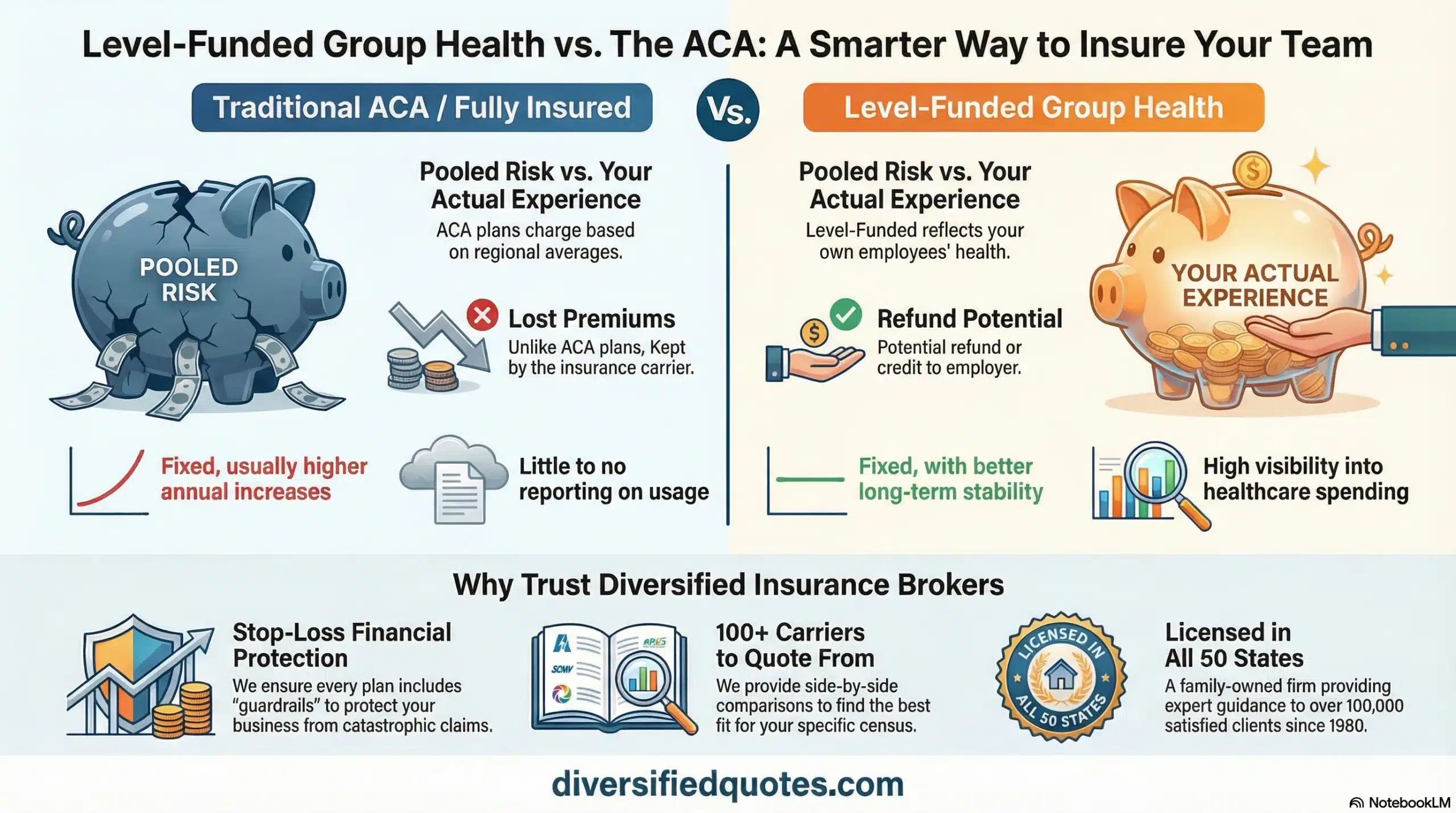
Fully insured group health insurance is the most familiar option. Under a fully insured plan, the school pays a fixed monthly premium to an insurance carrier, and the carrier assumes the financial risk of claims. This structure can feel straightforward: the premium is known, claims are handled by the insurer, and administration is generally simpler.
For smaller schools—or schools that prefer minimal administrative complexity—fully insured plans can remain a practical starting point. However, fully insured plans can also be the most expensive over time because pricing includes carrier margins, pooled-risk assumptions, and limited transparency into what is driving cost.
When a school experiences repeated double-digit renewals without clear explanations, it often becomes worth comparing structures that create better pricing mechanics.
Level-Funded Health Plans
Level-funded health insurance has become a common path for private schools that want cost control without a leap into full self-insurance. A level-funded plan typically keeps a predictable monthly payment while introducing stop-loss protection and more insight into plan performance. If claims run lower than expected, the school may receive a surplus credit or refund depending on the design.
This structure can be appealing for schools with stable staffing and leadership that values predictable budgeting. It also creates an incentive alignment that many schools prefer: favorable plan performance can benefit the school rather than disappearing into broad market pooling.
Schools often compare level-funded options alongside self-funded structures to understand the mechanics of claims, risk caps, and reporting. If you want a baseline explanation, start with what self-funded group health insurance is.
Self-Funded Health Plans
Self-funded group health insurance allows a private school to pay for employee healthcare claims directly rather than paying fixed premiums for the insurer to take the risk. While that may sound risky, properly designed self-funded plans include stop-loss coverage that caps exposure. The upside is transparency, flexibility, and potentially better long-term cost control because the school gains visibility into what is driving spend.
Self-funding is not exclusively for massive employers. For certain schools with stable demographics and enough scale, it can be a strong long-term structure. The key requirement is governance: a self-funded plan works best when leadership is willing to review plan performance, manage vendors intentionally, and keep the plan design aligned with how employees actually use care.
To evaluate tradeoffs clearly, review the pros and cons of self-funded group health.
Want a Side-by-Side Comparison for Your School?
We’ll compare plan types and carrier options and highlight the tradeoffs in plain language—cost, predictability, networks, and employee impact.
Minimum Participation and Employer Contribution Rules
Group health plans often have two operational gatekeepers: participation and employer contribution. Participation rules typically require a minimum percentage of eligible employees to enroll. This can be challenging for private schools when many employees have coverage through a spouse or another employer. Contribution rules often require the school to pay at least a minimum percentage of employee-only premiums.
The practical goal is to build a contribution strategy that is sustainable for the school and credible for employees. If contributions are too low, participation can weaken and the plan becomes difficult to renew. If contributions are too high, payroll becomes inflexible and renewals become disruptive. The best approach is usually a repeatable contribution model the school can maintain year after year.
Schools with diverse employment arrangements sometimes find certain plan structures provide more flexibility than others. The right solution depends on how your staff is classified, how eligibility is defined, and what participation norms apply in your state and market segment.
Coverage Options and Plan Design for Educators
Private school employees typically value predictable costs, broad provider access, and family coverage options. Plan design should balance affordability with benefits that staff will actually use. The “best” plan is rarely the richest plan on paper; it is usually the plan that delivers stability at renewal while keeping the employee experience simple and consistent.
Many schools choose between PPO networks, high-deductible health plans paired with HSAs, and hybrid designs that offer two options: a lower-premium plan for employees who want minimal payroll impact and a buy-up option for employees who prefer lower out-of-pocket costs. This approach can protect the school’s budget while still giving employees meaningful choice.
Another common strategy is pairing a high-deductible plan with an employer HSA contribution. That can reduce premium load while giving employees a structured way to handle predictable out-of-pocket expenses. When implemented properly, employees often feel more supported, not less supported, because the plan is easier to understand and budget for.
Budget Predictability and Renewal Stability
Private schools need renewals that do not become a yearly emergency. A stable renewal strategy typically has three elements. First, start with a strong baseline: network, plan structure, eligibility rules, and contribution strategy. Second, make modest, consistent adjustments over time instead of major plan swings that confuse employees. Third, begin the renewal review early enough to gather clean information and avoid rushed decisions.
Schools that stay on reactive fully insured renewals often feel trapped because pricing changes can be hard to explain. Schools that explore level-funded or self-funded structures often gain more insight into what is driving cost, which makes renewals easier to manage and employee messaging more credible.
The goal is not to chase the cheapest plan. The goal is to control trend, reduce surprises, and build a benefits structure the school can sustain for the long term.
Tax Considerations for Private and Nonprofit Schools
Many private schools operate as nonprofit organizations, which can affect how the school thinks about benefits expenses, governance, and reporting. Certain taxes and financial levers may differ from for-profit employers, and board-level decision-making often plays a role in benefit approvals.
Some plan structures can create efficiencies by reducing friction in how healthcare dollars are used and by improving the connection between plan performance and renewal outcomes. The appropriate strategy depends on the school’s size, governance preferences, and administrative capacity.
Because each school is different, the most effective approach is usually to model outcomes based on the school’s real staffing structure and budget constraints rather than assuming a one-size-fits-all rule applies.
Compliance and Regulatory Considerations
Private schools offering group health insurance must manage compliance responsibilities that can include plan documentation, employee notices, enrollment administration, and privacy obligations. The level of responsibility can vary depending on plan structure and how vendors are set up, but the risk of mistakes is real—particularly when staffing is lean and leadership is juggling multiple priorities.
Compliance matters not only to avoid penalties but also to prevent coverage gaps and employee frustration. A clean implementation process includes clear eligibility rules, consistent waiting periods, accurate payroll deductions, and a repeatable enrollment workflow.
Schools considering alternative funding structures should pay special attention to administration, because certain responsibilities shift closer to the employer. The right advisor helps ensure the plan is implemented correctly and managed with consistent oversight.
When Traditional Group Health Insurance May Not Be the Best Fit
In some cases, a traditional group plan may not be the best solution, particularly for very small private schools or schools with highly variable staffing models. When eligibility and participation are unstable, the school may need to evaluate alternative strategies that still support employee access to coverage.
These approaches require careful planning to maintain compliance and employee acceptance. The right answer depends on the school’s structure, its hiring goals, and how benefits fit into total compensation and retention strategy.
Why Private Schools Work With Diversified Insurance Brokers
Diversified Insurance Brokers is an independent, fiduciary insurance agency licensed in all 50 states. We work with private schools across the country and are not tied to a single carrier or platform. That independence allows us to compare plan structures and carrier options objectively and recommend what fits your school’s goals, staffing model, and budget realities.
Our role is to make the decision practical—not theoretical. We help leadership understand the tradeoffs, model financial outcomes, and implement a group health strategy that supports employees while protecting long-term institutional stability. Whether your school is exploring group coverage for the first time, facing a difficult renewal, or considering a transition to a more advanced funding model, we provide clear guidance and ongoing support.
Get Group Health Options for Your Private School
Tell us your staff size and priorities, and we’ll present plan options with clear costs, networks, and renewal expectations.
Financial Protection Essentials
Carrier reviews, retirement income planning tools, and specialized coverage resources for individuals and businesses.
Talk With an Advisor Today
Choose how you’d like to connect—call or message us, then book a time that works for you.
Schedule here:
calendly.com/jason-dibcompanies/diversified-quotes
Licensed in all 50 states • Fiduciary, family-owned since 1980
FAQs: Group Health Insurance for Private Schools
Can a private school offer group health insurance with only a few employees?
Yes. Many carriers offer small-group plans for eligible employers, and some alternative options (like level-funded) may work for schools with a modest staff size depending on state rules and plan availability.
What’s the difference between fully insured and level-funded health insurance?
Fully insured plans have a fixed premium and the carrier takes the claims risk. Level-funded plans also have a predictable monthly payment, but they include stop-loss protection and may provide renewal credits or surplus if claims run lower than expected.
Are self-funded health plans realistic for private schools?
They can be, especially for schools with stable enrollment and consistent staffing. With the right stop-loss structure and plan design, self-funded arrangements can provide better transparency and long-term cost control than traditional fully insured plans.
Do private schools have to meet minimum participation requirements?
Usually yes for fully insured small-group plans. Participation rules vary by state and carrier, and they may be affected by whether employees have other credible coverage through a spouse or another employer.
What plan types do private schools typically offer?
Common options include PPO plans, high-deductible plans paired with HSAs, and tiered offerings that let employees choose between lower-premium or richer-coverage designs based on their needs.
Can a private school offer coverage to part-time teachers or staff?
It depends on your eligibility rules, the carrier, and state regulations. Many plans restrict eligibility to full-time employees, but some schools design benefits to include certain part-time roles where allowed.
How can private schools control costs without cutting benefits?
Cost control often comes from plan design (deductibles, networks, copays), smarter funding approaches (level-funded or self-funded), and improving utilization through wellness and member education—without simply reducing coverage quality.
What compliance issues should private schools be aware of?
Key areas include ERISA plan documents, ACA rules where applicable, COBRA administration, HIPAA privacy requirements, and proper employee communications. Responsibilities vary based on plan type and employer size.
How long does it take to set up a new group health plan for a school?
Timelines vary, but many fully insured plans can be implemented in a few weeks. Level-funded or self-funded approaches may take longer due to underwriting, plan setup, and stop-loss coordination.
Can we compare multiple carriers and funding options before renewal?
Yes. It’s often best to start early so you can compare carriers, networks, renewals, and alternative funding strategies side by side—then select the option that best fits your budget and staff needs.
About the Author:
Jason Stolz, CLTC, CRPC and Chief Underwriter at Diversified Insurance Brokers, is a senior insurance and retirement professional with more than two decades of real-world experience helping individuals, families, and business owners protect their income, assets, and long-term financial stability. As a long-time partner of the nationally licensed independent agency Diversified Insurance Brokers, Jason provides trusted guidance across multiple specialties—including fixed and indexed annuities, long-term care planning, personal and business disability insurance, life insurance solutions, and short-term health coverage. Diversified Insurance Brokers maintains active contracts with over 100 highly rated insurance carriers, ensuring clients have access to a broad and competitive marketplace.
His practical, education-first approach has earned recognition in publications such as VoyageATL, highlighting his commitment to financial clarity and client-focused planning. Drawing on deep product knowledge and years of hands-on field experience, Jason helps clients evaluate carriers, compare strategies, and build retirement and protection plans that are both secure and cost-efficient.
