
How Social Security and Annuities Work Together

Jason Stolz CLTC, CRPC
How Social Security and annuities work together is one of the most practical retirement planning conversations you can have, because it focuses on what most retirees actually want: a dependable monthly paycheck that shows up no matter what markets do. Social Security provides an inflation-adjusted income foundation that lasts for life. Annuities can be designed to cover the gap between that foundation and your essential spending, provide additional lifetime income for one or two spouses, and reduce the pressure on your portfolio to “perform on schedule.” When the two are coordinated correctly, your retirement cash flow stops feeling like a guessing game and starts feeling like a plan.
The biggest mistake people make is treating Social Security and annuities as separate decisions. Social Security is often filed because “it feels like time,” while annuities are considered later only if someone is worried about the stock market. In reality, these decisions are naturally connected. Your Social Security claiming month changes the size of your lifetime check. Your annuity start date changes the size and timing of guaranteed income you can rely on. Together, they determine whether your essential bills are covered by guaranteed income or whether you’ll need to draw on investments during the years you can least afford a bad market stretch.
On this page, you’ll learn how to align claiming ages with annuity start dates, which annuity types are typically used alongside Social Security, how taxes can change the “real” value of your plan, and how to build a retirement paycheck that protects both spouses. If you want to begin by comparing what’s available today, start with current annuity rates and then consider whether bonus designs are relevant for your goals using current bonus annuity rates.
Ensure you are receiving the absolute top rates
Compare fixed and bonus annuity rates, then request personalized quotes based on your age, state, and income goals.
Estimate Guaranteed Income to Pair With Social Security
💡 Note: The calculator accepts premiums up to $2,000,000. If you’re investing more, results increase in direct proportion — for example, doubling your premium roughly doubles the guaranteed income at the same age and options.
After you run a few scenarios, compare structures using lifetime income annuity options so you can see how different start ages and income designs affect your paycheck.
Why Social Security and annuities complement each other
The most powerful reason Social Security and annuities work together is that both are designed to address longevity. Your retirement is not a 10-year event. It can easily last 25–35 years, and that timeline is long enough for multiple market cycles, multiple inflation phases, and major lifestyle changes. Social Security is built to provide a lifetime payment that includes cost-of-living adjustments. A well-structured annuity can provide a second lifetime payment that is designed around your budget goals, your spouse’s needs, and your preferred tradeoff between income and liquidity.
When households rely heavily on investments for essential bills, market declines can create “sequence risk.” That’s the risk that bad market years early in retirement force withdrawals at the worst time, permanently reducing the portfolio’s ability to recover. A plan that pairs Social Security with guaranteed annuity income can reduce that pressure because essential spending is less dependent on market performance. This does not mean you must annuitize everything. It means you can decide what needs to be guaranteed and what can remain market-linked without creating stress.
Another major benefit is simplicity. Retirees often want fewer moving parts in their monthly cash flow. Social Security provides predictable income and is typically paid monthly. Annuity income can be structured as monthly income as well, making it easier to map to bills. That can be especially helpful for couples who want a clear “income floor” so they can take discretionary withdrawals from investments with more confidence.
Finally, this combination helps reduce the burden on the higher earner’s Social Security decision. Many couples don’t realize how much the higher earner’s claiming age can affect survivor income for life. If the higher earner delays and locks in a larger Social Security benefit, that larger payment can become a long-term survivor anchor. Annuity choices can then be built to reinforce that survivor plan—either through joint payouts, continuation features, or staged income starts—depending on what the household values most.
Coordinating Social Security claiming age with annuity start dates
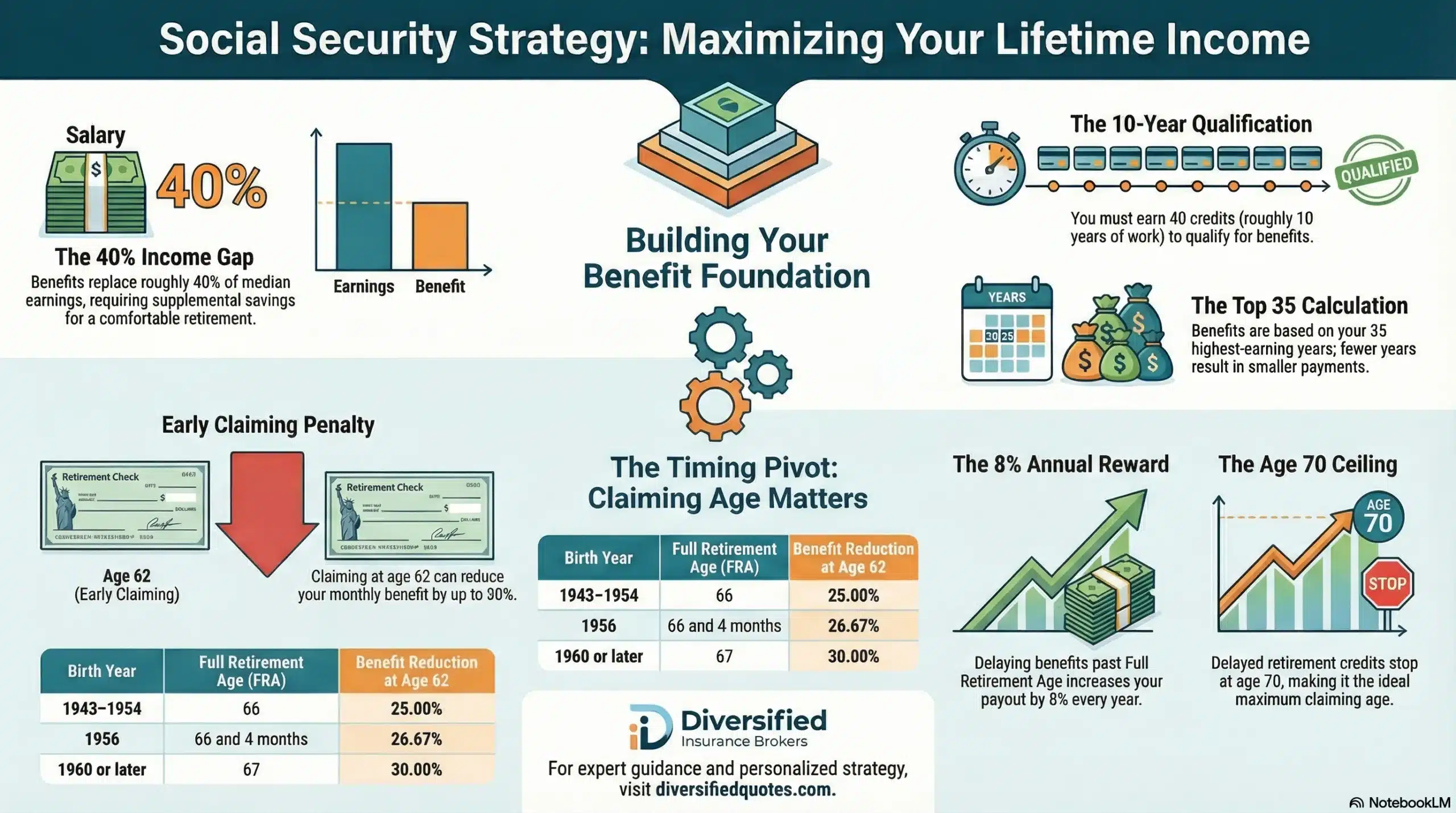
Social Security gives you a powerful lever: your claiming month. While people often talk about claiming “at 62” or “at 67,” the truth is that Social Security is month-based. That matters because the size of your benefit changes based on when you start, and it changes for life. Annuities give you another lever: you can decide when the annuity income begins. When you coordinate these levers, you can build a plan that intentionally covers the years when guaranteed income is lower and increases guaranteed income later when protection matters most.
One common strategy is the “bridge to delay” approach. In this strategy, the household delays Social Security—especially for the higher earner—to lock in a larger lifetime payment. The plan then uses a temporary income source to cover spending needs until the larger Social Security check begins. That temporary income can come from portfolio withdrawals, but many households prefer a more predictable bridge that reduces market reliance during those years. Annuities can be used for that bridge, either through a short-term income structure or through a safe accumulation vehicle with planned withdrawals.
Another common strategy is the “layered paycheck” approach. Instead of delaying Social Security to the maximum, the household claims around Full Retirement Age for one or both spouses and then layers annuity income on top to reach a reliable monthly target. This can feel more comfortable for retirees who want to reduce uncertainty quickly. It also helps households that have a larger gap between Social Security and essential spending, where the plan benefits from creating a second guaranteed layer rather than relying on investments for the gap.
The third planning concept is the “activate later” approach. Some households value liquidity early in retirement and want to keep assets available for travel, home projects, family support, or simply peace of mind. In that case, they may choose an annuity strategy that allows income to be turned on later, when they decide the retirement paycheck needs to be stronger. This approach is often implemented through structures that provide guaranteed lifetime withdrawal rights that can be activated later. The key is not to assume that “later activation” automatically means “best income.” You still want to compare what the contract actually pays at the age you intend to activate.
If you’re building a Social Security plan at the same time, start by understanding the household strategy and then work backward to the right combination. A helpful companion is maximizing Social Security benefits, because Social Security sequencing between spouses can change what “best” looks like for annuity start timing.
Which annuity types are commonly used with Social Security
If you want to understand how Social Security and annuities work together, it helps to know what each annuity category is typically used for. The goal is not to pick an annuity because it sounds good on paper. The goal is to pick an annuity that solves a specific cash-flow problem in your plan. That problem might be bridging years before Social Security starts, creating a lifetime “second paycheck,” adding spouse protection, or building a safe, rate-driven bucket that later converts into income.
Immediate income annuities are most often used to lock in a predictable monthly payment now. If the household wants a guaranteed paycheck right away, this category is typically the starting point. If you want a straightforward overview of how that works, review what is an immediate annuity. The key planning decision is not just “how much income do I get,” but also whether the income needs to last for one life, two lives, or for a certain period, and how those choices affect the payout.
Deferred income annuities are often used for future income needs, especially if someone wants income to begin later in retirement. This can pair well with Social Security planning because it allows you to design income for a later age when Social Security is fully established and the plan needs a second layer to keep pace with longevity. If you want to understand this category at a high level, review what is a deferred income annuity. The planning advantage is that you can buy today and schedule income later, rather than forcing all guaranteed income to start at the same time.
Multi-year guaranteed annuities are commonly used when the household wants a safe, predictable rate for a set term, especially when rates are attractive. Retirees sometimes use this category as a “safe bucket” that can later be repositioned to income at a future time. It can also be part of the bridge plan if the retiree wants predictable growth and planned withdrawals without being tied to market volatility. If you want to see how this category is used by retirees specifically, review multi-year guaranteed annuity for retirees.
Fixed indexed annuities are often considered when a household wants principal protection with the possibility of index-linked interest crediting, and also wants the option to create guaranteed lifetime withdrawals through an income rider. The important point is that this category is not “one thing.” It includes different crediting approaches, caps, spreads, and participation rates, and different rider structures that can materially change the income outcome. If your primary goal is lifetime income, focus on income results rather than marketing terms. For a helpful overview centered on income outcomes, review best fixed indexed annuities for income.
If you’re evaluating income riders, you’ll often see terminology like guaranteed lifetime withdrawal benefit riders. Those riders can be powerful if used correctly, but they need to be evaluated based on the actual income at your chosen start age and the contract rules around withdrawals. If you want a clear explanation of what that rider concept means, review what is a GLWB. The right way to think about a rider is as an income design tool, not as a simple “extra feature.”
Inflation planning: Social Security COLA and annuity income design
Social Security includes cost-of-living adjustments, which is one reason it functions as the foundation of many retirement plans. Annuity income can be designed in different ways around inflation depending on what you value most. Some retirees prioritize the highest starting paycheck possible, which can be helpful early in retirement when lifestyle spending is higher. Other retirees want a paycheck that increases over time to help keep pace with rising costs. The “best” approach depends on the household’s total guarantees, health outlook, and discretionary spending plans.
If you’re exploring increasing income features, it’s important to understand what the contract is actually offering and what tradeoffs are involved. An increasing income option often starts lower than a level-pay option, and then grows by a chosen percentage or according to a contract’s rules. If you want to understand how inflation adjustment options can show up on annuities, review what is COLA on an annuity. The planning objective is to avoid building a plan that looks great today but feels tight 10–15 years from now.
Another practical way retirees manage inflation is through staged income starts. Instead of trying to force one annuity to solve every problem, the plan might create one guaranteed layer today and a second guaranteed layer later. That later layer can begin when Social Security has already increased through cost-of-living adjustments and when the household wants more stability. This is one reason deferred income designs can pair well with Social Security planning: they can be timed intentionally rather than guessed.
Spousal protection: building a plan that works after the first death
Retirement income planning is not complete until you understand what happens after the first spouse dies. Social Security has built-in survivor rules, and the higher earner’s benefit is often the foundation of survivor protection. That is why the higher earner delaying Social Security can be a powerful planning move in many households. The surviving spouse may step into the higher Social Security benefit, and that income then continues for life. When annuities are layered into the plan, the question becomes: how do we make sure the total guaranteed income still supports the survivor’s lifestyle?
Annuities can be structured for one life or for two lives. If the goal is to protect the survivor with a continued income stream, a joint structure may make sense in certain situations. If you want a plain-English explanation of joint income structure, review what is a joint lifetime income annuity. Joint structures typically pay less initially than single-life structures because they are designed to last longer, but they can be valuable when the household wants a predictable survivor paycheck without relying on investments.
Some annuity contracts also offer continuation concepts that are designed to keep income going for the spouse in a structured way. These features can be useful when the household wants income continuity and a clean plan after the first death. If you want a focused explanation of that concept, review spousal continuation features. The key planning point is not to assume survivor protection exists automatically. It should be designed intentionally.
Understanding annuity income terms so you can compare correctly
When people compare annuities alongside Social Security, confusion often comes from terminology. A contract might advertise a bonus, a roll-up, or a growth rate, but the retiree’s real goal is simple: how much monthly income will I actually be able to take at the age I plan to start, and what happens if I live a long time? To make good decisions, you want to focus on what the contract pays, not the headline. Two annuities with very different marketing language can produce similar income. Two annuities that look similar can produce dramatically different income.
Bonuses are commonly misunderstood. A bonus might increase the account value used for income calculations, or it might apply to a specific value used for withdrawal calculations, or it might come with tradeoffs like longer surrender schedules or rider costs. If you want a focused explanation, review what is an annuity income bonus. The correct way to evaluate a bonus is to test whether it increases your actual expected income at your start age, after charges, in the strategy you intend to use.
Roll-up rates create a similar confusion. A roll-up rate is often applied to a value used for future income calculations, not a value you can withdraw as cash. Some retirees hear a roll-up number and assume it is investment growth. It usually is not. It is a mechanism for setting future income potential if the rider is activated later. If you want to understand the difference clearly, review what is an annuity roll-up rate. Once you understand the difference, you can compare annuities based on the only number that matters for a paycheck plan: the actual income available at the age you plan to start.
If you want a simple way to sanity-check income goals, it can help to use a payout calculator as a second reference point. That does not replace carrier illustrations or contract-specific quotes, but it helps you think in ranges. If you want a straightforward tool for that, use the annuity payout calculator as a checkpoint while you explore different structures.
Taxes: how Social Security and annuity income interact
A retirement paycheck plan should be evaluated in after-tax terms, not just gross monthly income. Social Security can become taxable depending on your “combined income,” and adding annuity income may change how much of Social Security is included in taxable income. This does not mean annuities are a bad idea. It means the plan should coordinate the timing and the income mix so you’re not surprised by taxes that reduce your net spendable cash flow.
If you want to understand how Social Security taxation can be reduced or managed, review reduce taxes on Social Security. Many strategies involve coordinating the “income window” before Social Security starts, smoothing taxable income across years, and intentionally planning when guaranteed income begins. This is where annuity start dates and Social Security claiming strategy naturally connect.
It also helps to understand how annuities are taxed so you can model what your net paycheck looks like. Some annuity income may be partially taxable, and the details depend on whether the annuity is qualified or non-qualified and on the payout structure. For a clear overview, review how annuities are taxed. The planning objective is to design income that is stable and efficient, so you can spend with confidence.
RMD planning is another reason Social Security and annuities should be coordinated. Some retirees want to use annuity structures inside retirement accounts, but the rules vary, and you want to avoid assuming that any annuity automatically “solves” RMDs. If you want an explainer on one common question, review does annuitization satisfy RMDs. The right approach is to map where money is held, what rules apply to that account type, and then design income around those rules instead of fighting them.
Medicare timing: don’t let healthcare planning break the income plan
Even though this page is about how Social Security and annuities work together, Medicare timing is often the third piece that changes the plan. Many retirees coordinate Social Security, annuity income, and Medicare enrollment in the same general season of life. If you make those decisions separately, you can create surprises in cash flow, taxes, and monthly expenses. A simple example is assuming Medicare costs will be “small,” then realizing plan choices and income thresholds create higher monthly premiums than expected.
To understand how Medicare and Social Security interact at a practical level, review how Medicare and Social Security work together. When you see the full picture, it’s easier to decide whether annuity income should start before Medicare, after Medicare, or in a staged way, and how that timing affects your net budget.
A simple framework for building a reliable retirement paycheck
If you want to turn this into a practical plan instead of an abstract concept, start with a basic structure. First, list essential monthly expenses—housing, food, utilities, insurance, transportation, basic healthcare. Second, list guaranteed income sources you already have—Social Security estimates for each spouse and any pensions. Third, measure the gap between essential spending and guaranteed income. That gap is what you want to solve. Annuities are often used to solve that gap because they can be designed for predictable lifetime cash flow.
Once essentials are covered, you can decide how to fund discretionary goals. Some retirees prefer keeping discretionary spending flexible and funded by the portfolio. Others want a higher guaranteed paycheck so discretionary spending feels stable too. There isn’t one right answer. The right answer is the one that matches your risk tolerance, your spending preferences, and how you want to feel about withdrawals during market declines.
The final step is to validate the survivor plan. Many households look good while both spouses are alive and then feel tight when one spouse dies, because costs do not fall as much as expected while income can drop. A coordinated Social Security and annuity strategy should be tested under survivor conditions before you commit to it. That is where joint structures, survivor-focused Social Security timing, and staged annuity income can make the difference between a plan that works and a plan that creates stress later.
Compare income designs side by side
The right annuity strategy depends on your Social Security timing, start age goals, and how much guaranteed income you want.
Request a Personalized Income ComparisonBottom line: treat Social Security and annuities as one system
Social Security is often the best lifetime income foundation available because of its inflation adjustments and survivor structure. Annuities can strengthen that foundation by filling income gaps, reducing sequence risk, and creating a predictable floor that helps you stay invested without panic. The “right” plan is not a generic answer like “delay Social Security” or “buy an annuity.” The right plan is a coordinated timeline that tells you when each income source starts, how it supports the household budget, and how it protects the surviving spouse.
If you are ready to compare income outcomes, begin with today’s rate environment through current annuity rates and then decide whether bonus structures are relevant using current bonus annuity rates. From there, the next step is to run your own numbers with the calculator on this page and then request a side-by-side illustration comparison so you can make decisions based on actual outcomes rather than assumptions.
Related Social Security Pages
Use these guides to coordinate claiming timing, work rules, and household strategy with your retirement paycheck plan.
Related Annuity Income Pages
These pages go deeper on income structures, payout design, and building guaranteed retirement cash flow.
Talk With an Advisor Today
Choose how you’d like to connect—call or message us, then book a time that works for you.
Schedule here:
calendly.com/jason-dibcompanies/diversified-quotes
Licensed in all 50 states • Fiduciary, family-owned since 1980
FAQs: Social Security and Annuities
How do Social Security and annuities work together in a retirement plan?
Social Security typically acts as your lifetime income foundation, and annuities can be designed to fill any gap between Social Security and essential monthly expenses. When coordinated well, the combination creates a reliable “income floor” so you’re less dependent on portfolio withdrawals during market downturns and can plan around a predictable paycheck.
Is it better to delay Social Security if I’m buying an annuity?
It depends on your income gap and which spouse has the higher earnings record. Some households use annuity income (or a planned “bridge” income strategy) to cover spending while delaying Social Security for a larger lifetime benefit and stronger survivor protection. Others claim closer to Full Retirement Age and use annuities to layer additional guaranteed income on top. The best approach is the one that matches your cash-flow needs and survivor plan.
Can an annuity replace Social Security?
An annuity can provide lifetime income that resembles a paycheck, but it doesn’t replicate Social Security’s structure. Social Security is inflation-adjusted through COLAs and includes unique survivor rules. Annuities are customizable and can provide additional lifetime income, but they should usually be viewed as a complement to Social Security rather than a replacement.
What’s the best annuity type to pair with Social Security?
The best type depends on your goal. If you want guaranteed income now, an immediate income annuity may fit. If you want income later, a deferred income annuity may fit. If you want a safe, rate-based bucket that could later convert to income, a multi-year guaranteed annuity may fit. If you want principal protection with optional lifetime withdrawal benefits, a fixed indexed annuity with an income rider may fit. The key is comparing actual income at your intended start age, not just marketing terms.
Do spousal Social Security benefits change how I should set up annuity income?
Yes. In many households, the higher earner’s Social Security decision affects survivor income for life, which can change how much annuity income needs to be joint versus single life. If Social Security provides strong survivor protection, some couples prefer more flexibility in annuity structure. If survivor income would drop sharply, joint lifetime or continuation-oriented annuity income may be more important.
Are Social Security benefits taxable if I also receive annuity income?
They can be. Social Security taxation depends on your total income picture, and adding annuity income may increase the portion of Social Security that is taxable. That doesn’t automatically make annuities a bad choice, but it does mean you should evaluate your retirement paycheck in after-tax terms and coordinate timing so you understand what you’ll actually net each month.
Can I use annuity income to avoid taking RMDs?
Not in a broad “one-size-fits-all” way. RMD rules depend on account type and how the annuity is structured. Some annuity payout structures can be coordinated with RMD needs, but you should confirm the rules for your specific account and annuity design rather than assuming an annuity automatically eliminates RMD requirements.
Should I buy an annuity before or after I start Social Security?
Either can work. Some retirees secure an annuity first so essential bills are covered before deciding when to file. Others finalize Social Security timing first and then size the annuity to fill the remaining income gap. The right order depends on your priorities: immediate stability, maximizing lifetime benefits, or keeping assets flexible early in retirement.
What’s the simplest way to know how much annuity income I need alongside Social Security?
Start with your essential monthly budget. Subtract your expected Social Security income (and any pensions). The remaining gap is the amount you may want to cover with reliable income. From there, model different annuity start ages and structures to see what premium is required to close that gap and how the plan looks for the surviving spouse.
About the Author:
Jason Stolz, CLTC, CRPC and Chief Underwriter at Diversified Insurance Brokers, is a senior insurance and retirement professional with more than two decades of real-world experience helping individuals, families, and business owners protect their income, assets, and long-term financial stability. As a long-time partner of the nationally licensed independent agency Diversified Insurance Brokers, Jason provides trusted guidance across multiple specialties—including fixed and indexed annuities, long-term care planning, personal and business disability insurance, life insurance solutions, and short-term health coverage. Diversified Insurance Brokers maintains active contracts with over 100 highly rated insurance carriers, ensuring clients have access to a broad and competitive marketplace.
His practical, education-first approach has earned recognition in publications such as VoyageATL, highlighting his commitment to financial clarity and client-focused planning. Drawing on deep product knowledge and years of hands-on field experience, Jason helps clients evaluate carriers, compare strategies, and build retirement and protection plans that are both secure and cost-efficient.
