
Hybrid Life vs. Traditional Long-Term Care Insurance

Jason Stolz CLTC, CRPC
Hybrid life vs. traditional long-term care (LTC) insurance is one of the most important planning decisions many families face as they approach retirement. Both strategies are designed to help protect assets, preserve income, and create a funding source for future care — but they do it in very different ways. A hybrid life/LTC strategy combines permanent life insurance with long-term care access, while traditional LTC insurance focuses purely on maximizing care coverage. At Diversified Insurance Brokers, we help families compare both approaches side-by-side so decisions are based on real numbers, realistic care scenarios, and long-term financial goals.
Planning for long-term care is not just about insurance — it is about maintaining independence, protecting retirement income, and reducing the financial and emotional stress placed on loved ones. Care costs continue rising nationwide, and many families underestimate how quickly care expenses can impact retirement savings. Whether someone chooses hybrid coverage, traditional LTC insurance, or a blended approach, the key is building a strategy that aligns with how they want care delivered and how they want their assets protected.
Compare Hybrid Life vs Traditional LTC — Side by Side
See real premium ranges, benefit structures, elimination periods, and inflation options tailored to your age and health.
Request My LTC ComparisonUnderstanding the Core Difference
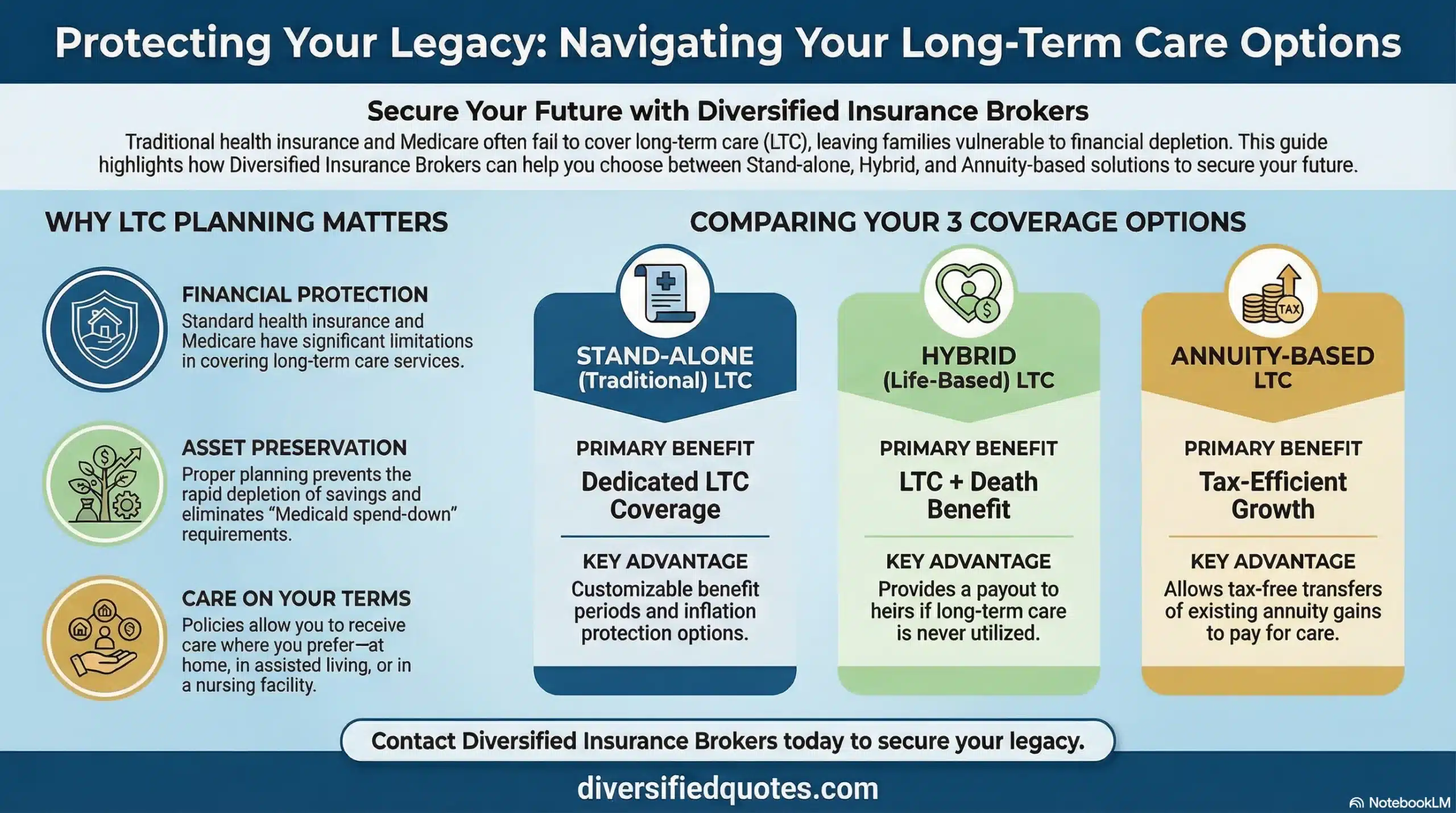
The primary difference between hybrid life/LTC and traditional LTC insurance comes down to how the policy creates value. Traditional long-term care insurance is built to maximize care benefits per premium dollar. Hybrid coverage is designed to provide care coverage, but also guarantees value even if care is never needed.
Traditional LTC insurance typically provides the strongest leverage when care is actually used. For individuals focused strictly on maximizing care dollars, traditional policies often deliver higher benefit pools relative to premium. These policies are highly customizable, allowing families to adjust benefit periods, elimination periods, and inflation protection to match expected care needs. Many families also pair traditional policies with strategies such as shared spousal benefit structures to extend coverage across two lives.
Hybrid life/LTC coverage takes a different approach. Instead of pure insurance, hybrid coverage often repositions existing assets into a contract that can be used three ways: long-term care benefits while living, a death benefit if care is never needed, or return-of-premium access in many designs. For families uncomfortable with “use it or lose it” insurance structures, hybrid solutions often create emotional and financial comfort.
Why Many Families Are Moving Toward Hybrid LTC Strategies
Hybrid long-term care designs have grown significantly in popularity because they solve several concerns families have historically had with traditional LTC insurance. One of the biggest drivers is predictability. Many hybrid designs offer guaranteed premium structures, meaning the funding schedule cannot change in the future. For retirees or pre-retirees who want cost certainty, this predictability is extremely valuable.
Another key advantage is asset repositioning. Many hybrid strategies allow individuals to move idle cash, low-performing CDs, or conservative investment dollars into a structure that provides both long-term care access and a legacy benefit. Instead of paying ongoing premiums indefinitely, many hybrid structures allow single-pay or limited-pay funding schedules.
Legacy protection is another major driver. If care is never needed, beneficiaries typically receive a life insurance death benefit. This is fundamentally different from traditional LTC insurance, which typically pays no benefit if care is never used. For families with estate planning goals or income replacement goals, this dual-purpose structure can be very attractive.
Why Traditional LTC Insurance Still Makes Sense for Many Families
Despite the growth of hybrid solutions, traditional long-term care insurance remains extremely valuable, especially for individuals who prioritize maximum care coverage efficiency. Traditional policies typically deliver more long-term care benefit per dollar of premium when care is actually used. For clients focused purely on care protection, this leverage can be difficult to match.
Traditional policies also allow deeper customization. Clients can structure monthly benefits, elimination periods, and benefit durations in highly specific ways. For example, some families design coverage specifically around aging-in-place care strategies using strong home care benefits. Others structure policies to provide high facility coverage levels in later life.
Couples planning is another major strength of traditional LTC insurance. Some couples use shared benefit pools that allow unused benefits from one spouse to transfer to the other. When structured correctly, these designs can significantly extend protection across two lifetimes.
Families often compare traditional coverage against strategies like affordable long-term care insurance planning for retirees to balance budget and coverage levels.
How Care Philosophy Influences the Right Choice
One of the most overlooked factors in LTC planning is care philosophy. Some families are strongly committed to aging in place, prioritizing home care, family care support, and outpatient services. Others are comfortable planning for facility-based care if necessary. Understanding this philosophy helps determine benefit structures, elimination periods, and inflation protection decisions.
Families planning primarily for home care often evaluate hybrid solutions alongside traditional policies that emphasize home care benefits. Those planning for longer-duration facility care often lean toward traditional LTC insurance because of benefit efficiency.
Care philosophy also influences elimination period selection. Families comfortable self-funding the first 60–90 days of care may select longer elimination periods to reduce premiums. More details can be found in LTC elimination period planning strategies.
Inflation Protection: The Silent Decision Driver
Inflation protection is often one of the largest drivers of both premium and long-term benefit adequacy. Medical inflation historically outpaces general inflation, meaning care costs often double over 15–20 years. Younger buyers often benefit significantly from compound inflation riders.
Hybrid policies and traditional LTC policies both offer inflation options, but the pricing structures differ. Traditional policies often offer broader inflation design menus. Hybrid policies typically bundle inflation into rider structures or offer limited selections.
Health and Qualification Considerations
Health underwriting can influence whether hybrid or traditional LTC is even available. Traditional LTC insurance typically has more stringent underwriting requirements. Hybrid policies sometimes allow approval for applicants who may not qualify for traditional LTC coverage, depending on the specific health condition.
Qualification factors typically include mobility history, cognitive history, chronic conditions, medication stability, and functional independence. Families researching eligibility often start by reviewing long-term care insurance qualification guidelines.
How Couples Should Approach Hybrid vs Traditional LTC
Couples often evaluate both hybrid and traditional LTC coverage together. In many cases, couples may combine solutions — one spouse using hybrid LTC coverage and the other using traditional LTC insurance. This diversification approach spreads risk across funding styles and benefit structures.
Couples frequently compare hybrid joint designs against traditional shared benefit pool designs. Shared pools can allow unused benefits from one spouse to extend protection for the other, which can dramatically increase total available coverage.
Families exploring this planning often compare multiple approaches including long-term care planning strategies for couples.
See Which LTC Strategy Fits Your Retirement Plan
We model hybrid and traditional LTC side-by-side using your retirement timeline, care goals, and premium comfort range.
Run My LTC ComparisonCoordinating LTC Coverage with Other Financial Assets
Long-term care planning rarely exists in isolation. Many families coordinate LTC planning with retirement accounts, HSAs, taxable savings, and other insurance coverage. Hybrid solutions are often considered when families want to reposition conservative assets into a multi-purpose solution. Traditional LTC insurance is often selected when families want to preserve investment growth potential while transferring care risk to insurance.
Some families also evaluate alternatives such as short-term care planning alternatives when budget or health considerations limit traditional LTC options.
The Emotional Side of LTC Planning
While financial math matters, emotional comfort plays a major role in LTC decisions. Many hybrid buyers prioritize certainty — knowing their money will create value even if care is never needed. Traditional LTC buyers often prioritize maximum care protection and are comfortable accepting the pure insurance model.
There is no universal right answer. The best strategy is the one that allows families to sleep at night while protecting long-term financial independence.
Long-Term Planning Timeline Considerations
Many families delay LTC planning until their late 50s or early 60s, but earlier planning can provide meaningful cost and approval advantages. Younger applicants typically have more options, stronger approval odds, and access to stronger inflation structures.
Families also use structured planning approaches such as long-term care funding strategies to align insurance decisions with retirement income timelines.
When Hybrid and Traditional LTC Are Used Together
In some cases, families intentionally blend both strategies. For example, hybrid coverage may provide base-level protection and legacy planning, while traditional LTC insurance provides high leverage coverage for catastrophic care scenarios. This layered strategy can create balanced protection across multiple risk types.
How Diversified Insurance Brokers Helps Families Decide
At Diversified Insurance Brokers, our advisors compare hybrid and traditional LTC structures across multiple carriers and product structures. Instead of starting with product recommendations, we start with care goals, retirement income planning, and asset protection priorities. From there, we model realistic scenarios including care timing, inflation impacts, and retirement income sustainability.
Our goal is not just finding coverage — it is building long-term care funding strategies that integrate into full retirement planning.
Build Your Long-Term Care Protection Plan
Compare hybrid life/LTC and traditional LTC options using real carrier pricing and benefit structures.
Start My LTC Planning ReviewRelated Long-Term Care Planning Pages
Explore additional long-term care education and planning resources.
Related Care Coverage Comparison Topics
Compare LTC planning with other care coverage approaches.
Talk With an Advisor Today
Choose how you’d like to connect—call or message us, then book a time that works for you.
Schedule here:
calendly.com/jason-dibcompanies/diversified-quotes
Licensed in all 50 states • Fiduciary, family-owned since 1980
Frequently Asked Questions
Is hybrid life/LTC insurance the same thing as “asset-based long-term care”?
In most cases, yes. “Hybrid” and “asset-based” are common ways to describe a permanent life insurance policy that includes long-term care benefits through a rider or linked-benefit design. The concept is that the policy can be used for care while living, or as a death benefit if care is never needed.
Which option usually provides more long-term care benefits for the premium?
Traditional long-term care insurance is typically designed to maximize long-term care benefits per premium dollar if you use the coverage. Hybrid policies may provide strong benefits too, but they also include built-in value if you never claim (such as a death benefit), which changes how the “value” comparison works.
If I never need long-term care, do I “lose” my money with traditional LTC insurance?
Traditional LTC insurance is pure insurance, so if you never trigger a claim, it may not pay a benefit. Some carriers offer optional return-of-premium features, but many traditional designs are built to provide the most protection if care is needed, rather than a guaranteed payout if it is not.
Do hybrid life/LTC policies usually have guaranteed premiums?
Many hybrid designs offer premium guarantees, especially limited-pay or single-pay structures, but it depends on the specific policy and funding approach. Some permanent life policies can have moving parts, so the most important step is reviewing how premiums, benefits, and guarantees are stated in the illustration.
What elimination period is “best” for long-term care coverage?
There is no universal best choice. The right elimination period depends on your cash reserves, your expected care pattern, and whether you want the policy to start paying sooner or you would rather reduce premiums by self-funding the early part of a claim. Many families compare 30/60/90-day options to see the tradeoff.
Is inflation protection worth it?
Inflation protection is one of the most important long-term decisions because care costs can rise significantly over time. For buyers planning 10–25 years ahead, compound inflation can materially increase future purchasing power. The right inflation option depends on age, budget, and how much of the future risk you want the policy to absorb.
Can couples share benefits on hybrid or traditional policies?
Traditional LTC insurance often offers strong shared or pooled benefit designs for couples. Hybrid solutions sometimes offer joint structures as well, but the mechanics vary by carrier. For couples, it’s usually best to compare multiple structures side-by-side rather than assuming one approach is always superior.
Which is easier to qualify for: hybrid life/LTC or traditional LTC?
It depends on the carrier, the product design, and your health profile. Traditional LTC can be more sensitive to certain medical histories. Some hybrid designs may be more flexible for specific conditions, while others may still be strict. The most reliable approach is to pre-screen and then quote based on realistic underwriting expectations.
Can I use both strategies together?
Yes. Some families layer coverage by using a hybrid policy as a base (for guaranteed value and legacy) and adding traditional LTC to maximize catastrophic care coverage. Others split strategies between spouses. Blended planning can be a strong fit when budget allows and goals are mixed.
What should I bring to a hybrid vs. traditional LTC comparison?
It helps to know your preferred monthly benefit target, whether you want home-care-first planning, how long you want benefits to last, and your comfort level with premium guarantees. If you’re not sure, we can start with a simple baseline comparison and refine the design from there.
About the Author:
Jason Stolz, CLTC, CRPC and Chief Underwriter at Diversified Insurance Brokers (NPN 20471358), is a senior insurance and retirement professional with more than two decades of real-world experience helping individuals, families, and business owners protect their income, assets, and long-term financial stability. As a long-time partner of the nationally licensed independent agency Diversified Insurance Brokers, Jason provides trusted guidance across multiple specialties—including fixed and indexed annuities, long-term care planning, personal and business disability insurance, life insurance solutions, Group Health, and short-term health coverage. Diversified Insurance Brokers maintains active contracts with over 100 highly rated insurance carriers, ensuring clients have access to a broad and competitive marketplace.
His practical, education-first approach has earned recognition in publications such as VoyageATL, highlighting his commitment to financial clarity and client-focused planning. Drawing on deep product knowledge and years of hands-on field experience, Jason helps clients evaluate carriers, compare strategies, and build retirement and protection plans that are both secure and cost-efficient. Visitors who want to explore current annuity rates and compare options across multiple insurers can also use this annuity quote and comparison tool.
