
Is Travel Medical Insurance Expensive?

Jason Stolz CLTC, CRPC
Is travel medical insurance expensive? In most cases, no. For many travelers, it is one of the most cost-effective ways to reduce financial risk when leaving the United States. The reason is simple: the cost of a travel medical plan is usually small compared to the downside of a single overseas emergency. A short doctor visit abroad may be manageable, but urgent care, imaging, hospitalization, surgery, or an emergency transfer can get expensive quickly—especially in places where providers require payment upfront or where you are dealing with a different billing system than you are used to at home.
At Diversified Insurance Brokers, we help travelers compare travel medical plans from providers like International Medical Group (IMG) and Petersen International Underwriters (PIU) so coverage fits the trip length, destination, and budget. If you want a quick recommendation based on your itinerary, you can request options through our form and we will point you toward the cleanest plan structure for your situation.
Compare Travel Medical Options in Minutes
Share your destination, dates, ages, and activity level. We’ll help you compare plans and avoid common gaps before you travel.
Why Travel Medical Insurance Is Often Worth It
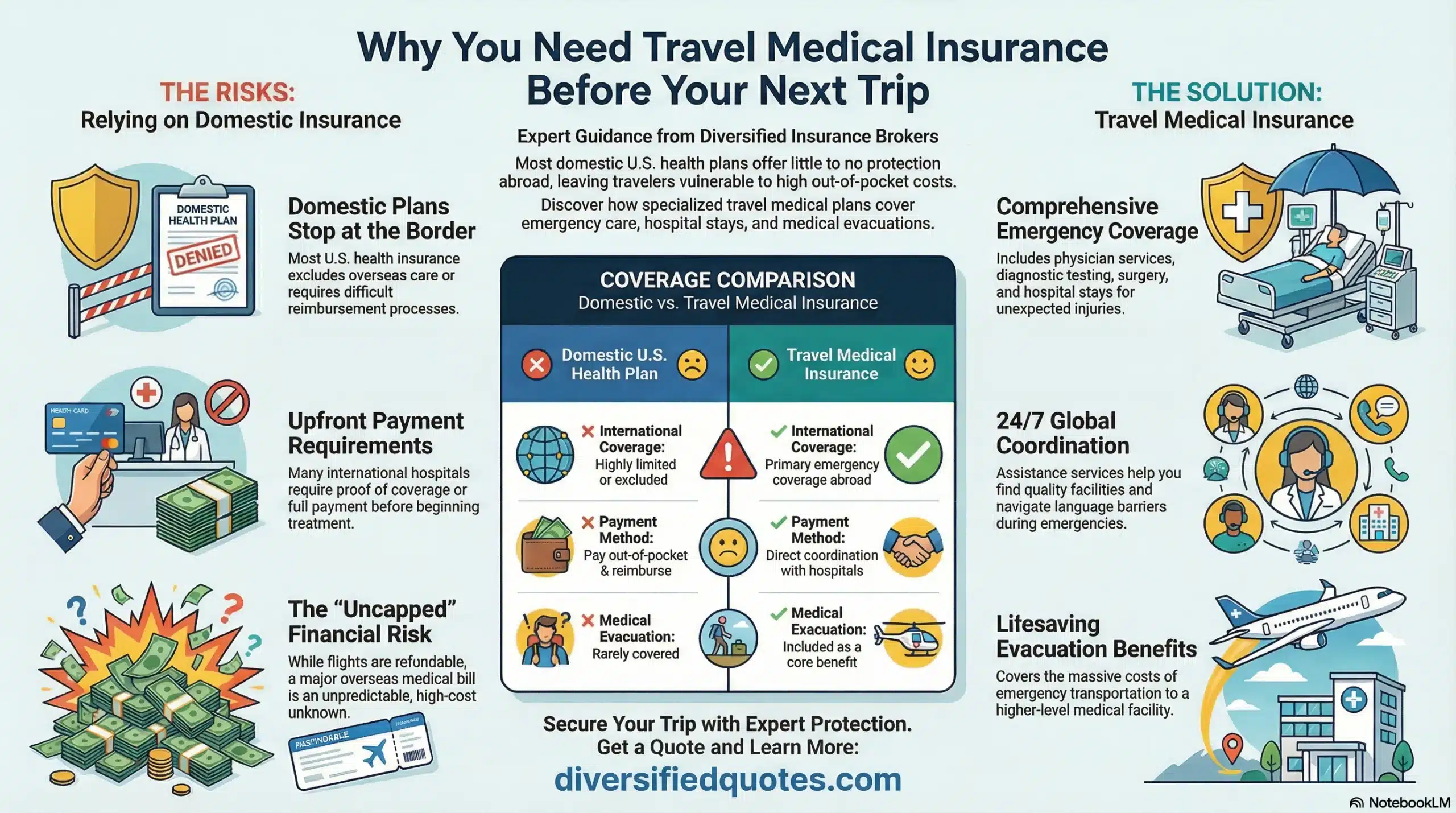
Many U.S. health insurance plans provide limited benefits outside the country, and Medicare generally does not function as primary coverage internationally. That creates a problem: if you need care abroad, you may be paying out of pocket first and hoping for reimbursement later, or you may find that reimbursement is limited and slow. Travel medical insurance is designed to fill that gap by creating a clear plan for emergency medical expenses while you are traveling. It also typically includes assistance services that can help you find appropriate facilities, coordinate care, and support logistical decisions when you are in an unfamiliar place.
The biggest “value moment” for travel medical insurance is not a simple doctor visit. It is when something escalates—severe illness, a fracture, a complicated infection, or a situation where you need advanced care that is not available nearby. In those moments, the coverage and the coordination can matter as much as the reimbursement. If you want a deeper explanation of what a travel medical policy is built to do, start with our overview of travel medical insurance and then come back here to evaluate whether the cost is worth it for your specific trip.
How Much Does Travel Medical Insurance Usually Cost?
Travel medical pricing is usually driven by risk and duration, not by the same long-term underwriting approach you see with domestic major medical plans. Many healthy travelers find that a basic travel medical plan can cost only a few dollars per day, depending on age, destination, and benefit choices. Premiums can increase for older travelers, longer trips, and higher benefit limits, but it is still common for the total cost to be far less than what one overseas emergency room visit or hospital stay could cost.
Instead of focusing only on “what is the cheapest plan,” we recommend thinking about value in terms of worst-case exposure. If a plan costs a modest amount for a two-week trip but protects against a six-figure evacuation scenario, the math is usually in your favor. If you are trying to keep premiums low, you can often adjust the deductible, the overall medical limit, and certain optional benefits to find a balance between affordability and meaningful protection.
What Drives the Price Up or Down
The length of the trip is a major factor because coverage is tied to the travel period. A longer trip usually costs more overall, but many plans are effectively priced in a way that stays “daily” and predictable. Age also matters, because the likelihood of needing care rises as travelers get older, and pricing reflects that increased utilization risk. The medical limit you choose impacts price as well, since higher limits typically mean higher premiums.
Deductibles are one of the most powerful cost levers. A higher deductible often lowers premium, which can make sense if you want the plan mainly for major events rather than for small claims. Destination can influence pricing because healthcare costs and claim patterns vary by region, and some areas create higher evacuation needs. If your trip includes more remote itineraries or places with limited medical infrastructure, you may want to place extra weight on evacuation benefits and coordination capability, which can change plan selection more than it changes premium.
If you are traveling to a destination with unique risk concerns, it can be helpful to review our guidance on high risk travel insurance to understand what changes when the itinerary includes higher-risk regions, remote travel, or environments where medical access is inconsistent.
Explore IMG Travel Medical Plans
Compare travel medical options built for international trips, with coverage designed for unexpected illness, injury, and emergency coordination.
What You Are Really Buying When You Purchase Travel Medical
Travel medical insurance is not just about reimbursement. In many situations, the most useful part of the policy is the assistance and coordination. If you are sick in a foreign country and you do not know where to go, an experienced assistance team can help direct you to appropriate facilities, support communication, and guide next steps. If a condition becomes serious, the policy’s evacuation provisions can become the centerpiece of protection, because evacuation solves the “access to the right level of care” problem—not just the “who pays the bill” problem.
This is why we encourage travelers to focus on medical and evacuation structure first, then layer in other travel protections if needed. If you want to understand evacuation benefits in more detail, our guide to emergency medical evacuation insurance breaks down what triggers evacuation, why coordination requirements matter, and what to look for in benefit limits.
When Longer-Term International Coverage Can Make More Sense
If you are traveling for an extended period, working overseas, doing recurring international assignments, or staying abroad long enough that you want a structure closer to major medical coverage, you may want to consider an international medical approach rather than a short-trip travel policy. In those cases, PIU options can be useful for longer timelines and higher-limit protection, especially when you want a plan that feels more like a comprehensive medical solution during the time you are abroad.
Digital nomads, expats, international students, and long-term volunteers often fall into this category because they are away longer and may need more continuity than a short-trip plan provides. If you are comparing travel medical versus longer-term structures, it can also help to review our overview of international health insurance to understand what changes when you move from “emergency travel coverage” to “ongoing medical coverage abroad.”
Longer-Term Global Health Coverage (PIU)
A strong option for extended stays abroad and travelers who want more comprehensive, longer-duration protection.
Medical Risk vs. Trip Cost Risk
A helpful way to decide what to buy is to separate two risks that people often blend together. The first is medical risk: the cost of needing treatment abroad and the possibility of evacuation. The second is trip cost risk: the financial loss of non-refundable airfare, hotels, tours, and prepaid expenses if something forces you to cancel or cut the trip short. Travel medical insurance is built to handle the medical side. If you also want to protect non-refundable travel expenses, you can layer in trip cancellation insurance so you are not exposed on the financial investment you made in the trip.
Many travelers skip cancellation coverage because their trip is refundable or low cost, but still buy travel medical because the medical downside is unpredictable and can be very large. That is why travel medical is often the first coverage we recommend for international travel, even when budgets are tight.
Want the Best Value for Your Trip?
We’ll help you choose limits and deductibles that keep premiums reasonable while protecting against the big-ticket risks.
Why Travelers Use Diversified Insurance Brokers
Travel insurance is easy to buy quickly, but it is also easy to buy wrong. We help you match coverage to the real trip, not just the calendar dates. That means confirming the destination is covered, confirming that activities you plan to do are not excluded, and confirming that evacuation and assistance services are strong enough for the type of travel you are doing. If you are traveling with a group, volunteering, or heading to more remote areas, those details matter even more.
We also help you coordinate travel medical with your broader protection picture. For example, if you are between jobs or in a domestic coverage transition, you may also want to understand how short-term health insurance can help fill gaps at home while travel medical handles the time abroad. The goal is not to stack products unnecessarily. The goal is to avoid blind spots.
Get Your Travel Medical Pricing and Options
Tell us where you’re going and for how long, and we’ll show you affordable options that fit your trip.
Related Travel Medical Pages
Use these guides to compare medical coverage structures, evacuation benefits, and trip protection layers.
Related Coverage Planning Pages
These pages help you coordinate travel coverage with trip-cost protection and home-country coverage gaps.
Talk With an Advisor Today
Choose how you’d like to connect—call or message us, then book a time that works for you.
Schedule here:
calendly.com/jason-dibcompanies/diversified-quotes
Licensed in all 50 states • Fiduciary, family-owned since 1980
FAQs: Is Travel Medical Insurance Expensive?
How much does travel medical insurance cost per trip?
Most travelers pay between $2–$5 per day depending on age, destination, and trip duration. Plans are flexible and can be tailored to fit your budget.
Does my U.S. health insurance cover me overseas?
In most cases, no. Medicare and many domestic health plans offer little or no international coverage, making travel medical insurance essential.
What’s the difference between travel medical and trip insurance?
Travel medical insurance covers emergency medical expenses abroad, while trip cancellation insurance reimburses prepaid, nonrefundable trip costs.
Can I get coverage for long-term travel?
Yes. Extended or international residents can apply for long-term global health coverage through providers like Petersen International Underwriters (PIU).
Does travel medical insurance cover COVID-19?
Many plans now include COVID-19 coverage for treatment and evacuation if contracted while traveling, though limits vary by insurer.
How soon should I buy travel medical insurance?
It’s best to purchase coverage as soon as you book your trip to ensure you’re protected from day one of travel.
About the Author:
Jason Stolz, CLTC, CRPC and Chief Underwriter at Diversified Insurance Brokers (NPN 20471358), is a senior insurance and retirement professional with more than two decades of real-world experience helping individuals, families, and business owners protect their income, assets, and long-term financial stability. As a long-time partner of the nationally licensed independent agency Diversified Insurance Brokers, Jason provides trusted guidance across multiple specialties—including fixed and indexed annuities, long-term care planning, personal and business disability insurance, life insurance solutions, Group Health, and short-term health coverage. Diversified Insurance Brokers maintains active contracts with over 100 highly rated insurance carriers, ensuring clients have access to a broad and competitive marketplace.
His practical, education-first approach has earned recognition in publications such as VoyageATL, highlighting his commitment to financial clarity and client-focused planning. Drawing on deep product knowledge and years of hands-on field experience, Jason helps clients evaluate carriers, compare strategies, and build retirement and protection plans that are both secure and cost-efficient. Visitors who want to explore current annuity rates and compare options across multiple insurers can also use this annuity quote and comparison tool.
