
Small Employer Group Health Insurance

Jason Stolz CLTC, CRPC
Small Employer Group Health Insurance helps businesses with fewer than 50 employees offer real medical coverage while keeping costs predictable and benefits competitive. For many small employers, the decision is not simply “do we offer coverage?”—it’s “how do we offer coverage in a way that supports recruiting, retention, and budget stability without locking into a one-size-fits-all approach?” The good news is that small employers have more viable plan structures today than ever before. Beyond traditional fully insured small group plans, many businesses can also consider hybrid funding strategies and, in some situations, self-funded approaches that are protected by stop-loss insurance.
At Diversified Insurance Brokers, we work with small employers nationwide to compare traditional group medical options and newer alternative-funding designs side by side. If you want the broad category overview first, start with group health insurance. If you’re trying to understand how hybrid funding works for smaller businesses, review why group level funding can make sense. And if you want to understand the self-funded approach from the ground up, our explainer on what is self-funded group health insurance provides the foundation.
Whether your company has 2, 10, or 40 employees, the best plan comes down to a few practical inputs: budget, workforce demographics, employer contribution goals, participation stability, and how much customization you want in plan design. Below, we break down small employer plan types, how funding models work, what to compare, and how to structure your quote request so underwriting stays smooth and your results are truly apples-to-apples.
Compare Small Employer Group Health Options
Get customized quotes for your business from leading national carriers—fully insured and level-funded options included.
What Counts as a Small Employer for Group Health Insurance?
Small employer group health insurance typically refers to employer-sponsored health coverage for businesses with fewer than 50 full-time employees (or full-time equivalents). Many businesses under this threshold are not required to offer coverage under federal rules, but employers that do often gain a major advantage in retention and recruiting. Employees consistently rank health benefits among the top reasons they stay with an employer, and small businesses that offer coverage often compete more effectively with larger organizations for the same talent pool.
Even though the “under 50” threshold is a common benchmark, the real-world quoting process is driven by carrier requirements around eligibility, employer contribution, and participation. In other words, the practical question is less “are you under 50?” and more “do you have eligible W-2 employees, and can the plan be structured to meet underwriting guidelines?” If you have a very small team, our resources on 2-person group health insurance can help you understand the micro-group end of the market and what documentation often matters most.
Workforce mix matters too. If your business relies heavily on contractors, you will want to separate “who is eligible for the group plan” from “how you support non-employee workers.” This is especially important for level-funded designs. Start with can 1099s get group level funding to understand what is typically allowed and how to avoid avoidable underwriting issues.
Why Small Employers Offer Group Health Coverage
Small employers choose group health coverage for one simple reason: it changes the quality of the business. When employees feel stable, they stay longer, perform better, and are easier to recruit. In many industries, the cost of turnover is far higher than employers realize because it includes lost productivity, hiring costs, training time, and the hidden cost of management distraction. A strong group health plan does not just provide coverage. It supports workforce stability.
There are also structural financial benefits. Employer contributions toward health coverage are commonly treated as a business expense, and employees often value the pre-tax treatment that can apply to their share of premiums. For employers who want to understand the tax logic behind alternative funding models, our guide on level-funded health insurance tax benefits explained provides a practical framework.
Finally, group health insurance often serves as the “hub” benefit that allows employers to add other benefits in a coherent way. Many small employers pair medical coverage with dental and vision (either embedded or stand-alone) and, as the business grows, build toward more comprehensive packages. The point is not to copy large-company benefits. The point is to build a sustainable benefit strategy that fits your budget and helps the business grow.
Small Employer Group Health Funding Options
When small employers say they are “shopping for group health insurance,” they’re often thinking about plan design—PPO vs. high-deductible, copays, networks, and prescriptions. But the bigger decision is usually the funding approach. Funding determines how risk is shared, how predictable costs are, and what type of transparency you get into claims drivers.
The most common funding approaches for small employer group health insurance include traditional fully insured plans, level-funded plans, and self-funded plans paired with stop-loss. These options are not “better vs. worse.” They are different tools for different risk tolerance levels and different employer goals.
Fully Insured Small Employer Group Health Plans
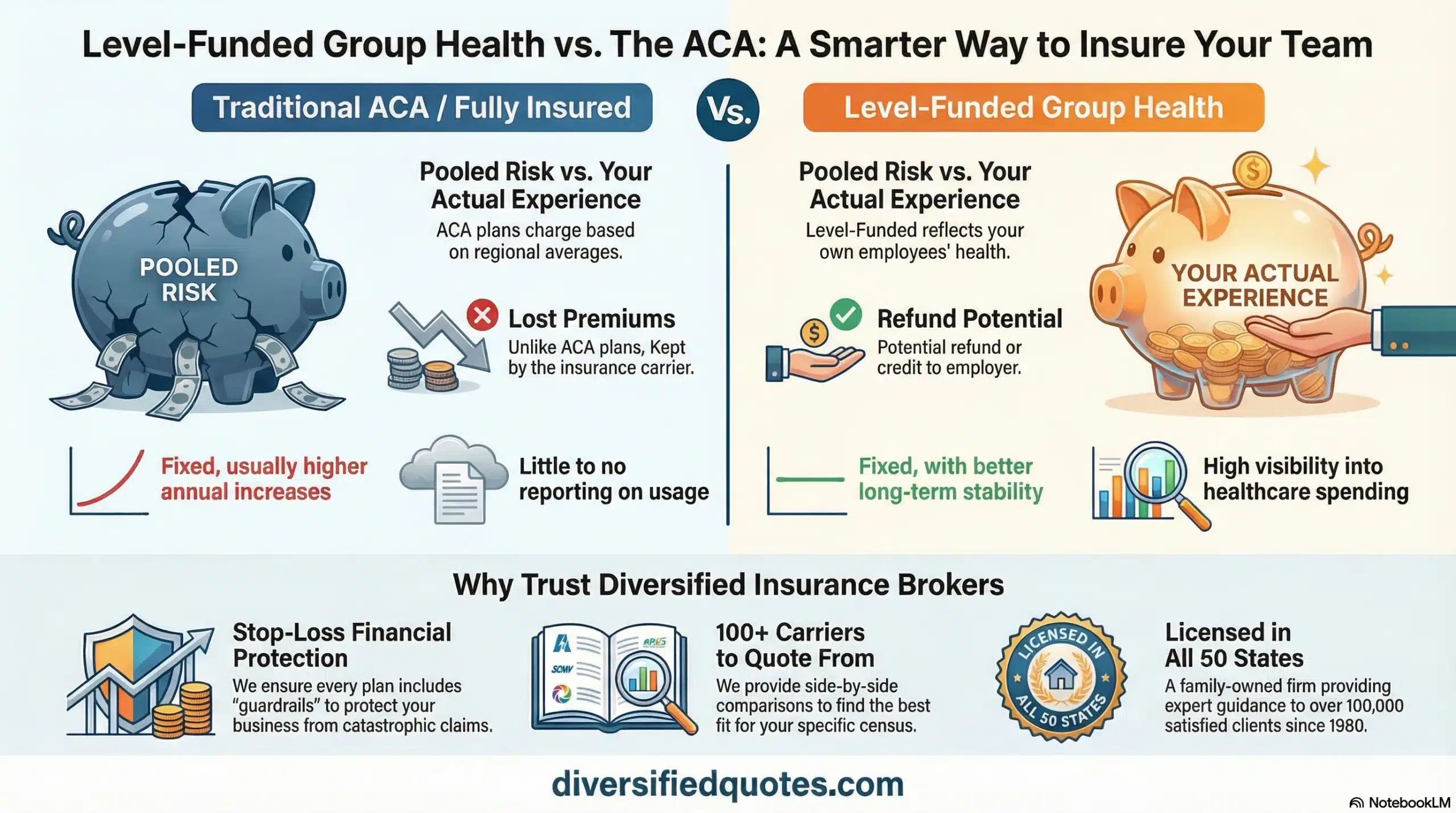
A fully insured plan is the classic structure: the employer pays a fixed premium to an insurance carrier, and the carrier assumes claims risk. Employers generally like fully insured plans because billing is predictable and administration feels straightforward. If the carrier’s rate is acceptable at renewal and the network works well for employees, fully insured can be an effective long-term solution for many small businesses.
The tradeoff is transparency and control. Fully insured pricing includes carrier risk charges, overhead, and built-in trend assumptions. Renewals can also swing based on the carrier’s experience with your group or with the broader pool, depending on structure. That does not mean fully insured is “bad.” It means the cost drivers are less visible and less adjustable than in alternative funding structures.
Level-Funded Small Employer Group Health Plans
Level-funded plans are a hybrid structure designed to preserve a predictable monthly payment while introducing some of the advantages of self-funding. In a level-funded arrangement, the monthly payment typically includes expected claims funding, fixed administrative costs, and stop-loss premium. When claims are favorable, many level-funded designs may return some portion of unused claims funding at year-end, depending on plan terms and contract structure.
Level-funded plans are popular with small employers because they can offer better clarity into “why” costs move and because they can reduce the feeling that renewals are random. Employers may also like the psychological benefit of having a more “engineered” plan structure that can be modeled and optimized over time rather than simply renewed at a new premium.
If you want a deeper explanation of where level funding fits in employer strategy, review why group level funding can make sense. If you want to understand the protection layer that makes level funding workable for smaller groups, see understanding stop-loss insurance in level-funded plans.
Self-Funded Small Employer Group Health Plans
In a self-funded plan, the employer funds claims directly and uses stop-loss insurance to cap exposure. Self-funding can offer the highest level of flexibility and transparency, and it can be very cost-effective for stable groups that want more control over plan design and cost drivers. Self-funding is not only for large employers anymore; with the right structure and protection, some small and mid-sized employers can implement it successfully.
However, self-funding requires a thoughtful risk strategy. Employers need to understand cash-flow implications, stop-loss reimbursement timing, and the importance of consistent plan governance. If you want the foundational explainer, start with what is self-funded group health insurance.
Quick definition: Level-funded is a budgeted monthly payment structure that can offer a refund when claims are lower than expected—while using stop-loss protection to cap risk.
What to Compare Before You Choose a Small Employer Group Health Plan
Network access is often the first filter. If employees cannot access preferred doctors and hospitals, the plan will be unpopular no matter how good it looks on paper. When comparing plans, it helps to identify key providers and ensure the network aligns with employee needs.
Plan design is where employee experience is built. Copays, coinsurance, deductibles, and out-of-pocket maximums determine how coverage feels during the year. Many small employers assume that the “lowest premium” design is best, but a plan that shifts too much cost to employees can create retention issues and lower satisfaction. The best design is one that fits your workforce income structure and typical healthcare usage patterns.
Prescription coverage can quietly drive total cost of coverage. Formularies vary, specialty medications can create large claim risk, and the way pharmacy is managed can change renewal behavior. If prescription spending is a concern, it may be helpful to compare how pharmacy benefits are structured across carriers, especially in level-funded or self-funded designs where strategy can matter more.
Employer contribution strategy impacts both participation and affordability. Carriers often require minimum employer contributions and participation thresholds. Beyond underwriting, contribution strategy is also part of recruiting: employees evaluate whether the employer is truly helping with healthcare costs or simply offering an option they cannot afford. Designing the contribution approach correctly can improve plan stability and reduce quoting friction.
Renewal predictability should be evaluated over more than one year. Fully insured plans can renew with significant increases, sometimes for reasons employers don’t fully understand. Level-funded and self-funded approaches can offer more transparency into claims drivers and more levers to adjust plan design. For employers who want to understand what refunds can look like in favorable claim years, see can small groups get health insurance refunds.
Administrative support matters more than most small employers expect. Enrollment, billing, employee onboarding, and ongoing service determine whether the plan becomes a distraction or an asset. Choosing the right support model can reduce HR burden and keep employees confident in using the plan.
Eligibility and Participation: The Rules That Drive Quoting Success
Small employer group health insurance is not just about picking a plan. It’s about qualifying for the plan. Most carriers look for bona fide W-2 employees and require that the employer meet minimum participation levels. Participation requirements exist to reduce adverse selection and keep pricing stable.
Eligibility rules should be clear and consistently applied. Underwriters often evaluate whether the census is stable, whether the business is legitimate, and whether employees meet eligibility definitions. When employers submit inconsistent information—changing who is eligible mid-process or failing to document payroll—quotes can be delayed, repriced, or declined.
If your workforce has mixed classifications, the best approach is to define employee classes clearly and keep coverage rules consistent. If contractors are part of your model, treat contractor support as a separate decision lane rather than forcing contractors into a structure that carriers won’t underwrite. Again, can 1099s get group level funding is a helpful resource for that scenario.
Not Sure Which Funding Model Fits Your Group?
We’ll show fully insured vs. level-funded vs. self-funded side by side and explain the tradeoffs in plain English.
Why Stop-Loss Matters for Small Employers Using Alternative Funding
Stop-loss insurance is the layer that makes level-funded and self-funded plans practical for smaller employers. It caps exposure to large claims (specific stop-loss) and, in many designs, can cap total annual claims exposure (aggregate stop-loss). The attachment points, contract basis, and underwriting terms determine how protected the employer truly is and how much premium is paid for that protection.
If you want a full breakdown of key stop-loss terms—attachment points, lasers, contract basis, and reimbursement timing—use understanding stop-loss insurance in level-funded plans. It explains what those quote terms mean and why two “similar” proposals can behave very differently when a real claim year hits.
Building a Small Employer Benefits Strategy That Works in Real Life
Small employer group health insurance should be designed around the workforce you actually have, not the workforce you wish you had. A high-deductible plan might look efficient on paper, but it can be unpopular if the team has frequent care usage or lower cash reserves. A rich copay plan might be attractive, but it can become expensive if the business is trying to keep payroll and benefits aligned.
The most sustainable strategy is often one that gives employees a clear “good” option and then adjusts contributions and design each year based on feedback and utilization patterns. Employers who treat benefits as a multi-year strategy often create better outcomes than employers who simply “shop premium” each year and hope renewals behave.
For micro-groups, it can help to start with dedicated guidance for the smallest market segment. Our page on 2-person group health insurance provides a practical view of how eligibility, documentation, and carrier options usually work when the group is tiny.
Comparing Group Health Options for Small Employers
| Plan Type | Employer Risk | Cost Stability | Potential Savings |
|---|---|---|---|
| Fully Insured | Low | High (fixed premium billing) | Limited |
| Level-Funded | Moderate | Fixed monthly budget (with guardrails) | Refunds possible if claims are low |
| Self-Funded | Higher (capped with stop-loss) | Variable | Strong potential for healthy/stable groups |
Compliance, Administration, and Enrollment Support
Small businesses often need help navigating enrollment rules, renewals, and ongoing administration. A well-structured group health plan should not become a recurring HR crisis. The right broker and service model can simplify everything from plan selection to employee onboarding, billing coordination, and year-to-year carrier management.
We help employers structure contributions and plan choices in a way that supports affordability for employees while keeping the business budget stable. That includes aligning plan design with participation expectations, clarifying eligibility rules early, and avoiding last-minute submission problems that can cause carriers to reprice or delay options.
Because employers evolve, the “right” plan structure may evolve too. Some businesses start fully insured, move to level-funded as headcount stabilizes, then explore self-funded strategies if the group becomes large and stable enough to benefit from deeper customization. The goal is not to jump to the most complex model. The goal is to match the model to your workforce and grow the benefits strategy intentionally.
Get Quotes for Small Employer Group Health Insurance
Share your employee count and goals. We’ll return clean, comparable options—so you can make a confident decision.
Related Small Employer Group Health Pages
Explore funding models, stop-loss basics, and small group eligibility resources.
Talk With an Advisor Today
Choose how you’d like to connect—call or message us, then book a time that works for you.
Schedule here:
calendly.com/jason-dibcompanies/diversified-quotes
Licensed in all 50 states • Fiduciary, family-owned since 1980
FAQs: Small Employer Group Health Insurance
Who qualifies as a “small employer” for group health?
Generally, companies with fewer than 50 full-time employees (including applicable full-time equivalents). If you’re very small, see our guide to 2-person group health insurance.
What’s the difference between fully insured, level-funded, and self-funded plans?
Fully insured plans have fixed premiums and the carrier takes the risk. Level-funded plans blend fixed monthly budgeting with potential refunds if claims are low. Self-funded plans give the employer maximum control and customization, backed by stop-loss protection.
Can a very small group really save with level-funding?
Yes—if your workforce is relatively stable and claims run modest, level-funded plans can cost less and may return unused claim dollars. Learn more about stop-loss insurance in level-funded plans.
Are refunds possible if our claims are low?
Many level-funded plans offer surplus sharing at renewal when claims spend is below expected. See: can small groups get health insurance refunds.
How do pre-existing conditions affect small group rates?
Fully insured small group rates primarily reflect age, location, and plan design. Level-funded/self-funded plans consider group health data to price accurately; stop-loss caps catastrophic risk.
What employer contribution is typical?
Commonly 50–75% of the employee-only premium, with employer-defined amounts for dependents. Contribution strategy impacts participation and overall cost.
Can we offer HSAs or HRAs with small group plans?
Yes. HSA-compatible high-deductible plans and employer-funded HRAs can reduce premiums and improve cost control while keeping coverage robust.
What administrative tasks will we handle?
Enrollment, eligibility updates, and renewals. An independent broker can offload onboarding, employee education, and carrier coordination, and help you compare group health plan options.
Are we required to offer coverage if we have under 50 employees?
No, but offering benefits can improve hiring and retention and may be more cost-effective than expected—especially with level-funded designs.
How long does it take to implement a new plan?
Typical timelines run 2–6 weeks depending on carrier approvals, underwriting (if any), and employee onboarding. Starting early ensures a smooth effective date.
About the Author:
Jason Stolz, CLTC, CRPC and Chief Underwriter at Diversified Insurance Brokers (NPN 20471358), is a senior insurance and retirement professional with more than two decades of real-world experience helping individuals, families, and business owners protect their income, assets, and long-term financial stability. As a long-time partner of the nationally licensed independent agency Diversified Insurance Brokers, Jason provides trusted guidance across multiple specialties—including fixed and indexed annuities, long-term care planning, personal and business disability insurance, life insurance solutions, Group Health, and short-term health coverage. Diversified Insurance Brokers maintains active contracts with over 100 highly rated insurance carriers, ensuring clients have access to a broad and competitive marketplace.
His practical, education-first approach has earned recognition in publications such as VoyageATL, highlighting his commitment to financial clarity and client-focused planning. Drawing on deep product knowledge and years of hands-on field experience, Jason helps clients evaluate carriers, compare strategies, and build retirement and protection plans that are both secure and cost-efficient. Visitors who want to explore current annuity rates and compare options across multiple insurers can also use this annuity quote and comparison tool.
