
Travel Medical and Evacuation from Haiti

Jason Stolz CLTC, CRPC
Haiti is a destination that draws travelers for many different reasons. Some people visit for short-term missions or humanitarian work. Others travel for family, business, education, or specialized projects. While Haiti offers a meaningful and memorable experience, it is also a country where medical access, infrastructure limitations, and emergency-response challenges can create very real risks for visitors and long-stay residents. That is why travel medical and evacuation insurance from Haiti matters so much. It is not just about having coverage “in case something happens.” It is about making sure you have a plan that can actually function in a real-world crisis.
Many travelers assume travel insurance is simply a reimbursement product. They imagine a minor doctor visit, a prescription, or a small urgent care bill. But in countries like Haiti, the biggest financial risk is often not the initial treatment. The biggest risk is what happens when you need a higher level of care than what is locally available, or when facilities are overwhelmed, delayed, or difficult to reach. In those situations, the cost of emergency logistics can easily exceed the cost of the medical services themselves.
At Diversified Insurance Brokers, we help individuals, families, mission organizations, contractors, and international travelers find practical travel medical coverage that includes evacuation support when it matters. Our focus is helping you avoid the common mistake of assuming every plan is the same. Plans may look similar on the surface, but details such as evacuation authorization requirements, benefit limits, provider networks, and exclusions can make a major difference once you are abroad.
If you are comparing travel medical and evacuation options for Haiti, you may also want to review how coverage works in other high-risk or infrastructure-limited regions. Many travelers plan multi-country routes or travel frequently across borders, which makes it important to understand how your protection changes across regions. For comparison, you can explore our resources on high risk travel insurance and emergency medical evacuation insurance to see how policies differ based on risk profile and travel circumstances.
Why Travel Medical and Evacuation Insurance Matters So Much in Haiti
In many destinations, travel medical insurance is primarily used to cover emergency doctor visits, minor hospital bills, or temporary prescriptions. Haiti is different. While medical treatment may be accessible in some urban areas, travelers can encounter limitations related to equipment, staffing, availability of specialists, and the ability to coordinate rapid transport when a situation escalates.
A traveler who becomes seriously ill or injured in Haiti may require medical stabilization locally, but the best clinical outcome may require transfer to another country or a more advanced facility. That is where evacuation benefits become essential. A well-designed policy does more than reimburse you later. It can coordinate and arrange the evacuation process, which is often the hardest part of the entire event.
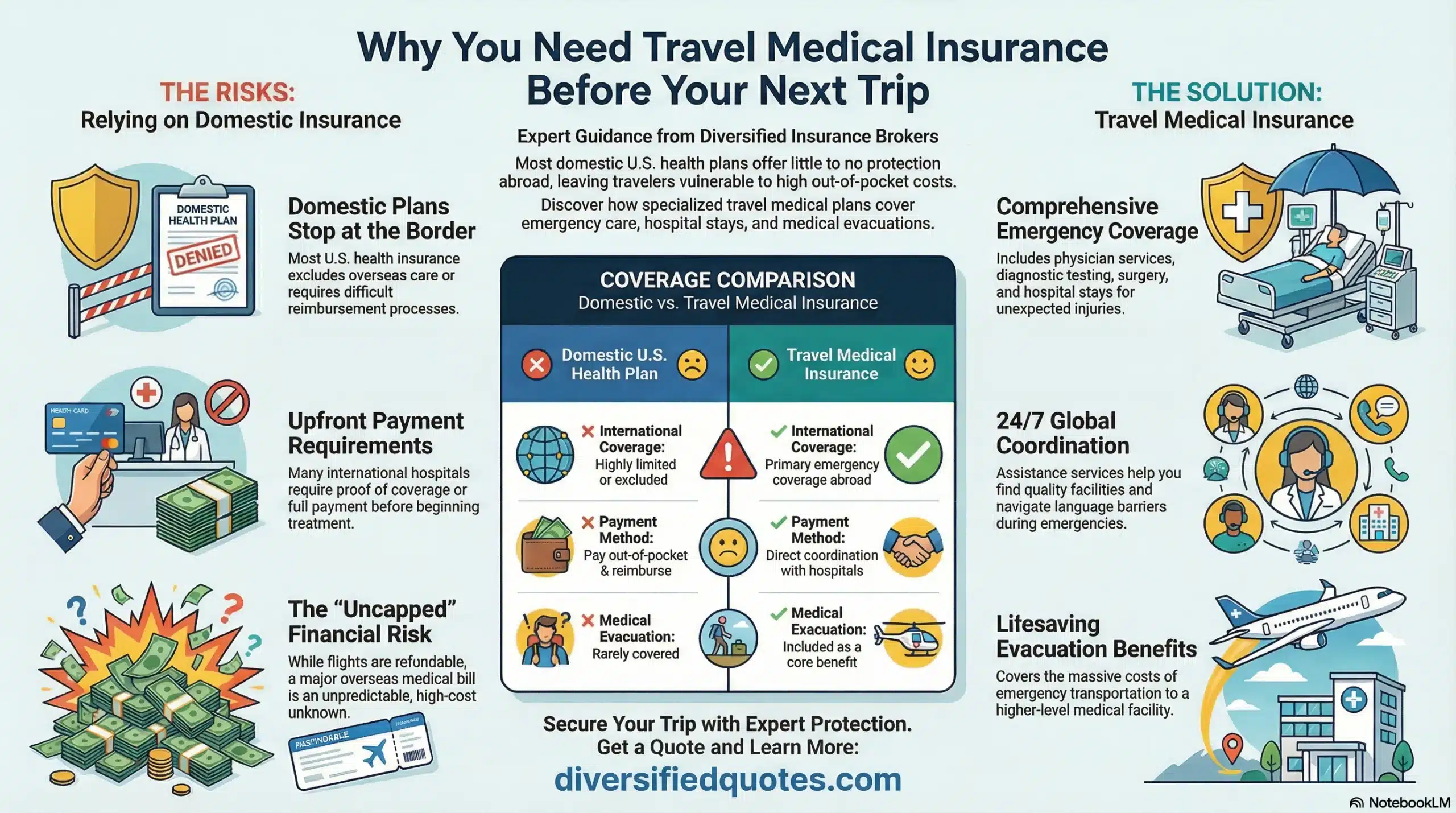
Even when treatment is available, travelers may face unexpected payment issues. In many international settings, certain facilities may require upfront payments or may not process claims as smoothly as a traveler expects. Insurance that includes strong assistance services and case management can reduce friction and help you get to the right place faster.
If you want broader context on the medical coverage side of travel protection, you can also review our page on travel medical insurance, which breaks down what these plans are designed to cover, what they are not designed to cover, and what you should look for when choosing benefits.
What “Travel Medical and Evacuation” Coverage Actually Includes
Travel medical and evacuation insurance is built to solve two problems at the same time. First, it helps pay for emergency medical care when you are away from home. Second, it provides access to evacuation services when the medical care you need is not available in your current location. Both components matter, and in Haiti, the evacuation component often becomes the most financially significant part of the coverage.
Travel medical benefits may include emergency hospital stays, physician services, diagnostic tests, medically necessary prescriptions, emergency outpatient care, and other covered treatment tied to an unexpected illness or injury. However, the practical value of these benefits depends heavily on policy terms, and not all policies define emergency treatment the same way.
Medical evacuation benefits generally include transportation to the nearest appropriate facility capable of providing the treatment you need. Depending on the situation, that “nearest appropriate facility” might be within the same country, or it may be in a regional hub outside the country. Some plans also include repatriation benefits, which help transport you back to your home country when medically necessary and approved through the assistance process.
Many travelers also look for coverage that includes security evacuation benefits. Security evacuation is different from medical evacuation. It refers to evacuation triggered by conditions such as political unrest, civil disorder, or other covered security events. Not all plans include this coverage, and it is often tied to specific definitions and rules. For travelers going to Haiti for mission work, NGO operations, or assignments in uncertain environments, this is a feature worth understanding.
If you are comparing broader global solutions beyond a short-term trip, you may want to review international health insurance, which can be a better fit for extended stays, expatriates, and individuals who want more robust long-term protection rather than short-duration travel coverage.
Secure International Medical Coverage
Apply online today for travel medical and evacuation coverage designed for international trips, mission work, and higher-risk destinations like Haiti.
Why Medical Evacuation Is Often the Biggest Financial Risk
Many people underestimate evacuation costs because they imagine evacuation as a simple flight or a local ambulance ride. Real medical evacuation is very different. Medical evacuation can involve specialized transport, medical staffing, coordination with multiple medical facilities, and urgent routing decisions based on your condition. Even within a short distance, evacuation can become very expensive if it requires advanced support.
In Haiti, evacuation becomes a serious consideration because travelers may need transfer to a facility with a higher level of resources. That may mean moving to a regional hub outside the country. When you combine aviation logistics, medical escort services, timing constraints, and emergency coordination, costs can escalate quickly.
The difference between having coverage and not having coverage is not simply financial reimbursement. In many cases, the most valuable part of a travel medical and evacuation policy is the assistance coordination itself. The ability to call a 24/7 team that knows how to coordinate evacuation approvals, determine appropriate receiving facilities, and handle logistics is often the difference between an organized response and a chaotic scramble.
If you want a dedicated page focused purely on how evacuation works, how it is arranged, and how benefit limits apply, you can review emergency medical evacuation insurance for a deeper explanation.
Common Reasons Travelers Use Travel Medical Coverage in Haiti
Travel medical and evacuation insurance from Haiti is used for many different types of emergencies. Some claims are minor and involve simple treatment. Others are serious and involve escalation, transfer, and long recovery periods. The point is not to predict exactly what could happen, but to prepare for the fact that international medical events rarely follow a simple path.
Travelers may need emergency treatment for sudden infections, injuries, dehydration, food-related illness, complications from chronic conditions, accidents during travel activity, or exposure-related illnesses. Individuals on mission trips or aid deployments may face additional risks depending on location, travel schedule, and the type of work being performed.
Another reality in Haiti is that natural disasters and infrastructure disruption are not theoretical risks. Travelers who have to deal with storms, earthquakes, or sudden civil disruptions may face limited access to transportation or care. This is one reason travelers may want to verify whether their plan includes security evacuation benefits, and whether those benefits apply under the conditions they may face.
Who Needs Travel Medical and Evacuation Coverage for Haiti?
This coverage is valuable for many different traveler types. Short-term tourists can benefit because even minor medical incidents can become complicated when you are far from home. Missionaries, volunteers, and humanitarian teams often benefit because of longer travel durations, remote travel routes, and higher odds of needing coordination support.
Business travelers may also need this coverage, especially when travel schedules are tight and a medical disruption creates complex logistical consequences. Students studying abroad and families on extended stays may benefit because risk accumulates over time, and longer stays increase the chance that at least one medical event occurs.
Whether you are traveling for a few days or for several months, the key question is the same. If something serious happens, do you have a realistic way to get the care you need and get transported appropriately if local treatment is not enough? In Haiti, that question is not hypothetical. It is practical.
How to Choose the Right Plan Limits for Haiti
Selecting the right plan is not only about finding the lowest price. In fact, low-cost travel insurance can be one of the biggest risks if it includes weak evacuation limits, narrow definitions, or strict exclusions. For Haiti, selecting meaningful limits matters because emergencies can involve high-cost transport and complex coordination.
One of the biggest selection decisions is your medical maximum. This should be high enough to cover hospitalization and emergency escalation. Another decision is your evacuation benefit limit. Travelers should choose a limit that realistically accounts for the possibility of cross-border transport if necessary.
Travelers should also review how pre-existing conditions are handled. Many travel medical plans exclude pre-existing conditions unless they include “acute onset” language or a specific benefit structure. If you or a family member has ongoing medical issues, prescription medications, or chronic conditions, you should review the plan definitions carefully before purchasing.
Travelers sometimes assume their domestic health insurance will handle emergencies abroad. But even when domestic coverage works internationally, it may not include evacuation benefits. This is a common gap. Travel medical and evacuation coverage can exist to fill that gap.
Why Work With Diversified Insurance Brokers?
Choosing travel medical and evacuation insurance for Haiti should not feel like guessing. It should feel like selecting a plan that matches the reality of your destination. At Diversified Insurance Brokers, we focus on helping travelers understand how these policies function under real conditions, not just how they look on a quote screen.
We help clients avoid common mistakes such as underinsuring evacuation benefits, misunderstanding exclusions, choosing limits that do not match the travel route, or assuming all “travel medical” policies provide the same level of coordination services. Our goal is to make sure you have the right protection before you depart.
If you are traveling across multiple regions, you may also want to explore how coverage approaches differ by destination. For example, you can review travel medical and evacuation from Colombia or travel medical and evacuation from Egypt to compare how medical access and evacuation logic changes from one country to another.
Get Covered Before You Travel
Apply online in minutes to secure travel medical and evacuation insurance protection for Haiti.
Related Travel Medical Pages
If you’re comparing destinations or planning multi-country routes, these pages help you match plan design to real-world medical access and evacuation needs.
Related Destination Pages
Use these destination pages to compare how coverage needs can change with infrastructure, distance to care, and travel logistics.
Talk With an Advisor Today
Choose how you’d like to connect—call or message us, then book a time that works for you.
Schedule here:
calendly.com/jason-dibcompanies/diversified-quotes
Licensed in all 50 states • Fiduciary, family-owned since 1980
Travel Medical & Evacuation from Haiti — FAQs
What does travel medical and evacuation insurance cover when traveling from Haiti?
Why is evacuation coverage especially important in Haiti?
Does this coverage include security evacuation?
Are pre-existing medical conditions covered under travel insurance for Haiti?
What are common exclusions in travel medical and evacuation policies?
How much can medical evacuation from Haiti cost without insurance?
How do you arrange evacuation if a serious emergency happens in Haiti?
Does evacuation mean leaving Haiti every time?
Who should strongly consider travel medical and evacuation insurance for Haiti?
About the Author:
Jason Stolz, CLTC, CRPC and Chief Underwriter at Diversified Insurance Brokers (NPN 20471358), is a senior insurance and retirement professional with more than two decades of real-world experience helping individuals, families, and business owners protect their income, assets, and long-term financial stability. As a long-time partner of the nationally licensed independent agency Diversified Insurance Brokers, Jason provides trusted guidance across multiple specialties—including fixed and indexed annuities, long-term care planning, personal and business disability insurance, life insurance solutions, Group Health, and short-term health coverage. Diversified Insurance Brokers maintains active contracts with over 100 highly rated insurance carriers, ensuring clients have access to a broad and competitive marketplace.
His practical, education-first approach has earned recognition in publications such as VoyageATL, highlighting his commitment to financial clarity and client-focused planning. Drawing on deep product knowledge and years of hands-on field experience, Jason helps clients evaluate carriers, compare strategies, and build retirement and protection plans that are both secure and cost-efficient. Visitors who want to explore current annuity rates and compare options across multiple insurers can also use this annuity quote and comparison tool.
