
Travel Medical and Evacuation from Iraq

Jason Stolz CLTC, CRPC
Iraq is a destination where planning matters. Whether you’re traveling for contracting work, energy or development projects, journalism, humanitarian missions, academic programs, or family visits, the reality is that a medical or security incident can become complicated quickly—especially if you are outside the largest urban centers. That is why travel medical and evacuation insurance from Iraq is not just a “nice-to-have” add-on. It is one of the most practical forms of protection you can put in place before you arrive, because it combines emergency medical benefits with the coordination and transport support that often becomes the deciding factor in a serious situation.
A lot of travelers think about travel coverage as simple reimbursement. They picture a doctor visit and a receipt. In higher-risk destinations, the real value is the system behind the policy: the emergency assistance team, the medical coordination process, and the evacuation structure that can move you to appropriate care when local resources are not sufficient. In Iraq, outcomes often depend on speed, logistics, and the ability to coordinate care and transport under pressure. When you have the right plan in place, you are not trying to “solve” a major emergency on your own in real time. You are triggering a process that was designed to respond to exactly that problem.
At Diversified Insurance Brokers, we help travelers compare travel medical coverage built for real-world emergencies, including medical evacuation and, when included by plan design, security evacuation. Two policies can look similar on a quote screen while behaving very differently in practice. Definitions, exclusions, authorization rules, and assistance coordination all matter more in Iraq than they do in low-complexity trips. Our goal is to help you select coverage that matches your itinerary, your risk profile, and your time on the ground—not just the destination name on a map.
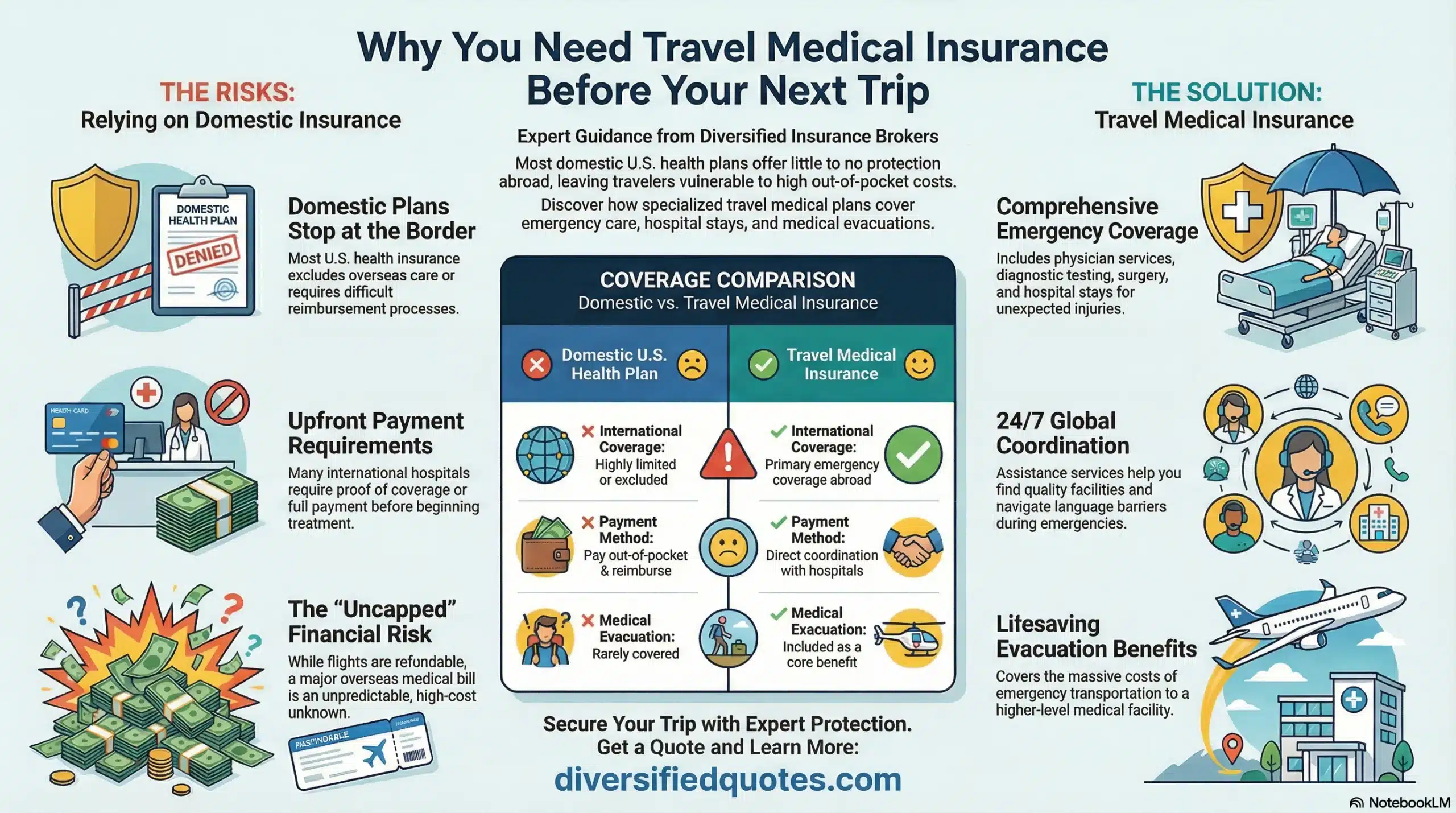
If you’re still at the early stage of comparing plan types, it helps to understand what travel medical coverage is actually designed to do. Our overview of travel medical insurance explains the difference between basic travel coverage and plans that are structured around emergency care coordination, higher benefit limits, and meaningful evacuation protection—features that become far more important when travel conditions are unpredictable.
What “Travel Medical and Evacuation” Coverage Is Built to Handle
Travel medical and evacuation coverage is typically built around two connected needs. The first is paying for covered emergency medical treatment while you are away from your home healthcare system. That includes unexpected illness or injury requiring urgent care, emergency physician services, hospitalization, imaging and diagnostics, emergency procedures, and medically necessary prescriptions tied to a covered event. While those benefits matter, what makes these plans especially valuable in higher-risk destinations is the second need: the ability to move you—safely, legally, and medically—when the best care is not accessible where you are.
Medical evacuation is not simply “transport.” It is a medically managed process designed to transfer you to the nearest appropriate facility capable of treating your condition at the required level. In Iraq, that can mean transferring to a higher-capability facility in another part of the country when available, or routing to a regional hub outside the country depending on the medical need, the location, and the plan’s definitions. Evacuation can involve medical escorts, specialized equipment, coordination with receiving facilities, and complex travel logistics. Those costs can escalate quickly—often faster than travelers expect—which is why evacuation benefits can be more financially important than the standard medical benefit limit in a major incident.
Many travelers also want security evacuation. Security evacuation is different from medical evacuation. It is typically tied to specific covered security events and triggers, and not every travel medical plan includes it. If security evacuation is important for your trip to Iraq, it is worth selecting a plan structure where that benefit is included and understanding what qualifies as a covered event, what the process looks like, and what the plan will and will not do once triggered.
For longer stays—such as multi-month work assignments, expatriate living, or repeated travel—some travelers benefit more from international health insurance than from short-duration travel medical. International health plans can be structured with broader ongoing medical benefits and a different approach to networks, renewability, and extended care. When the “trip” starts to look like a temporary relocation, international health may be the better match.
Get Travel Medical & Evacuation Coverage for Iraq
Apply online in minutes. If your itinerary includes remote travel, high-demand work, or extended stays, choose limits that assume evacuation might be needed—not just routine care.
Coverage rules, exclusions, and evacuation authorization requirements vary by plan. In an emergency, follow the insurer’s assistance process.
Why Evacuation Protection Matters More Than Most Travelers Expect
In many international emergencies, the biggest challenge is not the first step of care—it is what happens next. Stabilization can often be achieved, but the medically appropriate outcome may require specialized diagnostics, surgery, ICU-level monitoring, or advanced intervention that is not accessible where you are. That is when “how do we get to the right place?” becomes the main question. In Iraq, that question can be more complicated due to infrastructure variation, travel distances, timing, and the need to coordinate safely and quickly.
Evacuation costs are not fixed. They depend on where you are located at the time of the event, how quickly transport must occur, whether a medical escort is required, what type of aircraft is medically appropriate, and which facility is capable of receiving you. Even when the physical distance does not seem extreme, the operational logistics can be expensive. That is why travelers frequently underestimate evacuation costs. It can be tens of thousands of dollars, and in some circumstances substantially more. A strong plan is designed to protect against that financial exposure and to coordinate the logistics through a dedicated emergency assistance team.
Authorization is also a major factor. Many policies require that evacuation be arranged through the insurer’s assistance team. If transport is arranged independently without following the plan’s process, reimbursement can become difficult or impossible depending on the policy rules. The best way to think about this is simple: evacuation coverage is not only a benefit limit, it is a workflow. You want a workflow you can actually execute during a crisis.
If you want a clearer breakdown of what “medical evacuation” typically means, why “nearest appropriate facility” matters, and why authorization procedures are so important, our page on emergency medical evacuation insurance goes deeper into how these plans are structured in practice.
Common Situations Where Travelers Run Into Problems Without Proper Coverage
The majority of travelers do not experience a major emergency, but the entire purpose of this coverage is protecting against the scenario you cannot predict. In Iraq, travelers can face the same types of medical issues that appear anywhere—respiratory infections, gastrointestinal illness, dehydration, injuries from vehicle incidents, falls, or sudden acute medical events. The difference is that the same condition can be harder to manage when you are dealing with unfamiliar systems, different billing expectations, language barriers, and limited options for escalation when you are not close to a high-capability facility.
Contractors, project workers, and journalists often operate on demanding schedules that make it easier to ignore early symptoms, delay care, or keep moving. That can turn manageable problems into urgent situations. Aid workers and NGO staff may be traveling through multiple regions and may not have easy access to consistent medical support. Families and students on longer stays have more exposure time, which increases the likelihood that someone will need medical attention at least once during the trip. These are all reasons to treat travel medical coverage as a meaningful risk management decision rather than a checkbox.
Travelers should also be realistic about what plans commonly exclude. Many travel medical plans exclude pre-existing conditions unless the policy includes specific language (sometimes an “acute onset” provision or other defined allowance). Many plans exclude elective care and non-urgent treatment. Some plans exclude certain high-risk activities or require additional coverage for specific exposures. Security evacuation, if present, is typically limited to defined triggers and may not apply to every security concern a traveler experiences. The right move is not “find a plan that covers everything.” The right move is “choose a plan that covers the risks that matter most for my itinerary.”
If your travel profile involves higher risk by nature—remote routing, demanding work environments, complex logistics, or destinations where evacuation and coordination are more likely to matter—reviewing high risk travel insurance can help clarify what features are commonly prioritized for travelers whose emergencies are more likely to require escalation.
Example Scenario: How a Medical Event Can Escalate in Iraq
Imagine a contractor working in Baghdad who experiences a serious medical emergency. Initial care may be available, but the medically appropriate next step could be advanced imaging, specialist intervention, or intensive monitoring that is not immediately accessible within the local facility system. At that point, the outcome depends on coordination: identifying a facility capable of treating the condition, arranging acceptance, managing timing, and executing safe transport. The cost is not just medical bills. The cost includes the logistics required to move the patient to the correct level of care.
With a properly structured travel medical and evacuation plan, the assistance team coordinates the case, evaluates medical necessity, and arranges authorized transport when required. That coordination can prevent delays, reduce confusion, and keep the traveler and family from making expensive decisions in the moment without knowing how the policy will respond. The point is not that every traveler will need evacuation. The point is that if evacuation becomes necessary, you want it to be a managed process—not an unplanned financial and operational crisis.
Who Should Consider Travel Medical and Evacuation Coverage for Iraq
This coverage is important for a wide range of travelers, but it becomes especially relevant for certain profiles. Contractors and consultants working on infrastructure, energy, development, or specialized projects often need coverage that assumes long days, challenging logistics, and variable proximity to high-capability care. Journalists and media teams may move rapidly, work in unpredictable settings, and face higher disruption risk if a medical issue occurs. NGO and humanitarian staff often travel across multiple regions and may not have easy access to reliable medical escalation pathways without evacuation support.
Families visiting for extended periods and students traveling for programs also benefit because longer stays increase exposure time, and everyday medical issues can be harder to handle when you are away from familiar systems. Travelers with known health conditions should pay close attention to how plans define and treat pre-existing conditions, because assumptions in that area create the most common surprises during claims review. The goal is not to overbuy coverage. The goal is to avoid buying the wrong structure for the risk you actually have.
How to Choose the Right Limits and Features
The best way to choose limits is to start with your itinerary and your time on the ground. A short city-based trip is one risk profile. A multi-region itinerary is another. Remote travel, long-term assignments, and high-demand work schedules increase exposure and often increase the likelihood that an event requires evacuation. In those scenarios, evacuation limits and assistance reliability matter more, not less.
When comparing policies, look carefully at how evacuation is defined, whether authorization is required, and what the plan considers an “appropriate” facility. Understand whether the plan evacuates to the nearest capable facility, whether it includes repatriation to your home country when medically appropriate, and what documentation is usually required. If security evacuation matters, confirm that it is included and understand the triggers. The more complex your trip, the more those details determine whether the plan works the way you expect.
If your stay in Iraq is extended or recurring, consider whether a longer-term solution makes more sense. For some travelers, international health insurance can be a better fit than short-duration travel plans because it is often designed for ongoing coverage needs rather than trip-by-trip protection.
What to Do During an Emergency
If a medical emergency occurs, immediate safety comes first. Seek care. Then, as soon as it is feasible, contact the insurer’s 24/7 assistance team. That team is typically responsible for case management, coordination with facilities, authorization for evacuation, and guidance on documentation. Keeping the assistance contact information readily accessible is one of the simplest ways to improve outcomes during a crisis.
Documentation also matters. Keep discharge notes, receipts, and treatment summaries. If possible, keep a digital record of prescriptions and relevant medical history. Many claims and coordination delays happen not because the event is not covered, but because key documents are missing during review. In higher-complexity destinations, being organized with documentation can speed up coordination when time matters.
Why Diversified Insurance Brokers
In Iraq, “good coverage” is not only about a benefit maximum. It is about selecting a policy structure that behaves correctly when a situation escalates—especially around evacuation, authorization, and assistance coordination. Diversified Insurance Brokers helps travelers compare plan designs, avoid the most common pitfalls, and choose coverage that matches the realities of the destination and the way you will actually travel.
If you are comparing multi-country routes, it can help to see how coverage considerations shift across destinations with different infrastructure and evacuation routing. You can compare pages like travel medical and evacuation from Egypt and travel medical and evacuation from Colombia to understand how “distance to care” and “access to escalation” can change the plan features that matter most.
Get Covered Before You Travel
Apply online now to secure travel medical and evacuation protection designed for international travel and emergency coordination.
In any emergency, contact the insurer’s assistance team as soon as possible to coordinate care and required authorizations.
Related Travel Medical Pages
If you’re comparing plan designs or building a multi-country travel strategy, these pages help you understand how medical access and evacuation logistics affect coverage selection.
Related Destination Pages
Use these destination pages to compare how coverage needs can change with infrastructure, distance to care, and travel logistics.
Talk With an Advisor Today
Choose how you’d like to connect—call or message us, then book a time that works for you.
Schedule here:
calendly.com/jason-dibcompanies/diversified-quotes
Licensed in all 50 states • Fiduciary, family-owned since 1980
Travel Medical & Evacuation from Iraq — FAQs
What does travel medical & evacuation insurance typically cover for Iraq?
Why is evacuation coverage so important for Iraq?
Are pre-existing medical conditions covered?
What are common exclusions travelers should watch for?
How do I request evacuation if something happens?
Does evacuation always mean leaving Iraq?
Is security evacuation included?
How are premiums determined for Iraq travel medical & evacuation coverage?
About the Author:
Jason Stolz, CLTC, CRPC and Chief Underwriter at Diversified Insurance Brokers (NPN 20471358), is a senior insurance and retirement professional with more than two decades of real-world experience helping individuals, families, and business owners protect their income, assets, and long-term financial stability. As a long-time partner of the nationally licensed independent agency Diversified Insurance Brokers, Jason provides trusted guidance across multiple specialties—including fixed and indexed annuities, long-term care planning, personal and business disability insurance, life insurance solutions, Group Health, and short-term health coverage. Diversified Insurance Brokers maintains active contracts with over 100 highly rated insurance carriers, ensuring clients have access to a broad and competitive marketplace.
His practical, education-first approach has earned recognition in publications such as VoyageATL, highlighting his commitment to financial clarity and client-focused planning. Drawing on deep product knowledge and years of hands-on field experience, Jason helps clients evaluate carriers, compare strategies, and build retirement and protection plans that are both secure and cost-efficient. Visitors who want to explore current annuity rates and compare options across multiple insurers can also use this annuity quote and comparison tool.
