
Travel Medical and Evacuation from Kenya

Jason Stolz CLTC, CRPC
Kenya is one of Africa’s most popular destinations, known for world-class safaris, coastal escapes, and business growth centered in Nairobi. For many travelers, Kenya is a once-in-a-lifetime experience—Maasai Mara game drives, Amboseli views of Kilimanjaro, the Great Rift Valley, Mombasa beaches, and road travel between parks and cities. But the very things that make Kenya unforgettable can also make medical planning more important than travelers expect. You may be hours from the nearest high-capability hospital, you may be traveling on rough roads, and you may be visiting regions where advanced imaging, specialty care, or ICU-level resources aren’t readily accessible. That is why travel medical and evacuation insurance from Kenya matters: it helps cover emergency treatment and it helps solve the bigger problem—how to get you to the right care quickly if local resources aren’t enough.
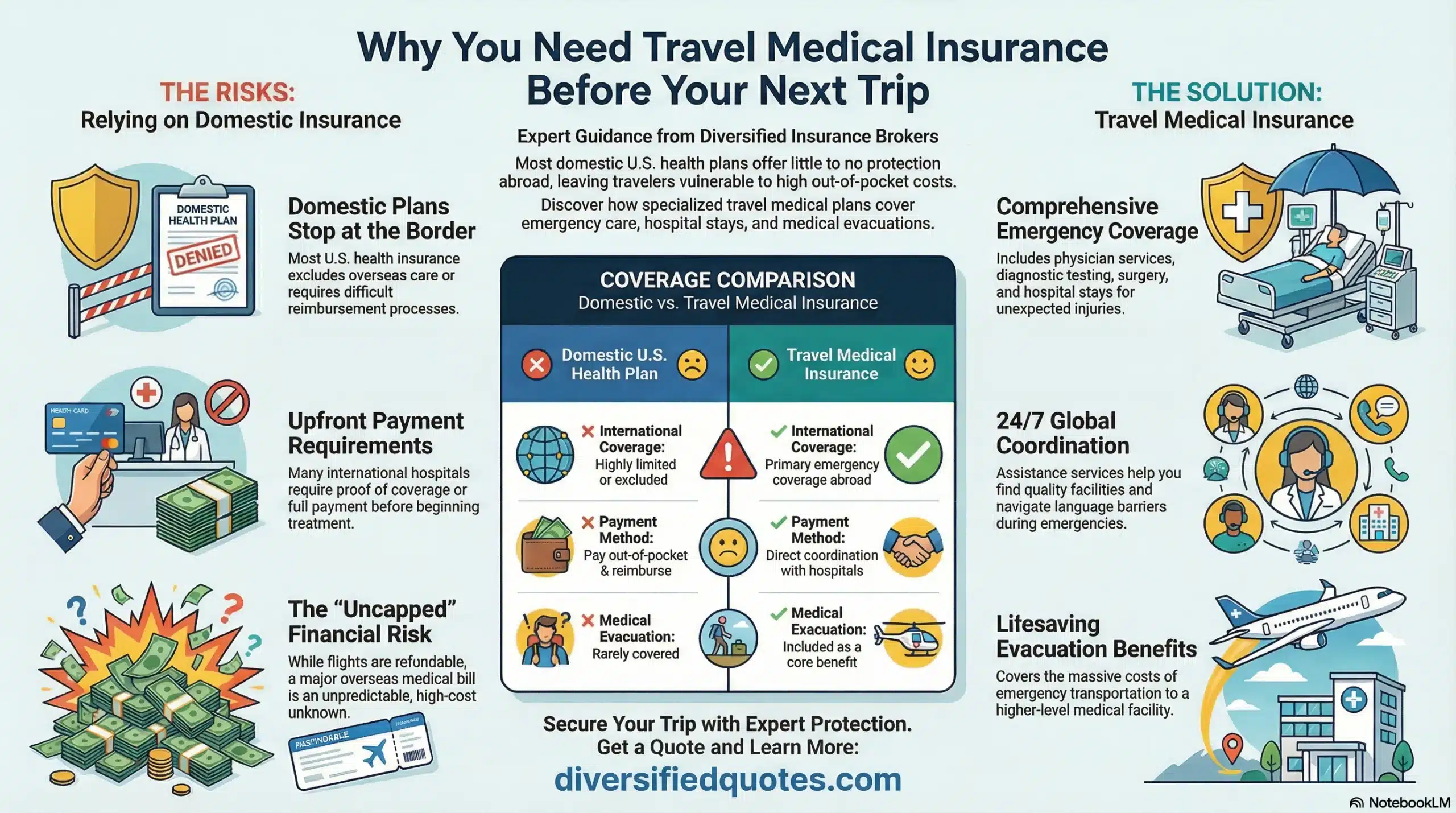
At Diversified Insurance Brokers, we help travelers, families, students, and professionals compare travel medical plans built for real emergencies. Many people assume they already have coverage through a credit card or a domestic health plan. In reality, credit card “travel insurance” often focuses on trip delay or cancellation, not medical care. And many domestic health plans either exclude international claims or handle them as limited out-of-network reimbursement—meaning you may still be paying out of pocket and hoping to recover costs later. With the right travel medical policy, you’re not trying to negotiate care and transportation while sick or injured. You have coverage and a 24/7 assistance team to help coordinate what happens next.
If you’re comparing options and want to understand plan types first, it can help to start with our core guidance on Medical Travel Insurance, then review how transport works on Emergency Medical Evacuation Insurance. If your itinerary includes remote travel, rugged excursions, or higher exposure (long drives, multi-park routes, or adventure activity), you may also want to compare that with High Risk Travel Insurance so you can see how stronger plan design is structured when the risk of escalation is higher. And if you’re planning an extended stay or relocation, you can compare short-term travel coverage to longer-stay options on International Health Insurance.
Travel Medical & Evacuation Coverage for Kenya
Apply online for travel medical insurance that includes emergency care and evacuation coordination for Kenya travel and extended stays.
Why Travel Medical Coverage Matters More in Kenya Than People Expect
Kenya has excellent private facilities in Nairobi and some strong options in other major areas, but the travel reality is that many visitors spend time well outside those corridors. Safari travel can place you hours from high-capability care. Road conditions, long drives between parks, and the nature of wildlife travel can increase the chance of injury, heat-related illness, dehydration, or sudden medical issues becoming complicated. Even a situation that is “treatable” can turn into a logistical challenge if you’re far from the right facility, if transport is delayed, or if the nearest clinic cannot provide the level of care your case requires.
Travel medical insurance is designed to handle unexpected, urgent situations while you are outside your home healthcare system. It helps pay eligible costs for emergency treatment and it provides a structure for coordination. In many international claims, the hardest part isn’t the diagnosis. It’s figuring out where to go, how to get there, and how to handle the financial requirements of treatment and transport without panic. When you have a travel medical plan with assistance services, you’re not trying to solve the crisis alone from a hotel room or a clinic.
Another reason this coverage matters in Kenya is that not all medical events happen in a city. Travel plans often include multiple regions—Nairobi to the Rift Valley, onward to the Maasai Mara, then perhaps to the coast. The more you move, the more the “nearest appropriate facility” becomes a moving target. That’s why evacuation coverage is often the most important part of the plan for travelers in Kenya: it gives you a path to higher-level care when local resources are not sufficient.
What Travel Medical & Evacuation Insurance Typically Helps With
This coverage is built around four practical needs: (1) emergency medical treatment, (2) evacuation coordination, (3) assistance infrastructure, and (4) financial protection from high-cost events. The emergency medical component is what most travelers expect—doctor visits, emergency room care, hospitalization, imaging, labs, eligible surgeries, and prescriptions related to a covered emergency. But the real value often shows up when a case escalates and you need help getting to the right care quickly.
Emergency Medical Care is the foundation. In Kenya, this can mean treatment for serious gastrointestinal illness, dehydration, infections, respiratory problems, injuries, or sudden unexpected events like a cardiac episode. Emergency care is rarely “cheap” when it involves imaging, inpatient monitoring, IV medications, or specialty consults. Travel medical coverage helps you avoid turning a medical event into an unplanned financial hit.
Medical Evacuation is the backstop when the local facility cannot provide appropriate care. Evacuation isn’t always an air ambulance, and it isn’t always international. It can be ground transport to a better facility, a commercial flight with medical escort, or air ambulance depending on severity, distance, and medical stability. The key is that the plan helps coordinate transport based on medical necessity rather than leaving you to improvise in a high-pressure moment.
Security Evacuation is separate from medical evacuation. Medical evacuation is driven by clinical necessity. Security evacuation is driven by a safety situation—civil unrest, credible threats, or destabilizing events that make it unsafe to remain in place. Not every policy includes security evacuation in the same way, so this is often more relevant for corporate assignments, NGO work, journalism, field operations, or extended stays where security planning is a real concern.
Financial Protection is the practical outcome. Many travelers buy coverage for the hospital bills, but evacuation can be the largest risk. Transport, staffing, and routing can move costs into five or six figures quickly depending on distance and urgency. Travel medical and evacuation insurance is designed so a serious emergency does not become a long-term financial burden for your family.
Medical Evacuation in Kenya: What It Actually Looks Like in the Real World
Evacuation is often misunderstood. It is not simply “a flight home.” In practice, evacuation is a coordinated medical transport decision. The plan’s assistance team typically confirms medical necessity, identifies the right receiving facility, coordinates acceptance, arranges the correct transport level, and manages approvals. In a serious event, the assistance team is often the difference between chaos and a controlled plan.
For Kenya, evacuation scenarios commonly arise from distance to care. A traveler may be stabilized at a local facility or clinic near a safari region, but the next step might require transfer to Nairobi for diagnostics, specialty care, or ICU capability. In some cases, the nearest appropriate option may be outside the country depending on the severity and the resources required. The point is not to assume the worst. The point is to plan for escalation because the cost and complexity of escalation is what catches travelers off guard.
Many plans also require that evacuation be coordinated or authorized through the assistance provider for coverage to apply, except in truly extreme circumstances where contact is impossible. That’s why we encourage travelers to choose coverage that makes it easy to activate support quickly. If you want a focused explanation of how evacuation works and what to watch for in policy language, review Emergency Medical Evacuation Insurance.
Example Scenario: A Safari Emergency That Requires Rapid Escalation
Imagine a traveler on safari in the Maasai Mara who suffers a serious injury from a fall or vehicle incident. Initial care may be limited to basic stabilization, and advanced imaging or surgical resources may require transfer. In that moment, the problem becomes “How quickly can we get to the right facility?” and “Who coordinates it?” Without coverage, the traveler and family may face large up-front costs and a scramble to arrange transport. With travel medical and evacuation insurance, the assistance team can coordinate the transfer path, arrange transport, and cover eligible expenses according to the policy’s terms. That coordination is often the real value because it happens when you have the least ability to manage logistics yourself.
Or consider a traveler who develops severe dehydration and infection symptoms after days of travel. A clinic may provide initial care, but complications can require hospitalization and monitoring. If the facility is not equipped for escalation, transfer becomes part of the medical plan. Again, the combination of medical benefits and coordinated evacuation support is what keeps the situation manageable.
Who Should Consider Travel Medical & Evacuation Coverage in Kenya
This coverage is a smart fit for almost anyone traveling to Kenya, but it becomes especially important when your itinerary or responsibilities increase the consequences of disruption. If you are traveling beyond Nairobi, moving between parks, spending time in remote areas, traveling with children, or managing any personal medical concerns, having a plan that can coordinate escalation is a major advantage.
Tourists and safari travelers benefit because safari routes naturally increase distance to advanced care. Even a minor issue can become complicated when you are far from a hospital, traveling in heat, or dealing with long drives. Coverage helps with emergency treatment and creates a pathway for transfer if needed.
Expatriates and families benefit because life abroad introduces new variables. Routine care may be manageable, but serious events are different. Evacuation coverage can be the safety net that gives you options when you want transfer to higher-capability care or repatriation after stabilization.
Business travelers, contractors, and professionals benefit because time matters. If you are on assignment, working on-site, or traveling frequently, you want a plan that supports quick coordination rather than leaving you to manage provider networks and payments alone.
Students, NGO teams, aid workers, and journalists benefit because assignments can include remote work sites, unpredictable travel, and a higher need for evacuation coordination and security planning. For these travelers, the assistance infrastructure and evacuation clarity matter as much as the headline coverage limit.
Coverage Details That Matter Before You Buy
Travel medical plans can look similar on the surface, but the differences show up during a claim. For Kenya travel, we encourage travelers to focus on the parts of the plan that affect real emergencies: benefit limits, evacuation structure, assistance services, and exclusions that could derail coverage.
Pre-existing conditions are one of the biggest variables. Many plans exclude them, while others provide limited coverage based on specific definitions such as “acute onset.” If you have a known condition, you should assume that plans handle it differently and choose intentionally. This is especially important for Kenya travel because distance to advanced care can make escalation more likely if a condition flares up.
Activity exclusions also matter. Some plans exclude certain higher-risk activities unless added. Safari travel is not usually excluded, but travelers often add excursions, hiking, water activities, and extended travel days that may fall into categories requiring clarification. The best approach is to match policy language to your actual itinerary, not your ideal itinerary.
Evacuation authorization rules matter because many policies require you to contact the assistance team before arranging transport. In a serious situation, you want a plan that makes it easy to follow the process correctly under stress. A plan that is “technically good” but hard to use in a real emergency is not the best plan.
Trip length and plan type matters as well. A short trip may be best served by a travel medical policy with strong evacuation. A longer stay may require a different structure that provides broader day-to-day medical protection while still including evacuation benefits. If you’re staying longer, compare travel medical coverage to International Health Insurance so you can choose the right category for your situation.
Why Work With Diversified Insurance Brokers
Travel medical insurance is one of those areas where the fine print matters because the claim event is stressful, time-sensitive, and expensive. Diversified Insurance Brokers helps travelers compare plan design based on real travel risk—where you’ll be, how remote your itinerary is, and what escalation would look like if something serious happens. We also help travelers who assume their domestic health plan follows them internationally, only to discover later that coverage is limited or reimbursement-based with strict rules.
Our goal is simple: help you choose coverage that you can actually use, with evacuation coordination that works when local care isn’t sufficient. That means focusing on the medical benefits, the assistance infrastructure, and the evacuation framework—not just the headline price.
And just as important, the best time to arrange coverage is before you depart. Once an incident starts, you cannot correct coverage gaps retroactively. Getting your plan in place early gives you the documents and emergency contacts you’ll rely on if something happens while you are in Kenya.
Get Covered Before You Travel
Apply online now to secure travel medical and evacuation coverage for Kenya.
Related Travel Medical Pages
If you’re comparing plan types or building a multi-country route, these pages help you line up coverage design with real-world medical access and evacuation needs.
Related Destination Pages
These destination pages help you compare how needs change based on infrastructure, distance to care, and travel logistics.
Talk With an Advisor Today
Choose how you’d like to connect—call or message us, then book a time that works for you.
Schedule here:
calendly.com/jason-dibcompanies/diversified-quotes
Licensed in all 50 states • Fiduciary, family-owned since 1980
Travel Medical & Evacuation from Kenya — FAQs
What does travel medical & evacuation insurance from Kenya cover?
Why is evacuation especially important when in Kenya?
Are security evacuations or civil unrest covered?
Who should consider this type of coverage?
• Expats or families living in Kenya (Nairobi, Mombasa, or more remote areas)
• Business travelers, contractors, aid workers, students in rural regions or high-risk zones
How are premiums and costs determined?
What are common exclusions?
How do I make a claim or request evacuation if needed?
About the Author:
Jason Stolz, CLTC, CRPC and Chief Underwriter at Diversified Insurance Brokers (NPN 20471358), is a senior insurance and retirement professional with more than two decades of real-world experience helping individuals, families, and business owners protect their income, assets, and long-term financial stability. As a long-time partner of the nationally licensed independent agency Diversified Insurance Brokers, Jason provides trusted guidance across multiple specialties—including fixed and indexed annuities, long-term care planning, personal and business disability insurance, life insurance solutions, Group Health, and short-term health coverage. Diversified Insurance Brokers maintains active contracts with over 100 highly rated insurance carriers, ensuring clients have access to a broad and competitive marketplace.
His practical, education-first approach has earned recognition in publications such as VoyageATL, highlighting his commitment to financial clarity and client-focused planning. Drawing on deep product knowledge and years of hands-on field experience, Jason helps clients evaluate carriers, compare strategies, and build retirement and protection plans that are both secure and cost-efficient. Visitors who want to explore current annuity rates and compare options across multiple insurers can also use this annuity quote and comparison tool.
