
Travel Medical and Evacuation from Russia

Jason Stolz CLTC, CRPC
Russia is a vast country with iconic cities, historic landmarks, and remote regions that can feel like a world of their own. From the museums and cathedrals of Moscow and St. Petersburg to the long distances of Siberia and the Far East, trips to Russia often involve major travel time between locations, changing climates, and uneven access to medical care. That combination is exactly why travel medical and emergency evacuation insurance from Russia matters. If you have an unexpected illness, injury, or hospitalization need while in Russia, the right plan can help cover eligible medical expenses and, when medically necessary, coordinate evacuation to a facility that can actually treat your condition.
At Diversified Insurance Brokers, we help travelers, students, expats, and business professionals compare travel medical plans that are designed for international use, with real-world support through 24/7 assistance services. The goal is simple: if something happens, you want access to care and you want an insurance team that can help you navigate the logistics—especially in a destination where distance, weather, language, and local facility limitations can create delays.
One of the biggest misunderstandings about international trips is assuming domestic health insurance or a credit card benefit will be “good enough.” In practice, many travelers discover that coverage can be limited outside the U.S., may reimburse slowly (if at all), and may not provide the evacuation coordination that becomes critical in a major emergency. A strong travel medical policy is built for the realities of overseas care. It can help with eligible emergency treatment, hospitalization, diagnostics, physician services, and other covered costs during the policy period. And if your situation requires higher-acuity care than what is available nearby, evacuation benefits can be the difference between getting stabilized locally versus getting transported to the nearest appropriate facility where definitive care is possible.
Russia’s geography also makes travel risk feel different. A city trip can quickly turn into a multi-region itinerary: a flight to Moscow, a train to another city, a winter trip to a ski destination, or a work assignment far from major medical centers. Many travelers also visit during cold-weather months, where slip-and-fall injuries, transportation delays, and exposure risks become more common. Even when you are in a major city, hospitals vary widely by facility type, language support, and payment processes. In more rural areas, you may be hours away from advanced imaging, surgical capability, or specialized physicians. A travel medical plan helps reduce the financial exposure of eligible care, while evacuation coverage helps address the “where do we go next?” question when local care is not enough.
If you’re comparing travel insurance options for Russia, it helps to understand the difference between “trip protection” and “travel medical.” Trip protection is often focused on cancellation/interruption for covered reasons, baggage, and delays. Travel medical is focused on eligible medical costs while abroad. Many travelers choose to combine features, but if your main concern is illness/injury and evacuation support, prioritize the medical and evacuation benefits first. You can also explore related options like emergency medical evacuation insurance when you want to focus specifically on transport and coordination, especially for multi-region itineraries.
Why coverage is essential in Russia comes down to four practical realities: (1) medical capacity is not uniform across the country, (2) language, payment, and documentation processes can complicate care, (3) distances and weather can slow down transfers and make evacuation decisions more urgent, and (4) some travelers have schedules or mission-critical responsibilities where delays in care create serious outcomes. A good plan does not “guarantee” that every expense will be covered—coverage depends on the policy, eligibility, and approvals—but it can drastically reduce the likelihood that you’re handling a complex medical emergency on your own.
Another key consideration is how evacuation decisions are made. Many travelers assume evacuation means “fly me home.” In most policies, evacuation is based on medical necessity and routing to the nearest appropriate facility capable of providing the required level of care. That may be inside Russia, or it may involve transport to another country depending on the situation, logistics, and approvals. The assistance team is an important part of this process: they coordinate with treating physicians, confirm medical necessity, arrange transport where possible, and guide you through next steps. If you buy a plan without a strong assistance provider, you may find that you’re responsible for arranging transportation yourself—exactly what you want to avoid in an emergency.
Coverage can be especially valuable for travelers who plan to spend time outside of major hubs. Remote travel is not only about wilderness or adventure. It can include business travel to industrial areas, academic programs in smaller cities, extended family visits outside Moscow, or travel by rail between regions. When the nearest facility can stabilize you but cannot complete specialized treatment, that’s where evacuation benefits become a practical tool instead of a theoretical feature.
Example scenario: A traveler visiting a remote region experiences a serious injury during winter conditions. A local facility can provide basic treatment but does not have the imaging or orthopedic surgical capability needed to address the injury safely. With a travel medical and evacuation plan, the assistance team coordinates transport to the nearest appropriate higher-level hospital, where specialists can evaluate and treat the injury. Eligible transportation and medical expenses may be handled through the policy structure depending on approvals and benefits. Without coverage, costs can escalate quickly—especially if private transport or specialized care becomes necessary.
It’s also worth thinking through the “smaller” situations that still create expensive problems. Food-borne illness that requires IV fluids and overnight observation, a severe respiratory infection that needs imaging and medication, a dental issue that becomes urgent, or a dehydration/heat-related event in summer travel can all lead to out-of-pocket costs when you’re overseas. Even if the hospital bill is not enormous by U.S. standards, the combination of multiple visits, medication costs, and administrative fees can surprise travelers. Travel medical insurance exists to help absorb eligible expenses during the covered period and provide a clear process for assistance and documentation.
If you are traveling to Russia for work, there are additional planning layers. Business travelers often have fixed schedules and limited flexibility. If you become ill, you may need care quickly so you can either continue travel safely or return home after stabilization. Business travel also tends to include flights, meetings, and regional movement, which increases exposure to accidents, transportation issues, and simple fatigue-related injuries. A travel medical plan can be particularly helpful for business travelers who want to avoid unplanned disruptions and protect the financial side of emergency medical expenses while abroad.
Students and academic travelers should think about coverage differently as well. If you’re studying abroad, volunteering, or doing research, your trip may be longer, and longer trips raise the probability of needing medical care—simply because you have more days of exposure. Students also tend to travel locally, use public transportation, and participate in group activities. That increases risk of minor injuries and illnesses that become bigger problems if access to care is complicated. For longer stays, many people compare “travel medical” versus broader international health insurance, depending on the length of stay and desired benefit structure.
For expatriates or long-term visitors, the biggest question is usually continuity. You want a plan that can address outpatient needs as well as emergency needs, and you want clear rules around prescriptions, physician visits, and urgent care. Some plans are designed for short trips and treat outpatient benefits differently than longer-term international medical plans. If your stay is extended, you may want to compare short-term travel medical plans with longer-term international medical options so you do not create a coverage gap that appears midway through the assignment.
Another factor to evaluate is how a plan handles pre-existing conditions. There is no universal rule. Some plans exclude pre-existing conditions. Others may offer limited “acute onset” coverage. Some plans may provide a waiver under specific timing rules and eligibility conditions (often tied to purchasing soon after your initial trip payment). If you or a family member has a chronic condition, history of cardiac issues, respiratory conditions, diabetes, or any ongoing medical concern, read the plan definitions carefully. You want to know how the plan defines “pre-existing,” what the look-back window is, and whether stabilization rules apply. That clarity matters long before you travel—because you do not want to discover limitations after you’re already overseas.
For Russia travel specifically, it is also smart to confirm whether your itinerary includes winter sports, trekking, or higher-risk activities. Many travel medical plans cover common recreational activities, but some exclude higher-risk activities or require an additional rider. Skiing, snowboarding, off-piste activities, snowmobile use, hiking in remote regions, or certain guided excursions may have exclusions depending on the plan. If your itinerary includes these activities, confirm coverage rules and safety requirements so you do not create an accidental coverage problem.
Travelers should also think about documents and communication. In any emergency, you want immediate access to your policy number and assistance hotline. Keep digital copies and an offline backup in case connectivity is limited. Bring a list of medications, known allergies, and any important medical history. If you have a chronic condition, consider carrying a short physician letter summarizing your condition and your medication list. These details speed up care and reduce confusion when you’re dealing with a medical system that may not share your language or documentation norms.
When it comes to payment questions, many travelers worry about paying out of pocket. Payment handling depends on the facility, the plan, and whether the assistance provider can coordinate direct billing or guarantees of payment. In many situations, you’ll be advised to call the assistance line first (or have a companion call) so the case is properly opened and the facility can work with the insurer. In other cases, you may pay and submit receipts for reimbursement. The main point is that you want a plan with strong assistance and a clear process, because that reduces friction when the situation is already stressful.
Finally, some travelers ask about security or political evacuation. Standard travel medical coverage is typically focused on medical necessity. Non-medical evacuation benefits vary by plan and rider. If you have concerns based on where you will be traveling within Russia or the nature of your work, the solution is to choose a plan or rider that explicitly includes non-medical evacuation benefits, rather than assuming it is included. If you do not need those benefits, prioritize medical and evacuation limits, assistance strength, and clarity around eligibility and exclusions.
For travelers who want to see how broad travel protection options compare, you can also review related topics such as cheap travel insurance for budget-focused comparisons, or high risk travel insurance when the traveler profile, itinerary, or health history requires a tighter underwriting and plan-fit conversation. If your travel includes both medical and non-medical risk factors, comparing plan types side-by-side helps ensure you’re not buying the wrong product for the wrong reason.
Travel Safely in Russia
Apply now for travel medical and emergency evacuation coverage before your trip to Russia.
When you’re choosing limits for Russia travel, many travelers look at medical coverage in the $100,000 range and evacuation coverage in the $250,000+ range, especially when the trip includes remote regions or complex routing. The “right” number depends on length of stay, activities, distance from major medical centers, and comfort level. A traveler staying in Moscow for a short period may evaluate limits differently than someone traveling across multiple regions or spending time far from major cities. If you’re unsure, it is usually better to buy stronger evacuation protection than weaker evacuation protection, because evacuation is the cost that can become financially disruptive fast.
It’s also helpful to mentally map the timeline of a serious emergency. First is stabilization and diagnosis. Second is deciding whether local care is sufficient. Third is arranging transport (if needed) and ensuring the receiving facility can accept the patient. That third step is where strong assistance matters. Transport decisions often involve medical escorts, aircraft availability, routing, weather conditions, and medical necessity documentation. The more remote the location, the more moving parts exist. This is why “evacuation coverage” is not just a dollar figure—it’s also the quality of the coordination behind the scenes.
For families traveling together, it can be valuable to confirm whether the plan includes benefits such as bedside visitation or family transport in specific cases, and whether minor children have any special rules. Those benefits vary by policy. If you’re traveling with older parents or someone with known medical history, the plan-fit conversation matters even more. The goal is to pick a plan with the right structure so your family is not scrambling for solutions in the middle of a crisis.
For travelers who will be moving between Russia and neighboring countries, confirm whether your plan treats the trip as one continuous policy period and whether it covers side trips. Many policies can cover multiple destinations as long as the dates and eligibility are correct, but you want to avoid a technical gap because the itinerary changed. This is also relevant for business travelers who may have last-minute schedule changes. Set your policy dates to cover your entire expected travel window plus buffer days, so delays or rerouting do not create an accidental coverage lapse.
At Diversified Insurance Brokers, we focus on matching the plan to the traveler’s reality: how long you’re going, where you’ll be traveling, whether the trip includes remote regions, and how much risk you want to absorb personally. If you want a plan that emphasizes medical benefits and evacuation coordination, we’ll help you prioritize those features first and avoid paying for extras that don’t match your trip goals. If you want broader protection that includes cancellation/interruption or other features, we can help you compare those structures too, so your plan is aligned with both the travel and the risk profile.
Get Travel Medical and Evacuation Coverage for Russia
Apply online in minutes and protect your health and safety while in Russia.
Related Travel Medical Pages
If you’re comparing travel medical benefits, evacuation limits, and plan types, these pages can help you narrow down the right direction before you apply.
Emergency Medical Evacuation Insurance International Health Insurance High Risk Travel Insurance Cheap Travel Insurance Travel and Medical Insurance for High Risk TravelRelated Destination Pages
Traveling elsewhere in the region or building a multi-country itinerary? Use these destination pages to compare how medical access and evacuation needs can change by country.
Travel Medical and Evacuation from Algeria Travel Medical and Evacuation from Mali Travel Medical and Evacuation from Nigeria Travel Medical and Evacuation from Pakistan Travel Medical and Evacuation from North Korea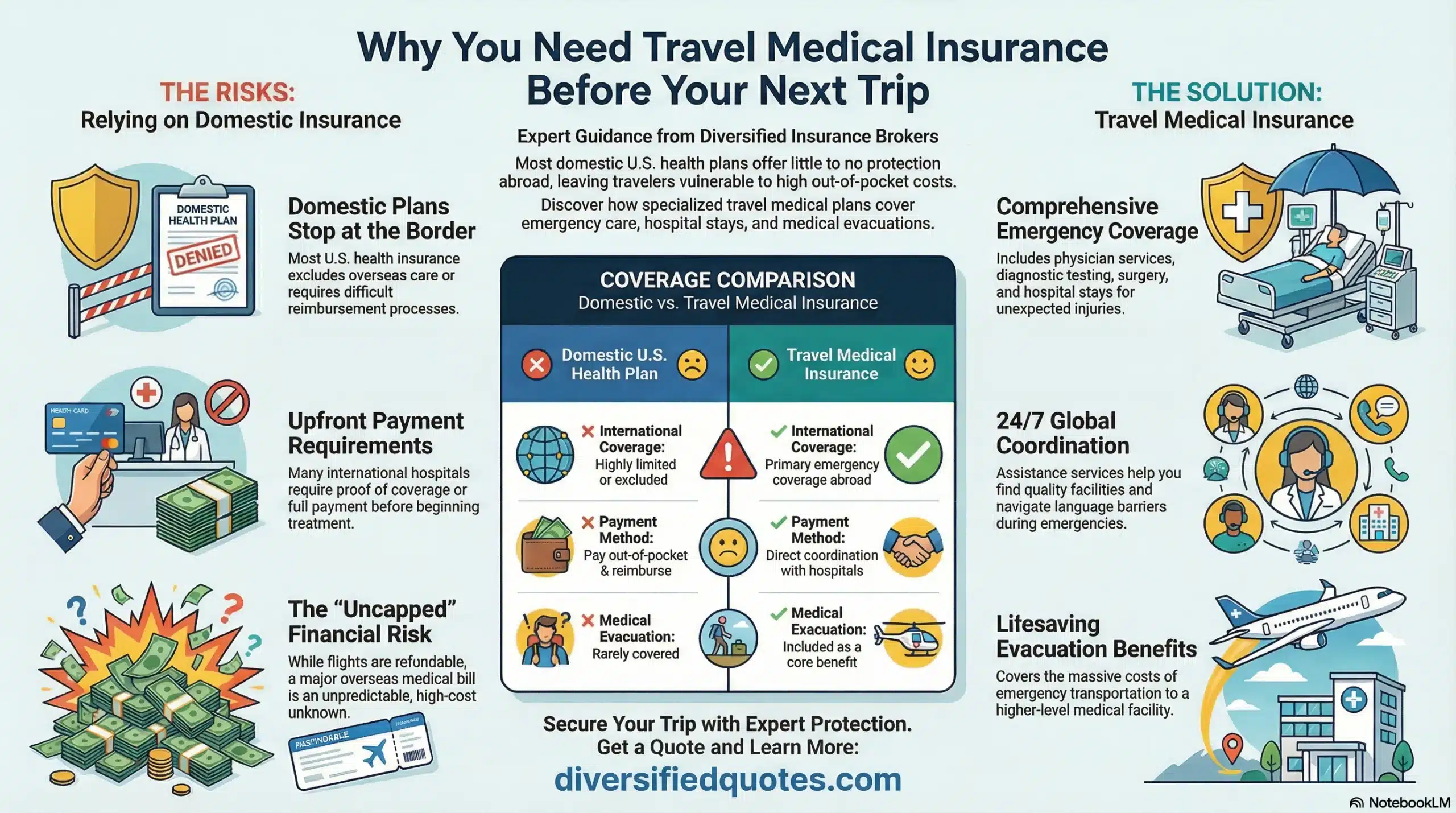
Talk With an Advisor Today
Choose how you’d like to connect—call or message us, then book a time that works for you.
Schedule here:
calendly.com/jason-dibcompanies/diversified-quotes
Licensed in all 50 states • Fiduciary, family-owned since 1980
Travel Medical & Evacuation Insurance — Russia (FAQ)
Do I need travel medical & evacuation insurance for Russia?
Yes. Medical care and payment processes can vary by region, and a serious emergency can require transfer to a higher-acuity facility. Travel medical coverage helps with eligible emergency treatment, and evacuation benefits help coordinate transport when local care isn’t adequate.
What does travel medical coverage typically pay for in Russia?
Most plans cover eligible emergency treatment for unexpected illness or injury during covered dates, such as hospital and physician charges, diagnostics, and certain prescriptions, subject to the policy terms and approvals.
What does medical evacuation usually include for Russia travel?
Evacuation benefits typically include coordination by a 24/7 assistance team, medically necessary transport to the nearest appropriate facility capable of treating your condition, and routing decisions based on medical necessity and logistics.
How much medical and evacuation coverage should I consider?
Many travelers consider at least $100,000 in emergency medical coverage and $250,000+ for evacuation, especially if traveling outside major cities, visiting remote areas, or traveling during winter months.
Will I have to pay the hospital up front?
It depends on the facility and the plan. Many plans include assistance services that can help coordinate documentation and payment processes where available. Contact the assistance hotline early so the case is properly opened and coordinated.
Are pre-existing conditions covered for Russia trips?
Coverage varies by policy. Some plans exclude pre-existing conditions, some offer limited acute onset coverage, and some may provide waivers under specific timing rules. Review definitions, look-back periods, and eligibility details before buying.
Does a standard policy include political or security evacuation?
Most standard travel medical policies focus on medical necessity. If you want non-medical evacuation benefits, choose a plan or rider that explicitly includes political/security evacuation coverage.
What if I’m traveling to remote regions or taking long rail journeys?
Remote itineraries and long-distance travel can increase the importance of higher evacuation limits and strong assistance coordination. Confirm that your coverage dates match your full itinerary and consider stronger evacuation benefits if you will be far from major medical centers.
What documents should I keep with me?
Carry your policy number, assistance hotline, passport/visa, itinerary, and a medication list. Keep digital copies accessible offline so you can reference them even if connectivity is limited.
How do I start a claim or request evacuation?
Call the 24/7 assistance number immediately. Provide your location, condition, and treating facility details. The assistance team will guide approvals, transfers, and the documentation you’ll need for the claim.
About the Author:
Jason Stolz, CLTC, CRPC and Chief Underwriter at Diversified Insurance Brokers (NPN 20471358), is a senior insurance and retirement professional with more than two decades of real-world experience helping individuals, families, and business owners protect their income, assets, and long-term financial stability. As a long-time partner of the nationally licensed independent agency Diversified Insurance Brokers, Jason provides trusted guidance across multiple specialties—including fixed and indexed annuities, long-term care planning, personal and business disability insurance, life insurance solutions, Group Health, and short-term health coverage. Diversified Insurance Brokers maintains active contracts with over 100 highly rated insurance carriers, ensuring clients have access to a broad and competitive marketplace.
His practical, education-first approach has earned recognition in publications such as VoyageATL, highlighting his commitment to financial clarity and client-focused planning. Drawing on deep product knowledge and years of hands-on field experience, Jason helps clients evaluate carriers, compare strategies, and build retirement and protection plans that are both secure and cost-efficient. Visitors who want to explore current annuity rates and compare options across multiple insurers can also use this annuity quote and comparison tool.
