
What are the Best Fixed Annuities

Jason Stolz CLTC, CRPC
What are the best fixed annuities? For most people, the “best” fixed annuity is not a single product or a single carrier—it’s the contract that fits your time horizon, your need for liquidity, your comfort with surrender schedules, and whether your goal is guaranteed growth, future income, or both. At Diversified Insurance Brokers, we work as an independent, fiduciary insurance agency licensed in all 50 states. That matters because it lets you compare fixed annuities across many top-rated companies rather than being steered toward just one carrier’s offering.
Fixed annuities are often a strong fit for conservative savers who want principal protection, predictable interest crediting, and tax-deferred growth. For retirees and pre-retirees, they can also serve as a way to “set a floor” under a portion of savings—especially when markets feel uncertain, CD rates change, or you’re trying to reduce sequence-of-returns risk. But the contract details matter. A high advertised rate doesn’t always mean it’s the best option once you factor in surrender terms, free-withdrawal rules, renewal rate history, and whether you’ll want to convert some of that value into reliable income later.
On this page, we’ll walk through how fixed annuities work, what actually makes one “best,” and the practical criteria we use when comparing options. If you want to start by seeing what’s available right now, you can review our current annuity rates along with our regularly updated pages on today’s best annuity rates and top annuity rates as of today. Then, if you want a side-by-side review that matches your age, state, and timeline, request a personalized quote from our annuity advisors.
What Is a Fixed Annuity and How Does It Work?
A fixed annuity is a contract with an insurance company where you exchange a lump sum (or a series of deposits) for a guaranteed crediting approach. In plain English, you’re buying a contractual promise: the insurance company credits interest according to the terms of the contract, and your principal is protected from market losses. That’s why fixed annuities are often used as part of a “safety bucket” strategy in retirement planning—especially for funds you don’t want exposed to stock-market drawdowns.
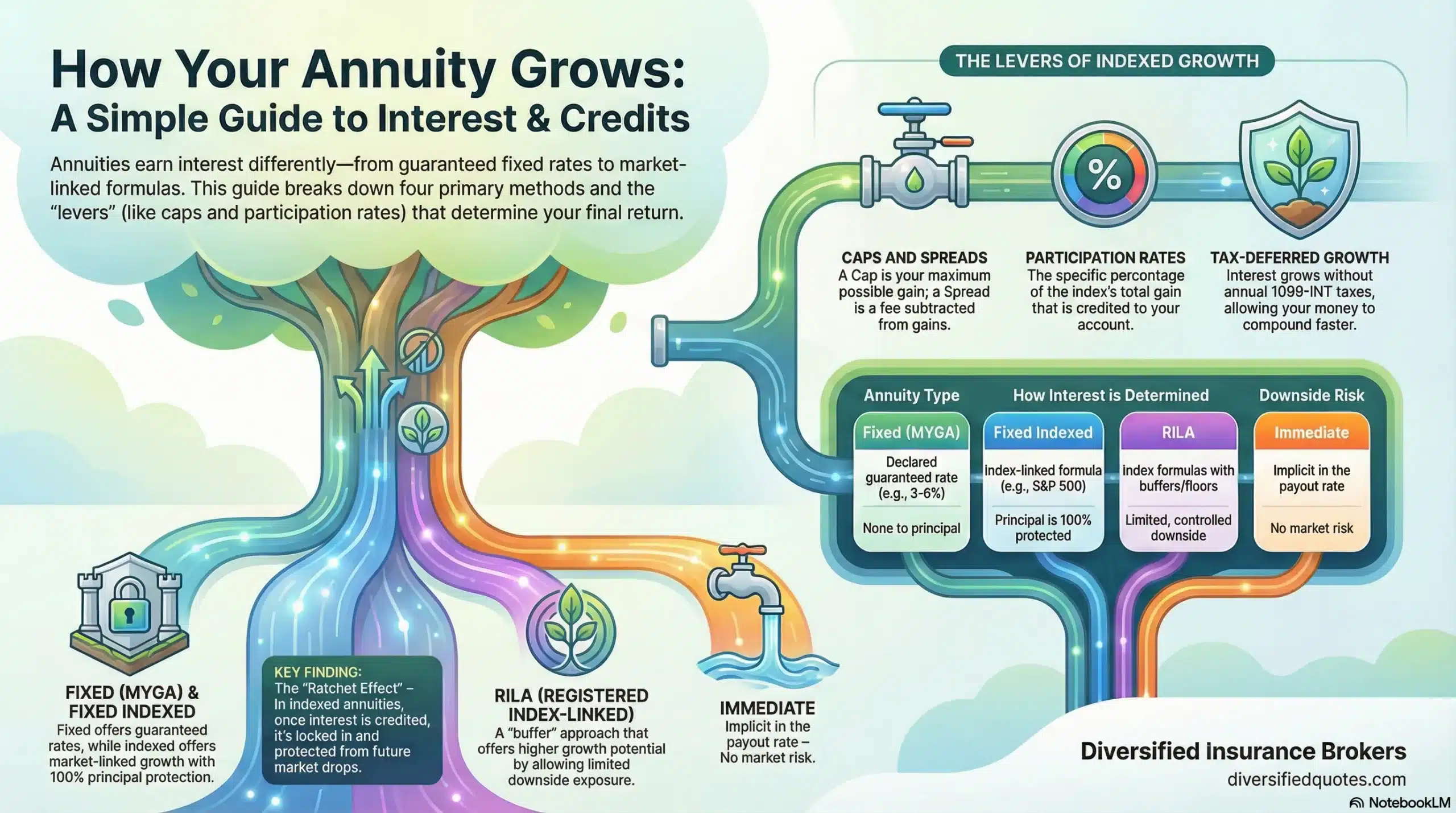
Most fixed annuities fall into a few practical categories. A multi-year guaranteed annuity (MYGA) is the most straightforward: you receive a guaranteed interest rate for a set term (commonly 3, 5, 7, or 10 years). During that guaranteed period, the insurer credits interest at the declared rate and your account value grows tax-deferred. MYGAs are commonly compared to CDs, but with important differences: annuities are insurance contracts (not bank deposits), they are generally tax-deferred, and they include surrender schedules that are different from early-withdrawal penalties on CDs. To understand the mechanics behind rate crediting and why some contracts compound differently than others, see how annuities earn interest.
Some fixed annuities are geared more toward future income rather than just accumulation. That doesn’t mean they’re “better” or “worse”—it means the contract was designed around a different outcome. If your plan is to convert part of your savings into predictable retirement income later, your “best” fixed annuity might be the one with stronger lifetime income options or more flexible payout elections. A helpful starting point for the income conversation is our page on the best retirement income annuities, which explains how income annuities and lifetime payout planning fit into the bigger picture.
Finally, many people exploring “fixed annuities” are also considering fixed indexed annuities (FIAs) or other structures. While FIAs are not the same as traditional fixed annuities, they are frequently compared because both can protect principal from direct market losses. If you want to understand the difference clearly before you compare quotes, review how fixed indexed annuities work so you don’t accidentally compare apples to oranges.
How We Define the “Best” Fixed Annuities
The word “best” can be misleading if it’s defined as “highest rate on a chart.” A rate is important—but a fixed annuity is a long-term contract, and the contract is only as good as the combination of (1) insurer strength, (2) guarantee structure, (3) surrender/liquidity rules, and (4) how well the contract matches your timeline. At Diversified Insurance Brokers, we define “best” as the contract that gives you the strongest chance of meeting your goal with the least amount of friction, surprise, and regret later.
Financial strength of the insurer. Fixed annuities are built on long-term promises. That’s why financial strength matters. A slightly higher rate can look attractive, but if the carrier’s overall profile creates concern, that “extra yield” may not be worth the trade-off. As an independent agency, we compare many carriers, which helps you avoid being boxed into one company’s rate sheet. We also frequently help people research insurers using our “Is X a good insurance company?” style pages across the site, so you can make an informed decision about who is backing the guarantee.
Guaranteed interest and crediting clarity. With MYGAs and traditional fixed annuities, the crediting approach should be simple to understand. You want to know whether the rate is guaranteed for the full term, how interest compounds, and what happens at the end of the term. Contracts that are clear and predictable tend to create better client outcomes, because you’re less likely to “buy something you didn’t mean to buy.” For deeper detail on crediting, compounding, and what impacts long-term results, revisit how annuities earn interest.
Surrender schedule and realistic liquidity needs. A fixed annuity is not designed for money you need next month. But most people still want some access—because life happens. We look closely at surrender periods, free-withdrawal provisions, and any built-in waivers that may apply under specific circumstances. This is one of the biggest reasons the “best” fixed annuity for one person is not the best for another: a strong 7-year rate might be perfect for someone who truly has a 7-year horizon, but a problem for someone who’s likely to need the funds in year two or three.
Income flexibility (if income is part of your plan). Not everyone buying a MYGA plans to annuitize it. Some people simply want guaranteed growth for a period and then will re-evaluate. Others want a contract that can transition into income planning later. If lifetime income is even a possibility, we usually coordinate the fixed annuity selection with the broader strategies discussed on annuities that pay income for life. The goal is not to force income riders on everyone—it’s to avoid selecting a contract that makes future income planning harder if you end up wanting it.
Tax fit and account type fit. Fixed annuities can be owned inside retirement accounts (qualified) or outside retirement accounts (non-qualified). The “best” annuity is the one that fits your broader tax plan and doesn’t create avoidable complications. We often connect this topic to the broader retirement account learning pages on how IRAs work and how 401(k)s work, because many annuity purchases are funded by rollovers or by repositioning savings after retirement.
When you put those criteria together, you get a more accurate definition of “best”: the contract that is guaranteed, understandable, appropriately liquid, supported by a financially sound insurer, and aligned with how you’ll actually use the money.
MYGAs vs. Traditional Fixed Annuities vs. Bonus Designs
Most people start their fixed annuity research with MYGAs because the value proposition is simple: pick a term, get a guaranteed rate. If your goal is conservative growth with clarity and you can comfortably match the surrender period to your horizon, a MYGA is often a top contender for “best fixed annuity.” The simplicity is also a benefit in real life: you’re less likely to misunderstand the guarantee, and it becomes easier to compare options side by side.
Traditional fixed annuities sometimes include renewal rate structures or crediting practices that require a little more attention. That doesn’t make them bad—many are excellent contracts—but it does mean you should be clear on what is guaranteed and what is not. For example, some contracts guarantee a rate for an initial period and then transition to a declared rate that the insurer can adjust in the future. If you want predictability for a defined timeline, that may be less attractive than a multi-year guarantee.
Bonus-oriented annuities frequently come up in the same conversation because bonuses can be compelling—especially when a bonus increases the account value or income value early. The key is to understand the trade-off. Bonus designs often involve longer surrender schedules, different crediting structures, or rules that reduce flexibility. That’s why we suggest reading bonus annuity pros and cons before making a decision based primarily on the bonus headline. If you are actively shopping bonus structures, we also maintain focused pages such as the 10 percent bonus annuity page so you can see how these designs are typically framed and what to verify before you commit.
In many real client scenarios, the best answer is not “all MYGA” or “all bonus.” It’s often a split strategy where part of the money is placed into a simple fixed rate for stability and clarity, while another part is structured toward income or other planning goals. The right split depends on your timeline, your household income picture, and how important liquidity is in the next several years.
Fixed Annuities Compared to Other Retirement Vehicles
Fixed annuities are not designed to replace everything else. They’re designed to solve a specific problem: how do you protect principal and create predictable growth (and potentially predictable income) without taking direct market risk? That’s why fixed annuities are often used alongside IRAs, 401(k)s, Roth IRAs, and brokerage accounts. They create a contractual base layer that can make the rest of the plan feel less fragile.
If you’re still building your retirement framework, understanding how accounts behave is important. For example, if much of your money is in tax-deferred employer plans, reading how 401(k)s work and how IRAs work helps clarify why rollovers, distribution rules, and tax planning become more important in retirement. If part of your plan includes Roth money, it can also help to understand how Roth IRAs work so you see how tax diversification can impact withdrawal strategy later.
For many retirees, the most practical way to use fixed annuities is to cover essential expenses with reliable income sources. Social Security is usually the first pillar. Annuities are sometimes used to strengthen that pillar—particularly when people want more guaranteed income than Social Security alone provides. If this is part of your thinking, our guide on how Social Security and annuities work together explains how we coordinate the timing of claiming strategies with annuity design so your guarantees complement each other instead of overlapping inefficiently.
Another reason fixed annuities are attractive is behavioral: when a portion of your money is in a contract that is not swinging daily with markets, it becomes easier to hold the rest of your portfolio steady. That can reduce the temptation to buy high and sell low. This is also why fixed annuities are commonly discussed in the context of protecting retirement funds more broadly, including the principles discussed in how to protect your funds in retirement.
Common Features That Separate “Best” Fixed Annuities from “Okay” Ones
When you compare fixed annuities side by side, many look similar at first glance. The differences show up in the details—especially when you try to use the contract. That’s why we encourage people to evaluate fixed annuities based on “real usage,” not just the headline rate.
Free-withdrawal provisions that match your life. Many fixed annuities allow you to withdraw a percentage each year without surrender charges. The best design is the one that matches how likely you are to need access. If you know you might need meaningful access in the next few years—for a home repair, medical expense, or family help—you want the liquidity rules to support that, not punish it.
Surrender schedule that you can truly live with. A surrender period is not inherently bad; it’s part of how insurance companies can offer competitive guarantees. The problem happens when the surrender schedule doesn’t match your timeline. If you choose a 7-year annuity but end up needing to reposition funds in year three, the contract may no longer feel “best,” even if the rate was excellent at the time you purchased it.
Clarity on end-of-term options. Many people buy a MYGA and then, near the end of the term, ask “Now what?” The best contracts make it clear what happens at maturity—whether there is a renewal, a new declared rate, a window to move, or an option to annuitize. The more clear the end-of-term process is, the easier it is to plan.
Transparent understanding of fees. Traditional fixed annuities and MYGAs are often purchased for simplicity. But people still hear “annuities have fees” and worry. The reality depends on the annuity type. If you want a clear discussion of where fees show up (and where they typically don’t), our guide on do annuities have fees is a helpful companion piece.
Compatibility with your “next step” plan. Sometimes the best fixed annuity is simply a safe holding place for a period of time. Other times it’s a stepping stone toward income. In either case, the contract should support what you plan to do next—whether that’s rolling into another fixed term, transitioning into income, or coordinating withdrawals with Social Security and other household income.
How to Choose the Right Term (3, 5, 7, or 10 Years)
Term selection is one of the most practical fixed annuity decisions you’ll make. A shorter term may provide more flexibility, while a longer term may provide a more attractive guaranteed rate. But the “best” term is rarely the one that looks best on a rate chart. It’s the one that matches your real timeline and your real need for access.
If you are newly retired or within a year of retiring, shorter terms often feel safer because you’re still learning what retirement expenses actually look like. Even conservative families sometimes underestimate travel, healthcare surprises, home upgrades, or family support in the first years after retirement. A shorter term can reduce the chance that you’ll need to break the contract at an inconvenient time.
If you have a clearer timeline—say you’re five to seven years from needing the money—then longer terms may make sense. In those scenarios, a MYGA can function as a planned “bridge” asset that matures around the time you want to make another decision, such as starting a new income stream or repositioning funds based on market conditions.
Some clients prefer a ladder approach where the money is split across multiple terms so not all of the annuity value is locked into one maturity date. A ladder can reduce reinvestment-rate risk (the risk that rates are lower at renewal) and can create more planning checkpoints. If you’re evaluating different approaches to guaranteed growth and how interest is credited over time, the page on simple vs. compound interest on annuities can help you think through how compounding interacts with your plan.
“Best Fixed Annuity” for Growth vs. “Best Fixed Annuity” for Income
One of the biggest clarity points in annuity planning is separating growth goals from income goals. If your primary goal is conservative accumulation—earning a predictable rate with principal protection—then the “best” fixed annuity is often the contract with a strong guaranteed rate, reasonable surrender schedule, and flexibility that matches your timeline.
If your primary goal is income, the best solution might not be a pure MYGA. It may be an income-focused annuity structure, or it may be a contract that is designed specifically to convert into a reliable stream of payments. That’s why we often connect fixed annuity discussions to broader retirement-income planning, including the concepts on annuities that pay income for life and the deeper dive on best retirement income annuities. Your “best” contract depends on which outcome matters most.
It’s also common for the goal to be both. Many retirees want growth first and income later. In those cases, the right plan can involve a fixed rate phase followed by a decision point—such as converting a portion of the accumulated value into guaranteed lifetime income while keeping some funds liquid. The key is to choose a contract that keeps options open rather than forcing you into a narrow lane later.
Fixed and Bonus Annuity Rates
Compare Top Fixed Annuity Rates
Want to see which fixed annuities may be best for your time horizon and risk tolerance? Request a personalized quote comparing multiple carriers and guarantee periods.
Explore Bonus and Income Annuities
Curious whether a bonus annuity or income-focused design might provide a better long-term benefit than a simple fixed rate? Compare options side by side with an independent advisor.
Fixed Annuity Income Calculator
Once you have a sense of which fixed annuities look most appealing, the next step is translating “rates” into realistic outcomes. Some people want to estimate how interest growth might look over a chosen term, while others want to understand what a guaranteed income stream could look like at their age under different payout options. The calculator below helps you explore income estimates so you can connect product choices to actual retirement cash flow.
Note: The calculator accepts premiums up to $2,000,000. If you are investing more, results increase in direct proportion — for example, doubling your premium roughly doubles the guaranteed income at the same age and options.
Why Work with Diversified Insurance Brokers
Diversified Insurance Brokers is a family-owned, fiduciary insurance agency headquartered in Suwanee, Georgia and licensed in all 50 states. Because we are independent, we can compare fixed annuity options across many top-rated insurers rather than being restricted to a single company’s lineup. That independence is especially important in fixed annuity planning because the “best” option for you may change based on your age, your state, your timeline, and whether you value liquidity, rate, or future income flexibility most.
We also take a planning-first approach. That means we don’t start with “what can we sell?” We start with “what outcome are we trying to accomplish?” If your goal is principal protection and predictable growth, we lean into rate strength and surrender fit. If your goal is future income, we evaluate how the contract can transition into a reliable income strategy and how it coordinates with broader retirement income pillars like Social Security. If you’re exploring the income intersection, how Social Security and annuities work together is one of the best companion reads because it clarifies how guarantees can be layered efficiently.
Finally, we focus on clarity. Fixed annuities should not feel like a mystery. The best fixed annuity recommendation is the one you understand, the one you can explain to your spouse, and the one you can live with for the full surrender period without feeling boxed in.
How to Get the “Best” Fixed Annuity for Your Situation
If you’re trying to choose the best fixed annuity, the fastest path is usually a structured comparison. That starts with a few simple details: your state (because availability and rates can vary), your approximate age range, your timeline (3, 5, 7, or 10 years), and how important liquidity is during the surrender period. From there, we can show a clear side-by-side of rates and terms and explain what each contract is actually designed to do.
Most people are surprised by how much the “best choice” depends on fit rather than hype. Sometimes the best fixed annuity really is the simplest MYGA. Other times, the right plan involves combining fixed and bonus designs or coordinating a fixed strategy with an income-focused approach. The right answer is the one that helps your retirement plan feel more stable without creating new constraints.
Talk With an Advisor Today
Choose how you’d like to connect—call or message us, then book a time that works for you.
Schedule here:
calendly.com/jason-dibcompanies/diversified-quotes
Licensed in all 50 states • Fiduciary, family-owned since 1980
What is a fixed annuity?
A fixed annuity is a contract with an insurance company that guarantees interest on your premium and protects your principal from market losses. In exchange for your lump sum or series of payments, the insurer agrees to credit interest according to the contract terms and, if you choose, provide guaranteed income in the future.
How do you decide which fixed annuities are “best”?
We look beyond just the highest advertised rate. When we evaluate fixed annuities, we consider the insurer’s financial strength, the guaranteed interest rate and term length, liquidity and surrender charges, income options, and how the contract fits into your overall retirement plan. The best fixed annuity for you is the one that balances these factors based on your goals.
What is the difference between a fixed annuity and a MYGA?
A multi-year guaranteed annuity (MYGA) is a type of fixed annuity that guarantees a specific interest rate for a set number of years, such as five or seven. Other fixed annuities may have different crediting structures or focus more on lifetime income. MYGAs are often used as a CD alternative for predictable, tax-deferred growth over a defined term.
Are fixed annuities safe?
Fixed annuities are considered conservative vehicles because they offer contractual guarantees backed by the issuing insurance company. Your principal is protected from market volatility, and your interest and income guarantees are defined in the contract. However, they are not bank products or FDIC insured, so it is important to choose financially strong insurers and appropriate coverage amounts.
How do I compare fixed annuity rates?
To compare fixed annuity rates, you should look at the guaranteed interest rate, the length of the guarantee period, the insurer’s financial rating, and the liquidity provisions. Our team can prepare a side-by-side comparison that shows how different MYGAs and fixed annuities stack up for your time horizon and premium amount.
Can a fixed annuity provide lifetime income?
Yes. Many fixed annuities can be converted into lifetime income through annuitization or income riders. This allows you to turn your accumulated value into a paycheck you cannot outlive. We help you evaluate whether using a fixed annuity for income makes sense compared to other options in your retirement plan.
What are the fees on fixed annuities?
Traditional fixed annuities and MYGAs generally do not charge explicit annual fees the way some investments do. Instead, the insurer sets the guaranteed interest rate after accounting for their own costs and profit margin. Some income or benefit riders may have separate fees. We disclose any charges and help you understand how they affect your guarantees.
Are fixed annuities a good alternative to CDs?
For many conservative savers, fixed annuities and MYGAs can be an attractive alternative to CDs because they often offer higher guaranteed rates and tax-deferred growth. However, annuities have surrender charges and different liquidity rules, so they are best suited for money you can leave invested for the full term.
How do I know if a fixed annuity is right for me?
If you want safety, predictable growth, and potentially guaranteed income later, a fixed annuity may deserve consideration. The best way to know is to review your goals, time horizon, and other accounts with an independent advisor who can show you both the benefits and trade-offs before you make a decision.
About the Author:
Jason Stolz, CLTC, CRPC and Chief Underwriter at Diversified Insurance Brokers (NPN 20471358), is a senior insurance and retirement professional with more than two decades of real-world experience helping individuals, families, and business owners protect their income, assets, and long-term financial stability. As a long-time partner of the nationally licensed independent agency Diversified Insurance Brokers, Jason provides trusted guidance across multiple specialties—including fixed and indexed annuities, long-term care planning, personal and business disability insurance, life insurance solutions, Group Health, and short-term health coverage. Diversified Insurance Brokers maintains active contracts with over 100 highly rated insurance carriers, ensuring clients have access to a broad and competitive marketplace.
His practical, education-first approach has earned recognition in publications such as VoyageATL, highlighting his commitment to financial clarity and client-focused planning. Drawing on deep product knowledge and years of hands-on field experience, Jason helps clients evaluate carriers, compare strategies, and build retirement and protection plans that are both secure and cost-efficient. Visitors who want to explore current annuity rates and compare options across multiple insurers can also use this annuity quote and comparison tool.
