
2 Person Group Health Insurance

Jason Stolz CLTC, CRPC
2 Person Group Health Insurance is one of the most overlooked strategies available to small business owners who want better coverage, better cost control, and better long-term financial efficiency. Many business owners assume group health insurance only becomes available once a company reaches five, ten, or twenty employees. In reality, many carriers allow true group health plans starting with just two qualified employees, which means small partnerships, family businesses, and micro companies can access coverage structures that are often stronger than what is available in the individual marketplace.
At Diversified Insurance Brokers, we work with small businesses nationwide to design compliant two-person group health insurance strategies that balance cost predictability, coverage strength, and tax positioning. Because we compare multiple carriers, funding models, and plan structures, we help business owners determine whether a fully insured plan, level funded structure, or hybrid micro-group model produces the best overall outcome. In many cases, the difference between individual coverage and a properly structured two-person group plan can be thousands of dollars annually when factoring premiums, tax deductibility, and long-term cost stability.
Healthcare is often the second or third largest expense inside a small business after payroll and operating overhead. Because of this, the decision around health insurance is rarely just about medical coverage. It is about tax planning, employee retention, risk management, and long-term business sustainability. When implemented correctly, a two-person group health insurance structure can transform healthcare from an unpredictable personal expense into a structured, deductible business expense that improves financial planning visibility year over year.
For many business owners, two-person group coverage becomes especially valuable during transition periods, including business expansion phases, partnership formation, and pre-retirement planning. Locking in a compliant group structure early often makes scaling easier later because the company already understands participation requirements, contribution structures, and renewal cycles. This guide explains how qualification works, how carriers evaluate two-person groups, how tax advantages typically apply, and why many small businesses are transitioning from individual plans into micro-group coverage structures.
Compare 2 Person Group Health Insurance Options
See how a properly structured two-employee group plan can improve benefits while lowering long-term total healthcare costs.
How 2 Person Group Health Insurance Works
Two person group health insurance operates under the same regulatory and carrier framework as larger employer group health plans. The only difference is group size. Instead of spreading risk across dozens or hundreds of employees, carriers evaluate the risk characteristics of a two-person workforce while still applying group plan rating structures and participation rules.
Carriers typically verify several core factors before approving coverage. First, they verify the business is active and legitimate. This normally requires EIN verification, business bank account documentation, and proof of ongoing business operations. Second, they verify payroll documentation confirming both employees are actively working and receiving W-2 income. Third, they verify participation and contribution requirements, which often require the employer to pay at least 50 percent of the employee premium.
Unlike individual plans, which are heavily influenced by marketplace participation and regional rating volatility, group plans are often built around stable plan design structures. This allows business owners to maintain more consistent deductible levels, copay structures, and provider network access from year to year. For small businesses trying to manage predictable operating budgets, this stability can be extremely valuable.
Another major difference involves cost positioning. Individual plans are typically paid with after-tax dollars, even when partial deductions are available. Group health premiums paid by the employer are typically treated as deductible business expenses. This shifts healthcare from a personal financial burden into a business operating cost, which can significantly change overall tax efficiency.
Who Typically Qualifies for Two-Person Group Health Plans
Two-person group plans are most commonly used by partnerships, husband-and-wife businesses where both spouses draw payroll income, professional firms with one owner and one employee, and small family businesses. Many consultants, financial professionals, real estate teams, and medical or legal offices also fall into this category.
Qualification rules can vary slightly depending on state regulations and carrier underwriting guidelines. Some states allow spouse-only payroll groups. Other states require at least one non-owner W-2 employee. This is why carrier-specific eligibility confirmation is critical before selecting a funding structure.
Business structure typically does not prevent qualification. LLCs, S-Corps, C-Corps, and partnerships may all qualify as long as payroll documentation is consistent and the business is actively generating revenue. The key factor is demonstrating legitimate employer-employee relationships supported by payroll reporting and tax documentation.
Before recommending any plan structure, our advisors verify eligibility directly with carriers. This prevents application delays, prevents retroactive eligibility denials, and ensures the business meets minimum participation and contribution rules from the beginning.
Tax Efficiency Advantages of 2 Person Group Health Insurance
One of the largest advantages of two-person group health insurance is tax positioning. Employer-paid premiums are typically deductible as business expenses. This can reduce taxable business income while simultaneously funding employee healthcare coverage. For many high-income business owners, this shifts healthcare costs into a more efficient tax category.
Additionally, some businesses implement Section 125 cafeteria plan structures. These allow employees to pay their portion of premiums using pre-tax payroll deductions. This reduces taxable income and increases net take-home pay efficiency. Over time, the combined tax efficiency between employer deductions and employee pre-tax contributions can offset premium differences between individual and group coverage.
Tax efficiency becomes especially important for business owners planning long-term wealth accumulation or retirement transition. Healthcare costs represent one of the largest lifetime expenses for most households. Structuring these costs through business deduction strategies can significantly influence long-term net wealth accumulation.
For business owners exploring alternative funding models, reviewing self funded group health insurance structures can help clarify how risk sharing and claim funding models differ from traditional fully insured designs.
Fully Insured vs Level Funded for Two-Person Groups
Most micro groups begin with fully insured plans because they offer administrative simplicity and predictable monthly premiums. The carrier assumes full claim risk, and the employer pays a fixed monthly premium regardless of claim utilization. For new businesses or companies prioritizing cost stability, this can be the most straightforward starting point.
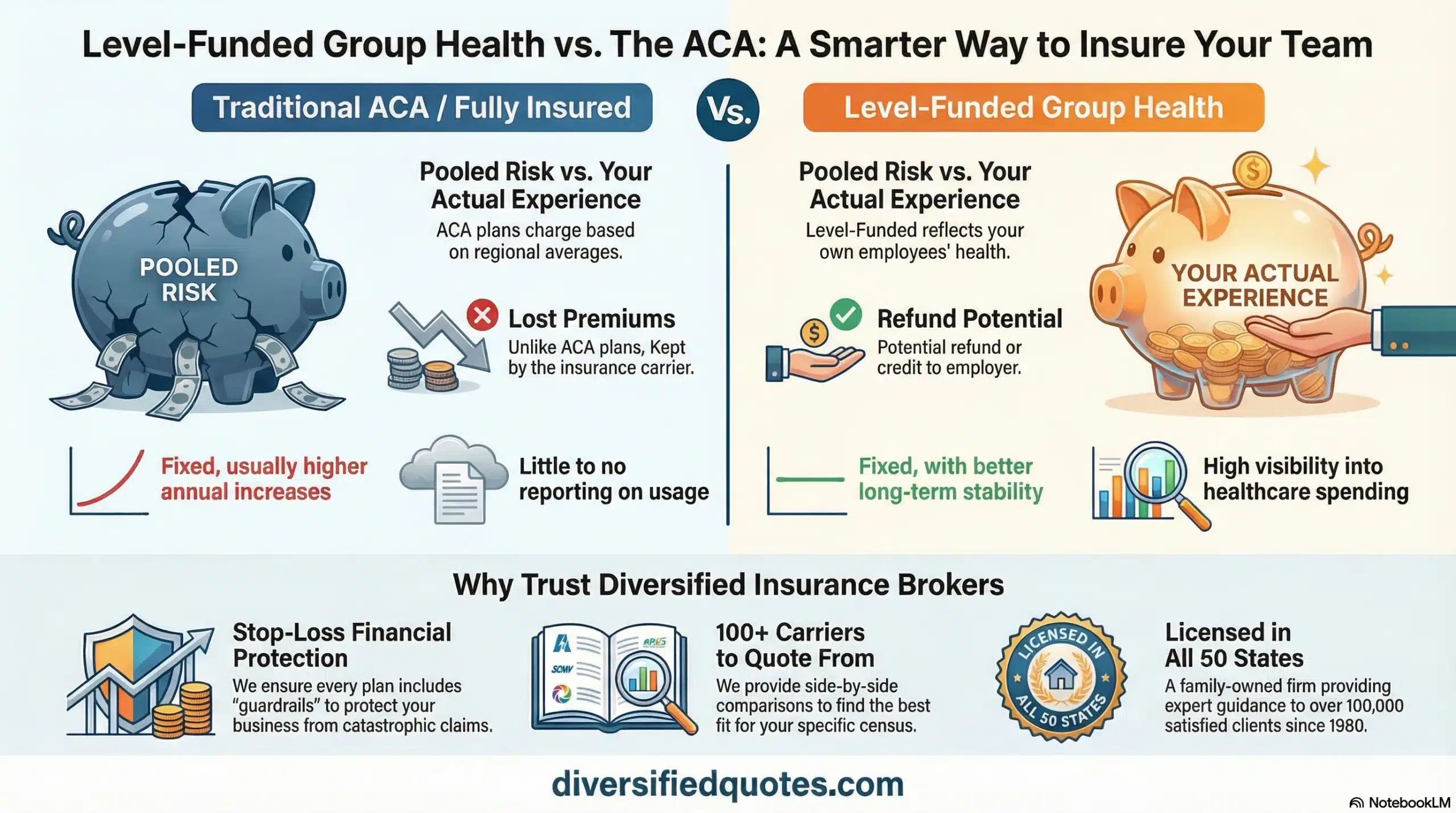
Level funded plans are becoming more available to small groups, including two-person companies in some cases. Level funded structures combine predictable monthly payments with claim funding pools. If claims run lower than projected, some plans provide surplus credits or renewal adjustments. While not guaranteed, this can produce long-term cost advantages for healthier groups.
To understand how claim risk is limited in these models, reviewing stop loss insurance protection inside level funded plans helps illustrate how catastrophic claim risk is capped.
Check If Your Business Qualifies for 2 Person Group Coverage
Eligibility rules vary by carrier and state. We verify payroll, participation rules, and funding structure options before submission.
Why Many Small Businesses Miss This Opportunity
Many small business owners default to individual coverage simply because they assume group coverage is unavailable. In reality, micro-group eligibility has expanded significantly as carriers have recognized the stability of small professional firms and partnership-based businesses.
Another common barrier is misunderstanding payroll requirements. Some business owners assume ownership status disqualifies them from group coverage. In reality, owners drawing W-2 payroll often qualify depending on carrier guidelines and business structure documentation.
Many businesses also overlook potential refund or surplus opportunities within certain funding models. Some level funded plans allow surplus claim credits if claims remain below projections. While these are not guaranteed, they can significantly reduce long-term cost trends.
Additional insight into potential claim surplus models can be found when reviewing health insurance refund scenarios for small employer groups.
Individual vs Two Person Group Health: Long-Term Planning Differences
Individual plans typically provide easier enrollment but less long-term cost predictability. Marketplace plans can change network access, deductible structures, and premium costs annually depending on carrier participation and regional rating changes.
Two-person group plans typically provide more structured benefit design stability. This allows businesses to forecast healthcare costs more effectively and build long-term compensation strategies around predictable benefit structures.
Group plans also allow layering strategies. Some employers pair group medical coverage with HSA compatible plans or voluntary supplemental benefits. This allows employers to offset high deductible exposure while maintaining lower premium structures. This type of design flexibility is rarely available in the individual marketplace.
Employers evaluating long-term cost modeling should review group level funding long term cost modeling strategies to understand how risk pooling and claim utilization impact renewal costs.
Long-Term Strategic Value of Starting Group Coverage Early
Healthcare cost predictability is a major advantage for businesses planning long-term growth. Starting group coverage early helps companies build benefit infrastructure before expanding headcount. It also positions the business more competitively when hiring future employees.
Two-person group health insurance also supports long-term owner planning. Business owners approaching retirement often need stable healthcare coverage during transition years before Medicare eligibility. A properly structured group plan can provide cost predictability and network stability during this phase.
For many businesses, micro-group coverage becomes the foundation for future employee benefit strategy. As the business grows, the company already understands renewal timelines, compliance documentation requirements, and funding structure decision points.
Build a Long-Term 2 Person Group Health Strategy
Compare fully insured and level funded micro-group options designed around your business structure and future growth plans.
Related Group Health Strategy Pages
Explore advanced small group coverage and employer planning strategies.
Related Funding & Compliance Pages
Learn how funding models and compliance rules influence small group healthcare costs.
Financial Protection Essentials
Carrier evaluations, senior burial planning, and guaranteed issue life insurance strategies to strengthen financial protection.
Talk With an Advisor Today
Choose how you’d like to connect—call or message us, then book a time that works for you.
Schedule here:
calendly.com/jason-dibcompanies/diversified-quotes
Licensed in all 50 states • Fiduciary, family-owned since 1980
FAQs: 2-Person Group Health Insurance
Can two people really start a group health plan?
Yes. In many states, two employees—such as business partners or owners—can qualify for small group coverage if both are active on payroll and receiving earned income. Businesses evaluating options often compare this structure alongside group health insurance for consulting firms to understand eligibility rules.
Can spouses count as two employees?
Sometimes. Eligibility depends on state and carrier guidelines. In certain cases, spouses may qualify as separate employees if both draw W-2 wages. Reviewing broader employer strategies like ACA alternatives for company healthcare can clarify available structures.
Is it cheaper than individual coverage?
Often yes. Small group plans are rated differently than individual marketplace plans and may offer stronger networks or benefits at competitive costs. Employers looking to control expenses sometimes explore ways to reduce company healthcare costs when comparing both approaches.
Can I include dependents?
Yes. Spouses and eligible dependents can typically be added under group rates, with employer and employee contribution structures customized to fit the company budget. Businesses comparing benefit add-ons may also review options like dental and vision insurance to enhance their benefits package.
What if my partner leaves the company?
If one partner departs, maintaining eligibility may require replacing that employee or transitioning coverage. Because group plans require at least two active participants, planning ahead is important. Some small employers evaluate backup structures such as major medical alternatives when workforce changes occur.
About the Author:
Jason Stolz, CLTC, CRPC and Chief Underwriter at Diversified Insurance Brokers (NPN 20471358), is a senior insurance and retirement professional with more than two decades of real-world experience helping individuals, families, and business owners protect their income, assets, and long-term financial stability. As a long-time partner of the nationally licensed independent agency Diversified Insurance Brokers, Jason provides trusted guidance across multiple specialties—including fixed and indexed annuities, long-term care planning, personal and business disability insurance, life insurance solutions, Group Health, and short-term health coverage. Diversified Insurance Brokers maintains active contracts with over 100 highly rated insurance carriers, ensuring clients have access to a broad and competitive marketplace.
His practical, education-first approach has earned recognition in publications such as VoyageATL, highlighting his commitment to financial clarity and client-focused planning. Drawing on deep product knowledge and years of hands-on field experience, Jason helps clients evaluate carriers, compare strategies, and build retirement and protection plans that are both secure and cost-efficient. Visitors who want to explore current annuity rates and compare options across multiple insurers can also use this annuity quote and comparison tool.
