
Are Annuities Guaranteed

Jason Stolz CLTC, CRPC
Are annuities guaranteed? The short answer is yes — but understanding what is guaranteed, how it is guaranteed, who backs the guarantee, and how those guarantees function under different product structures is what separates surface-level marketing from real retirement planning. Annuities are insurance contracts. That means their guarantees are not market promises or hypothetical projections. They are contractual obligations issued by life insurance companies and backed by the financial strength and claims-paying ability of those carriers. However, not every feature inside an annuity is guaranteed, and not every annuity works the same way. If you are considering moving retirement funds into a fixed annuity, fixed indexed annuity, income annuity, or MYGA, understanding the structure of those guarantees is essential before committing capital.
At Diversified Insurance Brokers, we focus on helping clients evaluate guarantees in context. A guarantee only matters if it aligns with your objective. Some retirees want principal protection. Others want predictable growth. Others want lifetime income they can never outlive. Still others want structured tax control inside qualified accounts. The type of guarantee you need depends entirely on what risk you are trying to eliminate — market volatility, longevity risk, reinvestment risk, sequence risk, or income instability. This page will walk through each guarantee type in depth and explain what is contractually protected, what is adjustable, and how to evaluate carrier strength before making a decision.
Compare the Strongest Guaranteed Annuity Contracts
Review today’s highest guaranteed fixed rates and top bonus indexed annuities before moving retirement funds.
View Highest Fixed Annuity Rates View Highest Bonus FIA RatesWhat Does “Guaranteed” Actually Mean in an Annuity Contract?
The word “guarantee” in financial services is often used loosely. In annuities, it has a very specific meaning. It means the insurance company has legally obligated itself to provide a defined benefit under stated conditions. Those obligations are written into the contract and filed with state insurance regulators. If the contract says your rate is 5.40% for five years, that rate does not change. If the contract says your income rider will pay you $28,500 per year for life beginning at age 67, that payment does not stop even if your account value declines to zero. That is the nature of insurance-based guarantees. They are not dependent on stock market performance once locked in.
This is fundamentally different from market-based investment accounts. A brokerage portfolio may project a 6–8% long-term return, but that projection is not guaranteed. Dividends can be cut. Bond prices can fall. Withdrawals during downturns can permanently impair portfolio longevity. An annuity shifts certain risks from the individual to the insurance company. In exchange, you accept contract structure, surrender schedules, and in some cases, capped upside. Understanding that tradeoff is key.
Guaranteed Interest Rates in Fixed Annuities and MYGAs
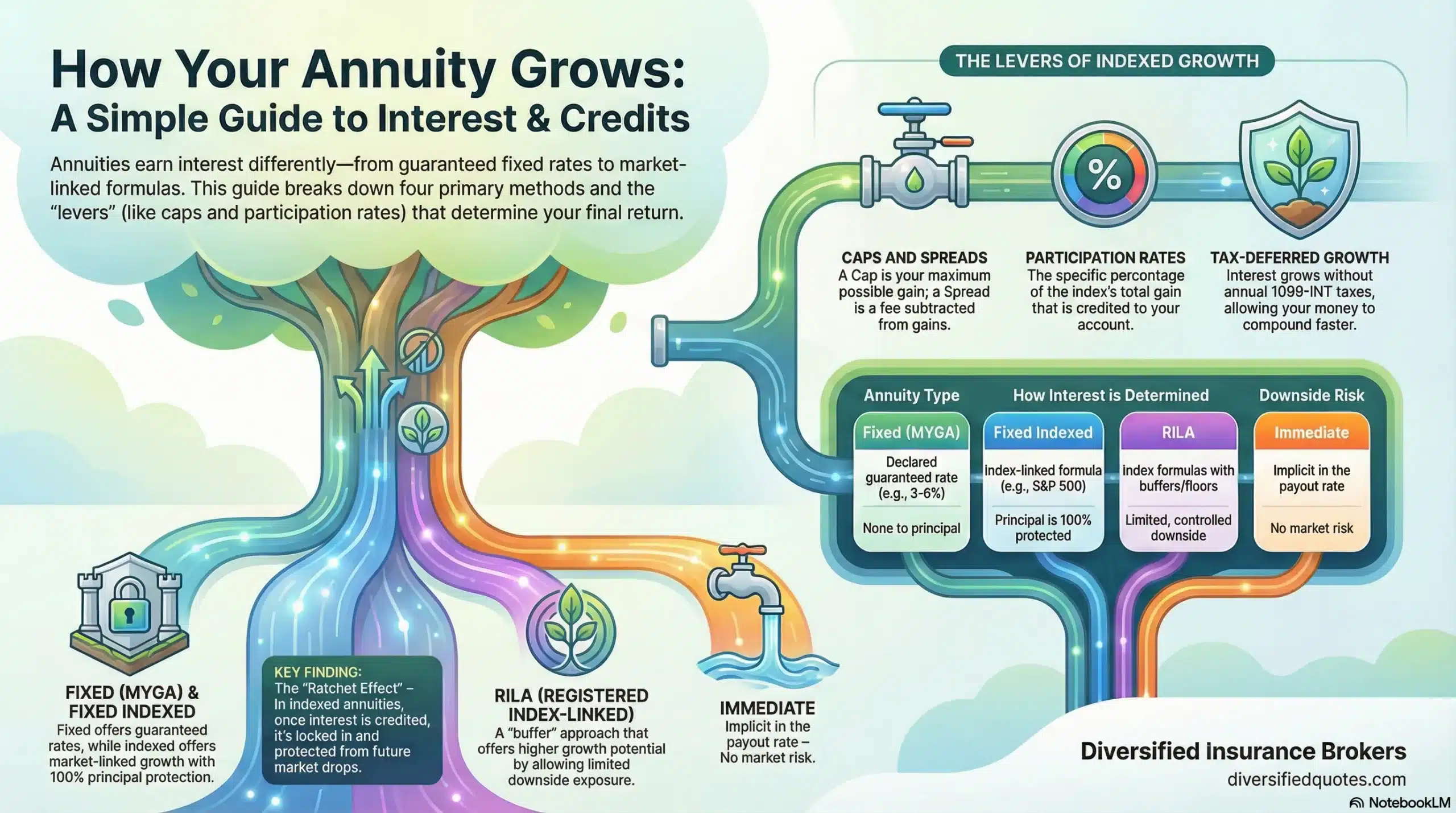
The most straightforward annuity guarantee is found in traditional fixed annuities and multi-year guaranteed annuities (MYGAs). These contracts credit a fixed interest rate for a defined period. If you purchase a 3-year MYGA at 5.75%, your rate is locked for three full contract years. It does not fluctuate. It does not decline if interest rates fall. It does not change if equity markets experience volatility. Your principal grows at the declared rate, tax-deferred, for the duration of the guarantee period.
Because of this structure, fixed annuities are often compared to CDs. However, unlike CDs, annuities grow tax-deferred and are not subject to annual 1099 interest reporting inside non-qualified accounts. For retirees who want safe accumulation without market exposure, fixed annuities provide one of the strongest contractual guarantees available in the financial system.
Before purchasing, always compare competitive offerings on our Highest Guaranteed Annuity Rates page. Rates vary by carrier, term length, and state approval. Even small differences in rate can compound meaningfully over multi-year periods.
Guaranteed Principal Protection in Fixed Indexed Annuities
Fixed indexed annuities (FIAs) introduce a different type of guarantee: principal protection combined with index-linked upside. These contracts credit interest based on the performance of a market index such as the S&P 500, but they do not directly invest in the market. The guarantee lies in the floor. Your worst annual return is 0%. That means if the index declines 20% in a given year, your account does not lose 20%. It simply credits zero for that period. Previously credited gains are locked in annually under most designs.
This structure eliminates sequence-of-returns risk during the accumulation phase. You do not experience market losses that require recovery before new growth can occur. However, participation rates, caps, and spreads are not permanently guaranteed beyond the initial declared period. They are subject to adjustment within contractual minimums. Understanding which elements are fixed and which are adjustable is critical when evaluating indexed annuities.
Competitive structures, including enhanced bonus designs, can be reviewed on our Highest Bonus FIA Rates page, where we monitor leading carriers offering accumulation and income rider value.
Guaranteed Lifetime Income: The Core Retirement Protection
The most powerful annuity guarantee is lifetime income. Only two financial systems in the United States can legally guarantee income for life: Social Security and life insurance companies through annuities. When you activate a lifetime income rider or purchase an immediate income annuity, the carrier assumes longevity risk. That means if you live to 95 or 105, payments continue regardless of market conditions or remaining account value.
This guarantee protects against the greatest retirement risk: outliving your assets. Portfolio-based withdrawals require ongoing growth to sustain distributions. Annuity income removes that dependency once activated. Payments are contractually defined. This allows retirees to stabilize a portion of their income floor while leaving other assets invested for liquidity and growth.
Estimate Your Guaranteed Lifetime Income
Preview income payouts from 75+ carriers using the calculator below.
Income payouts vary by age, gender, deferral period, and product structure. Modeling before committing capital ensures expectations align with contractual reality.
Who Backs the Guarantee?
Annuity guarantees are backed by the issuing insurance company’s claims-paying ability. They are not FDIC insured. However, insurers are regulated at the state level and must maintain statutory reserves, risk-based capital ratios, and asset-liability matching standards. Independent rating agencies such as AM Best, S&P, and Moody’s evaluate insurer strength. We strongly recommend diversifying large allocations across multiple highly rated carriers rather than concentrating risk in a single contract.
Each state also maintains a guaranty association providing coverage up to statutory limits if a carrier becomes insolvent. Coverage levels vary by state. While insolvencies are rare among top-tier insurers, understanding structural protections provides additional peace of mind.
What Is NOT Guaranteed?
Understanding limitations is just as important as understanding protections. In indexed annuities, future participation rates and caps may adjust after initial guarantee periods. Bonus structures may include vesting schedules. Illustrated income projections beyond contractual minimums are not guaranteed. Riders may include fees that reduce accumulation value if income is never activated. Reading the contract and comparing guaranteed columns versus non-guaranteed columns is essential before purchase.
We guide clients through these distinctions before any transfer or rollover occurs. Whether repositioning funds from an IRA, 401k, 403b, TSP, SEP, or 457 plan, structure matters. If you are reviewing retirement accounts before funding an annuity, you may want to revisit how an IRA works or how a 401k works to understand tax positioning before execution.
Request a Personalized Annuity Guarantee Comparison
We compare fixed, indexed, and income annuities across 75+ carriers and identify the strongest contractual guarantees for your situation.
Request Your Annuity ComparisonFinancial Protection Essentials
Core strategies to protect retirement income, prepare for healthcare costs, and build long-term financial stability.
Talk With an Advisor Today
Choose how you’d like to connect—call or message us, then book a time that works for you.
Schedule here:
calendly.com/jason-dibcompanies/diversified-quotes
Licensed in all 50 states • Fiduciary, family-owned since 1980
FAQs: Are Annuities Guaranteed?
Are annuities guaranteed?
Certain parts of an annuity can be guaranteed by contract, such as minimum interest on fixed annuities or lifetime income from an income rider. The guarantee applies to what is written in the contract, not to investment performance in variable products.
What parts of an annuity are actually guaranteed?
Common guarantees include principal protection on fixed and MYGA annuities, a stated interest rate or crediting formula, and defined payout options such as lifetime income or period-certain payments. Fees, surrender charges, and benefit formulas are also spelled out in the contract.
Are annuity guarantees backed by the government?
No. Annuities are not guaranteed by the federal government or FDIC. Guarantees are backed by the issuing insurance company’s financial strength, subject to state insurance regulation and any protection offered by your state’s guaranty association, which has limits.
How safe is my principal in a fixed annuity?
With a fixed annuity purchased from a licensed insurer, your principal is protected from market losses as long as you follow the contract rules. You can still face surrender charges or market value adjustments if you withdraw more than the free amount during the surrender period.
Can annuity income be guaranteed for life?
Yes. Many immediate annuities and fixed indexed annuities with income riders offer lifetime income options. Once you turn on the income stream, the insurer is obligated to pay for as long as the contract specifies, even if you live longer than expected.
What could affect my annuity guarantees?
Taking early or excess withdrawals, changing riders, or surrendering the contract can reduce future benefits. For indexed or variable annuities, poor market performance can affect non-guaranteed values such as current account value or future step-ups, even if base guarantees remain intact.
How do state guaranty associations protect annuities?
If a licensed insurer becomes insolvent, your state’s guaranty association may help continue coverage up to specific dollar limits per owner, per company. These protections vary by state and should be viewed as a backstop, not a replacement for choosing strong carriers.
About the Author:
Jason Stolz, CLTC, CRPC and Chief Underwriter at Diversified Insurance Brokers, is a senior insurance and retirement professional with more than two decades of real-world experience helping individuals, families, and business owners protect their income, assets, and long-term financial stability. As a long-time partner of the nationally licensed independent agency Diversified Insurance Brokers, Jason provides trusted guidance across multiple specialties—including fixed and indexed annuities, long-term care planning, personal and business disability insurance, life insurance solutions, and short-term health coverage. Diversified Insurance Brokers maintains active contracts with over 100 highly rated insurance carriers, ensuring clients have access to a broad and competitive marketplace.
His practical, education-first approach has earned recognition in publications such as VoyageATL, highlighting his commitment to financial clarity and client-focused planning. Drawing on deep product knowledge and years of hands-on field experience, Jason helps clients evaluate carriers, compare strategies, and build retirement and protection plans that are both secure and cost-efficient.
