
Disability Income Insurance for Law Enforcement

Jason Stolz CLTC, CRPC
Disability income insurance for law enforcement is designed to protect the paycheck you’ve earned through years of training, experience, and public service. Police work isn’t a typical occupation. It’s physical, unpredictable, and high stakes—where one injury, one illness, or one medical restriction can instantly change what you’re able to do on the job. Whether you’re patrol, investigations, SWAT, K9, school resource, corrections, or command staff, disability risk is real, and it can show up on duty or off duty.
At Diversified Insurance Brokers, we help law enforcement professionals build disability coverage that fits the realities of the job: overtime and special duty pay, rotating schedules, physical requirements, duty-related exposures, and the possibility that “return to work” might mean light duty instead of the role you trained for. We compare multiple carriers and focus on the policy features that determine whether benefits actually pay when you need them most.
Request a Disability Income Quote for Law Enforcement
Compare coverage built for police officers, deputies, and public safety professionals nationwide.
Request a Quote Prefer to talk first? Call 800-533-5969.
Why Law Enforcement Officers Need Specialized Disability Coverage
Most law enforcement officers already know the obvious risks: pursuits, fights, falls, vehicle accidents, and training injuries. But disability doesn’t always come from a headline moment. Many claims come from common issues that gradually become career-limiting—back and neck conditions, shoulder injuries, knee injuries, repetitive strain, chronic pain, and medical events that create permanent duty restrictions.
The “specialized” part of law enforcement disability coverage is not just the occupation class. It’s the way the policy behaves in real life. If you can’t wear a duty belt, can’t drive a patrol vehicle for long shifts, can’t qualify on firearms, can’t restrain suspects, or can’t perform physical tasks under stress, you may not be able to return to the role you’ve built your income around. That’s why definitions, residual benefits, and how income is calculated matter so much.
We also see many officers with income that is bigger than their base salary. Overtime, shift differentials, special duty, court pay, details, and side work can make up a meaningful portion of household cash flow. If your disability plan only protects “base salary,” you can still experience a major financial hit even if you remain employed in some limited capacity.
The Real-World Risks Insurers Underwrite for Police Officers
Law enforcement professionals think in terms of calls, shifts, incidents, and physical readiness. Underwriters think in terms of claim probability and the long-term patterns they see in disability claims. Understanding what carriers typically focus on can help you choose the best structure and avoid surprises during underwriting.
Orthopedic and musculoskeletal issues are a major driver in public safety underwriting. Back pain, disc problems, sciatica, knee issues, shoulder injuries, and chronic pain conditions are common reasons officers become restricted or medically retired. Underwriters look closely at prior injuries, whether imaging has been done, whether you’ve had surgery, physical therapy history, and whether you have ongoing symptoms.
Cardiovascular risk is another key underwriting category. Irregular schedules, stress exposure, adrenaline spikes, and physical exertion can compound risk over time. Blood pressure history, cholesterol levels, sleep issues, BMI, family history, and tobacco history all influence underwriting outcomes.
Mental and emotional health is real in law enforcement, and disability can occur. Some group policies and some individual policies limit benefits for mental/nervous claims. This doesn’t mean coverage is “bad,” but it does mean you need to know how the contract treats those claims before you rely on it. If a policy has a limitation, we walk through what that means, and we help you balance realistic protection with cost and underwriting feasibility.
Off-duty risk matters too. Many officers are active outside work—training, fitness, sports, side businesses, and off-duty security work. A disability from a non-duty incident can still remove your ability to work law enforcement. Since many employer benefits are tied to employment and administrative determinations, many officers like the portability and clarity of an individual contract they own.
Group LTD vs. Individual Disability Insurance: Where the Gaps Show Up
Most officers have some type of group long-term disability benefit through their employer, city, county, or state system. Group coverage can be valuable, but it often has gaps that don’t show up until you read the plan details. One common issue is that group LTD benefits are frequently capped at a specific monthly amount, which may not reflect your real income once overtime and special pay are included.
Another issue is definition. Many group LTD plans eventually shift to an any-occupation definition, meaning the insurer can reduce or deny benefits if they believe you can work in another job—even if that job pays less or is not law enforcement. That can create a difficult reality for officers: you may be unable to perform police work but still be considered employable, which can limit benefits right when the financial impact is greatest.
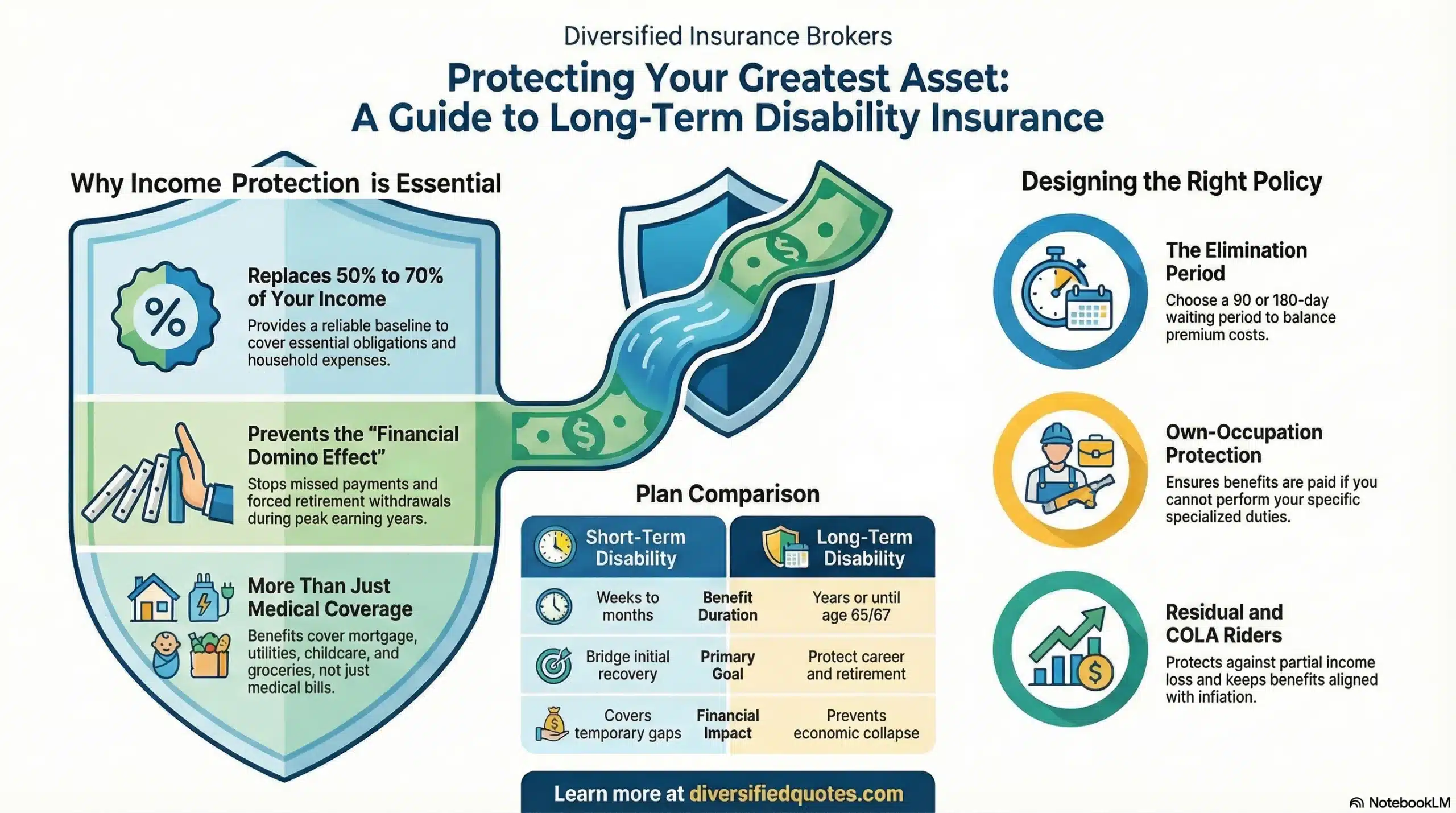
Individual disability insurance is often used as a supplement because it can be designed with stronger definitions and more predictable benefit structure. It’s also portable—meaning it can follow you if you change departments, move states, or transition into a new role.
Key Features to Look for in Law Enforcement Disability Insurance
The best disability policy for a law enforcement officer is the one that pays reliably in the scenarios officers actually face. Premium matters, but features matter more because they determine whether a “disability” is recognized in realistic return-to-work conditions.
Own-occupation definition is one of the most important policy features. In plain language, it’s designed to pay benefits when you can’t perform the material and substantial duties of your occupation. For law enforcement, that means you want the definition to align with real job demands and not trap you in a gray area where you’re technically employed but financially disrupted.
Residual or partial disability benefits are equally important. Many law enforcement situations involve restrictions rather than immediate total disability. You may return to work in a limited role, lose eligibility for overtime, or lose access to special duty income. A strong residual benefit helps protect pay in those “partially able” scenarios where income still drops.
Non-cancelable and guaranteed renewable provisions can provide long-term stability. Police officers often buy coverage early in their careers. Policies that protect rates and terms over time can add confidence that the contract won’t be changed as long as premiums are paid.
Future increase options are important because law enforcement incomes can grow through promotions, specialty assignments, and step increases. A future increase rider can allow you to expand coverage later without redoing full medical underwriting, which can be especially valuable as health history evolves.
Elimination period and benefit period should be designed to match your real safety net. Some officers have strong sick leave banks and injury leave. Others don’t. Some departments have meaningful disability pensions. Others have capped LTD plans. These differences matter because you want the policy to begin paying benefits at the right time and for the right duration if the disability becomes long-term.
How to Include Overtime, Special Duty, and Off-Duty Pay
One of the biggest mistakes officers make is assuming disability insurance automatically protects the income they actually live on. Many officers rely on overtime, details, court pay, and special assignments. In some departments, those extra earnings are the difference between “surviving” and “building a strong financial plan.”
When you apply, carriers typically evaluate income documentation (W-2, pay stubs, tax returns, and sometimes employer verification). The goal is to structure coverage around stable, documentable earnings. That’s why we focus on building a plan that realistically matches your compensation, not just your base salary. If your income includes consistent overtime, we’ll help you determine how carriers view it and how best to design the policy.
This is also where residual coverage becomes important. If you can return in a restricted capacity but lose your overtime eligibility, your income can drop sharply even if you’re still technically “working.” A strong residual benefit is designed to protect that scenario.
Example Scenario: How a Layered Plan Can Protect Take-Home Pay
Imagine an officer earning $85,000 per year after overtime and special duty. A duty-related injury results in chronic back limitations and prevents them from returning to full patrol. The department offers a group LTD benefit, but it’s based on base pay and may be taxable depending on how it’s funded.
A common strategy is layering group coverage with an individual policy. For example, the group plan might provide a baseline benefit, while the individual DI policy—paid personally—can provide additional, tax-free income replacement. The correct goal is not to chase the biggest number on paper. The goal is to protect the household’s real cash flow and avoid having to drain savings, miss mortgage payments, or stop retirement contributions during recovery.
This is why we design around after-tax replacement rather than only gross replacement. A taxable benefit and a tax-free benefit that look similar on paper can produce very different take-home pay.
How to Choose and Apply for Law Enforcement DI
The smartest way to approach disability insurance is to start with what you already have. Review your department or employer benefits, including any group LTD, injury leave policies, pension disability provisions, and workers’ compensation coordination. Identify what is truly guaranteed and what depends on administrative determinations, medical boards, or contested decisions.
Then calculate what you actually need. Most officers aim to protect enough income to maintain household stability without over-insuring. This includes not only monthly bills, but the financial habits that protect your future—like retirement contributions, debt payoff plans, and savings.
From there, we compare carriers that are known for more favorable occupational treatment for law enforcement and design the policy around elimination periods, benefit periods, and the features that matter most for real-world claim scenarios. That includes residual benefits, own-occupation strength, and how income is calculated when overtime is involved.
Tax Treatment: Why It Changes How You Should Size Your Coverage
Disability insurance taxation is generally determined by how premiums are paid. If you pay premiums personally with after-tax dollars, benefits are typically tax-free. If an employer pays premiums, benefits are often taxable. This is why two officers with the same “benefit amount” can end up with very different take-home income during a claim.
For many law enforcement professionals, the best plan is a layered approach that includes the employer plan (if available) and a personally owned policy that protects take-home pay. The goal is to reduce financial uncertainty when the job has already delivered enough uncertainty.
Other Disability Options Law Enforcement Officers Commonly Compare
Some officers prefer a faster, simpler path to coverage, especially early in a career or when medical history makes fully underwritten policies harder to place. In those cases, solutions like No Exam Disability Insurance may be helpful as a starting point. While simplified underwriting may reduce friction, it can also come with design trade-offs, so it’s best to compare options side by side.
If you’re part of a larger group, carve-out plans or employer supplemental options may also exist. In specific scenarios, Guaranteed Issue Disability Insurance can be valuable, particularly for groups, but it often comes with lower maximum benefits or less customization. We treat it as one tool in the toolbox, not a default solution.
And for officers who move into higher income leadership roles with larger overall compensation, High Income Disability Insurance may help protect income above traditional limits.
Why Work with Diversified Insurance Brokers
We’re a family-owned, fiduciary insurance agency licensed in all 50 states, and we help law enforcement professionals build disability coverage that is clear, practical, and built for real job demands. Our role is to compare carriers, translate the contract language into plain English, and structure policies so the coverage actually protects your lifestyle—not just a generic illustration.
When appropriate, we also coordinate disability insurance alongside other planning strategies so your protection layers work together. If you’re building a longer-term safety net, disability planning is one of the smartest foundations you can put in place.
Request a Disability Income Quote for Law Enforcement
Protect your income, your family, and your future. Quick, confidential, nationwide.
Request a Quote Or call 800-533-5969.
Related Pages
Explore other disability options and underwriting pathways that may fit your situation.
Financial Protection Essentials
Indexed annuity education, inclusive life insurance access, employer coverage planning, and international travel protection strategies.
Talk With an Advisor Today
Choose how you’d like to connect—call or message us, then book a time that works for you.
Schedule here:
calendly.com/jason-dibcompanies/diversified-quotes
Licensed in all 50 states • Fiduciary, family-owned since 1980
FAQs: Disability Income Insurance for Law Enforcement
Why do law enforcement officers need their own disability insurance?
Your occupation includes physical risk, trauma exposure and overtime/moonlighting income which standard employer LTD may not fully cover.
What is “own-occupation” coverage for an officer?
It means you are covered if you cannot perform your law enforcement duties—even if you could do another job.
Does off-duty or moonlighting income count toward my benefit?
Only if your policy includes those as part of your income base. Make sure the insurer recognizes special duty, overtime and off-duty pay.
Are benefits taxable?
If you pay the premiums personally, benefits are typically tax-free. If your employer pays them, benefits may be taxable.
Can I get coverage without a medical exam?
Yes. Many first responder-friendly policies offer No Exam DI with streamlined underwriting.
How much coverage should I aim for?
Most officers aim to replace 60-70% of after-tax income including overtime, special duty and moonlighting.
Does mental health disability qualify?
Yes, if your policy’s trauma/mental health rider covers PTSD, depression or anxiety triggered by occupation-related events.
About the Author:
Jason Stolz, CLTC, CRPC and Chief Underwriter at Diversified Insurance Brokers (NPN 20471358), is a senior insurance and retirement professional with more than two decades of real-world experience helping individuals, families, and business owners protect their income, assets, and long-term financial stability. As a long-time partner of the nationally licensed independent agency Diversified Insurance Brokers, Jason provides trusted guidance across multiple specialties—including fixed and indexed annuities, long-term care planning, personal and business disability insurance, life insurance solutions, Group Health, and short-term health coverage. Diversified Insurance Brokers maintains active contracts with over 100 highly rated insurance carriers, ensuring clients have access to a broad and competitive marketplace.
His practical, education-first approach has earned recognition in publications such as VoyageATL, highlighting his commitment to financial clarity and client-focused planning. Drawing on deep product knowledge and years of hands-on field experience, Jason helps clients evaluate carriers, compare strategies, and build retirement and protection plans that are both secure and cost-efficient. Visitors who want to explore current annuity rates and compare options across multiple insurers can also use this annuity quote and comparison tool.
