
Fixed Annuity with Long Term Care Benefits

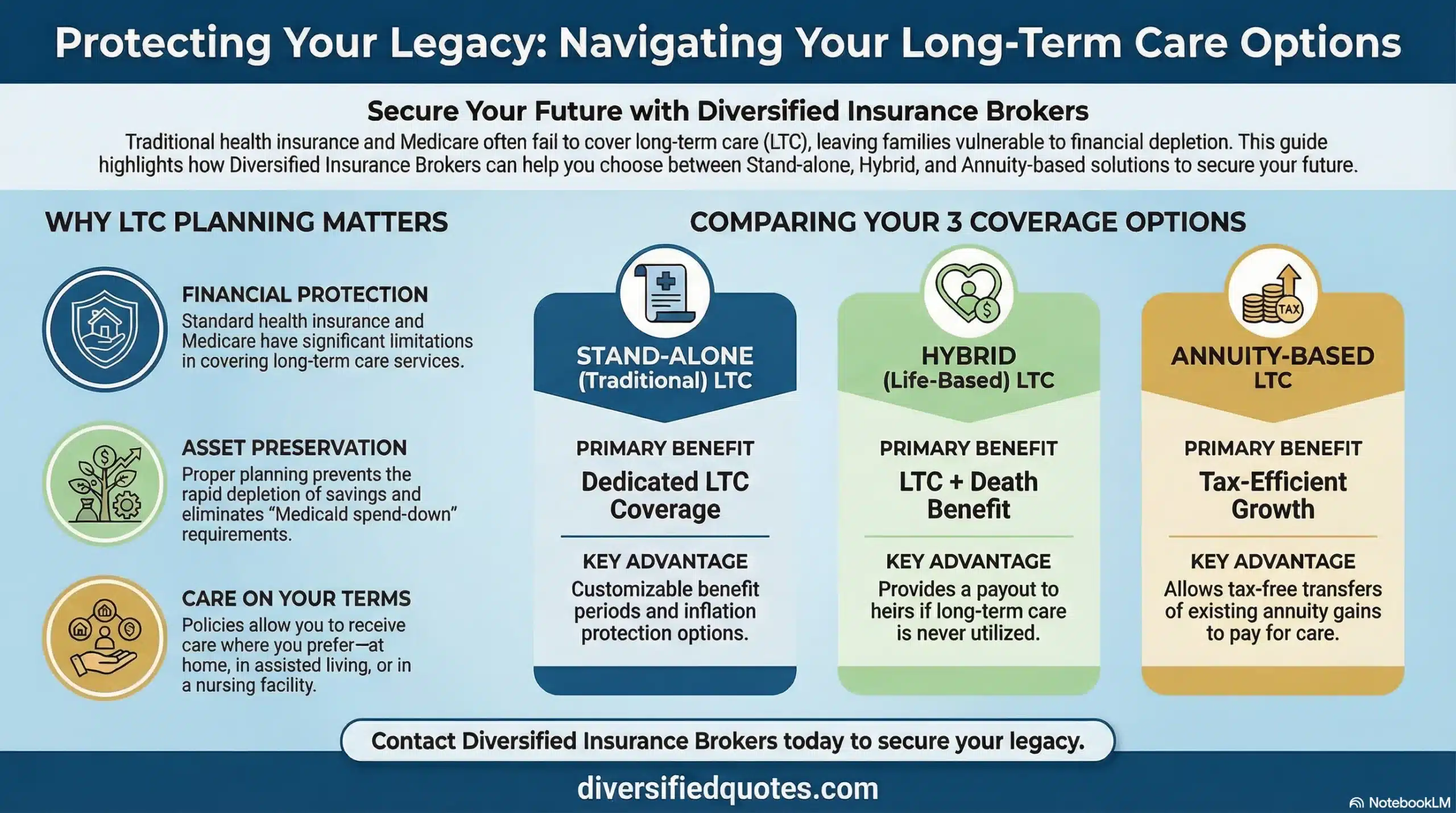
A fixed annuity with long term care benefits can be a practical way to protect retirement assets from one of the most common “silent threats” to a financial plan: the cost of extended care. It combines the steady, principal-protected nature of a fixed annuity with an added layer of long term care leverage—so your dollars can work in two directions. For many families, this becomes a middle ground between leaving conservative money in low-yield accounts and committing to a traditional long term care insurance policy with ongoing premiums.
At Diversified Insurance Brokers, we frequently help clients use a single lump sum to create a dedicated “care-ready” bucket while still keeping options open for retirement income, legacy planning, or future flexibility. Many of these strategies involve repositioning existing assets—like CDs, money market funds, or an older annuity—into a design that can increase available care dollars if the policy triggers are met, without forcing a use-it-or-lose-it outcome.
One of the biggest advantages is the mindset shift: instead of paying premiums and hoping you never need the coverage, you’re repositioning money you already own into a contract that can (1) grow conservatively, (2) potentially provide income later, and (3) expand benefits for qualified care needs. If care is never needed, the annuity value can still be used for other goals or coordinated with your annuity beneficiary and death benefit options.
Get a Personalized Annuity + LTC Comparison
Request a side-by-side comparison of fixed annuities with long term care benefits and see how they can help protect retirement assets from costs Medicare doesn’t fully cover.
💡 Note: The calculator accepts premiums up to $2,000,000. If you’re investing more, results increase in direct proportion — for example, doubling your premium roughly doubles the guaranteed income at the same age and options.
How Fixed Annuities with LTC Benefits Work
A fixed annuity is designed to provide principal protection with predictable growth, typically through a guaranteed interest rate. Like many retirement-focused tools, it can also offer tax-deferred growth (meaning gains are not taxed until withdrawn), which can be helpful for conservative savers who want stability. When you add a long term care benefit or rider, the annuity becomes more than a “safe accumulation” strategy—it becomes a funding source that may expand specifically for qualified care expenses.
Most annuity-LTC designs work by allowing the contract’s value to be accelerated and/or multiplied when you meet long term care benefit triggers. In many cases, that means your available monthly benefit is increased—sometimes significantly—so you can pay for in-home care, assisted living, or nursing facility expenses. The exact leverage varies by carrier and design, and it is always subject to monthly and lifetime maximums outlined in the contract.
To qualify, you typically must meet long term care “trigger” conditions—commonly needing assistance with two of the six Activities of Daily Living (ADLs) (such as bathing or dressing) or having a severe cognitive impairment. Once triggered, benefits can begin after any contractual elimination period (if applicable), and the plan may pay benefits as reimbursement or on a per diem basis depending on how the policy is structured.
Because long term care rules can have important tax considerations, it’s smart to understand the basics of how LTC-related benefits can be treated. If that’s a key concern, review Are Long Term Care Benefits Taxable? to understand what families typically need to evaluate before committing to a design.
Why Many Retirees Consider This Strategy
The biggest appeal of a fixed annuity with long term care benefits is efficiency. You’re not paying for a benefit that disappears if unused. You’re repositioning money you already have into a contract that can still serve traditional retirement goals, while also building a dedicated pool of potential care dollars. That dual-purpose structure is why many families see this as “safe money with leverage,” especially when the alternative is leaving cash parked in accounts that may not keep pace with inflation or future care costs.
This approach can also reduce decision fatigue. Instead of trying to layer multiple products and funding sources, many retirees prefer a single contract they can understand, track, and coordinate with their broader plan. In the real world, simplicity matters—especially when the benefit is most likely to be used later in life, when paperwork and coordination become harder.
Finally, the strategy can be emotionally easier for families. Many people hesitate to buy stand-alone long term care coverage because it feels like paying for a “maybe.” With an annuity-based approach, there is still value even if care is never needed—often making the decision feel more balanced.
Who This Can Be a Good Fit For
A fixed annuity with long term care benefits can be a strong fit for retirees who want predictable growth with no market risk and who also want a dedicated plan for care costs that could otherwise pressure income and assets. It’s especially common for clients who have “safe money” sitting in CDs, money markets, or older annuities and want to reposition those dollars into something that provides more meaningful leverage for future care needs.
It can also be a helpful option for families who don’t love the long-term premium commitment of traditional LTC insurance but still want real protection beyond “self-insuring.” Some people choose annuity-based LTC because they prefer a single premium structure and want the ability to preserve value for heirs if care is never needed.
If you already own a policy and want to coordinate strategies, some clients compare their annuity-LTC option against other LTC designs, including return-of-premium long term care structures. The “best” answer depends on funding preference, benefit goals, and how comfortable you are with ongoing premiums versus repositioning a lump sum.
How This Compares to Traditional Long Term Care Insurance
Stand-alone long term care insurance is still a strong solution for many families, especially when you want pure LTC leverage and flexible benefit design. However, traditional policies can involve ongoing premiums, and in some situations premiums may change over time. If care is never needed, families sometimes feel like they paid for coverage without seeing a “return.”
With a fixed annuity and LTC benefits, you start with a known annuity value and a predictable growth structure. Rider charges—when applicable—are typically built into the contract design rather than billed as lifetime premiums the same way a traditional LTC policy is. If you never need care, the contract can still be used for retirement income planning or passed to beneficiaries (subject to the contract rules and withdrawals over time).
Some families use a hybrid approach: an annuity-LTC solution to create a core pool of leveraged care dollars, plus additional coverage features where needed, such as couple-focused designs like long term care insurance with shared benefits for spouses who want coordinated protection.
Coordinating LTC Benefits with Medicare and Other Coverage
One of the biggest misconceptions we hear is that Medicare will cover a long stay in a nursing home or ongoing assisted living. In reality, Medicare does not cover most long term care, and it’s important to understand the difference between medical coverage and custodial care coverage. Many families only discover this gap when a parent needs ongoing help, and at that point, options are more limited and decisions become more stressful.
It also helps to understand the basic concept: Medicare and long term care insurance are not the same thing. Medicare focuses on medical services. Long term care planning focuses on custodial support—help with ADLs, supervision, and ongoing assistance that often lasts months or years.
A fixed annuity with LTC benefits helps by creating a dedicated pool of funds that can be tapped when triggers are met. We can also help you coordinate this strategy with other coverage you already have, including traditional LTC policies, retirement income sources, and your Medicare supplement or Medicare Advantage structure.
Why Work with Diversified Insurance Brokers
Since 1980, our team has helped families build retirement strategies that emphasize guaranteed security and practical protection against large, unexpected care costs. As an independent, family-owned agency with access to a wide range of carriers and designs, we can compare multiple fixed annuity and hybrid long term care structures before guiding you toward the best fit.
Our process is designed to keep things clear. We start with your assets and priorities, then show side-by-side illustrations using different benefit structures, rider designs, and planning assumptions. If a more traditional design makes more sense for your situation, we can also discuss options like Partnership-qualified long term care insurance, which can be relevant for certain asset-protection strategies depending on your state rules and planning goals.
Most importantly, we help you understand the tradeoffs in simple terms—so you can make a confident decision without feeling like you need to become an insurance expert to move forward.
Protect Retirement Assets from Future Care Costs
Request a comparison and see how a fixed annuity with long term care benefits stacks up against other LTC strategies.
Talk With an Advisor Today
Choose how you’d like to connect—call or message us, then book a time that works for you.
Schedule here:
calendly.com/jason-dibcompanies/diversified-quotes
Licensed in all 50 states • Fiduciary, family-owned since 1980
FAQs: Fixed Annuity with Long-Term Care (LTC) Benefits
What is a fixed annuity with long-term care benefits?
It’s a fixed (or multi-year guaranteed) annuity that adds an LTC rider or is designed as a hybrid annuity-LTC policy. Your principal is protected and grows at a fixed rate, and if you need qualifying long-term care, the contract can pay enhanced benefits beyond your account value, subject to rider terms.
How do the LTC benefits work?
When you meet benefit triggers—typically needing help with two of six Activities of Daily Living (ADLs) or severe cognitive impairment—the contract can accelerate your account value and/or provide additional LTC payouts for covered care at home, assisted living, or nursing facilities, up to monthly and lifetime maximums.
What are common LTC triggers and waiting periods?
Most riders use ADL or cognitive impairment triggers certified by a licensed healthcare practitioner. An elimination period (e.g., 0–90 days) may apply before benefits pay. Some designs reimburse actual expenses; others pay an indemnity (set amount) regardless of receipts.
How big can the LTC pool be?
Designs vary, but a typical structure multiplies your premium/account value (e.g., 2×–3×) to create a larger pool available for LTC, subject to monthly caps and a maximum benefit period (often 24–72 months).
What’s the difference between reimbursement and indemnity benefits?
Reimbursement pays up to the monthly limit for eligible, receipted care. Indemnity pays a fixed monthly amount once you qualify—more flexible for family care and incidental costs.
Is medical underwriting required?
Usually simplified underwriting (health questions and possibly a phone interview). No paramedical exam in many cases. Approval depends on age and health history.
How are benefits and charges taxed?
Generally, qualified LTC benefits from tax-qualified riders are intended to be received income-tax-free up to federal per-diem limits; charges for LTC riders may reduce account value or credited interest. Tax rules are complex—consult your tax advisor.
Can I 1035 exchange an existing policy to fund this?
Yes, many contracts accept a non-taxable 1035 exchange from another annuity or life policy. Compare surrender charges, tax basis, and rider availability before moving assets.
Does this affect Required Minimum Distributions (RMDs)?
If funded with IRA/qualified money, RMDs still apply. We’ll help coordinate RMDs so you stay compliant while preserving LTC benefits.
Is this “Partnership”-qualified LTC?
State Partnership programs generally apply to stand-alone LTC insurance, not annuity-based LTC. Hybrid/annuity LTC typically does not create Partnership asset protection.
What about inflation protection?
Some riders offer optional inflation features (e.g., 3%–5% compound on LTC limits) for an extra charge. Others allow periodic increases subject to underwriting.
What fees or trade-offs should I know?
Riders may have ongoing charges or embedded costs that reduce credited interest. Standard annuity limitations apply (surrender schedule, free withdrawals, possible market value adjustment). Review the contract disclosure for details.
Can I use benefits for home care or family caregivers?
Many plans cover home health and assisted living. Indemnity designs are often more flexible for family-provided care; reimbursement designs may require licensed providers. Check the certificate for specifics.
Who is this best for?
Pre-retirees and retirees who want principal protection and a dedicated LTC reserve without “use-it-or-lose-it” premiums, or those repositioning low-yield CDs/annuities to leverage dollars for potential care needs.
About the Author:
Jason Stolz, CLTC, CRPC, is a senior insurance and retirement professional with more than two decades of real-world experience helping individuals, families, and business owners protect their income, assets, and long-term financial stability. As a long-time partner of the nationally licensed independent agency Diversified Insurance Brokers, Jason provides trusted guidance across multiple specialties—including fixed and indexed annuities, long-term care planning, personal and business disability insurance, life insurance solutions, and short-term health coverage. Diversified Insurance Brokers maintains active contracts with over 100 highly rated insurance carriers, ensuring clients have access to a broad and competitive marketplace.
His practical, education-first approach has earned recognition in publications such as VoyageATL, highlighting his commitment to financial clarity and client-focused planning. Drawing on deep product knowledge and years of hands-on field experience, Jason helps clients evaluate carriers, compare strategies, and build retirement and protection plans that are both secure and cost-efficient.
