
Group Long Term Care

Jason Stolz CLTC, CRPC
Group Long Term Care Insurance is one of the most practical ways an employer can help employees prepare for a major retirement risk that traditional health insurance does not solve. Most people understand the role of medical insurance, disability coverage, and basic life insurance. What often gets missed is the risk that arrives later in life—when a spouse, parent, or employee needs help at home, in assisted living, in memory care, or in a skilled nursing setting. Those costs can erode a lifetime of savings faster than most families expect, and the financial pressure often shows up at the same time caregiver stress peaks.
At Diversified Insurance Brokers, we help organizations evaluate group long term care options that can be offered as a voluntary benefit or as an employer-sponsored solution. A well-designed group program can make coverage simpler to enroll in, more accessible for employees who might not qualify individually, and easier to keep long-term because premiums can be paid through payroll deduction. In many cases, employees can also extend coverage to spouses and eligible family members—turning the employer benefit into a household protection plan rather than “one more checkbox” in open enrollment.
In today’s benefits environment, employers want differentiation. Employees want benefits that are meaningful, not just standard. Group long term care coverage can be one of the strongest “value-per-dollar” benefits an employer offers because it addresses a risk that can otherwise dismantle retirement timelines, family finances, and workplace productivity when caregiving becomes necessary.
Explore Group Long Term Care Options for Your Organization
We’ll review your employee population, outline plan designs, and provide customized proposals from leading carriers.
What “Group Long Term Care” Means in the Workplace
Group long term care coverage is generally offered through an employer as part of the benefits package, often during an enrollment window that aligns with open enrollment or a dedicated benefits campaign. The “group” aspect matters because it can reduce friction for employees who might otherwise avoid the topic. In an individual application, many people delay long term care planning because the underwriting process feels intimidating or because they assume they won’t qualify.
With a workplace program, enrollment may be simplified. Depending on the plan design and employer eligibility, employees may be able to obtain coverage through guaranteed issue or streamlined underwriting during the initial enrollment period. That can be especially valuable for employees who have minor health histories, family medical risk factors, or prescription profiles that would make individual shopping difficult later.
Group programs also tend to be easier to communicate. Benefits education can be delivered at scale through meetings, webinars, HR materials, and one-on-one sessions. That matters because long term care is rarely “understood” by employees the first time it’s presented. A benefit is only valuable if people actually use it, keep it, and understand how it works.
How Group Long Term Care Coverage Works
Although plan structures vary, most group long term care solutions follow a similar concept: employees elect coverage during an enrollment period and receive long term care benefits that can be used if they meet eligibility triggers later. Those triggers are usually connected to functional impairment—such as needing help with a certain number of daily activities—or requiring supervision due to cognitive impairment.
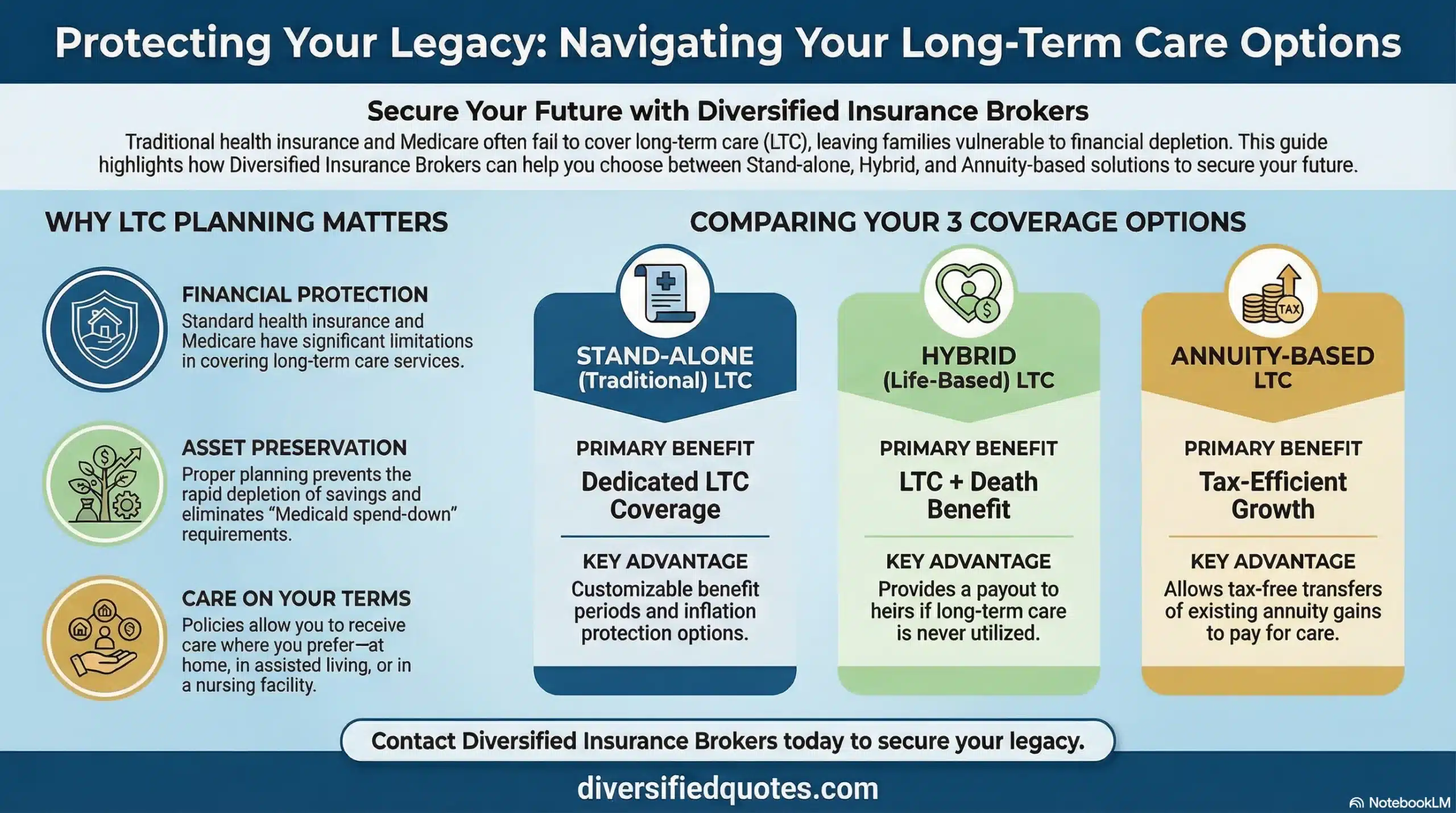
In many designs, the coverage is built on a permanent life insurance policy chassis that includes a long term care or chronic illness benefit. This structure can create a “multi-use” solution. While the insured is healthy, the policy may build cash value based on policy terms. If long term care is needed, the long term care or chronic illness benefit can help pay for care. If care is never needed, a life insurance benefit may still pass to beneficiaries, subject to the policy design and how benefits were used.
From a planning standpoint, that multi-use element is often what makes group long term care attractive to employees. Many people dislike the idea of paying premiums for something they might never use. A linked-benefit structure can reduce that emotional barrier because the coverage can still provide value in multiple future scenarios.
Just as long term care benefits are typically triggered using functional criteria, the broader long term care ecosystem uses similar definitions. If employees want a simple reference point for what typically creates eligibility, the ADL framework used across the industry is explained in what are activities of daily living.
Benefit Triggers: When Coverage Actually Pays
Employees often assume long term care coverage pays only for nursing homes. That assumption is outdated. Modern long term care designs are generally intended to support care in multiple settings, including care at home. The “trigger” is less about where the care happens and more about whether the insured meets the eligibility criteria defined in the policy.
Most policies evaluate benefit eligibility based on one of two categories:
Functional limitation.
The insured needs substantial assistance with a defined number of activities of daily living. The most common examples include bathing, dressing, toileting, transferring, eating, and continence. When those abilities decline, families often begin with care at home and then transition as needs increase. This is why many long term care plans start with the question of how care can be supported at home before a move becomes necessary. A helpful reference for employees is what are in-home care services, which explains how home care often becomes the first layer in a care plan.
Cognitive impairment.
A severe cognitive impairment may trigger eligibility even if the insured can still perform some physical tasks. In many real situations, the biggest issue is supervision—wandering risk, medication safety, inability to manage routines, or unsafe decisions.
Once eligibility is established, many group LTC designs pay benefits in a way that favors simplicity and control. Some pay as cash benefits, which can reduce the administrative burden compared to strict reimbursement models. In practice, that flexibility can be the difference between a workable plan and a plan that becomes frustrating during a claim.
Guaranteed Issue and Simplified Enrollment Opportunities
One of the most compelling reasons to add group long term care coverage to a benefits lineup is the potential for guaranteed issue or simplified issue enrollment during the initial offering window. That matters because the individual long term care market is often underwriting-driven. As employees age, qualify for fewer plan options, or accumulate medical history, individual coverage can become significantly harder to obtain on favorable terms.
A group enrollment window can create a rare planning advantage. Employees can often secure meaningful coverage without the extensive underwriting steps that commonly block older applicants later. This can be particularly valuable for employees who have minor conditions that are stable but still “count” in underwriting—such as controlled hypertension, controlled cholesterol, or certain prescription profiles.
Many workplace programs also allow spouses or eligible family members to participate. When that option exists, the benefit becomes more than an employee perk. It becomes a family-level asset protection strategy. That’s important because long term care is often a “two-spouse risk.” Even if one spouse is healthy now, the financial plan can change quickly if either spouse experiences a prolonged care need.
If employees want to better understand why underwriting matters and what typically affects eligibility, the process is explained in how to qualify for long-term care insurance. The group environment can often improve access, but underwriting reality still matters outside those guaranteed windows.
Cash Benefits and Flexible Care Choices
Traditional long term care insurance often pays on a reimbursement basis, meaning the policy pays only after qualified expenses are incurred and documented. That approach can work well, but it can also create friction during a claim, especially when families are moving quickly, coordinating multiple caregivers, or trying to keep a loved one at home.
Many modern workplace designs focus on flexibility. When benefits are paid as cash or indemnity benefits, the policy can provide a defined monthly amount once eligibility is established. That cash can be used in a broader range of real-world care arrangements. Families may use it to hire professional caregivers, offset assisted living costs, supplement facility expenses, or coordinate care that blends paid and family support.
This flexibility is especially relevant because long term care rarely follows a clean pattern. Many families use a layered approach: part-time home care, adult day programs during the week, family caregiving support on evenings, and eventual facility care as needs increase. A benefit structure that supports those transitions without constant “re-approval” can make the program feel practical, not theoretical.
If your organization is evaluating group long term care, one of the best questions to ask is: “How does the plan work when life is messy?” The best benefits programs are the ones employees can actually use under stress.
Portable Coverage That Follows the Employee
Portability is one of the most valuable features of a well-designed group long term care program. Although coverage is offered through the employer, the policy usually belongs to the insured employee. That means if the employee changes jobs, reduces hours, or retires, they can often keep the coverage in force by continuing premiums directly.
Portability matters because long term care risk rises with age. If an employee loses coverage at retirement—or loses the ability to obtain coverage later because their health changed—the benefit failed at the exact moment it was most needed. Portable group designs aim to prevent that outcome.
Portability also supports modern career patterns. Employees frequently change employers. A benefit that can be carried forward is far more valuable than one that disappears with a job change. For employers, this feature often improves participation because employees can view the benefit as a personal long-term asset rather than “something tied to this job only.”
Model Participation, Costs, and Benefit Levels for Your Workforce
We’ll help you compare voluntary vs. employer-paid designs and build a clear rollout plan that employees will understand.
Employer Advantages: A Differentiated, High-Impact Benefit
From the employer’s perspective, group long term care coverage can support recruitment, retention, and long-term employee wellbeing. It also addresses a workplace reality that many employers feel but rarely name: caregiving affects productivity. When an employee becomes a caregiver for a parent or spouse, they often experience absenteeism, schedule disruption, and emotional stress that can affect performance and engagement.
Offering long term care protection doesn’t just “help later.” It can reduce future crisis intensity by creating a plan employees can rely on. That can be meaningful in industries where the workforce is aging or where key roles are hard to replace. A benefits lineup that includes long term care communicates that the organization is thinking beyond the next 12 months.
Plan designs are flexible. Some employers choose a base benefit with employer-paid premiums and allow employees to buy additional coverage. Others offer the program on a voluntary basis with payroll deduction. Both models can work. The best choice depends on your budget, benefits philosophy, workforce demographics, and goals for participation.
Education is a key component. Most employees won’t adopt group long term care unless they understand what it does and why it matters. Enrollment success often depends on communication, benefit meetings, and simple “what this looks like in real life” examples. When the program is positioned clearly, it can become one of the most appreciated benefits you offer—because it solves a problem employees already worry about but rarely address.
Why Group Long Term Care Matters for Retirement and Asset Protection
From a financial planning standpoint, long term care is one of the most disruptive risks to retirement income. The cost can be large. The duration can be unpredictable. And the timing is often the worst possible—when the healthy spouse needs stability and when portfolio withdrawals are already under pressure.
Without a strategy, families may be forced to spend down savings quickly, reduce the quality of care options, or make rushed decisions in a crisis. Group long term care coverage gives employees a way to address that risk while they are still working and generally more insurable. It also gives families a defined “pool” of benefit dollars rather than relying exclusively on personal savings or taxable account distributions.
For organizations that prioritize long-term financial wellness, this benefit aligns well with retirement plan education because it protects the outcomes those retirement plans are intended to create. Retirement savings are meant to support lifestyle and stability. Long term care is one of the few risks that can override both.
If your benefits strategy already includes retirement plan education, it can be helpful to connect long term care planning to “where care happens” and “how care is typically paid for.” A common misconception is that Medicare pays for extended long-term custodial care. For employees who ask that question, these references can help set expectations: does Medicare cover long-term care and Medicare vs. long-term care insurance.
Implementation Considerations: Enrollment Windows, Education, and Employee Support
One of the most overlooked parts of a successful group long term care program is the implementation. A great plan design can fail if employees don’t understand it or if enrollment is confusing. The goal is to make the benefit feel accessible and relevant, not technical.
Most successful rollouts include an enrollment window, a clear explanation of how benefits are triggered, and practical examples of how cash benefits can be used. Employees benefit from understanding how care often begins at home and how support layers evolve. They also benefit from understanding that long term care is not just a “later in life” issue. Many employees begin caregiving long before retirement—often for a parent—so the emotional relevance is immediate even if they don’t view themselves as at-risk.
HR teams also benefit from a simple process that reduces ongoing administration. Payroll deduction, portability, and clear employee communications all reduce friction. When the program is simple to manage, it becomes easier to maintain year after year rather than becoming “one more benefit that nobody uses.”
Next Steps: Evaluate a Group LTC Program for Your Organization
Every employer group is different. The right group long term care approach depends on workforce age bands, participation goals, budget, and how you want the benefit to be perceived within your benefits lineup. Some organizations want a high-participation voluntary option that employees can elect easily. Others want a core employer-paid program that signals commitment to long-term wellbeing. Both can be effective when positioned correctly.
Our team at Diversified Insurance Brokers can help you explore plan designs, model different funding approaches, and obtain proposals from carriers that specialize in workplace long term care solutions. We also help organizations plan employee education and enrollment so the benefit is understood, adopted, and retained.
If you are considering adding group long term care coverage—or revamping an existing program—start with a simple conversation. We’ll help you determine whether a group solution fits your goals, how portable coverage can be positioned to employees, and what implementation timelines look like so you can roll out a meaningful benefit without creating administrative burden.
Ready to Explore a Group LTC Benefit?
Share a few details about your organization and we’ll follow up with options, illustrations, and implementation timelines.
Talk With an Advisor Today
Choose how you’d like to connect—call or message us, then book a time that works for you.
Schedule here:
calendly.com/jason-dibcompanies/diversified-quotes
Licensed in all 50 states • Fiduciary, family-owned since 1980
What is Group Long Term Care insurance?
Group Long Term Care insurance is employer-sponsored coverage that helps employees pay for home care, assisted living, memory care, or nursing facilities if they cannot perform daily living activities or develop a cognitive impairment. It is typically built on a permanent life insurance policy with an LTC or chronic illness benefit.
How does eligibility for benefits work?
Benefits are generally triggered when the insured cannot perform at least two Activities of Daily Living—such as bathing, dressing, eating, or transferring—or is diagnosed with a qualifying cognitive impairment. Once eligible, the plan can pay a monthly benefit to help cover care needs.
Do employees need medical underwriting to qualify?
During the initial enrollment window, many programs offer guaranteed or simplified issue options. This allows employees to get meaningful long term care protection without medical exams, bloodwork, or detailed health questionnaires.
Can spouses or family members enroll too?
Yes. Many group LTC programs allow spouses and eligible dependents to participate. Spouses may qualify on a simplified underwriting basis, making this one of the only ways some households can secure long term care coverage affordably.
How are benefits paid?
Most modern group LTC plans pay benefits as cash rather than reimbursement. This gives families flexibility to choose who provides care—professional caregivers, assisted living facilities, or even family members.
Is the coverage portable if the employee leaves the company?
Yes. Group Long Term Care insurance is typically portable. Employees can take the coverage with them when changing jobs or retiring by continuing premiums directly, ensuring they don’t lose valuable protection later in life.
Does the policy build cash value?
Because the coverage is often based on a permanent life insurance chassis, many policies build cash value over time. If care is never needed, a life insurance benefit may still pass to beneficiaries.
What are the employer benefits of offering Group LTC?
Offering Group LTC can strengthen recruitment and retention, add a high-value financial protection benefit to the company’s compensation package, and demonstrate long-term commitment to employee well-being.
How are premiums determined?
Premiums are usually based on the employee’s age at enrollment, selected benefit levels, and participation rates. Group pricing can be more favorable than individual LTC policies, especially with strong enrollment.
Why is Group Long Term Care important for retirement planning?
LTC expenses can rapidly erode retirement savings. Group LTC helps employees secure protection early, when coverage is easier to obtain and more affordable, ensuring they have a plan in place if extended care is ever needed.
About the Author:
Jason Stolz, CLTC, CRPC and Chief Underwriter at Diversified Insurance Brokers (NPN 20471358), is a senior insurance and retirement professional with more than two decades of real-world experience helping individuals, families, and business owners protect their income, assets, and long-term financial stability. As a long-time partner of the nationally licensed independent agency Diversified Insurance Brokers, Jason provides trusted guidance across multiple specialties—including fixed and indexed annuities, long-term care planning, personal and business disability insurance, life insurance solutions, Group Health, and short-term health coverage. Diversified Insurance Brokers maintains active contracts with over 100 highly rated insurance carriers, ensuring clients have access to a broad and competitive marketplace.
His practical, education-first approach has earned recognition in publications such as VoyageATL, highlighting his commitment to financial clarity and client-focused planning. Drawing on deep product knowledge and years of hands-on field experience, Jason helps clients evaluate carriers, compare strategies, and build retirement and protection plans that are both secure and cost-efficient. Visitors who want to explore current annuity rates and compare options across multiple insurers can also use this annuity quote and comparison tool.
