
Guaranteed Issue Long-Term Care Insurance

Jason Stolz CLTC, CRPC
Guaranteed Issue Long-Term Care (LTC) Insurance is built for people who want meaningful long-term care protection without going through the traditional underwriting process. Instead of ordering medical records, scheduling paramed exams, running labs, and waiting through a long carrier review, guaranteed-issue designs usually rely on age-based eligibility and a short set of simplified “knockout” questions focused on current care needs and major functional limitations.
The goal isn’t “free coverage,” “no rules,” or “automatic approval no matter what.” The goal is access: creating a practical path to get long-term care benefits in place when fully underwritten LTC is slow, uncertain, or simply unrealistic due to health history, timing, or prior declines.
At Diversified Insurance Brokers, we compare guaranteed-issue options alongside simplified-issue and hybrid designs so you can choose the structure that matches your health history, budget, and what you’re actually trying to protect—assets, income, family burden, or all three. If you want the bigger picture first, start here: Long-Term Care Insurance.
What “Guaranteed Issue LTC” Really Means
“Guaranteed issue” is a phrase people recognize from other insurance categories, but it can mean very different things depending on the product type. In the long-term care world, guaranteed issue typically means the carrier removes the traditional underwriting workflow and replaces it with a more limited approval process designed to expand access.
Most guaranteed-issue LTC solutions are built around three guardrails. First, there is usually age-based eligibility within a defined issue-age band. Second, there is minimal health screening, most often a short set of yes/no questions that attempt to confirm the applicant is not already in an active care situation. Third, the plan usually has defined benefit limits so the carrier can manage risk while offering broader acceptance.
In many cases, guaranteed-issue LTC is offered through a hybrid policy chassis (life insurance or annuity-based) because carriers can structure risk differently when there is an underlying value component. If you want a clear explanation of why hybrid designs are so common—and how they differ from stand-alone LTC—this companion page is helpful: Understanding Hybrid Long-Term Care Insurance.
Important reality check: guaranteed issue usually means “no traditional underwriting,” not “no eligibility rules.” If someone already needs hands-on help with daily activities, is currently receiving care, or has advanced cognitive impairment requiring constant supervision, most plans still won’t issue coverage. Insurance is designed to cover uncertain future risk, not an already-known claim that’s already in motion.
That said, many people who assume they are “uninsurable” actually have a profile that can work well for guaranteed-issue or simplified issue solutions—especially when the goal is to establish a meaningful benefit pool quickly, with a predictable process and fewer moving parts.
How Guaranteed Issue LTC Works
Guaranteed-issue LTC solutions are designed around a simple promise: pay for eligible long-term care services when an insured person can’t safely and independently manage basic daily life, or when a qualifying cognitive impairment creates a need for ongoing supervision. The exact benefit and claim rules depend on the carrier and policy design, but the core concept is consistent: the policy is there to help fund care at the time care becomes necessary.
In most designs, benefit triggers are tied to functional or cognitive criteria. Functional triggers commonly reference the inability to perform 2 of the 6 Activities of Daily Living (ADLs)—bathing, dressing, toileting, transferring, continence, or eating. Cognitive triggers often focus on the need for substantial supervision due to impairment that creates safety risk or an inability to manage routine daily life.
If you want a clear definition of ADLs (and why insurers use them), this page breaks it down in plain language: Activities of Daily Living. Understanding ADLs matters because the ADL standard frequently determines when coverage becomes available and how quickly claims can be approved.
Once benefits are triggered, coverage can apply to eligible services such as home health care, assisted living support, adult day care, caregiver support, and nursing facility care—depending on the policy. What matters most in real life is not just “does it pay,” but how it pays. Benefit structure and claim administration drive the real-world experience when a family is under stress and needs the policy to behave predictably.
Many people begin planning from the assumption that long-term care only means nursing homes. In reality, most care journeys start at home. A plan that supports home-based care can be valuable even if it is not designed to cover 100% of every possible cost scenario. The purpose is often to reduce the financial shock, protect retirement income, and reduce the burden on family members who would otherwise become the default caregivers.
Why Speed Matters (And Who This Is For)
For many families, the biggest value of a guaranteed-issue or simplified path is speed and certainty. Traditional LTC underwriting can take weeks—or longer—especially when medical records are requested and providers are slow to respond, or when the applicant has layered medical history that requires additional review.
A shorter process matters when you’re approaching retirement and want coverage in place before you stop working, when you’re trying to lock in coverage during a narrow eligibility window, or when you’ve been declined before and don’t want to repeat a months-long process only to get another “no.” It also matters when families are simply trying to reduce “decision fatigue.” Long-term care planning is emotionally heavy. A product path that is easier to implement can help families actually complete the plan instead of postponing it year after year.
Guaranteed issue is often a fit for people with moderate complexity—multiple medications, stable chronic conditions, prior declines, or simply a profile that makes standard underwriting unpredictable. It can also work as a supplemental strategy: a smaller benefit pool to soften the financial impact of a care event, with personal savings covering the remainder. In many real-world plans, the goal is not to cover every dollar of care. The goal is to reduce the rate at which retirement assets would otherwise be drained.
It’s also a strong fit for people who want a plan with fewer “surprises.” Some applicants prefer a more defined approval process because they don’t want to invest time, energy, and uncertainty into a fully underwritten submission. While guaranteed issue does not eliminate eligibility rules, it often creates a clearer pathway and a faster “yes or no,” which is what many families want.
Request Guaranteed-Issue LTC Options
Compare guaranteed-issue, simplified-issue, and hybrid LTC solutions—matched to your health history and budget.
What the “Knockout Questions” Usually Screen For
Because guaranteed-issue designs remove traditional underwriting, the carrier still needs a way to confirm the applicant is not already in a care situation that would predictably trigger a near-term claim. That’s why guaranteed-issue LTC commonly uses a short set of “knockout” questions.
While the exact wording varies by carrier, the themes are usually consistent. The questions often aim to identify whether someone is currently receiving personal care assistance, has a major mobility limitation, requires help with basic daily activities, is currently living in a facility setting, or has significant cognitive impairment that requires constant supervision. The carrier is typically trying to confirm the applicant is still independent today, even if they have medical history that makes full underwriting difficult.
It’s important to understand what the questions are not trying to do. They are not a deep medical evaluation. They are not designed to “price” risk the way full underwriting does. They are a screening tool intended to keep guaranteed issue viable for a broad group of people.
For families, the practical takeaway is this: if the person applying is still living independently and can safely manage daily life, guaranteed-issue or simplified-issue paths may be available even when a traditional application is uncertain. The sooner you apply—before functional limitations begin—the more options you typically have.
Key Plan Design Features That Matter More Than “Approval”
Getting approved is only step one. The more important question is: “If we ever need care, will this policy behave the way we expect?” This is where long-term care planning becomes less about a marketing label and more about the details that determine the claim experience.
Elimination period (waiting period)
Many LTC plans have an elimination period—essentially a deductible measured in days of care rather than dollars. A shorter elimination period can make benefits easier to access, but it can also increase cost. Some families prefer a longer elimination period because they can self-fund the first portion of care while preserving insurance benefits for the longer, more disruptive care window.
This guide explains the tradeoffs clearly: LTC Elimination Periods Explained.
Benefit pool and monthly benefit
Guaranteed-issue designs are typically built to be accessible and predictable, not to provide the largest possible leverage at the lowest premium. Many families choose a pool that covers a meaningful portion of home care or assisted living expenses because the real objective is protecting retirement income and reducing family burden, not necessarily paying 100% of every cost for every duration.
In practice, families often aim for a benefit level that turns a “financial emergency” into a “managed expense.” Even partial coverage can change the entire outcome of a care situation when the alternative is pulling large monthly amounts from retirement accounts or relying heavily on adult children.
Inflation approach
Inflation options can be simple or complex depending on the chassis. Some designs focus on a defined pool that’s adequate for a shorter horizon. Others attempt to build rising benefits over time. The “best” approach depends on age, budget, and how you expect care to be used (home care vs facility).
Another practical angle is whether the benefit is intended to cover the full cost of care or reduce the financial pressure. If the plan is built to be supplemental, inflation may be handled differently than it would be in a plan designed to replace most of the care cost.
Cash value / preserved value features (hybrid designs)
This is where hybrid designs often win hearts: many people dislike paying premiums for years with the possibility that benefits are never used. Hybrids frequently preserve some form of value if care is never needed—through a death benefit or retained value—so the plan feels less like “use it or lose it.”
Tax details and funding efficiency can also change meaningfully based on chassis. For a practical overview of the tax angle, see: Tax Advantages of Long-Term Care Insurance and Hybrid Policies.
How the policy pays (reimbursement vs cash style)
Many families underestimate how much payment structure affects real life. Reimbursement-based benefits can be effective, but they usually require documentation and a claim process that mirrors billed care. Cash-style benefits can feel more flexible because the family can decide how to apply the funds once eligibility is established.
If the plan’s purpose is to preserve flexibility—supporting a mix of paid care, informal caregiving, and evolving care settings—cash-like benefits often align well with how care is actually delivered.
Funding Strategies Families Use
How you fund coverage often matters as much as which plan you pick. Some people want to keep payments low and flexible. Others want to “finish the funding” quickly and remove future premium concerns. Guaranteed-issue and hybrid designs are often compatible with different funding approaches depending on the carrier and chassis.
Many families choose single-pay or limited-pay funding when they are repositioning assets that are currently sitting in savings, CDs, or conservative accounts. The logic is straightforward: if the money is already “designated” for safety, using a portion of it to build a care-benefit pool can create meaningful protection while potentially preserving value if care is never needed (depending on the structure).
Other families prefer level-pay structures because they want cash-flow stability and the ability to integrate the plan into the monthly household budget without a large upfront repositioning. In those cases, the best strategy often involves right-sizing the benefit pool so the plan covers the most likely and most disruptive care scenarios first.
There is also a strategy that is less about “maximizing benefit” and more about “reducing disruption.” A modest guaranteed-issue plan can be used as a base layer so that if care happens, the family has immediate support. Then, personal savings can be used more strategically instead of being drained immediately from the start.
If you’re trying to decide whether to transfer risk to an insurer or self-fund from savings, this comparison is a useful lens: Self-Insured Long-Term Care.
Guaranteed Issue vs Traditional LTC vs Hybrid: A Practical Comparison
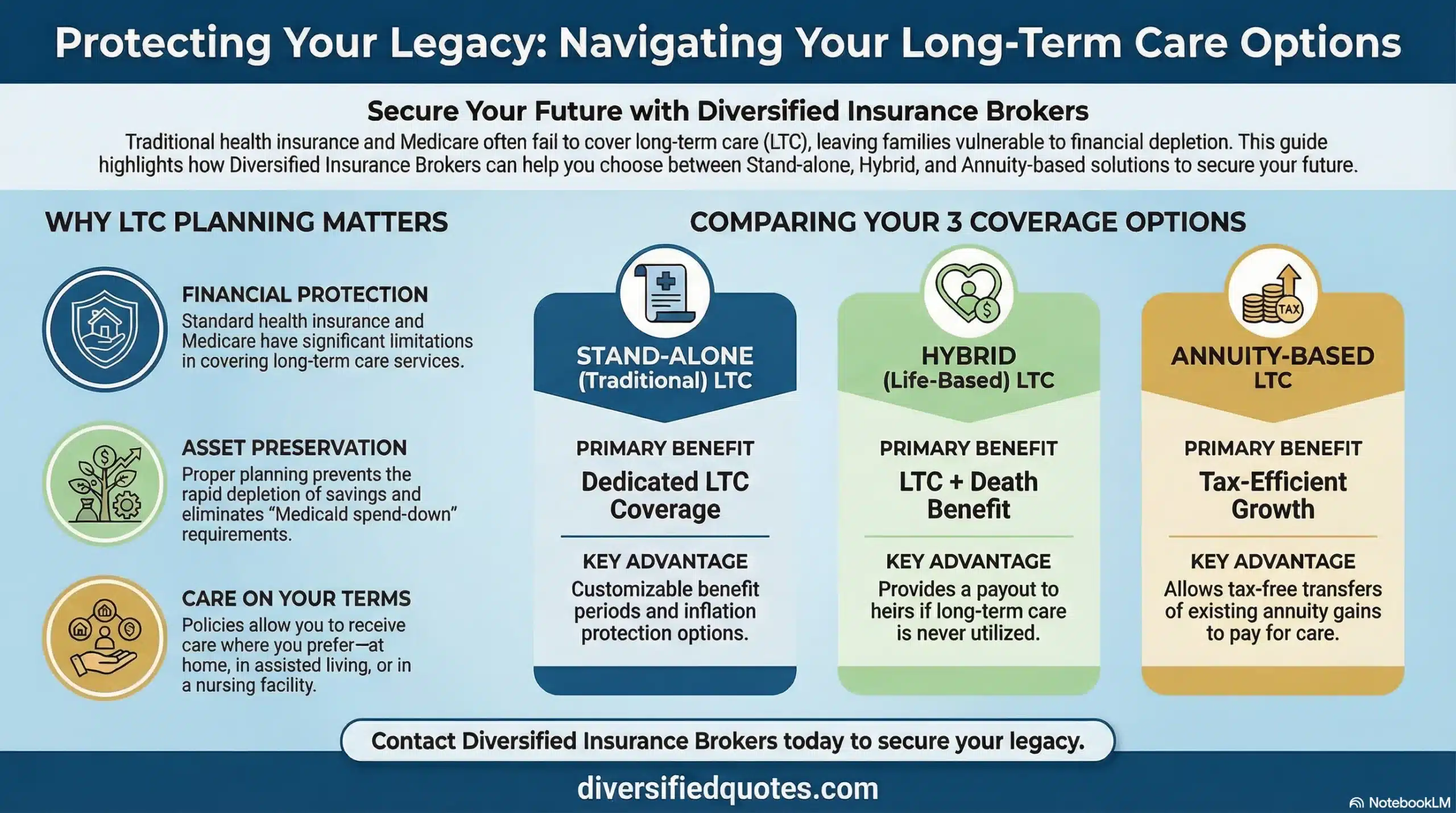
Most families are choosing between three directions. The best fit usually comes down to health profile, budget, and whether leaving value to heirs matters as much as maximizing the care pool. The comparison below is intentionally practical. It’s not about “best in theory.” It’s about “best given your situation right now.”
| Feature | Guaranteed Issue / Minimal Underwriting | Traditional LTC (Fully Underwritten) | Hybrid (Life/Annuity + LTC) |
|---|---|---|---|
| Approval path | No exam; short eligibility questions | Full underwriting; records/labs possible | Often simplified; varies by design |
| Primary value | Access + speed + predictability | Potentially stronger leverage if very healthy | Care pool + preserved value (often) |
| Tradeoffs | Lower max pools; design limits for broader acceptance | Harder approval; slower process | Funding size can be higher; structure matters |
| If care isn’t needed | Benefit may go unused | Benefit may go unused | Legacy value / retained value (common) |
The key takeaway is that each category can be “right” depending on the goal. Fully underwritten LTC can be powerful for very healthy applicants who want maximum leverage. Hybrid designs can be compelling for those who value retained value if care is never needed. Guaranteed-issue solutions can be the right answer when access, speed, and predictability are the priority.
How We Build a Guaranteed-Issue LTC Strategy That Actually Fits
Most families start with one simple question: “If something happens, what would care do to our retirement?” From there, we build around real-world outcomes—extended home care, an assisted living transition, or a longer facility scenario—so the plan materially reduces financial pressure.
We typically focus on three things.
1) Approval reality: what the applicant can reasonably qualify for now. Not in theory. Not “if we wait a year.” Now—based on functional independence, eligibility screening, and the carrier’s structure.
2) Plan behavior: elimination period, triggers, benefit structure, and how claims are administered. A plan that looks good on paper but is confusing during a claim can create frustration at the exact moment the family needs relief.
3) Funding comfort: a premium approach you can actually stick with so the plan doesn’t become a future regret. Long-term care planning fails most often when the funding method is uncomfortable or unclear. The best plan is the one that stays in force.
In many cases, the “best” guaranteed-issue plan is not the one with the biggest number. It’s the one that aligns to the family’s real goal—protecting the healthy spouse, preserving retirement income, and reducing the emotional and financial load that would otherwise fall on children.
Why Diversified Insurance Brokers
Diversified Insurance Brokers is a family-owned, fiduciary agency licensed nationwide. We specialize in building LTC strategies for real-world households—especially when traditional underwriting is difficult, time-consuming, or uncertain. With access to a broad range of carriers and product structures, we can compare solutions that many people never see when they only speak with one company or one captive agent.
Guaranteed-issue LTC isn’t about chasing a perfect policy. It’s about putting the right protection in place—fast—so you can preserve assets, protect income, and reduce the burden on your family if care becomes necessary.
If you want to explore options, we’ll help you compare guaranteed issue vs simplified issue vs hybrid designs and identify the structure that fits your health profile, timeline, and goals.
Get Guaranteed-Issue LTC Quotes
We’ll help you compare accessible LTC options and identify which structure fits your goals.
Financial Protection Essentials
Employer health planning, high-risk life insurance guidance, retirement transitions, and long-term care comparison tools.
Talk With an Advisor Today
Choose how you’d like to connect—call or message us, then book a time that works for you.
Schedule here:
calendly.com/jason-dibcompanies/diversified-quotes
Licensed in all 50 states • Fiduciary, family-owned since 1980
FAQs: Guaranteed Issue Long-Term Care Insurance
Can I get LTC coverage with no medical exam?
Yes. Guaranteed-issue and many hybrid LTC policies require no medical exam and only minimal health questions, focusing instead on age and basic eligibility.
Are long-term care benefits tax-free?
Qualified LTC benefits are generally received income-tax free when used for covered care. Policy structure and limits apply; ask us to design a tax-aware plan.
Can I deduct my LTC premiums?
Premiums for tax-qualified LTC policies may be deductible subject to age-based IRS limits and other rules. HSAs can often pay LTC premiums up to annual limits.
What if I never need care?
Hybrid policies can return value via a death benefit or cash value. We can show traditional vs. hybrid vs. guaranteed-issue options so your dollars work either way.
How much coverage should I buy?
We align benefit pools and monthly amounts with your budget, local care costs, and time horizon—often using inflation protection to keep benefits relevant.
Can I use a 1035 exchange to fund LTC?
In many cases, yes. Certain life insurance or annuity values can be moved tax-advantaged into eligible LTC/hybrid policies. We’ll confirm eligibility and structure.
About the Author:
Jason Stolz, CLTC, CRPC and Chief Underwriter at Diversified Insurance Brokers (NPN 20471358), is a senior insurance and retirement professional with more than two decades of real-world experience helping individuals, families, and business owners protect their income, assets, and long-term financial stability. As a long-time partner of the nationally licensed independent agency Diversified Insurance Brokers, Jason provides trusted guidance across multiple specialties—including fixed and indexed annuities, long-term care planning, personal and business disability insurance, life insurance solutions, Group Health, and short-term health coverage. Diversified Insurance Brokers maintains active contracts with over 100 highly rated insurance carriers, ensuring clients have access to a broad and competitive marketplace.
His practical, education-first approach has earned recognition in publications such as VoyageATL, highlighting his commitment to financial clarity and client-focused planning. Drawing on deep product knowledge and years of hands-on field experience, Jason helps clients evaluate carriers, compare strategies, and build retirement and protection plans that are both secure and cost-efficient. Visitors who want to explore current annuity rates and compare options across multiple insurers can also use this annuity quote and comparison tool.
