
How Much Does Disability Insurance Cost

Jason Stolz CLTC, CRPC
How Much Does Disability Insurance Cost is one of the first questions people ask once they realize their paycheck is the engine behind everything else—housing, family expenses, retirement savings, and debt payoff. Disability insurance is designed to replace a portion of your income if you become sick or injured and can’t work. The surprise for many people is that the cost is often more affordable than expected, especially when the policy is designed correctly and matched to your occupation and income structure. At Diversified Insurance Brokers, we help individuals, families, and business owners understand the pricing levers, compare multiple carriers, and structure coverage so it’s strong enough to matter but still comfortable in the budget.
Before you even get to numbers, it helps to understand what disability insurance is protecting. Life insurance pays a benefit after death. Disability insurance pays while you’re alive, during the years you’re supposed to be earning. Many long-lasting disabilities are not caused by dramatic accidents; they’re caused by illnesses and common medical issues that disrupt work over time—musculoskeletal injuries, chronic conditions, and other health events. That’s why disability coverage is frequently framed as a foundational layer of planning in guides like why you need disability insurance even if you’re young and healthy. When income pauses, everything else gets harder, and the “plan” becomes a scramble.
For certain occupations, disability insurance isn’t just “nice to have”—it’s the difference between stability and financial freefall. If your income depends on physical ability, fine motor skills, travel, consistent performance, or specialized decision-making, a disability can reduce earnings quickly and for longer than expected. The need for job-specific coverage shows up the same way it does in other niche insurance needs—when risk profile changes, the solution should change too, similar to specialized underwriting discussions found on pages like life insurance for offshore oil workers. The goal is not just owning a policy. The goal is owning the right policy for how you actually earn money.
Get a Real Disability Insurance Price Range for Your Occupation
We’ll compare multiple top-rated carriers and show how the biggest pricing levers affect your monthly cost.
Designed for individuals, professionals, business owners, and high earners who want strong contract language—not guesswork.
So, How Much Does Disability Insurance Actually Cost?
Most people want a simple number, but disability insurance cost is more like a range than a fixed price. In many cases, a well-designed individual disability policy commonly costs around 1% to 3% of your annual income. That range can be lower for younger applicants with favorable occupations, and higher for older applicants, higher-risk occupations, or designs with stronger definitions and longer benefit periods. The “right” cost isn’t determined by a marketing estimate. It’s determined by your occupation class, your age, your health profile, your benefit amount, and the contract features that govern when benefits pay.
To make this more concrete, imagine two people who earn the same income. One is a 30-year-old office-based professional with a clean medical history and a stable occupation classification. The other is a 45-year-old who travels heavily, has prior orthopedic issues, and needs a higher benefit because their lifestyle and obligations are larger. Both people might be looking at “disability insurance,” but they aren’t buying the same product in the eyes of underwriting. The cost reflects that difference.
It also helps to look at disability insurance cost in context. People spend money every month protecting things that are replaceable—phones, appliances, cars—yet the paycheck that funds all of those is often left exposed. Disability insurance plays the “cash flow defense” role in a financial plan. It pairs naturally with longer-term income strategies. For example, retirement planning tools like guaranteed income at age 60 help plan for later decades, while disability insurance protects the decades before retirement when your income is still being built, invested, and compounded.
If you’re asking this question because you want to make sure your plan survives a worst-case scenario, you’re asking the right question. The goal is not to “find the cheapest policy.” The goal is to find a premium level you can live with for a contract you can trust when you actually need it.
Why Disability Insurance Pricing Can Feel Confusing
Disability insurance is one of the most customizable personal insurance products. That’s good because it lets you build a policy that matches real life, but it also means pricing is influenced by multiple design choices. When you see a quote online or a “rule of thumb,” it’s usually assuming a generic benefit amount, a generic waiting period, and a generic benefit period. Real-world policies vary because real people vary.
There’s also a difference between price and value. Two policies can cost roughly the same but produce very different outcomes in a claim. For professionals, the definition of disability matters because it determines whether you’re paid when you can’t do your job duties. For anyone with variable income, partial disability language matters because it determines whether you’re paid when you can work but your income drops meaningfully. If you only compare premium dollars without comparing contract language, you can end up “saving money” on a policy that doesn’t solve the problem you’re trying to solve.
That’s one reason we encourage people to learn the basics of definition first. If you want a deeper explanation of how definitions work and why they matter, start with own-occupation disability insurance. Understanding that concept often makes pricing make sense because you see what you’re paying for.
What Factors Matter Most for Disability Insurance Pricing?
Disability insurance pricing is not random. It’s a set of levers. Once you understand those levers, you can usually shape the premium without weakening protection in the wrong places. In fact, many buyers lower premium the “smart way” by adjusting design choices instead of simply cutting the benefit.
1) Your occupation class
Your job is one of the biggest pricing drivers because it’s tied to claim frequency and severity. Some occupations are considered lower risk because they’re less physically demanding and offer stable duties. Other occupations carry higher risk ratings due to physical labor, hazardous environments, travel, or unpredictable work conditions. Beyond physical hazard, insurers also care about how clearly your duties can be defined. The more specialized your role is, the more important contract language becomes—especially if you need the policy to protect your ability to work in your own occupation.
If your income is specialized—based on performance, technical skill, licensing, or a narrow set of duties—the definition of disability can be the difference between a claim being paid or denied. That’s why many professionals start with own-occupation disability insurance, because a strong definition protects your ability to perform your specific duties, not just your ability to do “any job.” When you understand definitions, you can evaluate whether the premium is buying the right outcome.
For executives and high earners, the pricing isn’t just about job safety—it’s about making sure the benefit structure keeps pace with income, bonuses, and career trajectory. If that’s your situation, it’s worth reviewing how income protection is framed in disability insurance for executives, because the wrong design can create gaps that show up only after a claim happens.
2) Your age at application
Age matters because disability risk increases as we get older, and insurers price for the probability of claim. Buying earlier often means lower premiums and better insurability. It can also allow you to lock in policy features that protect future earning power. If you wait until your mid-40s or 50s, premiums are usually meaningfully higher, and small health issues can lead to exclusions, ratings, or limited offers. In practical terms, buying earlier is often a “rate lock” strategy that protects both price and availability.
Age also affects how long benefits might be paid in a worst-case scenario. A 30-year-old who becomes disabled could require benefits for decades if the benefit period extends to a retirement age. That’s a large risk for the insurer, and the cost reflects the combination of claim probability and potential duration.
3) Your health and underwriting profile
Underwriting is where the carrier evaluates your medical history, prescriptions, height/weight, and any conditions that could increase the likelihood of a disability claim. Many people assume they won’t qualify if they’ve had any medical event, but that’s rarely true. The more accurate statement is that pricing and exclusions depend on the severity, recency, and stability of issues. If something is well managed and stable, many carriers will still consider strong offers.
This dynamic mirrors other underwriting-driven coverages where a specific condition changes how offers are structured. If you want an example of how carriers approach a major health event and how shopping matters, see life insurance for heart attack survivors. The principle is similar: the carrier’s view of risk is not uniform across the market, and the best outcome often comes from presenting the situation correctly and matching it to carriers that view your profile favorably.
Health also affects cost indirectly. If health factors reduce available carrier options, the range of policy designs can shrink. That can make “price shopping” less effective, which is why timing matters—locking in coverage while health is strong can preserve more options and better pricing.
4) Monthly benefit amount
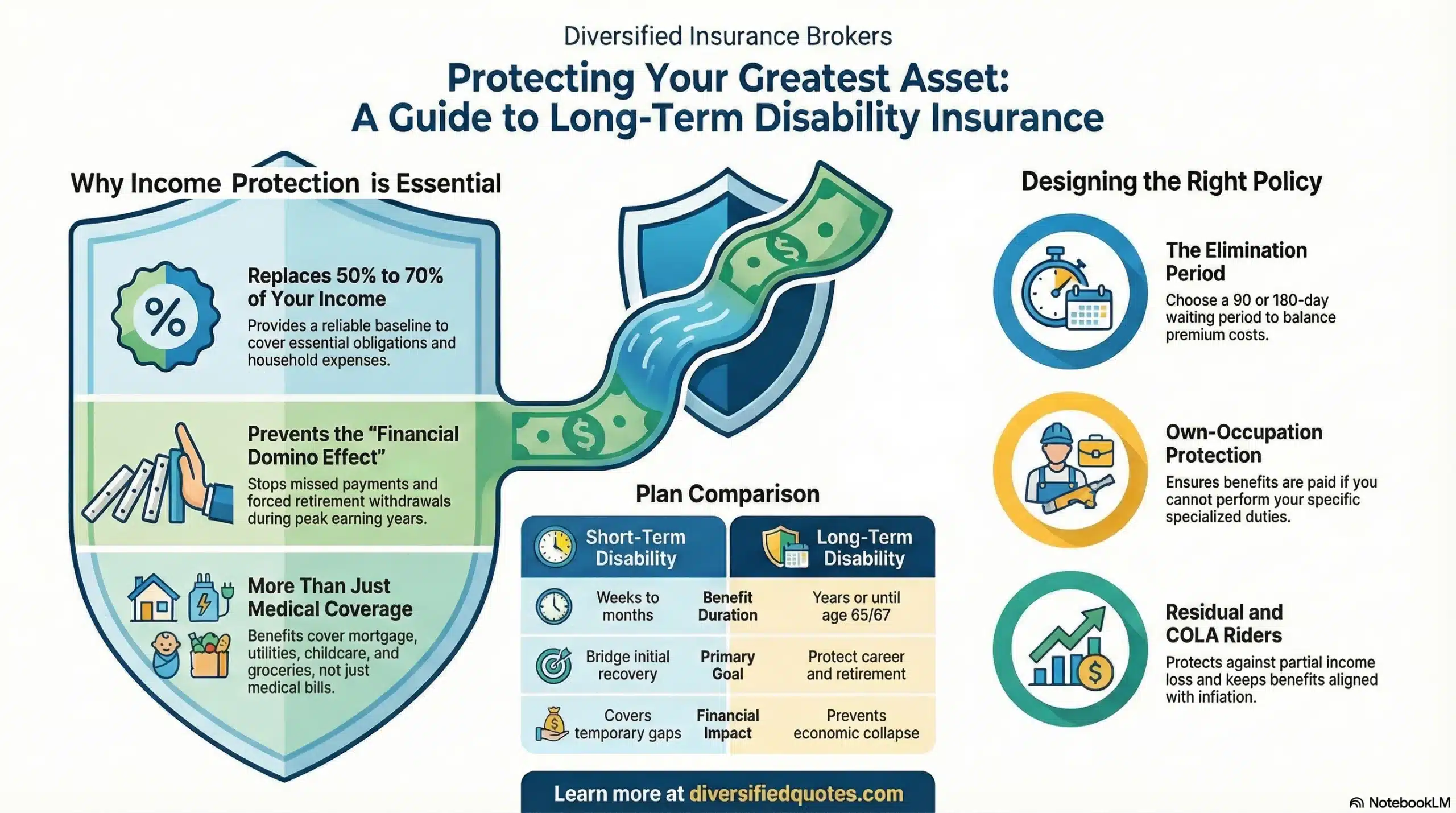
The bigger the monthly payout, the higher the premium—because the insurer is taking on more financial exposure. Most individual policies aim to replace about 50% to 70% of earned income, depending on income level and carrier limits. Many people assume they should insure “all” income, but disability insurance is typically designed to cover core lifestyle and financial obligations. Also, benefits may be tax-free depending on how premiums are paid, which means a smaller benefit can sometimes cover more of your lifestyle than you expect.
The right benefit is not always “max it out.” It’s “cover what matters most, reliably.” If you want a framework for sizing the benefit around your actual obligations, review how much disability insurance do I need. Many people find that once they calculate their stability number, they can choose a benefit amount with more confidence and less guesswork.
5) Benefit period (how long payments can last)
Benefit period is one of the biggest cost levers because it changes how long the insurer could pay. Policies can be designed to pay for shorter durations or to a specific retirement age. Longer benefit periods cost more, but they also protect against the type of disability that changes your career permanently. Shorter durations can make sense in some budget-driven situations or when you have substantial assets that could bridge a shorter gap, but they can also create a dangerous coverage gap if a disability lasts longer than expected.
In real life, people often choose benefit periods based on the stage of their career. A younger professional may want protection that lasts to a retirement age because their future earning years are still being built. A late-career professional might focus more on protecting the transition into retirement and avoiding forced withdrawals. The key is to choose a benefit period that matches the risk you’re actually trying to insure.
6) Elimination period (waiting period)
The elimination period is the number of days you must be disabled before benefits begin. Common choices are 30, 60, 90, or 180 days. A longer elimination period generally lowers premiums because you’re self-insuring the early part of the disability. This is where design becomes practical. Many people choose 90 days because it aligns with emergency reserves, employer sick leave, or short-term coverage. If you have a strong cash reserve, a 180-day waiting period can reduce premium significantly. If you don’t, choosing too long a wait can create stress exactly when you’re already dealing with a health event.
The right waiting period is not the one that produces the lowest premium. It’s the one you can actually sustain without creating financial pressure or forcing poor decisions. If you choose a longer waiting period, make sure you have a realistic plan for how you’ll cover the “gap months” if a disability occurs.
7) Policy definition and riders
Riders are where disability insurance becomes custom, and they can move cost up or down depending on what you choose. The most important concept is whether the policy is written to protect your ability to do your own job duties. For many professionals, own-occupation coverage is the key feature worth paying for because it directly addresses how you earn money.
Beyond definition, common riders include residual/partial disability benefits (which can be especially important because many claims are partial), cost-of-living adjustment features (which protect buying power during a long claim), and future increase options (which allow coverage to grow as income grows). The best approach is to start with the definition and the benefit period, then add riders only when they solve a real problem in your income model. That’s how you keep the policy strong without inflating premium unnecessarily.
Does “No Exam” Disability Insurance Cost More?
Sometimes—because simplified underwriting can increase the insurer’s uncertainty. But the relationship is not always straightforward. Some simplified programs price competitively, especially for certain occupations and ages, because carriers are targeting a specific market with streamlined approvals. The tradeoff is that no-exam programs may have lower benefit limits, more standardized contract structures, or fewer customization options compared to fully underwritten policies.
If you’re considering a streamlined option for speed and convenience, review no exam disability insurance for how these programs typically work, what benefit levels are realistic, and when a fully underwritten plan may be worth it. Many people choose a “layered” strategy: a simplified policy now for speed, then a stronger fully underwritten layer later as time and documentation allow. The right move depends on your timeline, health, income level, and how critical contract language is for your occupation.
Is Employer Group Disability Coverage Enough?
Employer group disability coverage can be helpful, but it often isn’t enough—especially for higher earners. Group long-term disability is commonly set at 60% of income but capped at a maximum monthly benefit. That cap can create an immediate shortfall. Group coverage can also be less portable if you change jobs, and the policy definition may be less protective than high-quality individual contracts. If your group plan is your only coverage, it’s worth reviewing whether it truly covers your fixed obligations during disability—mortgage, childcare, student loans, retirement contributions, and other commitments.
If you’re in a career where your income includes significant bonuses or variable compensation, group plans can also fall short because they may not fully count those income components. That’s why many professionals supplement group coverage with an individual policy that is designed to protect what the group plan can’t protect. The cost of the individual policy is often smaller than expected once you view it as a “gap coverage” layer rather than a full replacement for everything.
How to Lower the Cost Without Weakening the Coverage
The best way to get a better price is rarely “buy less insurance.” The better path is designing the policy so it matches your risk realistically. There are several proven levers that can reduce premium while keeping protection meaningful.
Buy earlier when possible. Age is a major pricing factor, and early underwriting usually creates better options. Waiting often means paying more and possibly facing exclusions for issues that weren’t present earlier.
Choose a waiting period you can truly sustain. If you have a real emergency fund or resources that can cover the early months, a longer elimination period can reduce premium without reducing long-term protection.
Right-size the benefit to your stability number. A benefit designed to cover core lifestyle obligations is usually more sustainable than trying to insure every dollar of income. If you want a clean framework for sizing, reference how much disability insurance do I need.
Pay for the contract language that matters, skip what doesn’t. For many professionals, strong own-occupation language and strong partial disability structure matter more than “extra” features. Start with the definition, choose an appropriate benefit period, then add riders only when they solve a real problem.
Shop the market. Different carriers treat the same occupation and medical history very differently. The only way to find the best fit is to compare. This is where independent brokerage adds real value: it’s not just rate shopping—it’s matching your profile to carriers that underwrite your occupation and health most favorably.
Why Disability Insurance Is Often Worth Far More Than It Costs
Disability insurance can feel like another monthly bill until you compare it to the size of the risk. A long-term disability can mean years of lost earnings. Even a two-year interruption can derail retirement contributions, force liquidation of assets, or add debt at exactly the wrong time. A well-designed policy helps prevent that chain reaction. It keeps cash flow stable while you recover or adapt, which can preserve long-term planning and reduce the likelihood of permanently damaging decisions.
That “plan preservation” effect is one reason income protection sits quietly beneath many wealth-building strategies. When people talk about long-term outcomes and how families maintain stability across decades, cash-flow defense is always part of the story. It aligns with broader thinking around protecting compounding and avoiding forced decisions, similar to themes discussed in how the wealthy stay wealthy.
What to Expect When You Ask for a Quote
Because disability insurance pricing is so sensitive to occupation class, benefit design, and underwriting, the best next step is to compare real options rather than guessing. A proper quote process should clarify how much benefit you can qualify for based on documented income, what definition structure is available for your occupation, how long benefits can last, and how premium changes when you adjust waiting periods and riders.
You don’t need to be an insurance expert to make a good decision. You just need the quotes presented in a way that makes the tradeoffs clear. That’s what our process is built to do—so you can choose a plan that fits your budget without sacrificing the parts that matter most.
Find Out What Disability Insurance Costs for You
Compare multiple carriers and see how occupation class, benefit period, waiting period, and definitions affect your monthly premium.
Clear comparisons and a policy design that matches how you actually earn.
Financial Protection Essentials
Executive coverage strategies, senior care planning, inherited IRA education, and advanced retirement income concepts.
Talk With an Advisor Today
Choose how you’d like to connect—call or message us, then book a time that works for you.
Schedule here:
calendly.com/jason-dibcompanies/diversified-quotes
Licensed in all 50 states • Fiduciary, family-owned since 1980
FAQs: How Much Does Disability Insurance Cost
What is the average cost of disability insurance?
Most people pay between 1% and 3% of their annual income for disability insurance. Costs vary based on age, health, occupation, and coverage type.
Does my occupation affect pricing?
Yes. High-risk or physically demanding jobs often result in higher premiums, while office or professional roles tend to receive lower rates.
Does disability insurance cover partial disabilities?
Many policies offer residual or partial disability benefits, which pay a reduced amount if you can work but earn less due to illness or injury.
Is long-term disability insurance worth the cost?
Yes. Long-term disability claims are more common than most people expect, and a single event could impact decades of future earnings.
Can self-employed workers get disability insurance?
Absolutely. Self-employed individuals often need coverage the most because they do not have employer-sponsored disability benefits.
Does disability insurance replace all of my income?
Most policies replace 50% to 70% of income. Higher-income earners may add supplemental coverage to fill gaps.
About the Author:
Jason Stolz, CLTC, CRPC and Chief Underwriter at Diversified Insurance Brokers (NPN 20471358), is a senior insurance and retirement professional with more than two decades of real-world experience helping individuals, families, and business owners protect their income, assets, and long-term financial stability. As a long-time partner of the nationally licensed independent agency Diversified Insurance Brokers, Jason provides trusted guidance across multiple specialties—including fixed and indexed annuities, long-term care planning, personal and business disability insurance, life insurance solutions, Group Health, and short-term health coverage. Diversified Insurance Brokers maintains active contracts with over 100 highly rated insurance carriers, ensuring clients have access to a broad and competitive marketplace.
His practical, education-first approach has earned recognition in publications such as VoyageATL, highlighting his commitment to financial clarity and client-focused planning. Drawing on deep product knowledge and years of hands-on field experience, Jason helps clients evaluate carriers, compare strategies, and build retirement and protection plans that are both secure and cost-efficient. Visitors who want to explore current annuity rates and compare options across multiple insurers can also use this annuity quote and comparison tool.
