
How to Choose the Right Disability Insurance Policy

Jason Stolz CLTC, CRPC
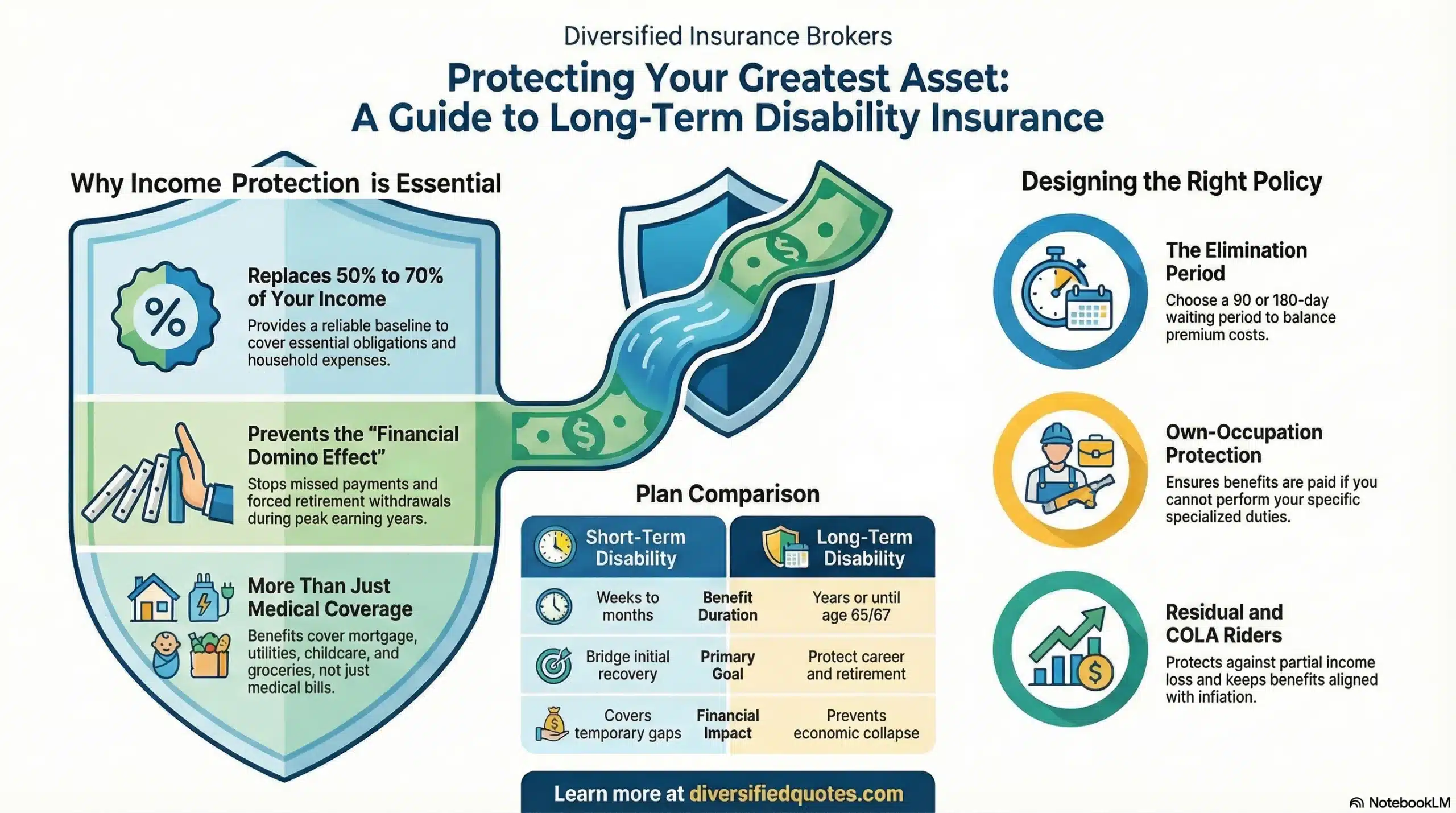
Choosing the right disability insurance policy is one of the most overlooked — and most important — financial decisions you can make. While life insurance protects your family if you pass away, disability insurance protects your income while you are still alive. For most working professionals, your ability to earn an income is your largest financial asset. If an illness or injury prevents you from working for months or even years, the impact can be financially devastating. Mortgage payments, student loans, car payments, childcare expenses, retirement contributions, and everyday living costs do not stop simply because your paycheck does. The right disability policy replaces a portion of your income so you can focus on recovery rather than financial survival. The wrong policy — or no policy at all — can leave you scrambling to drain savings, liquidate investments, or rely on family support.
Most people assume workplace coverage is enough. In reality, employer-provided disability insurance is often limited, taxable if premiums are employer-paid, and rarely portable if you change jobs. Many group plans only replace 50–60% of base salary and may exclude bonuses or commissions. Even more importantly, the definition of disability inside group policies can shift after a short period of time, reducing benefits if you can work in any occupation rather than your own occupation. Understanding how your current coverage works — and where it falls short — is the first step. If you have not reviewed your protection recently, it is worth comparing it against a private individual policy that follows you regardless of employer.
Request a Personalized Disability Insurance Review
We’ll evaluate your current coverage, compare multiple top-rated carriers, and help you understand true income replacement — clearly and objectively.
Start Your Disability Insurance ConsultationThe most important feature in any disability policy is the definition of disability. An “own occupation” definition pays benefits if you cannot perform the material duties of your specific profession — even if you could technically work in another field. This is especially critical for physicians, dentists, attorneys, engineers, and other highly specialized professionals. An “any occupation” definition, by contrast, may deny benefits if you are capable of working in a different job, even at significantly lower pay. Some policies begin as own occupation and later transition to any occupation. Others remain true own occupation for the full benefit period. That distinction dramatically affects how protected you truly are.
Benefit amount is the next major consideration. Most policies replace between 50–70% of your gross income, subject to underwriting limits. While that may sound sufficient, remember that certain expenses — retirement contributions, disability premiums, and healthcare costs — may not be fully accounted for. If your employer coverage is taxable, the net benefit may be even lower. For higher earners, supplemental or “excess” disability policies may be necessary to fully protect income. Just as with calculating life insurance needs, disability planning requires a careful review of your true financial obligations, not just a rough percentage estimate.
Elimination period and benefit period are also essential design elements. The elimination period is the waiting period before benefits begin — commonly 30, 60, 90, or 180 days. A longer elimination period reduces premiums but requires more emergency savings. The benefit period determines how long benefits last — two years, five years, or to age 65 or 67. Short-term policies may cover temporary injuries but provide little protection against long-term illnesses. Long-term disability insurance provides far broader protection but requires a thoughtful balance between cost and duration.
Occupation class plays a major role in pricing and eligibility. Carriers categorize professions based on income stability and physical risk. Office-based professionals generally qualify for stronger definitions and lower rates than physically demanding occupations. Self-employed individuals, business owners, and commission-based earners may require additional documentation to establish income stability. If you are self-employed, combining disability planning with broader financial protection — such as reviewing term life insurance options — ensures both income and family security are aligned.
Riders can meaningfully strengthen a disability policy when selected strategically. A residual or partial disability rider allows benefits if you can work part-time but experience a loss of income. A cost-of-living adjustment (COLA) rider increases benefits over time during long claims. A future purchase option allows you to increase coverage later without new medical underwriting. A catastrophic disability rider can provide additional benefits if severe disability limits activities of daily living. Not every rider is necessary, but understanding which ones align with your career stage and risk tolerance is key.
Underwriting for disability insurance is detailed. Carriers review medical history, prescriptions, income verification, occupational duties, hobbies, and sometimes financial documentation. Pre-existing conditions may be excluded or rated. Mental health history, musculoskeletal issues, and certain chronic conditions receive particular scrutiny. Working with an independent brokerage allows comparison across multiple carriers, as underwriting philosophies vary significantly. One company may be more flexible regarding mild anxiety or past back injuries, while another may offer stronger occupation definitions for certain professionals. Shopping intelligently can materially impact both approval and pricing.
Short-term disability policies differ from long-term disability coverage. Short-term policies typically cover periods from a few weeks to several months and often complement employer plans. Long-term disability policies cover extended periods and are critical for protecting against life-altering illnesses such as cancer, neurological disorders, or severe injuries. In many financial plans, disability insurance should be prioritized even before permanent life insurance structures such as whole life insurance or indexed universal life (IUL), because income replacement during working years is foundational to every other goal.
Business owners face additional considerations. Disability can impact not only personal income but also business continuity. Overhead expense disability policies reimburse fixed business expenses such as rent, utilities, and employee salaries during a disability. Buy-sell disability policies fund ownership transfers if a partner becomes permanently disabled. Coordinating personal coverage with business protection is essential to prevent financial strain on partners and employees.
Tax treatment must also be evaluated. If you pay premiums with after-tax dollars, benefits are generally tax-free. If an employer pays premiums, benefits are typically taxable. Some individuals choose to split premiums to diversify tax treatment. Reviewing these details in advance prevents unpleasant surprises during a claim.
Protect Your Income Before It’s Too Late
Disability premiums increase with age and health changes. Lock in coverage while you qualify for the strongest definitions and best rates.
Apply for Disability Coverage TodayAffordability matters. The right disability policy is one you can maintain consistently. Overextending on premiums may lead to lapse, leaving you exposed. Adjusting elimination periods, benefit amounts, or rider selection can help balance cost and protection. Layering employer coverage with supplemental individual coverage often provides cost-efficient enhancement without duplicating benefits.
Another frequent mistake is waiting. Disabilities are more common than many realize, and the probability of experiencing a disabling condition before retirement is significant. Health can change unexpectedly. Securing coverage while healthy protects insurability. Just as delaying life insurance later in life can increase premiums, postponing disability coverage can limit options.
Ultimately, choosing the right disability insurance policy requires clarity about your income, occupation, financial responsibilities, savings reserves, and long-term goals. It requires understanding definitions, riders, underwriting, benefit coordination, and tax implications. Most importantly, it requires aligning coverage with real-world risk rather than assumptions. Income fuels every other financial objective — retirement contributions, debt repayment, investment growth, and family security. Protecting that income stream is not optional; it is foundational financial planning.
Related Pages
Talk With an Advisor Today
Choose how you’d like to connect—call or message us, then book a time that works for you.
Schedule here:
calendly.com/jason-dibcompanies/diversified-quotes
Licensed in all 50 states • Fiduciary, family-owned since 1980
Most professionals aim to replace 60–70% of their gross income, since benefits are typically paid tax-free when you use after-tax dollars. Your ideal amount depends on your income, debts, savings, and fixed expenses. Review your budget carefully and compare individual coverage with any employer-provided group plan. For deeper planning strategies, visit our Disability Insurance Overview.
Own-occupation coverage pays benefits if you cannot perform the duties of your specific profession—even if you can work in another field. Any-occupation coverage only pays if you cannot work in any reasonable job based on your training and experience. High-income professionals often prefer own-occupation policies for stronger protection. Learn more about specialty coverage in our Long-Term Disability Insurance Guide.
Benefit periods typically range from 2 years to age 65 or even age 67. If your disability risk could impact your career long term, extended benefit periods provide stronger retirement protection. Shorter periods may reduce premiums but increase long-term risk exposure. Compare durations carefully with guidance from our Short-Term Disability Insurance resource.
Employer coverage is a helpful foundation but often replaces only 40–60% of income and may be taxable. It may also lack portability if you change jobs. Many professionals supplement group coverage with an individual policy for stronger and more flexible protection. Review coordination strategies on our Group vs. Individual Disability Insurance page.
Yes. Common riders include cost-of-living adjustments (COLA), future purchase options, residual disability benefits, and non-cancelable guarantees. Riders increase flexibility but also affect premium cost, so they should align with your income growth and career path. See our Disability Insurance Riders Guide for details.
About the Author:
Jason Stolz, CLTC, CRPC and Chief Underwriter at Diversified Insurance Brokers, is a senior insurance and retirement professional with more than two decades of real-world experience helping individuals, families, and business owners protect their income, assets, and long-term financial stability. As a long-time partner of the nationally licensed independent agency Diversified Insurance Brokers, Jason provides trusted guidance across multiple specialties—including fixed and indexed annuities, long-term care planning, personal and business disability insurance, life insurance solutions, and short-term health coverage. Diversified Insurance Brokers maintains active contracts with over 100 highly rated insurance carriers, ensuring clients have access to a broad and competitive marketplace.
His practical, education-first approach has earned recognition in publications such as VoyageATL, highlighting his commitment to financial clarity and client-focused planning. Drawing on deep product knowledge and years of hands-on field experience, Jason helps clients evaluate carriers, compare strategies, and build retirement and protection plans that are both secure and cost-efficient.
