
Non Qualified Long Term Care Annuity

Jason Stolz CLTC, CRPC
Non-qualified long-term care annuities are a powerful way to reposition after-tax savings into a strategy that can help pay for future care costs without creating new taxes. Many retirees already own an older non-qualified annuity that was purchased years ago for “tax-deferred growth,” but it’s no longer serving a clear purpose. This is where a long-term care annuity strategy can shine.
Thanks to the Pension Protection Act (PPA), certain annuity designs can allow annuity earnings (and in many cases the full benefit stream) to be used tax-free when the dollars are applied to qualified long-term care benefits. At Diversified Insurance Brokers, we help clients evaluate existing annuities, consider a compliant repositioning strategy, and align the outcome with what matters most: protecting retirement income, reducing family burden, and keeping more money available for a spouse or heirs.
Request LTC Annuity Options (PPA Tax-Free Benefits)
We’ll review your existing annuity (or after-tax assets) and show how non-qualified LTC annuity designs can create tax-efficient care protection.
Request Your LTC Annuity Quote
Want the basics first? Review non-qualified annuities and how they’re commonly used in retirement planning.
What Is a Non-Qualified Long-Term Care Annuity?
A non-qualified annuity is funded with after-tax dollars (not a 401(k) or IRA). Historically, the main advantage was tax-deferred growth. The challenge is that when you take withdrawals later, gains are generally taxed as ordinary income.
A non-qualified LTC annuity strategy aims to solve that problem by pairing an annuity structure with long-term care benefits in a way that can convert what would have been taxable annuity gain into tax-free long-term care benefits—when benefits are used for qualifying care. The result is often more efficient than paying for care using taxable withdrawals from other sources.
How Non-Qualified LTC Annuities Work in Real Life
Unlike a traditional long-term care policy that requires new ongoing premiums, a non-qualified LTC annuity approach often starts with money you already have—especially an existing deferred annuity that’s “sitting there” with embedded gain.
Depending on the design, you may:
1) Use a repositioning strategy to place an older annuity into a newer structure built for long-term care benefits, 2) trigger benefits if you meet the policy’s long-term care eligibility definition, and 3) receive benefits that can be used for qualified care services.
What matters most is how the contract defines eligibility, how benefits are paid, and how the plan fits alongside the rest of your retirement income. For many families, this is less about “buying a policy” and more about turning a dormant asset into a purposeful plan.
Pension Protection Act (PPA): Why the Tax Treatment Can Change
Under the Pension Protection Act, certain annuity structures can provide a major advantage: annuity dollars used for qualified long-term care benefits may be treated as tax-free under the rules governing long-term care benefits.
In plain English: instead of pulling taxable gains out of an annuity and paying ordinary income taxes, the strategy is designed so that long-term care benefit payments are treated as qualified benefits when used appropriately. This can be especially valuable for people who have meaningful gain inside an older annuity and are worried about a future care event creating a tax problem on top of a financial problem.
Because tax rules can be design-specific, the key planning step is to evaluate how the contract pays benefits and how it aligns with qualified long-term care definitions and benefit triggers.
Who Should Consider a Non-Qualified LTC Annuity Strategy?
This strategy is commonly a fit for retirees and pre-retirees who want long-term care leverage but also want control, simplicity, and the comfort of using a repositioned asset rather than committing to new lifetime premiums.
It can be a strong option for:
- People with an existing non-qualified annuity that no longer has a clear role in the plan (especially if it has embedded gains).
- Retirees seeking tax-efficient care funding rather than relying on taxable withdrawals later.
- Households that want “value either way,” meaning a care benefit if needed and a remaining value pathway if care is never used.
- Clients with underwriting concerns who may find traditional LTC approval challenging.
- Couples planning together who want an asset-based approach to reduce the risk of one spouse’s care draining the other spouse’s retirement lifestyle.
Using a 1035 Exchange to Reposition an Existing Annuity
If you already own a deferred annuity, a common path is a Section 1035 exchange. This is an IRS-recognized, tax-deferred transfer from one annuity to another that is intended to preserve tax treatment while you reposition into a better-fitting structure.
The practical goal is to avoid creating a taxable event just to change the plan. Instead of surrendering an annuity and potentially triggering tax on gain, the exchange route is commonly used to reposition to a structure that may be more efficient for long-term care planning.
Most importantly, the exchange decision should be evaluated alongside any surrender schedule, current contract features, and whether the existing annuity still serves your objectives.
Example: Turning an “Idle” Annuity into Long-Term Care Leverage
Imagine a retiree who owns a non-qualified annuity that was purchased years ago and is no longer needed for income. The annuity has grown meaningfully, and the owner is concerned that using the money later could create taxes at the exact time the family is dealing with long-term care decisions.
By repositioning into a long-term care annuity design intended to produce qualified long-term care benefits, the family may be able to shift the future “taxable withdrawal” problem into a “tax-efficient benefit” approach—so a care event doesn’t also create a tax event.
For many households, this is the difference between hoping the portfolio can absorb care costs and having a defined plan that reduces the impact on retirement income.
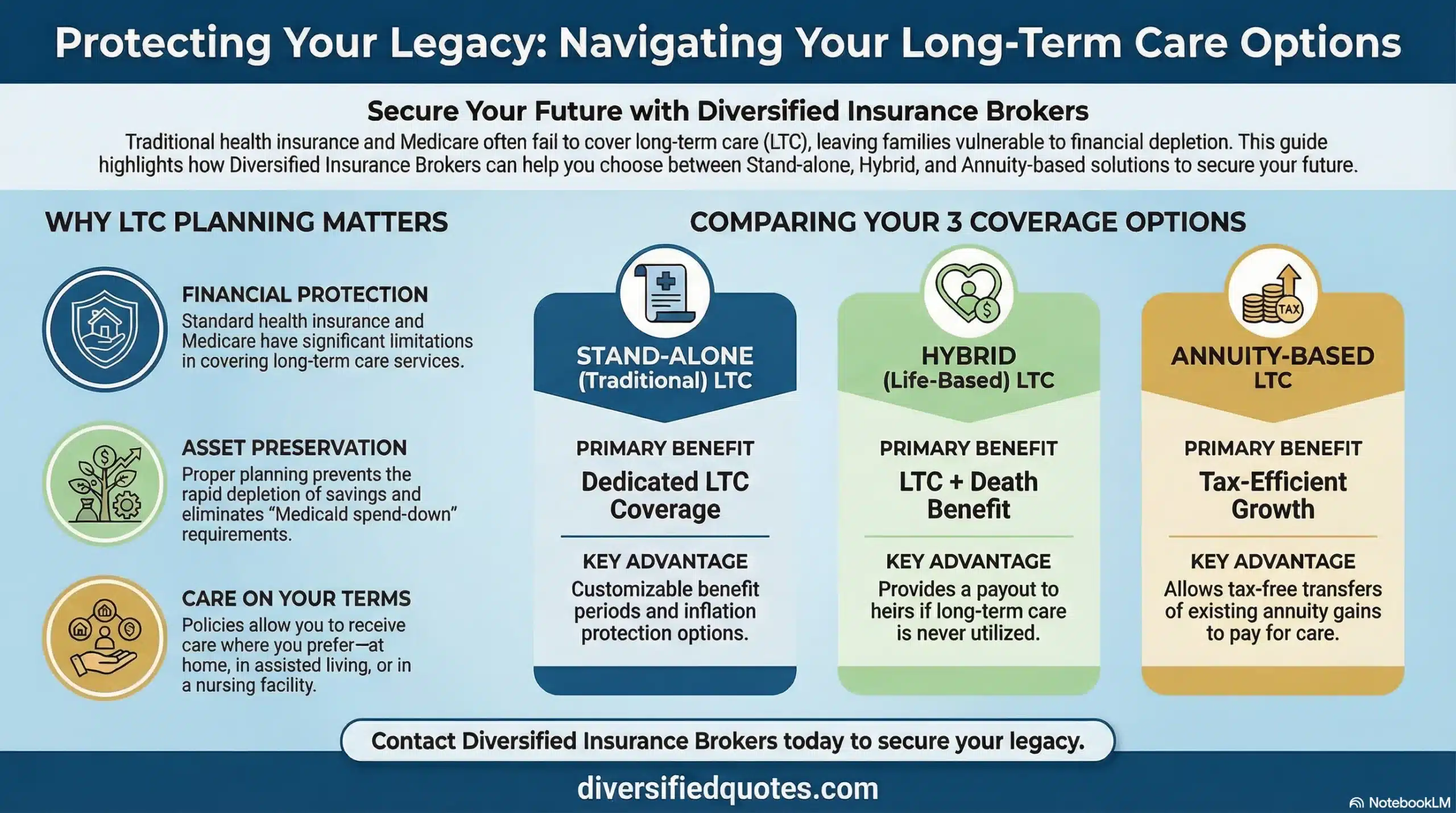
Traditional LTC Policy vs. Non-Qualified LTC Annuity
Both approaches can be valid—what’s “best” depends on your health profile, cash-flow preferences, and whether you want to reposition an existing asset rather than start a new premium commitment.
| Feature | Traditional LTC Policy | Non-Qualified LTC Annuity Strategy |
|---|---|---|
| How it’s funded | Ongoing premiums | Often a repositioned after-tax asset |
| Tax angle | Premiums may be deductible in some cases | Designed for tax-efficient LTC benefit treatment under PPA rules |
| If care isn’t needed | May feel “use-it-or-lose-it” | Often retains value that can pass to heirs, subject to contract terms |
| Approval process | Often full underwriting | Can be simplified depending on design |
| Best fit | Maximizing pure LTC leverage | Balancing LTC protection with asset repositioning goals |
Coordinating Long-Term Care Planning with Retirement Income
Long-term care planning works best when it is coordinated with the rest of your retirement strategy. The objective is not just “having coverage,” but reducing the odds that a care event forces disruptive choices—selling assets at the wrong time, increasing taxes unexpectedly, or reducing a spouse’s standard of living.
Some families pair a long-term care annuity approach with predictable accumulation strategies like a fixed annuity ladder. Others view the plan alongside broader tax and distribution strategies, including charitable planning tools that may help reduce future tax friction while meeting legacy goals.
The best structure is the one that behaves well under stress: when care is needed, when markets are volatile, or when the household is trying to protect both income and dignity at the same time.
Compare LTC-Qualified Annuity Designs
We’ll evaluate your existing annuity and show which long-term care annuity options fit your goals.
Talk With an Advisor Today
Choose how you’d like to connect—call or message us, then book a time that works for you.
Schedule here:
calendly.com/jason-dibcompanies/diversified-quotes
Licensed in all 50 states • Fiduciary, family-owned since 1980
FAQs: Non-Qualified Long-Term Care Annuities
Are non-qualified LTC annuities tax-free?
Yes. Under the Pension Protection Act, earnings from a non-qualified annuity are tax-free when used to pay qualified long-term care expenses.
What is the advantage of using a 1035 exchange?
A 1035 exchange lets you move an existing annuity into an LTC-qualified contract without taxes, preserving gains for tax-free care benefits.
Do I need to qualify medically?
Most non-qualified LTC annuities have simplified underwriting or no medical exam—ideal for those who might not qualify for traditional LTC insurance.
Can I still earn interest while my funds are in the annuity?
Yes. Your principal continues to grow tax-deferred, and unused value passes to beneficiaries if long-term care is never needed.
Are payouts guaranteed for life?
LTC annuity payouts continue until the policy’s LTC benefit pool is exhausted. Some hybrid annuities extend benefits for lifetime care.
What happens if I never need long-term care?
Any remaining account value is paid to beneficiaries, often without surrender charges after the vesting period.
Can couples share one annuity for LTC benefits?
Yes. Many non-qualified LTC annuities offer joint coverage for two insureds under a single contract.
Can business owners use this strategy?
Yes. Business owners can use after-tax assets to fund LTC annuities, keeping benefits tax-free while maintaining liquidity and estate flexibility.
About the Author:
Jason Stolz, CLTC, CRPC and Chief Underwriter at Diversified Insurance Brokers (NPN 20471358), is a senior insurance and retirement professional with more than two decades of real-world experience helping individuals, families, and business owners protect their income, assets, and long-term financial stability. As a long-time partner of the nationally licensed independent agency Diversified Insurance Brokers, Jason provides trusted guidance across multiple specialties—including fixed and indexed annuities, long-term care planning, personal and business disability insurance, life insurance solutions, Group Health, and short-term health coverage. Diversified Insurance Brokers maintains active contracts with over 100 highly rated insurance carriers, ensuring clients have access to a broad and competitive marketplace.
His practical, education-first approach has earned recognition in publications such as VoyageATL, highlighting his commitment to financial clarity and client-focused planning. Drawing on deep product knowledge and years of hands-on field experience, Jason helps clients evaluate carriers, compare strategies, and build retirement and protection plans that are both secure and cost-efficient. Visitors who want to explore current annuity rates and compare options across multiple insurers can also use this annuity quote and comparison tool.
