
Self Insured Long Term Care

Jason Stolz CLTC, CRPC
Self Insured Long Term Care is a phrase that sounds empowering—but in practice, it usually means self-funding 100% of an unpredictable, inflation-sensitive liability with personal assets. Insurance spreads risk across thousands of policyholders. Self-funding concentrates that risk entirely on you, your spouse, and your retirement portfolio. The difference matters. Long-term care is not a small, fixed expense. It is an open-ended cost that can last years, escalate with medical inflation, and force withdrawals during market downturns. According to industry data, roughly 70% of people over age 65 will need some form of extended care. Yet only a minority carry dedicated coverage. That gap creates exposure—not just to care costs themselves, but to sequence-of-returns risk, tax inefficiency, and legacy erosion. Families often begin by asking whether they can “just use investments” or rely on Medicare. However, as explained in Does Medicare Cover Nursing Home Care?, Medicare is designed for short-term, medically necessary skilled care—not long-duration custodial support driven by Activities of Daily Living. When care is needed for bathing, dressing, transferring, or cognitive supervision, out-of-pocket expenses quickly accumulate. Before deciding to self-fund, it’s worth evaluating alternatives like Should You Buy Long-Term Care Insurance? and understanding how hybrid options such as Hybrid Life & LTC policies reposition assets into contractually guaranteed care benefits.
Start with three questions: Where would you want care—at home, assisted living, memory care, or skilled nursing? Who would provide it—family members, private caregivers, or licensed professionals? And how would you pay for it—taxable portfolio withdrawals, real estate liquidation, or a dedicated insurance pool? Self-funding assumes your portfolio can withstand prolonged withdrawals without compromising income for a surviving spouse. For many retirees coordinating Social Security, pensions, and potential annuity income such as Guaranteed Income at Age 65 or Guaranteed Income at Age 70, large, unexpected care costs disrupt carefully engineered income streams. Consider the math: four years of part-time home care at $35 per hour can exceed $200,000 before inflation. To net $200,000 after taxes from an IRA, you may need to withdraw $250,000 or more depending on your bracket. If those withdrawals occur during a bear market, the compounding damage accelerates. That’s not just a healthcare issue—it’s a retirement sustainability issue, similar to concerns addressed in How Long Will My Solo 401k Last in Retirement? and even portfolio risk modeling like the Investment Risk Calculator.
Protect Retirement Assets From Long-Term Care Risk
Compare traditional, hybrid, and single-pay LTC options tailored to your goals and budget.
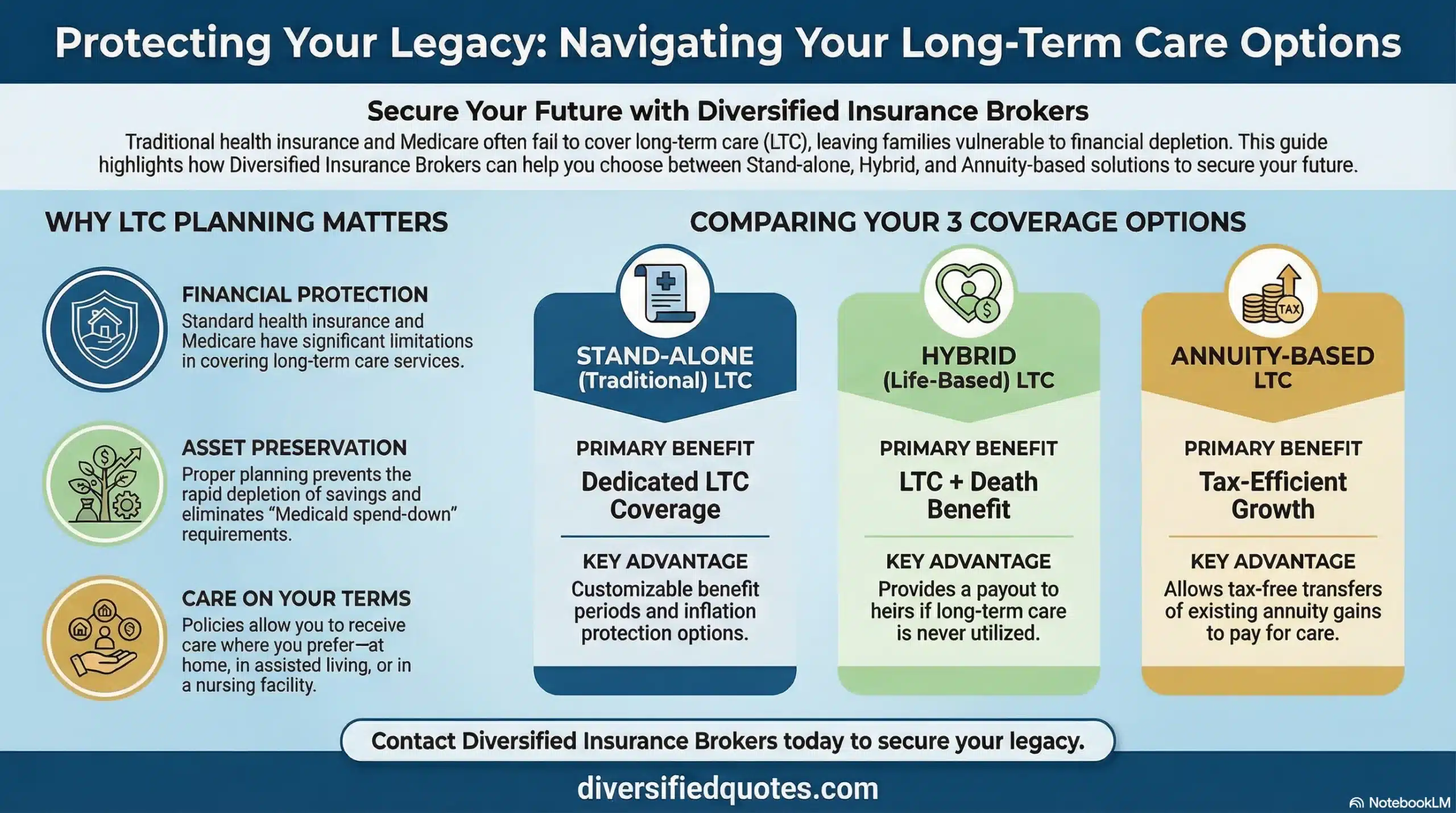
Request Your LTC QuoteTraditional long-term care insurance creates leverage: a relatively modest premium purchases a significantly larger pool of tax-advantaged dollars dedicated exclusively to care. Benefits are generally received income tax-free when used for qualified services. Hybrid policies—life insurance or annuities with LTC riders—offer asset repositioning strategies: if care is never needed, beneficiaries receive a death benefit; if care is required, the policy accelerates or multiplies available funds. This structure addresses a common objection to LTC coverage: “What if I never use it?” For those holding substantial idle cash or low-yield CDs, single-premium designs can convert stagnant assets into immediate, guaranteed care pools. This approach mirrors other risk-transfer decisions families make—whether evaluating Is USAA a Good Insurance Company?, Is Brighthouse a Good Insurance Company?, or Is Farmers a Good Insurance Company?—the core question is financial strength and contract reliability.
Self-funding also assumes emotional resilience and family availability. Many adult children live out of state, manage careers, or lack clinical training. Without coverage, caregiving often defaults to spouses, increasing burnout and health decline. Dedicated LTC benefits protect not just assets, but relationships. They allow families to choose quality home care, explore options like What Is Adult Daycare?, and transition gradually if memory care becomes necessary. Planning early matters because underwriting becomes more restrictive with age or medical changes. Just as individuals facing health conditions explore targeted solutions such as Life Insurance for Atrial Fibrillation or Life Insurance for Hodgkin’s and Lymphoma, LTC eligibility is easier and more affordable before diagnoses accumulate.
High-net-worth families sometimes assume Medicaid can serve as a backstop. While Medicaid may eventually cover care, it requires asset spend-down and limits provider choice. Estate planning tools such as Irrevocable Life Insurance Trusts (ILITs) focus on preserving wealth efficiently; self-funding long-term care without strategy can undermine those plans. Similarly, individuals evaluating advanced strategies like The Infinite Banking Concept or Indexed Universal Life in Qualified Plans should account for the possibility that extended care costs may interrupt cash value growth or retirement income assumptions.
Model the Cost of Self-Funding vs. Insurance
See how elimination periods, inflation riders, and benefit pools compare to portfolio withdrawals.
Start Your LTC Planning ReviewThe most effective long-term care plans integrate multiple moving parts: benefit amount calibrated to regional costs, elimination period aligned with emergency reserves, inflation protection to preserve purchasing power, and shared-care riders for couples. An independent broker benchmarks multiple carriers, negotiates underwriting positioning, and ensures that cognitive impairment triggers are clearly defined. The goal is not to over-insure, but to transfer catastrophic risk while preserving flexibility. Whether you ultimately choose traditional LTC, a hybrid approach, or partial self-funding supplemented by insurance, the key is intentional design—not assumption. “Self-insured” sounds decisive, but true confidence comes from modeling scenarios, understanding tax implications, and protecting both income streams and family stability.
Related Long-Term Care & Retirement Planning Guides
Talk With an Advisor Today
Choose how you’d like to connect—call or message us, then book a time that works for you.
Schedule here:
calendly.com/jason-dibcompanies/diversified-quotes
Licensed in all 50 states • Fiduciary, family-owned since 1980
FAQs: Self Insured Long Term Care
What’s the difference between self-insuring and self-funding?
“Self-insuring” is a myth—insurance spreads risk across many people. Self-funding means you alone pay future care costs from your assets.
Why not just pay for care out of pocket?
Care is unpredictable and expensive. Large withdrawals can trigger taxes, sequence-of-returns risk, and reduce income for a surviving spouse.
Isn’t LTC insurance too expensive?
Traditional LTC usually delivers the most benefit per premium dollar. Hybrids can return value to beneficiaries if care isn’t needed.
What’s the advantage of single-pay LTC?
You reposition a lump sum to create a leveraged, contractually guaranteed pool for care—often with built-in inflation options.
How does inflation protection work?
You can add a rider that increases your monthly and total benefits annually, helping benefits keep pace with rising care costs.
Are LTC benefits taxable?
Qualified LTC benefits are generally received tax-free. Some premiums may receive favorable tax treatment depending on your situation.
Can I get coverage if I have health conditions?
Possibly. Carriers vary. We pre-screen your case across multiple insurers to find the best fit and pricing.
What if I never need care?
Hybrid policies can return remaining value to beneficiaries. With traditional LTC, you’ve transferred risk during the years you needed protection.
How do we get quotes?
Complete our quick request and we’ll compare top-rated carriers: Request LTC Quotes.
About the Author:
Jason Stolz, CLTC, CRPC and Chief Underwriter at Diversified Insurance Brokers (NPN 20471358), is a senior insurance and retirement professional with more than two decades of real-world experience helping individuals, families, and business owners protect their income, assets, and long-term financial stability. As a long-time partner of the nationally licensed independent agency Diversified Insurance Brokers, Jason provides trusted guidance across multiple specialties—including fixed and indexed annuities, long-term care planning, personal and business disability insurance, life insurance solutions, Group Health, and short-term health coverage. Diversified Insurance Brokers maintains active contracts with over 100 highly rated insurance carriers, ensuring clients have access to a broad and competitive marketplace.
His practical, education-first approach has earned recognition in publications such as VoyageATL, highlighting his commitment to financial clarity and client-focused planning. Drawing on deep product knowledge and years of hands-on field experience, Jason helps clients evaluate carriers, compare strategies, and build retirement and protection plans that are both secure and cost-efficient. Visitors who want to explore current annuity rates and compare options across multiple insurers can also use this annuity quote and comparison tool.
