
Travel Insurance for Humanitarian Aid Workers

Jason Stolz CLTC, CRPC
Travel insurance for humanitarian aid workers is essential protection for anyone deploying into challenging, unpredictable, or high-risk environments. Whether you’re supporting disaster relief, medical teams, refugee assistance, food distribution, logistics, or international development work, the right travel medical coverage helps you stay focused on the mission instead of worrying about unexpected medical costs or emergency coordination.
At Diversified Insurance Brokers, we help humanitarian organizations, nonprofits, and individual aid workers secure travel medical coverage for both domestic and international deployments. The primary goal is simple: make sure you can access appropriate care quickly, and make sure evacuation logistics are not a financial barrier if the local medical system cannot support the situation.
If you’re building a broader travel medical framework for multiple trips, it can also be helpful to review your foundational options first: Travel Medical Insurance.
Apply for Travel Medical Insurance
Instant enrollment for individuals and groups. Coverage is available for many destinations worldwide, with benefits geared toward real-world deployment risk.
Want us to align coverage to your deployment conditions?
Share destination(s), dates, job role, and whether the deployment includes remote travel or higher-risk environments. We’ll help confirm the coverage structure fits the mission.
Why humanitarian workers need specialized travel insurance
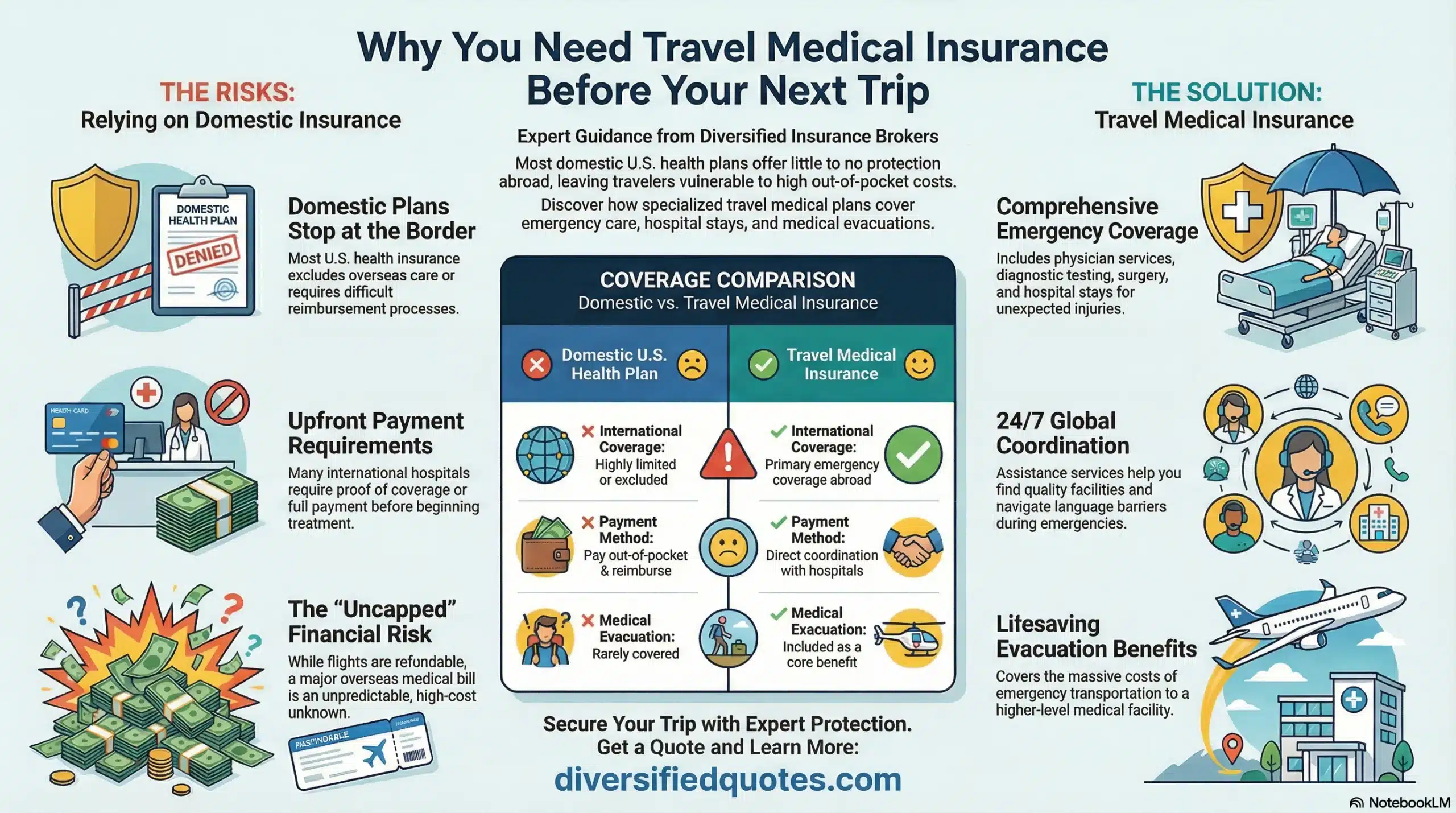
Humanitarian deployments often involve locations with limited healthcare, unstable infrastructure, disrupted transportation, or unpredictable operating conditions. Traditional “vacation-style” travel coverage is not built around these realities. A humanitarian-focused travel medical plan is designed to help with the scenarios that matter most in the field: sudden illness or injury, treatment coordination in unfamiliar systems, and the ability to move someone to appropriate care when local facilities are not sufficient.
Evacuation planning is especially important for humanitarian workers because deployments can place you hours from advanced care or in environments where the safest medical option may be outside the region entirely. When you review coverage, it helps to treat evacuation as a core planning item rather than a “nice-to-have.” For deeper context on that benefit layer, review: Emergency Medical Evacuation Insurance.
Many organizations also want coverage that works for short deployments, longer missions, or recurring travel schedules—without adding administrative complexity for coordinators and team leads.
What travel medical insurance can help cover during humanitarian deployments
Humanitarian travel medical plans are intended to help with emergency medical treatment and hospitalization for covered illness or injury while traveling. Depending on plan structure and selected options, coverage may include physician services, medically necessary diagnostics, certain prescriptions tied to a covered event, and assistance services that help coordinate care and next steps when you’re outside your normal healthcare network.
For many deployments, the operational value is not just reimbursement—it is coordination. Assistance services can help locate appropriate facilities, guide documentation, and support evacuation decisions when local care is inadequate. This is the planning layer that keeps a medical event from turning into a logistical emergency.
If you’re comparing cost expectations for different travel profiles, a practical next step is understanding how pricing tends to work: Is Travel Medical Insurance Expensive?.
Who should consider humanitarian travel medical coverage?
This type of coverage can be a fit for disaster relief volunteers responding to hurricanes, wildfires, earthquakes, floods, or other crises, as well as medical professionals serving abroad, refugee support staff, development workers, and NGO teams supporting logistics, engineering, construction, or field operations. It is also common for faith-based humanitarian programs coordinating service work in regions with limited medical infrastructure.
If your humanitarian work includes mission components or church-affiliated deployments, you may also want to compare how coverage is structured for those group travel scenarios: Travel Insurance for Missionary Groups.
Benefits for organizations and nonprofits
For nonprofits and NGOs, offering appropriate travel medical coverage is a practical part of risk management and volunteer safety. It creates consistency across the roster, reduces uncertainty when an incident occurs, and provides leaders a clear set of emergency steps and contacts. It can also help meet partner requirements for deployments, especially when working with host organizations or collaborating across agencies.
Larger deployments may benefit from group-oriented structures that streamline enrollment and simplify administration. If you’re comparing that approach, start with: Cheap Group Travel Insurance.
The goal is not to overcomplicate the planning process. The goal is to make sure teams deploy with clear documentation, clear emergency procedures, and protection that matches the realities of the field.
Have multiple trips or rotating volunteers?
Tell us how often teams deploy and what destinations are typical. We can help structure coverage that stays consistent across deployments.
Compare related travel protection options
Humanitarian deployments often overlap with other structured travel categories. If your team is operating under a church umbrella, you may also find it useful to compare church travel planning considerations: Travel Insurance for Church Groups.
If the primary objective is affordability while still maintaining meaningful medical and evacuation protection, you can also compare: Cheap Travel Insurance.
(Note: The existing non-travel links in the original draft remain unchanged per your instruction to not change anything already there.)
How Diversified Insurance Brokers helps
We help humanitarian teams compare travel medical plan structures, clarify exclusions, and match coverage to realistic deployment risks. That includes aligning benefits with destination conditions, confirming evacuation planning aligns with remote or limited-care environments, and making sure team leads have clear proof of coverage and emergency contact procedures before anyone deploys.
The goal is to remove uncertainty. When something happens in the field, you want a clear plan—not a scramble for paperwork and emergency phone numbers.
Get covered before you deploy
Make sure you have protection for emergency medical care, evacuation coordination, and common deployment-related medical risks.
Need help choosing limits and evac options?
We’ll help you avoid underinsuring the high-severity outcomes while keeping the plan cost-efficient for the deployment.
Related Travel Medical Pages
Focus on medical access, emergency support, and evacuation readiness for field deployments.
Related Group & Deployment Pages
Compare structures for NGO teams, church-affiliated deployments, and mission programs.
Talk With an Advisor Today
Choose how you’d like to connect—call or message us, then book a time that works for you.
Schedule here:
calendly.com/jason-dibcompanies/diversified-quotes
Licensed in all 50 states • Fiduciary, family-owned since 1980
FAQs: Travel Insurance for Humanitarian Aid Workers
Do humanitarian aid workers need special travel insurance?
Yes. Standard travel insurance often excludes high-risk areas, remote locations, or crisis zones. Humanitarian plans include emergency medical care, evacuations, and crisis response appropriate for aid environments.
Does the insurance cover evacuation from dangerous areas?
Yes. Most humanitarian travel medical plans include emergency evacuation due to medical events, natural disasters, or security threats—depending on the policy.
Can groups or nonprofit teams enroll together?
Yes. Nonprofit groups, volunteer teams, and mission organizations can enroll individuals or entire teams under coordinated coverage.
Is coverage available for long-term assignments?
Yes. Plans can cover short-term trips, multi-trip volunteers, or long-term humanitarian placements lasting several months or longer.
Does the plan cover COVID-19?
Many plans include COVID-19 treatment as any other illness. Coverage varies by carrier and destination requirements.
Does travel medical insurance cover routine care?
No. Travel medical insurance is designed for emergencies, accidents, and urgent medical needs—not routine or preventive care.
About the Author:
Jason Stolz, CLTC, CRPC and Chief Underwriter at Diversified Insurance Brokers (NPN 20471358), is a senior insurance and retirement professional with more than two decades of real-world experience helping individuals, families, and business owners protect their income, assets, and long-term financial stability. As a long-time partner of the nationally licensed independent agency Diversified Insurance Brokers, Jason provides trusted guidance across multiple specialties—including fixed and indexed annuities, long-term care planning, personal and business disability insurance, life insurance solutions, Group Health, and short-term health coverage. Diversified Insurance Brokers maintains active contracts with over 100 highly rated insurance carriers, ensuring clients have access to a broad and competitive marketplace.
His practical, education-first approach has earned recognition in publications such as VoyageATL, highlighting his commitment to financial clarity and client-focused planning. Drawing on deep product knowledge and years of hands-on field experience, Jason helps clients evaluate carriers, compare strategies, and build retirement and protection plans that are both secure and cost-efficient. Visitors who want to explore current annuity rates and compare options across multiple insurers can also use this annuity quote and comparison tool.
