
Travel Medical and Evacuation from Jordan

Jason Stolz CLTC, CRPC
Jordan is one of the Middle East’s most visited destinations, known for Petra, Wadi Rum, the Dead Sea, and a reputation for hospitality. Whether you’re in Jordan for tourism, business, study, humanitarian work, or an extended stay, it’s smart to plan for the “what if” moments that can derail a trip fast—especially medical emergencies and urgent evacuations. That’s why travel medical and evacuation insurance from Jordan matters. It helps protect you from major out-of-pocket expenses, gives you access to coordinated emergency support, and can arrange transport to the nearest appropriate facility (or back home) if local care isn’t sufficient.
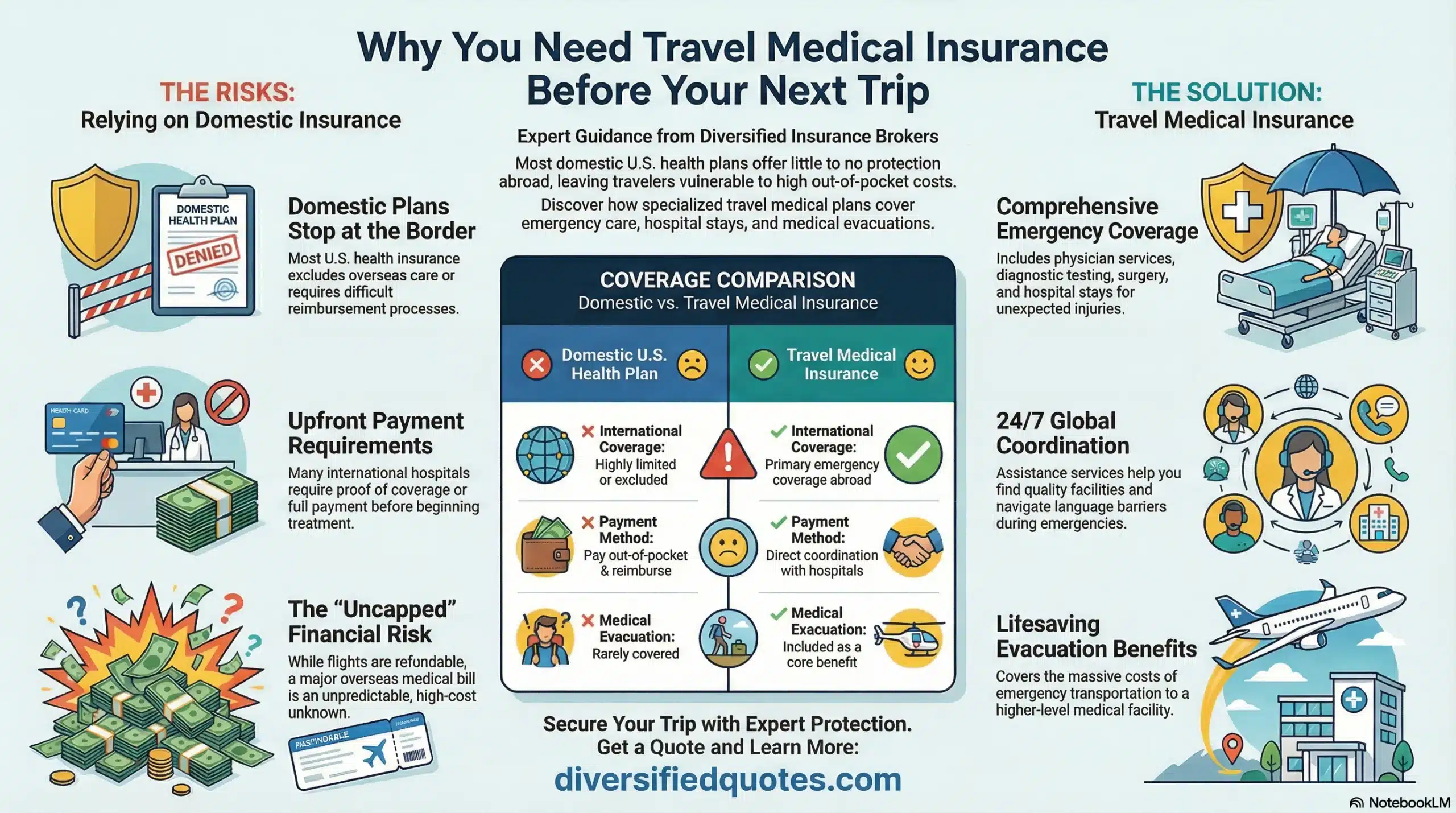
At Diversified Insurance Brokers, we help travelers and expats secure international medical coverage built for real-world scenarios. Many people assume their domestic health plan will follow them internationally—often it doesn’t. Even when some out-of-network benefits exist, payment logistics, provider requirements, and coverage limits can still create delays and unexpected bills. When you’re outside your home system, the difference between “I have coverage” and “I have the right coverage” can be the difference between quick treatment and major disruption.
We also recommend thinking about the full arc of your trip. If you’re leaving the U.S. (or any home country plan) and you’ll be crossing borders, your medical plan should match your travel reality. If you’re traveling beyond Jordan or using Jordan as a base for regional travel, it can help to pair this page with our guidance on emergency travel medical insurance for U.S. citizens so you know what coverage is designed to do when domestic insurance doesn’t apply. If you want to compare plan “categories” at a high level, start with Medical Travel Insurance for shorter trips and consider International Health Insurance if you’re staying longer, relocating, or traveling continuously.
Why Travel Medical and Evacuation Coverage Matters in Jordan
Jordan has reputable hospitals and physicians, particularly around Amman and other major areas. But like many countries, access to advanced or specialty care can vary dramatically by location and by the type of event. If you’re touring remote sites, driving between cities, hiking, spending time in desert regions, or moving on tight schedules, the distance to a high-capability hospital can become the most important “risk factor,” not your age or health status. Travel medical coverage helps with emergency treatment, while evacuation coverage helps solve the bigger problem: getting you to the right care quickly when local options aren’t enough.
Even when local care is available, international coverage can simplify logistics. Claims support, medical case management, and 24/7 assistance can reduce stress for you and your family. This is especially valuable for travelers who are older, traveling with children, managing prescriptions, traveling solo, or staying abroad for work. The moment a situation becomes serious, the “insurance” value often shifts from reimbursement to coordination—finding the right facility, arranging the right transport, and removing as many delays as possible while you focus on health and safety.
Another practical issue is how emergencies unfold. A mild problem might be treatable locally. But serious trauma, severe infections, neurologic symptoms, cardiac symptoms, complicated abdominal pain, dehydration, or pediatric emergencies can change the equation quickly. If you’re in an area where higher-level imaging, specialty surgery, or ICU capability isn’t readily available on short notice, evacuation becomes the bridge between an emergency and the care you actually need.
What Travel Medical and Evacuation Coverage Typically Helps With
Travel medical and evacuation coverage is designed to do more than reimburse a bill. It’s meant to provide a complete support system during a crisis—medical coordination, emergency decision-making, and transport planning. Most policies revolve around a few core protections, and the way those protections are written is what determines how well the plan performs when you actually need it.
Emergency medical care is the foundation. In a genuine emergency, this may include ER treatment, hospital stays, physician services, diagnostic testing, imaging, surgery when needed, and eligible prescriptions. The most important word here is “emergency,” because many policies draw a clear line between urgent/accidental illness and elective or routine care. If your trip includes excursions, long drives, heat exposure, hiking, or time in rugged areas, emergency medical coverage addresses the first and most urgent need: treatment when something goes wrong unexpectedly.
Medical evacuation addresses the next step: getting you to the nearest appropriate facility when the local option cannot handle your situation. Evacuation can be within Jordan, and in some cases it may be to a nearby country depending on medical necessity and what the policy defines as an “adequate” facility. Some plans focus on transport to the nearest capable care center; other designs can include repatriation after stabilization depending on terms. This benefit is one of the most important reasons travelers buy coverage because the costs can escalate quickly—especially when air transport, medical staffing, and cross-border logistics are involved. If you want a deeper explanation of how evacuation works as a benefit, review Emergency Medical Evacuation Insurance, which breaks down what the benefit typically includes and how coordination decisions are made.
Security evacuation can help when safety becomes a concern unrelated to a medical diagnosis—regional instability, civil unrest, or other sudden threats. Not every plan includes security evacuation in the same way, and some plans exclude certain events entirely depending on definitions and triggers. This is not about being alarmist; it’s about aligning your plan to your profile. A tourist staying in central areas for a short trip has a different exposure profile than an NGO worker, journalist, contractor, or long-stay traveler who may spend time outside major corridors.
Financial protection is the practical outcome. A single emergency room visit abroad can be expensive. A short hospitalization can become very expensive. But evacuation is where costs can become most dramatic and most immediate. Having coverage is about preventing a high-stakes emergency from turning into a high-stakes financial event for your family—especially if deposits or payment guarantees are needed quickly. If you are comparing medical coverage with a budget focus, you can still keep evacuation in view by reviewing Cheap Travel Insurance and then comparing whether the evacuation structure and assistance services are strong enough for your itinerary.
What “Medical Evacuation” Actually Means in Real Life
Medical evacuation is often misunderstood as “an air ambulance back home.” In practice, evacuation is a coordinated medical transport decision driven by medical necessity, local capability, and the plan’s rules for authorization. A strong plan typically includes a 24/7 assistance center that confirms the situation, works with the treating provider, locates an appropriate receiving facility, and coordinates the correct level of transport. Depending on the situation, that could mean a ground ambulance transfer, a commercial flight with medical escort, or an air ambulance. The best option depends on urgency, stability, and what level of care is needed during transport.
This is why travelers should look beyond the headline “evacuation included” and confirm how it’s defined. Many plans reference evacuation “to the nearest adequate facility.” Others can include repatriation after stabilization or transport to a facility that can handle the case in the most clinically appropriate way. “Nearest adequate” can be excellent for speed. Repatriation can be valuable for longer recovery and follow-up with familiar providers. The right fit depends on your travel duration, whether you’re traveling alone or with family, and how strongly you value getting back to your home medical network if something major happens.
It also matters how evacuation is triggered. Most plans require that evacuation be coordinated through the assistance provider except in truly extreme circumstances where contact is impossible. This is not a “gotcha”—it’s how the plan ensures transport is medically necessary, appropriately staffed, and directed to a facility that can accept the patient. If you want a high-level framework for comparing plan designs when your travel includes remote segments, field work, or a higher exposure profile, review Travel and Medical Insurance for High Risk Travel as a companion guide.
Jordan Travel Patterns That Can Change Your Coverage Needs
Jordan travel is often “city + sites,” which can create long travel days and distance from high-capability care. A traveler might spend time in Amman, then drive south to Petra, continue into Wadi Rum, and add the Dead Sea, Jerash, and smaller cultural stops. Even if you feel healthy, what matters in an emergency is how quickly you can access the right facility and whether a plan can coordinate the next steps if the initial facility can’t fully manage the event.
Heat exposure and dehydration risks rise when travel includes desert regions, long outdoor excursions, and long drives—especially for older travelers, travelers with children, and people with underlying health conditions. Road travel between destinations can also increase exposure to accidental injury risk simply because more time is spent in transit. None of this is meant to sound dramatic. It’s just the practical reality of “distance + timing” when you are traveling in a region where the best next step may require coordination beyond the nearest clinic.
For longer stays—study programs, multi-month assignments, humanitarian work, or expat living—coverage decisions shift again. Travelers may place more weight on a plan that behaves like longer-duration medical coverage rather than a short-term travel policy. That’s where comparing International Health Insurance becomes helpful, because it typically aligns better with longer stays and ongoing coverage needs while still maintaining the emergency/evacuation “backstop” that matters most when something serious happens.
Example Scenario: Why Coordination Matters as Much as Coverage
Picture a family visiting Petra when one traveler experiences sudden chest pain and shortness of breath. The first goal is immediate evaluation and stabilization. Jordan has hospitals in major cities, but the clinical question quickly becomes a logistics question: where is the most appropriate facility for the next step, how quickly can the traveler get there, and who coordinates that process? In time-sensitive events, the gap between “I have insurance” and “I have coordinated support” can matter.
A comprehensive travel medical and evacuation plan can coordinate immediate care, communicate with hospitals, and handle transport logistics so the family is not stuck trying to solve a medical crisis while also negotiating costs and arranging transportation. In many real claims, the best value is not “reimbursement later.” It’s minimizing delays, removing guesswork, and getting the traveler to the right level of care without having to build a crisis plan on the fly.
Who Should Consider Travel Medical & Evacuation Coverage in Jordan?
This type of coverage is valuable for almost anyone spending time in Jordan, but it becomes especially important when your itinerary, responsibilities, or location increases the consequences of a medical or security event. If you’re traveling independently, moving between cities, traveling with dependents, spending time outside major metro areas, or traveling on a schedule where delays create big ripple effects, coverage becomes more than a “nice to have.” It becomes part of your risk management plan.
Tourists benefit because travel days are packed—long drives, guided tours, outdoor excursions, heat exposure, and unfamiliar food or water. A simple incident can become complicated quickly when you’re far from your home doctor, dealing with language barriers, or unsure where to go for quality care. Tourists also tend to underestimate how quickly travel logistics can become expensive when a return flight must change, a companion must stay longer, or a destination shift becomes necessary.
Expatriates and families often need coverage because everyday life adds new variables. Routine care may be manageable locally, but serious events are different. Evacuation coverage can act as the backstop when you want the option to move to a higher-capability facility or return to your home country for continued care. For families, coordination matters even more because you’re managing children, school schedules, and support systems at the same time.
Business travelers benefit because disruptions are costly. If you’re on a deadline, working on-site, traveling frequently, or supporting a team, you want a plan that supports quick coordination rather than leaving you to manage payments and provider navigation alone. A plan that coordinates properly can reduce downtime and help you get back to your schedule faster when the event is manageable—and it can also protect you from significant financial exposure if it is not.
NGO workers, aid professionals, students, and project-based travelers benefit because assignments can involve remote areas, unpredictable schedules, and heightened exposure. These travelers often prioritize plans that include robust emergency assistance and clear evacuation protocols, because the ability to “escalate care” quickly can be the difference between a contained issue and a major crisis. If your itinerary includes remote travel, multi-country routes, or higher-risk conditions, it can also be useful to review High Risk Travel Insurance as another comparison point for plan structure and exclusions.
Coverage Highlights Travelers Value Most
Travel medical and evacuation plans differ by carrier and design, but the most useful features tend to be the same: responsive assistance, real medical coordination, and the ability to escalate care without confusion. The benefit is not only the coverage amount—it’s the system behind the coverage and the clarity of how to activate it.
24/7 multilingual emergency assistance helps you access support during medical or security events. Many travelers don’t realize how valuable it is to have a dedicated assistance team coordinating hospital admissions, communication with physicians, documentation, and updates to family back home. In a serious event, having a real support center matters as much as the policy itself.
Worldwide medical coordination helps ensure you’re not guessing where to go next. When you’re abroad, “nearest” is not always “best.” The right plan can help point you to appropriate facilities, support transfers, and reduce the chance that you lose time in a system that doesn’t operate like your home system.
Evacuation coordination is one of the most important practical features. In an emergency, the challenge is not just “Can I pay for evacuation?” It’s “Can I arrange it correctly, quickly, and safely?” A strong plan makes that coordination part of the benefit rather than leaving it to you or your family in the moment.
Flexible plan structures matter because not everyone is traveling for the same reason. A tourist may want a straightforward short-term plan. An expat may need longer-duration coverage with different benefits and options. A traveler with multiple destinations may prioritize continuity across borders so coverage doesn’t become fragmented mid-route.
How to Choose the Right Plan for Jordan
The best plan is the one that matches your itinerary and risk profile. A traveler spending three days in Amman has different needs than someone hiking in Wadi Rum, driving across long desert routes, working outside city centers, or traveling across borders. When selecting a policy, focus on three practical areas: (1) the strength of emergency medical benefits, (2) the evacuation and assistance features, and (3) whether the plan aligns with your trip length and activities.
If you plan to do higher-activity travel—long hikes, rugged sightseeing, multi-day excursions, or remote travel—review how plans define and exclude higher-risk activities. If your travel involves work exposure—construction sites, field projects, humanitarian work—pay attention to exclusions, definitions of covered events, and how claims are coordinated. And if your trip is extended, compare whether a longer-duration structure is a better fit than a short-term travel medical policy by reviewing International Health Insurance as an alternative category.
Finally, remember that the “best” plan is often the plan you can actually use correctly in an emergency. That means you know where the assistance number is, you understand that evacuation typically needs to be coordinated, and you have realistic limits that reflect what evacuation can cost when distance, medical staffing, and logistics are involved.
Secure International Medical Coverage
Protect yourself and your loved ones with reliable travel medical and evacuation insurance while in Jordan.
Why Work with Diversified Insurance Brokers
Travel medical insurance is one of those areas where details matter. Coverage can look similar at a glance, but the claim process, assistance services, evacuation definitions, and eligibility rules can vary. Diversified Insurance Brokers helps you choose coverage that matches your trip length, destination mix, and exposure profile—so you’re not guessing when it matters most.
We also help travelers who are unsure whether their existing insurance follows them internationally. Many people only discover gaps after a claim. If you’re traveling internationally, this is the time to confirm what protection you truly have and what needs to be added so your travel plan remains solid even if the unexpected happens.
Get Covered Before You Travel
Apply online in minutes to secure your medical and evacuation insurance for Jordan.
Related Travel Medical Pages
If you’re comparing plan types or building a multi-country route, these pages help you match coverage design to real-world medical access and evacuation needs.
Related Destination Pages
Use these destination pages to compare how coverage needs can change with infrastructure, distance to care, and evacuation logistics.
Talk With an Advisor Today
Choose how you’d like to connect—call or message us, then book a time that works for you.
Schedule here:
calendly.com/jason-dibcompanies/diversified-quotes
Licensed in all 50 states • Fiduciary, family-owned since 1980
Travel Medical & Evacuation from Jordan — FAQs
What does travel medical and evacuation insurance cover in Jordan?
Is travel medical insurance necessary if I’m healthy?
Does coverage apply outside Amman?
Are security evacuations included?
Can evacuation be international?
How do I access emergency assistance?
About the Author:
Jason Stolz, CLTC, CRPC and Chief Underwriter at Diversified Insurance Brokers (NPN 20471358), is a senior insurance and retirement professional with more than two decades of real-world experience helping individuals, families, and business owners protect their income, assets, and long-term financial stability. As a long-time partner of the nationally licensed independent agency Diversified Insurance Brokers, Jason provides trusted guidance across multiple specialties—including fixed and indexed annuities, long-term care planning, personal and business disability insurance, life insurance solutions, Group Health, and short-term health coverage. Diversified Insurance Brokers maintains active contracts with over 100 highly rated insurance carriers, ensuring clients have access to a broad and competitive marketplace.
His practical, education-first approach has earned recognition in publications such as VoyageATL, highlighting his commitment to financial clarity and client-focused planning. Drawing on deep product knowledge and years of hands-on field experience, Jason helps clients evaluate carriers, compare strategies, and build retirement and protection plans that are both secure and cost-efficient. Visitors who want to explore current annuity rates and compare options across multiple insurers can also use this annuity quote and comparison tool.
