
Travel Medical and Evacuation from Myanmar

Jason Stolz CLTC, CRPC
Myanmar is one of those destinations that can feel like a once-in-a-lifetime trip — temples in Bagan, lakeside villages, cultural markets, and landscapes most travelers never get to experience. But from a travel risk standpoint, it’s also a country where you should plan carefully for medical and evacuation needs before you arrive. That’s why travel medical and evacuation insurance from Myanmar matters. It isn’t just about getting reimbursed for a doctor visit. It’s about having a real emergency response system behind you when the situation is serious, unpredictable, or happens far from major hospitals.
At Diversified Insurance Brokers, we help travelers, students, expatriates, and professionals secure international coverage that’s built for real-world emergencies — including illness, injury, hospitalization, and medically necessary evacuation. For destinations like Myanmar, evacuation benefits often end up being the most important part of the policy, because if you need advanced testing, surgery, specialty care, or long-term monitoring, the next step may require transport to another country entirely.
Travel Medical & Evacuation Coverage for Myanmar
Apply online for travel medical insurance that includes emergency care and evacuation coordination for higher-risk destinations.
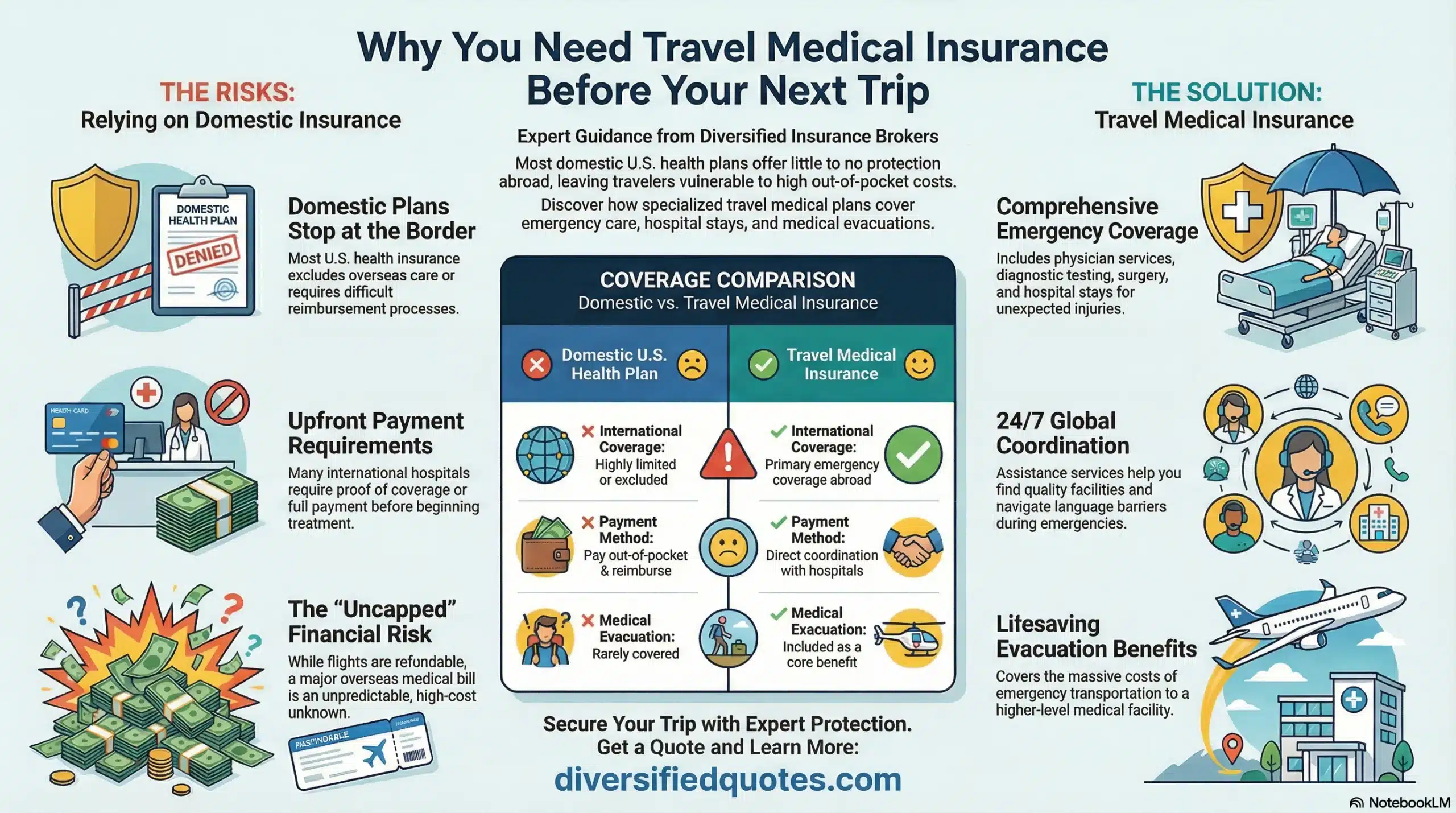
One of the biggest travel insurance mistakes people make is assuming their domestic health plan will “basically work overseas.” In many cases, it won’t. Even when a plan technically offers emergency coverage abroad, it may have strict limits, reimbursement delays, or exclusions that create major issues when you actually need help. In countries where hospitals may require payment before treatment continues, relying on reimbursement later can be risky. Travel medical coverage helps close that gap, and evacuation coverage helps solve the bigger challenge: getting you to the right facility when local care can’t support what you need.
Myanmar’s medical infrastructure can vary widely depending on where you are. In major areas like Yangon or Mandalay, you may find stronger private medical resources, but once you travel outside major urban centers, access to advanced imaging, specialists, surgical facilities, or ICU-level care can become limited. The farther you go from the main cities, the more important it becomes that your plan isn’t just “coverage on paper,” but a plan that includes coordination and evacuation procedures that work in real life.
For many travelers, the worst-case scenario isn’t simply getting sick — it’s getting sick in a location where the nearest appropriate medical facility is not only far away, but logistically complicated to reach. If an accident happens during long-distance travel days, rural sightseeing, boat travel, or remote tours, the problem isn’t always “can I find a clinic.” The real problem becomes “how do I get stabilized and transported safely to a facility that can fully treat me.” A strong travel medical and evacuation plan is designed for that exact situation.
Another critical factor in Myanmar is that some emergencies require fast escalation even if they start as something small. For example, dehydration or gastrointestinal illness can become severe quickly in a hot climate. A simple fall on uneven terrain can become a serious orthopedic injury. Mosquito-borne illnesses may require hospitalization depending on severity. Travel medical insurance helps you get immediate treatment, and evacuation coverage gives you options if that treatment can’t be delivered locally at the standard you need.
Evacuation is often misunderstood. Many travelers assume evacuation means “a flight home.” Most policies do not work that way. Medical evacuation generally means transport to the nearest appropriate facility capable of treating your condition. That might be within Myanmar if appropriate care is available. But depending on severity and capacity, it may be to another country such as Thailand or Singapore. The difference matters because the cost of properly coordinated evacuation can be massive — not just transportation, but medical staffing, approvals, hospital-to-hospital coordination, and the logistics of receiving care at the correct facility.
In addition to medical evacuation, some travelers also care about the option for security evacuation — meaning non-medical departure based on defined safety events such as civil unrest or sudden security conditions. Not every travel medical policy includes this. That’s why it’s important to match the plan design to your profile: tourist vs. expat, student vs. contractor, short-term visitor vs. long-stay traveler. When you know your exposure is different, your coverage should reflect that reality.
Travel medical insurance is also valuable because it includes the support infrastructure behind the policy. Strong plans typically come with a 24/7 assistance team that can help coordinate where to go, how to handle treatment approvals, and what steps need to happen for evacuation to be eligible. This is important because with many carriers, evacuation must be coordinated or authorized through the assistance team in order for the policy to pay. You never want to arrange emergency transport on your own and discover afterward that the plan required prior coordination.
We commonly see travelers in Myanmar fall into a few categories: tourists who want protection for unexpected illness or injury, students or volunteers spending extended time outside tourist areas, business travelers working under deadlines who need smooth coordination, and longer-stay expatriates who want protection beyond a quick trip. The right coverage depends on length of stay, travel route, and how far you’ll be from major facilities at any point during the trip.
Pre-existing conditions are another important detail to get right before you travel. Some plans exclude them entirely. Some cover only acute flare-ups. Others may provide limited coverage based on specific definitions. If you have a known condition and you’re traveling to a destination where escalation may require evacuation, the safest strategy is to choose coverage with clear terms, higher limits, and strong emergency assistance support so you’re not relying on assumptions when things get serious.
In real emergencies, the process moves quickly. You seek immediate care, and then you contact the assistance line as soon as possible to coordinate next steps. The assistance team can help locate appropriate facilities, coordinate hospital admissions, arrange transfers, and keep documentation aligned with claim requirements. That structured system is the main advantage of choosing a travel medical plan that is designed for higher-risk destinations — the policy works as a plan, not just as a reimbursement form.
At Diversified Insurance Brokers, we help travelers approach coverage the same way we approach any major protection decision: align the plan with the real risk. In Myanmar, that often means treating evacuation as a real possibility, choosing benefit levels that match the actual cost exposure, and making sure the coverage includes assistance services that can coordinate the hardest part of the emergency for you.
The best time to secure coverage is before you depart. Once travel begins, you cannot retroactively fix gaps or add evacuation protection after symptoms start. Getting your policy in place early gives you the documents, contacts, and system you’ll rely on if something happens while you’re in Myanmar.
Get Covered Before You Travel
Apply online now to secure travel medical and evacuation coverage for Myanmar.
Related Travel Medical Pages
If you’re comparing coverage levels or building a multi-country itinerary, these pages help you understand how travel medical insurance and evacuation benefits work in real emergencies.
Related Destination Pages
Use these destination pages to compare how coverage needs change based on distance to advanced care, local medical access, and travel logistics.
Talk With an Advisor Today
Choose how you’d like to connect—call or message us, then book a time that works for you.
Schedule here:
calendly.com/jason-dibcompanies/diversified-quotes
Licensed in all 50 states • Fiduciary, family-owned since 1980
Travel Medical & Evacuation Insurance — Myanmar (FAQ)
Do I need travel medical and evacuation insurance for Myanmar?
Yes. Myanmar is a destination where access to advanced medical care can be limited outside major cities, and evacuation to another country may be required for serious conditions.
What does travel medical insurance typically cover in Myanmar?
Most plans cover eligible emergency doctor visits, hospital stays, diagnostic testing, and urgent treatment for unexpected illness or injury while you’re traveling in Myanmar.
What does medical evacuation from Myanmar include?
Evacuation typically covers medically necessary transport to the nearest appropriate facility that can treat your condition. Depending on severity, that may mean a transfer outside Myanmar.
Why is evacuation so important for travelers in Myanmar?
Because advanced care may not be available in every region. If you’re in a rural area, on a long travel route, or dealing with a serious condition, evacuation can be the fastest way to reach the right level of care.
How much medical and evacuation coverage should I carry?
Many travelers choose at least $100,000–$250,000 for medical benefits and $250,000–$500,000 (or higher) for evacuation, especially for remote travel or longer stays.
Will my plan help if I’m asked to pay for treatment up front?
It can. The best plans include a 24/7 assistance team that may coordinate billing support, payment guarantees, and next-step logistics to reduce delays during treatment.
Are pre-existing conditions covered for travel to Myanmar?
It depends on the plan. Some exclude pre-existing conditions entirely, while others may cover limited emergency situations based on the policy’s definitions and restrictions.
Does travel medical coverage include security evacuation?
Not always. Security evacuation is a separate benefit that must be specifically included in the policy or added by rider if you want that protection.
How do I request evacuation or emergency support?
Call the emergency assistance number on your policy ID card as soon as it is safe to do so. They can coordinate where to go, what steps are required, and how transport is arranged.
When should I buy travel medical and evacuation insurance for Myanmar?
Before you depart. Travel medical coverage is designed to be purchased in advance, and you can’t fix coverage gaps once an illness or injury starts.
About the Author:
Jason Stolz, CLTC, CRPC and Chief Underwriter at Diversified Insurance Brokers (NPN 20471358), is a senior insurance and retirement professional with more than two decades of real-world experience helping individuals, families, and business owners protect their income, assets, and long-term financial stability. As a long-time partner of the nationally licensed independent agency Diversified Insurance Brokers, Jason provides trusted guidance across multiple specialties—including fixed and indexed annuities, long-term care planning, personal and business disability insurance, life insurance solutions, Group Health, and short-term health coverage. Diversified Insurance Brokers maintains active contracts with over 100 highly rated insurance carriers, ensuring clients have access to a broad and competitive marketplace.
His practical, education-first approach has earned recognition in publications such as VoyageATL, highlighting his commitment to financial clarity and client-focused planning. Drawing on deep product knowledge and years of hands-on field experience, Jason helps clients evaluate carriers, compare strategies, and build retirement and protection plans that are both secure and cost-efficient. Visitors who want to explore current annuity rates and compare options across multiple insurers can also use this annuity quote and comparison tool.
