
Travel Medical Insurance for Religious Groups

Jason Stolz CLTC, CRPC
Mission trips, retreats, pilgrimages, conferences, and volunteer travel can be some of the most meaningful experiences a faith community shares. But religious group travel also carries practical risks that can become expensive quickly—especially when someone needs medical care far from home. Even well-planned trips can be disrupted by illness, injury, dehydration, infections, accidents, or a medical flare-up that requires urgent attention.
Travel medical insurance for religious groups is designed to help protect travelers and organizations during faith-based travel by providing coverage for unexpected medical costs and access to emergency support services during the trip. At Diversified Insurance Brokers, we help churches, ministries, synagogues, mosques, temples, and faith-based organizations choose travel medical coverage that fits the destination, the itinerary, the ages of participants, and the nature of the activities planned.
This page explains how travel medical insurance works for religious groups, what to prioritize when comparing plans, and how to build a coverage approach that protects participants while reducing financial exposure for the organization. If you already have travel dates and a destination, you can run quotes immediately and then we can help you confirm the plan truly fits your trip.
Protect Your Group While Traveling
Tell us your destination, dates, group size, ages, and the type of faith-based travel you’re planning. We’ll help you identify travel medical options that match the trip and avoid common gaps.
Get Travel Medical Quotes for Religious Group Travel
Compare short-term travel medical and evacuation plans based on your exact dates and destination. This is a fast way to see pricing and benefit options.
Why travel medical insurance matters for religious groups
Religious group travel often includes a wider range of ages, medical histories, and physical ability levels than many other kinds of trips. Youth mission travel may include active service projects, long travel days, and exposure to new food and water environments. Adult retreats and conferences may include large groups staying together for multiple days with tight schedules. Pilgrimages can involve extended walking, altitude changes, and international travel where familiar healthcare networks are not available.
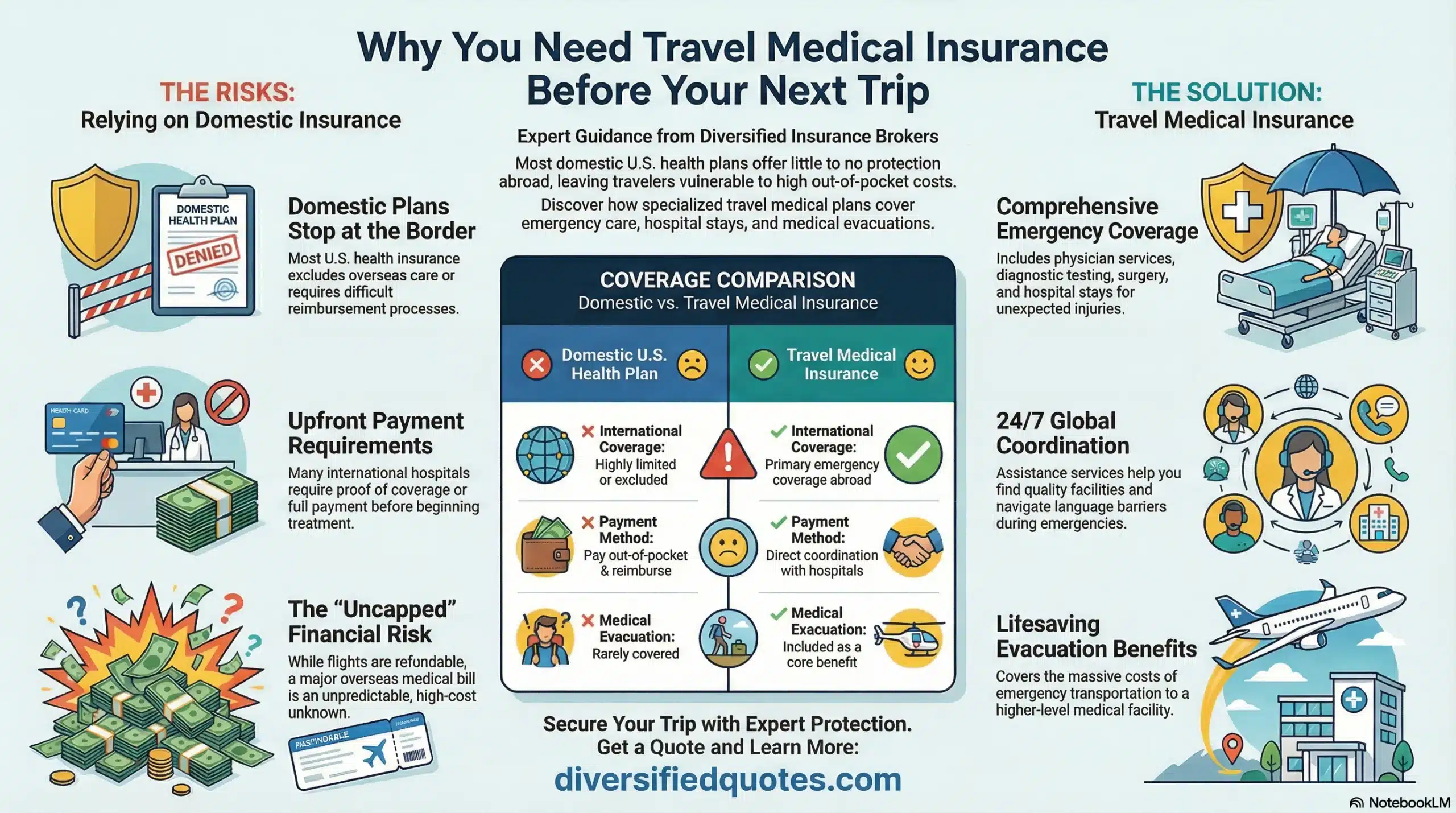
When a medical issue happens away from home, standard health insurance may offer limited out-of-network benefits, and for international travel it may provide little to no coverage. That’s where travel medical insurance becomes an important planning tool. It helps cover eligible medical costs during the trip and typically includes assistance services that can guide travelers to appropriate care and help coordinate next steps when a situation escalates.
For leaders, travel medical insurance is also about reducing stress and uncertainty. A clear plan for emergencies—benefit limits, assistance contact, and evacuation support—creates confidence for participants, parents, and sponsoring organizations.
Common types of religious group travel and how risk changes
Mission trips often involve volunteer labor such as building projects, community outreach, food distribution, medical support work, or travel into rural areas. Those activities can increase exposure to sprains, cuts, falls, infections, and dehydration. Retreats and conferences may be lower-risk physically, but group travel increases the chance that someone gets sick, needs urgent care, or requires help coordinating treatment while away from home.
Pilgrimages can introduce their own risk profile: long walking days, changes in climate, altitude, and extended time on the move. When travelers are older or managing chronic conditions, even a small disruption can become a bigger medical event. Planning coverage ahead of time helps leaders respond with clarity rather than scrambling during a stressful moment.
The practical approach is simple: match the plan to the trip’s reality. That means benefits that are strong where you need them (medical and evacuation) and straightforward when you need to use them.
What travel medical insurance typically covers
Travel medical insurance is designed to cover unexpected medical expenses during travel, such as emergency treatment, physician visits, hospitalization, diagnostic tests, and prescriptions related to covered conditions that occur during the trip. Coverage is typically limited to the travel period, which helps keep it cost-effective for short-term travel.
Many plans also include emergency medical evacuation insurance and repatriation benefits. For international mission travel or trips to remote regions, evacuation coverage can be one of the most important features because the cost of transport to a suitable facility can be extremely high if paid out of pocket.
When comparing plans, don’t just look at the headline medical limit. Look at how the plan behaves when someone needs care quickly: access to assistance services, clarity of the process, and whether benefits align with your itinerary and activities.
Domestic vs. international religious travel
For domestic trips, travel medical coverage can help reduce surprise costs when participants face limited out-of-network benefits or significant deductibles. Even within the U.S., emergency care and urgent care expenses can add up quickly when a group is traveling away from home. Travel protection can also simplify the process for leaders who want one consistent approach across the group.
International travel adds complexity because many U.S. health plans provide little to no coverage abroad, and foreign providers may require payment up front. This is one reason many groups prioritize emergency travel health insurance and evacuation benefits. For certain travel populations and eligibility scenarios, these pages may also be helpful when comparing plan structures: Emergency Travel Health Insurance for Foreign Nationals and Emergency Travel Medical Insurance for U.S. Citizens.
The key goal is always the same: make sure the plan you choose makes medical care accessible and reduces financial friction during the trip.
Group travel medical plans vs. individual policies
Many religious organizations choose between arranging coverage at the individual traveler level or using a group-oriented approach that keeps everyone on the same structure. Group planning can simplify administration and help leaders ensure consistent protection for participants. It can also make communication easier because everyone has a similar set of benefits and emergency procedures.
Individual policies can be useful when participants depart from different cities, arrive on different schedules, or stay for varying lengths of time. In those cases, the “best” approach is often the one that reduces administrative friction while still maintaining strong medical and evacuation protection.
If you’re coordinating multiple sub-groups or different travel durations, it’s worth mapping your logistics first. Once the travel plan is clear, selecting the right coverage structure becomes much easier.
Underwriting and eligibility: what to expect
Travel medical insurance is usually designed for streamlined enrollment. Pricing and eligibility commonly reflect age, destination, trip length, and coverage selections rather than medical exams. That’s helpful for groups because it keeps planning simple and makes it easier to cover travelers with different backgrounds.
Pre-existing conditions may be limited depending on the plan, which can matter for older participants or those managing chronic issues. The correct approach is not to assume. It’s to review plan rules and match expectations to how the plan is written. When we help groups, we focus on the practical decision: choosing a plan that’s honest about what it covers and strong where you need it most.
If you have a group with higher-risk travel conditions or challenging destinations, comparing high risk travel insurance options can be a smart part of the process.
Have a destination and travel dates already?
Share your itinerary and what your group will be doing (mission work, conference, pilgrimage, retreat). We’ll help you confirm you’re choosing coverage that matches the trip.
Common mistakes religious groups make when planning coverage
One of the biggest mistakes is assuming personal health insurance will behave the same way during travel as it does at home. Domestic out-of-network limits can be restrictive, and international coverage may be nonexistent. Another common mistake is choosing a plan without confirming that the trip’s real activities are compatible with coverage expectations, especially when mission work includes volunteer labor or extended travel into rural regions.
Leaders also run into problems when coverage is purchased at the last minute. Waiting can reduce plan options and make it harder to coordinate documentation and emergency procedures for the group. A better approach is to choose coverage early, distribute plan details to travelers, and make sure everyone knows where to find their ID card and how to contact assistance services.
Finally, many groups underestimate evacuation risk. If your destination includes remote areas or limited medical infrastructure, evacuation planning isn’t optional—it’s one of the most important reasons to purchase travel medical coverage in the first place.
How Diversified Insurance Brokers helps religious organizations
Our job is to make travel medical planning feel clear and predictable. We help faith-based organizations compare options, confirm benefit levels align with destinations, and avoid coverage gaps that can create financial exposure for participants and leaders. We also help simplify communication so travelers know what to do if someone gets sick or injured during the trip.
If your organization coordinates mission programs frequently, you may also want to explore group-specific planning topics that connect with religious travel, such as travel insurance for church groups and travel insurance for missionary groups. If the group travels with youth programs, this page may also be relevant: travel insurance for youth mission trips.
If you’d like help now, run quotes to see options, then send us your details so we can help you finalize coverage with confidence.
Compare plans and choose the right fit for your religious group
Use the quoting tool to compare coverage levels and evacuation options, then we’ll help you verify the plan matches your destination and group activities.
Request a quick coverage review before your group departs
We’ll confirm the plan fits your trip type (mission, retreat, pilgrimage, conference), your destination, and your travelers—so you can travel with clarity.
Related Travel Insurance Pages
Explore mission travel coverage, evacuation planning, and emergency travel health options for faith-based travel.
Talk With an Advisor Today
Choose how you’d like to connect—call or message us, then book a time that works for you.
Schedule here:
calendly.com/jason-dibcompanies/diversified-quotes
Licensed in all 50 states • Fiduciary, family-owned since 1980
What is travel medical insurance for religious groups?
It is short-term medical coverage designed to pay for unexpected illness or injury while members of a religious group are traveling.
Is travel medical insurance required for mission trips?
Some organizations or host countries require it, and it is strongly recommended even when not required.
Does travel medical insurance cover mission or volunteer work?
Many plans do, but coverage varies. It’s important to confirm that volunteer or mission activities are included.
Are older participants eligible for coverage?
Yes. Many travel medical plans are available for seniors, though benefits and limits may vary by age.
Is emergency medical evacuation included?
Most comprehensive travel medical plans include evacuation benefits, which are especially important for international trips.
Can coverage be purchased for the entire group?
Yes. Group travel medical plans are available and can simplify administration for religious organizations.
What happens if someone has a pre-existing condition?
Coverage for pre-existing conditions varies by plan and may be limited, so plan details should be reviewed carefully.
About the Author:
Jason Stolz, CLTC, CRPC and Chief Underwriter at Diversified Insurance Brokers (NPN 20471358), is a senior insurance and retirement professional with more than two decades of real-world experience helping individuals, families, and business owners protect their income, assets, and long-term financial stability. As a long-time partner of the nationally licensed independent agency Diversified Insurance Brokers, Jason provides trusted guidance across multiple specialties—including fixed and indexed annuities, long-term care planning, personal and business disability insurance, life insurance solutions, Group Health, and short-term health coverage. Diversified Insurance Brokers maintains active contracts with over 100 highly rated insurance carriers, ensuring clients have access to a broad and competitive marketplace.
His practical, education-first approach has earned recognition in publications such as VoyageATL, highlighting his commitment to financial clarity and client-focused planning. Drawing on deep product knowledge and years of hands-on field experience, Jason helps clients evaluate carriers, compare strategies, and build retirement and protection plans that are both secure and cost-efficient. Visitors who want to explore current annuity rates and compare options across multiple insurers can also use this annuity quote and comparison tool.
