
Burial Insurance for Stroke Survivors

Jason Stolz CLTC, CRPC
Burial insurance for stroke survivors is often available—even if you’ve had a stroke or TIA in the past. The biggest factors are timing (how long it has been since the most recent event), how stable your follow-up care has been, and whether you have ongoing limitations that suggest higher risk. Many final expense carriers routinely approve stroke survivors, sometimes with day-one coverage and other times with a graded benefit structure designed to make approval more predictable.
At Diversified Insurance Brokers, we compare stroke-friendly burial insurance options by matching your specific history to carriers whose underwriting guidelines fit your timeline and recovery profile. If you want a deeper look at how carriers evaluate stroke history for larger policies, start here: life insurance for stroke. Even when traditional life underwriting feels strict, burial insurance is often the faster, simpler path to permanent final expense protection.
If you’re trying to decide on a benefit amount before you do anything else, it helps to see what real pricing looks like at the most common face amount. This guide breaks it down clearly: monthly cost of a $10,000 burial insurance policy.
Instant Burial Insurance Quotes After a Stroke
Compare rates from multiple carriers in minutes. Most plans are simplified issue (no medical exam), using basic eligibility and health questions.
Can You Get Day-One Coverage After a Stroke?
Often, yes—but it depends primarily on the date of your most recent stroke or TIA and what your recovery looks like today. In simplified-issue underwriting, carriers typically care less about the label (“stroke”) and more about how recent the event was, whether there have been repeat events, and whether your day-to-day function is stable.
As a general pattern, the strongest chance of level (day-one) benefits appears when the stroke or TIA was far enough in the past and your follow-up has been stable without recent hospitalizations. When the event is more recent, carriers may still approve—but they’re more likely to use a graded structure so your coverage is issued predictably.
If you also have common stroke-related risk factors—like blood pressure issues, diabetes, or cholesterol management—that does not automatically block approval. It usually just changes which carrier is the best fit. For people with cardiovascular overlap, this page is helpful context: burial insurance for people with heart conditions.
How Carriers Underwrite Stroke History for Final Expense
Final expense underwriting is designed to be streamlined. Most applications ask a short set of questions that focus on the “big risk signals” rather than a complete medical chart review. Expect underwriting to focus on timing since last event, whether there were any significant complications, and whether you’re able to live independently.
Carriers commonly look at four practical buckets: (1) timing since the last stroke/TIA, (2) recovery stability (no new episodes and steady follow-up), (3) functional independence (especially daily activities and mobility), and (4) overall risk profile (blood pressure, diabetes, smoking history, and any major hospitalizations). When those buckets look stable, the policy outcome is usually better and the premium is often more manageable.
If you want the simplest path and prefer to avoid health questions, you can compare the trade-offs here: burial insurance with no health exam. It can be convenient, but the price-per-dollar of coverage is often higher because the carrier takes on more unknown risk.
For a broader overview of how different carriers approach final expense underwriting styles, this resource is useful: best-rated burial insurance companies in the U.S..
Level vs. Graded vs. Guaranteed Issue After a Stroke
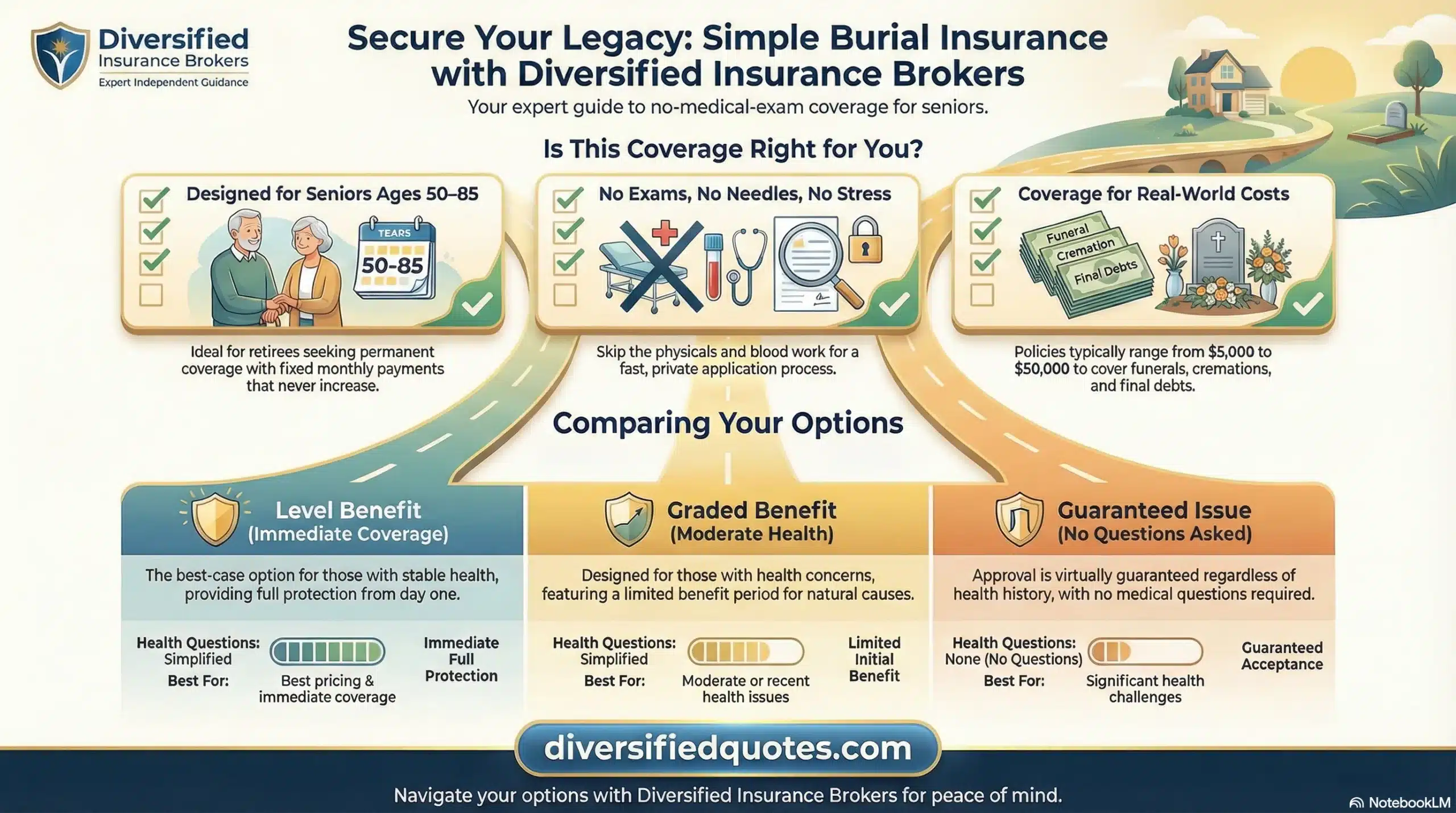
Stroke survivors typically see three policy structures in the final expense market. A level benefit policy pays the full death benefit immediately (subject to policy terms) and is often the best value when your stroke was far enough in the past and your recovery has been stable. A graded benefit policy is commonly used when the carrier wants a short period of reduced natural-cause benefits early on; it’s designed to expand approval when health history is more recent or more complex. A guaranteed issue policy does not ask health questions and is usually treated as a last-resort safety net when simplified-issue options are not available.
When we shop, the goal is not to push you into the most expensive category “just to get approved.” We typically evaluate whether simplified issue can work first, then price graded versus guaranteed issue so you can see the real trade-off between premium and benefit timing. If you’re deciding between insurance and prepaid arrangements, this comparison helps: burial insurance vs pre-paid funeral.
Case Study: Stroke 18 Months Ago, Seeking $15,000
Profile: A 67-year-old woman with an ischemic stroke 18 months ago. She had consistent follow-up, took blood pressure and statin medication as directed, had no hospitalizations since the event, and remained independent in daily activities.
Approach: We compared carriers that are comfortable with stroke history in the 12–24 month window and priced both level and graded structures. One option offered a graded structure early on with full level benefits after the graded period. We also priced a guaranteed issue alternative as a backup so she could see the cost difference of skipping health questions entirely.
Outcome: She chose the graded option that fit her budget now and planned to revisit level-benefit eligibility after crossing the 24-month mark post-stroke, assuming continued stability. That “shop now, improve later” approach is common when you’re close to a timeline milestone that can widen carrier eligibility.
Ways Stroke Survivors Can Lower Burial Insurance Premiums
Premiums usually improve when the benefit amount is sized to match real final expenses, when you select the best-fit carrier for your timeline, and when you avoid adding extras that don’t materially improve the core goal (a clean, reliable final expense payout). Many families target a $10,000–$20,000 range because it can cover typical services, travel, and small bills without pushing premiums beyond comfort.
If you want to dial in a benefit amount and see how it affects monthly cost, use this tool to run multiple scenarios quickly: burial insurance calculator. And if you’re considering add-ons, it’s worth understanding what you’re paying for before you include them—especially riders that can increase cost without changing the fundamental final expense outcome: burial insurance with an accidental death benefit.
If your stroke occurred alongside other diagnoses—such as kidney disease or other chronic conditions—you can still often get coverage. What changes is the carrier selection and sometimes the policy tier. This condition-specific page shows how complications can affect final expense underwriting paths: burial insurance for people with kidney disease.
Related Pages
Explore additional burial insurance resources that may fit your age, budget, or health profile:
Financial Protection Essentials
Specialized underwriting guidance, international travel coverage, and income-focused life insurance strategies for long-term stability.
Talk With an Advisor Today
Choose how you’d like to connect—call or message us, then book a time that works for you.
Schedule here:
calendly.com/jason-dibcompanies/diversified-quotes
Licensed in all 50 states • Fiduciary, family-owned since 1980
FAQs: Burial Insurance After a Stroke
Can I qualify for day-one burial insurance coverage after a stroke?
Often yes, especially when your most recent stroke or TIA was far enough in the past and your follow-up has been stable without major ongoing limitations.
What if my stroke was within the last year?
Many carriers will still approve coverage using a graded benefit structure. Guaranteed issue can be a backup when simplified issue is not available.
How do TIAs affect burial insurance approval?
TIAs are commonly underwritten similarly to minor strokes in simplified-issue final expense. Timing since the most recent event is usually the biggest factor.
Do I need a medical exam to get burial insurance after a stroke?
Usually no. Most burial insurance is simplified issue with health questions and basic eligibility checks rather than medical exams or lab work.
Will my medications increase my premium?
Not necessarily. Being on appropriate medications and showing stable follow-up often improves underwriting outcomes compared to untreated risk factors.
Can I be declined because of a stroke history?
It’s possible when the event is very recent or when there are significant ongoing impairments, but guaranteed issue policies exist to keep coverage available even when health questions are a barrier.
What type of burial insurance is most common after a stroke?
Many stroke survivors qualify for simplified issue. Depending on timing and recovery, that can be level (day-one) benefits or graded benefits that transition to full coverage after the initial period.
How much burial insurance do stroke survivors usually buy?
$10,000 to $25,000 is common because it can cover services, travel, and small bills without forcing premiums too high.
Should I wait to apply until I’m farther out from my stroke?
If you are close to a timeline milestone, it can be worth comparing options now and then re-shopping later when more carriers offer level benefits. The best choice depends on how urgently you want coverage in place.
What can improve approval odds after a stroke?
Stable follow-up care, no recent hospitalizations, good control of blood pressure and cholesterol, and strong functional independence typically improve available options.
About the Author:
Jason Stolz, CLTC, CRPC and Chief Underwriter at Diversified Insurance Brokers (NPN 20471358), is a senior insurance and retirement professional with more than two decades of real-world experience helping individuals, families, and business owners protect their income, assets, and long-term financial stability. As a long-time partner of the nationally licensed independent agency Diversified Insurance Brokers, Jason provides trusted guidance across multiple specialties—including fixed and indexed annuities, long-term care planning, personal and business disability insurance, life insurance solutions, Group Health, and short-term health coverage. Diversified Insurance Brokers maintains active contracts with over 100 highly rated insurance carriers, ensuring clients have access to a broad and competitive marketplace.
His practical, education-first approach has earned recognition in publications such as VoyageATL, highlighting his commitment to financial clarity and client-focused planning. Drawing on deep product knowledge and years of hands-on field experience, Jason helps clients evaluate carriers, compare strategies, and build retirement and protection plans that are both secure and cost-efficient. Visitors who want to explore current annuity rates and compare options across multiple insurers can also use this annuity quote and comparison tool.
